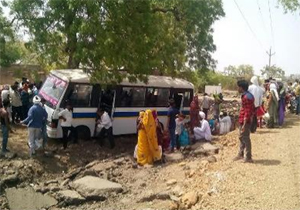
Bus driver Abdul Rasheed suffers heart attack, but saves all before dying

[email protected] (News Network)
June 14, 2016

Indore, Jun 14: A major accident was averted when a bus driver suffered a massive heart attack when he was driving at a high speed, but he managed to bring the vehicle to halt without causing any injury to the passengers in Khandwa district of Madhya Pradesh on Monday.

arThough the driver lost his life to the cardiac arrest, 29 passengers of the bus had a narrow brush with death.

The incident took place in the afternoon when Rasheed was driving the bus belonging to Arya Travels from Khandwa to Kohdar. As he neared village Chhoti Borgaon, he suffered a heart attack, police said.

Despite the pain, he gained control of the vehicle and brought it to a halt. The bus had left the road and came to a standstill near a tree, they added.

Passengers called emergency services and the police, but Rasheed passed away before help could reach him. His death led to emotional outbursts from passengers, who blamed the police for delay in getting Rasheed to a hospital.

Police have seized the bus and were in the process of recording the death.

Comments

SHAJI
 - 
Tuesday, 14 Jun 2016

Hats off this hero who saved lives of many people on sacrificing his own life. Govt should award compensation to his family and provide a job to his son / daughter. Govt should show humanity on such deserved people.

SK
 - 
Tuesday, 14 Jun 2016

RIP......Martyr... condolences to his Family

Add new comment

  • Coastaldigest.com reserves the right to delete or block any comments.
  • Coastaldigset.com is not responsible for its readers’ comments.
  • Comments that are abusive, incendiary or irrelevant are strictly prohibited.
  • Please use a genuine email ID and provide your name to avoid reject.
News Network
July 5,2020

Bengaluru, Jul 5: Karnataka Chief Minister BS Yediyurappa has announced an ex-gratia of Rs 5 lakh each for the families of a youth and a child, who died due to a landslide at Gurupura in Mangaluru.

"The Chief Minister announces Rs 5 lakh each compensation to Safwan (17) and Shehla (10) who died due to landslide at Gurupura, Mangaluru. Houses will also be built for people who lost houses at Bodanthilla, Dakshina Kannada," an official said.

The incident occurred on Sunday afternoon.
The State Disaster Management Authority said that 57 people and 262 animals lost their lives in flood, rainfall and lightning-related incidents in Karnataka between April 1, 2020, and July 5, 2020. 

Comments

Add new comment

  • Coastaldigest.com reserves the right to delete or block any comments.
  • Coastaldigset.com is not responsible for its readers’ comments.
  • Comments that are abusive, incendiary or irrelevant are strictly prohibited.
  • Please use a genuine email ID and provide your name to avoid reject.
coastaldigest.com news network
May 2,2020

Mangaluru, May 2: Ibrahim Musliyar Bekal, a prominent Muslim religeous leader in coastal Karnataka has urged the Dakshina Kannada district administration not to end the covid-19 lockdown before the end of the blessed month of Ramadan. 

The appeal comes in the wake of reports that the state government may allow opening of clothe shops during the month of Ramadan to felicitate Muslims for Eid shopping.

"Muslims in the district have completely cooperated with the district administration in making the lockdown sucessfull. They have refrained from going to mosque even for Juma and Taraveeh during Ramadan. Such a lockdown is necessary to contain the pandemic," said Musliyar, who is also the Khazi of Udupi and Chikkamagaluru.

If the district administration withdraws lockdwon or relaxes it, people in large numbers may storm cloth shops wherein it physical distancing will be difficult, Musliyar warned.

He said that Muslims in the region have decided to observe Eid ul Fitr, a festival which marks the end of the blessed month, in a simple way maintaining physical distance. Hence the lockdown should be relaxed only after the festival, he suggested.

Comments

Add new comment

  • Coastaldigest.com reserves the right to delete or block any comments.
  • Coastaldigset.com is not responsible for its readers’ comments.
  • Comments that are abusive, incendiary or irrelevant are strictly prohibited.
  • Please use a genuine email ID and provide your name to avoid reject.
News Network
April 2,2020

The current physical distancing guidelines provided by the World Health Organisation (WHO) and by the US Centers for Disease Control and Prevention (CDC) may not be adequate to curb the coronavirus spread, according to a research which says the gas cloud from a cough or sneeze may help virus particles travel up to 8 metres. The research, published in the Journal of the American Medical Association, noted that the the current guidelines issued by the WHO and CDC are based on outdated models from the 1930s of how gas clouds from a cough, sneeze, or exhalation spread.

Study author, MIT associate professor Lydia Bourouiba, warned that droplets of all sizes can travel 23 to 27 feet, or 7-8 metres, carrying the pathogen.

According to Bourouiba, the current guidelines are based on "arbitrary" assumptions of droplet size, "overly simplified", and "may limit the effectiveness of the proposed interventions" against the deadly pandemic.

 She explained that the old guidelines assume droplets to be one of two categories, small or large, taking short-range semi-ballistic trajectories when a person exhales, coughs, or sneezes.

However based on more recent discoveries, the MIT scientist said, sneezes and coughs are made of a puff cloud that carries ambient air, transporting within it clusters of droplets of a wide range of sizes.

Bourouiba warned that this puff cloud, with ambient air entrapped in it, can offer the droplets moisture and warmth that can prevent it from evaporation in the outer environment.

"The locally moist and warm atmosphere within the turbulent gas cloud allows the contained droplets to evade evaporation for much longer than occurs with isolated droplets," she said.

"Under these conditions, the lifetime of a droplet could be considerably extended by a factor of up to 1000, from a fraction of a second to minutes," the researcher explained in the study.

The MIT scientist, who has researched the dynamics of coughs and sneezes for years, added that these droplets settle along the trajectory of a cough or sneeze contaminating surfaces, with their residues staying suspended in the air for hours.

"Even when maximum containment policies were enforced, the rapid international spread of COVID-19 suggests that using arbitrary droplet size cutoffs may not accurately reflect what actually occurs with respiratory emissions, possibly contributing to the ineffectiveness of some procedures used to limit the spread of respiratory disease," Bourouiba wrote in the study


Comments

Add new comment

  • Coastaldigest.com reserves the right to delete or block any comments.
  • Coastaldigset.com is not responsible for its readers’ comments.
  • Comments that are abusive, incendiary or irrelevant are strictly prohibited.
  • Please use a genuine email ID and provide your name to avoid reject.