Buy American, hire Americans: Trump's 2 simple rules

December 15, 2016

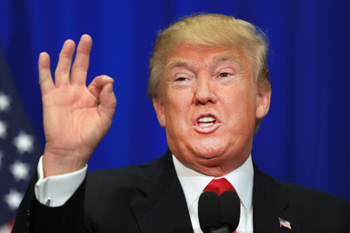
Washington, Dec 15: "Buy American and hire Americans" - US President-elect Donald Trump on Wednesday said his government will follow these two simple rules and claimed that the treaties the US had signed with other countries suggest that it has been putting interests of others ahead of itself. At a 'Thank You Tour' rally in Milwaukee in Wisconsin, Donald Trump said, "My administration will follow two simple rules. Buy American and hire Americans, right? We're going to do it. Because from now on it's going to be America first, America first."

DonaldAt the impressive victory rally which was his first in Milwaukee after his big win, Donald Trump claimed previous leaders did not put the US's interest on top while striking deals with other countries.

"I look at some of these deals we make and some of the treaties and some of everything and I say, I think these people were thinking about the other nations. I honestly do. I say it's impossible for this to happen either that or campaign contributions were magnificent for people. But they are so bad the deals are so bad, so disgraceful that I actually think they are putting other countries ahead of our own," he said.

"On trade, we're now running a nearly USD 800 billion annual trade deficit. I say who makes these deals? Who, now think of it. I have friends in here who are business people. Who makes these deals? Eight hundred billion dollars," he asked.

Donald Trump said America has lost one-third of its manufacturing jobs since NAFTA (North American Free Trade Agreement). "We have lost 70,000 factories. Think of it 70,000. It like doesn't even sound like it's possible. And I know it's right because I have said it for the last month and a half and they never corrected me. So it has to be," Donald Trump said.

Comments

Add new comment

  • Coastaldigest.com reserves the right to delete or block any comments.
  • Coastaldigset.com is not responsible for its readers’ comments.
  • Comments that are abusive, incendiary or irrelevant are strictly prohibited.
  • Please use a genuine email ID and provide your name to avoid reject.
News Network
April 17,2020

Washington, Apr 17: The confirmed coronavirus death toll in the United States reached 32,917 on Thursday, according to a tally by Johns Hopkins University.

The toll as of 8:30 pm (0030 GMT Friday) marked an increase of 4,491 deaths in the past 24 hours, by far the highest daily toll in the pandemic so far.

But the figure likely includes "probable" deaths related to COVID-19, which were not previously included. This week, New York City announced it would add 3,778 "probable" coronavirus deaths to its toll.

As of Thursday night, the US Centers for Disease Control and Prevention had recorded 31,071 coronavirus deaths, including 4,141 "probable" virus deaths.

The US has the highest death toll in the world, followed by Italy with 22,170 dead although its population is just a fifth of that of the US.

Spain has recorded 19,130 deaths, followed by France with 17,920.

More than 667,800 coronavirus cases have been recorded in the United States, which has seen a record number of deaths over the past two days.

Meanwhile, President Donald Trump unveiled plans Thursday evening to reopen the US economy, allowing each state's governor "to take a phased deliberate approach to reopening their individual states".

Comments

Add new comment

  • Coastaldigest.com reserves the right to delete or block any comments.
  • Coastaldigset.com is not responsible for its readers’ comments.
  • Comments that are abusive, incendiary or irrelevant are strictly prohibited.
  • Please use a genuine email ID and provide your name to avoid reject.
Agencies
July 2,2020

Ramallah, Jul 2: Several world countries renew a call for Israel to halt contentious plans to annex parts of the occupied Palestinian territory after the regime delayed the implementation of the land garb bid in the face of a series of stumbling blocks, including internal rifts, global criticisms and the US’s failure to give Tel Aviv the go-ahead for the move.

Israel's ruling coalition, led by Prime Minister Benjamin Netanyahu, had announced July 1 as the date to begin moving forward with the plan to impose Tel Aviv’s “sovereignty” over about a third of the West Bank, including settlements and the fertile Jordan Valley.

Without clarifications, the regime, however, failed to launch the scheme on the set date amid widening differences between Netanyahu and his coalition partner, minister of military affairs Benny Gantz.

Meanwhile, there are signs that the administration of US President Donald Trump, a staunch Israel supporter, has cooled its backing for the Israeli move amid what is believed to be troubles at home and fears that it might hurt the president’s chances of re-election besides international pressure.

On Wednesday, Netanyahu's office said in a statement that he would continue to discuss a possible West bank annexation with the US administration.

“In the coming days there will be additional discussions,” the statement said.

Labor, Social Affairs and Social Services Minister Ofir Akunis said the Israel would annex portions of the West Bank in July but only after the US president issued a declaration on the matter.

The annexation “will only happen after a declaration by Trump,” he told Israeli Army Radio.

Trump had already given Tel Aviv the green light for the land grab in his self-proclaimed “deal of the century,” which was unveiled in January with the aim of re-drawing the Middle East map.

However, the Trump administration has so far refrained from offering official support for the annexation sought by Netanyahu and his right-wing allies.

Unlike the US, several countries, including some of Israel’s allies, have expressed their opposition to Israel’s planned push to consolidate its occupation of Palestine.

Germany passes anti-annexation resolution

On Wednesday, the German parliament approved a resolution calling on the government to dissuade Israel from annexing the West Bank.

The motion, which was brought in the German legislature by the three parties in Chancellor Angela Merkel's coalition, was approved without opposing votes. 

Berlin should use its “special relations and contacts [with Tel Aviv] to express to the Israeli government our concerns and our urgent demand to refrain from an annexation of parts of the West Bank and from the continued expansion of settlements, both of which contradict international law,” read the resolution.

Speaking at the parliamentary debate before the vote, German Foreign Minister Heiko Maas said, “We reject unilateral changes of borders, and we won’t recognize them.”

He also stressed that peace “cannot be achieved through unilateral steps but only through serious negotiations.”

France warns of consequences

Similarly, French Foreign Minister, Jean-Yves Le Drian warned that any Israeli annexation would be a violation of international law and would bring about consequences.

“Annexation of Palestinian territories, whatever the perimeters, would seriously throw into question the parameters to resolve the conflict,” he told a parliamentary hearing. 

The top diplomat added, “An annexation decision could not be left without consequences and we are examining different options at a national level and also in coordination with our main European partners.”

Australia raises concerns

Additionally, Australian Foreign Minister Marise Payne voiced worries about the Israeli scheme, saying she had directly expressed this view to Israeli Foreign Minister Gabi Ashkenazi.

“We are following with concern possible moves towards the unilateral annexation or change in status of territory on the West Bank,” she said in a statement.

“The focus needs to be on a return to direct and genuine negotiations between Israel and the Palestinians for a durable and resilient peace arrangement, as soon as possible,” Payne added.

Vatican summons US, Israeli envoys

Meanwhile, the Vatican announced on Wednesday that it had summoned the American and Israeli ambassadors to protest Israel’s annexation bid.

In separate meetings, Vatican Secretary of State Cardinal Pietro Parolin told Israeli Ambassador Oren David and US Ambassador Callista Gingrich of concerns “regarding possible unilateral actions that may further jeopardize the search for peace between Israelis and Palestinians, as well as the delicate situation in the Middle East,”

“As already declared … the Holy See reiterates that ... Israel and the State of Palestine have the right to exist and to live in peace and security, within internationally recognized borders,” the Vatican said in a statement.

“It thus appeals to the parties to do everything possible to reopen the process of direct negotiation, on the basis of the relevant Resolutions of the United Nations,” it added.

Amnesty urges firm action

Amnesty International called on the international community to take firm action against Israel’s annexation plan and its “law of the jungle” mentality.

“Members of the international community must enforce international law and restate that annexation of any part of the occupied West Bank is null and void,” said Saleh Higazi, deputy regional director for Amnesty Middle East and North Africa.

“They must also work to immediately stop the construction or expansion of illegal Israeli settlements and related infrastructure in the Occupied Palestinian Territories as a first step towards removing Israeli civilians living in such settlements,” he added.

Palestinians mark ‘Day of Rage'

Also on Wednesday, Palestinians held “Day of Rage” rallies both in the West Bank and the Gaza Strip against the Israeli expansionism.

In Gaza city, several thousand protesters gathered, some brandishing Palestinian national flags and placards condemning Trump.

Some demonstrators carried signs in English reading, “We Can’t Breathe Since 1948” and “Palestinian Lives Matter,” in reference to the American Black Lives Matter movement.

“The occupation has killed us and killed our children and deprived us of a good life. May God grant the Resistance victory,” a protester told the al-Aqsa TV.

“The resistance must be revived,” Gaza protester Rafeeq Inaiah told media persons. “Israel is afraid of force.”

Similar demonstrations also took place in the West Bank cities of Ramallah and Jericho.

Comments

Add new comment

  • Coastaldigest.com reserves the right to delete or block any comments.
  • Coastaldigset.com is not responsible for its readers’ comments.
  • Comments that are abusive, incendiary or irrelevant are strictly prohibited.
  • Please use a genuine email ID and provide your name to avoid reject.
Agencies
July 1,2020

The ILO has warned that if another Covid-19 wave hits in the second half of 2020, there would be global working-hour loss of 11.9 percent - equivalent to the loss of 340 million full-time jobs.

According to the 5th edition of International Labour Organisation (ILO) Monitor: Covid-19 and the world of work, the recovery in the global labour market for the rest of the year will be uncertain and incomplete.

The report said that there was a 14 percent drop in global working hours during the second quarter of 2020, equivalent to the loss of 400 million full-time jobs.

The number of working hours lost across the world in the first half of 2020 was significantly worse than previously estimated. The highly uncertain recovery in the second half of the year will not be enough to go back to pre-pandemic levels even in the best scenario, the agency warned.

The baseline model – which assumes a rebound in economic activity in line with existing forecasts, the lifting of workplace restrictions and a recovery in consumption and investment – projects a decrease in working hours of 4.9 percent (equivalent to 140 million full-time jobs) compared to last quarter of 2019.

It says that in the pessimistic scenario, the situation in the second half of 2020 would remain almost as challenging as in the second quarter.

“Even if one assumes better-tailored policy responses – thanks to the lessons learned throughout the first half of the year – there would still be a global working-hour loss of 11.9 per cent at the end of 2020, or 340 million full-time jobs, relative to the fourth quarter of 2019,” it said.

The pessimistic scenario assumes a second pandemic wave and the return of restrictions that would significantly slow recovery. The optimistic scenario assumes that workers’ activities resume quickly, significantly boosting aggregate demand and job creation. With this exceptionally fast recovery, the global loss of working hours would fall to 1.2 per cent (34 million full-time jobs).

The agency said that under the three possible scenarios for recovery in the next six months, “none” sees the global job situation in better shape than it was before lockdown measures began.

“This is why we talk of an uncertain but incomplete recovery even in the best of scenarios for the second half of this year. So there is not going to be a simple or quick recovery,” ILO Director-General Guy Ryder said.

The new figures reflect the worsening situation in many regions over the past weeks, especially in developing economies. Regionally, working time losses for the second quarter were: Americas (18.3 percent), Europe and Central Asia (13.9 percent), Asia and the Pacific (13.5 percent), Arab States (13.2 percent), and Africa (12.1 percent).

The vast majority of the world’s workers (93 per cent) continue to live in countries with some sort of workplace closures, with the Americas experiencing the greatest restrictions.

During the first quarter of the year, an estimated 5.4 percent of global working hours (equivalent to 155 million full-time jobs) were lost relative to the fourth quarter of 2019. Working- hour losses for the second quarter of 2020 relative to the last quarter of 2019 are estimated to reach 14 per cent worldwide (equivalent to 400 million full-time jobs), with the largest reduction (18.3 per cent) occurring in the Americas.

The ILO Monitor also found that women workers have been disproportionately affected by the pandemic, creating a risk that some of the modest progress on gender equality made in recent decades will be lost, and that work-related gender inequality will be exacerbated.

The severe impact of Covid-19 on women workers relates to their over-representation in some of the economic sectors worst affected by the crisis, such as accommodation, food, sales and manufacturing.

Globally, almost 510 million or 40 percent of all employed women work in the four most affected sectors, compared to 36.6 percent of men, it said.

The report said that women also dominate in the domestic work and health and social care work sectors, where they are at greater risk of losing their income and of infection and transmission and are also less likely to have social protection.

The pre-pandemic unequal distribution of unpaid care work has also worsened during the crisis, exacerbated by the closure of schools and care services.

Even as countries have adopted policy measures with unprecedented speed and scope, the ILO Monitor highlights some key challenges ahead, including finding the right balance and sequencing of health, economic and social and policy interventions to produce optimal sustainable labour market outcomes; implementing and sustaining policy interventions at the necessary scale when resources are likely to be increasingly constrained and protecting and promoting the conditions of vulnerable, disadvantaged and hard-hit groups to make labour markets fairer and more equitable.

“The decisions we adopt now will echo in the years to come and beyond 2030. Although countries are at different stages of the pandemic and a lot has been done, we need to redouble our efforts if we want to come out of this crisis in a better shape than when it started,” Ryder said. 

Comments

Add new comment

  • Coastaldigest.com reserves the right to delete or block any comments.
  • Coastaldigset.com is not responsible for its readers’ comments.
  • Comments that are abusive, incendiary or irrelevant are strictly prohibited.
  • Please use a genuine email ID and provide your name to avoid reject.