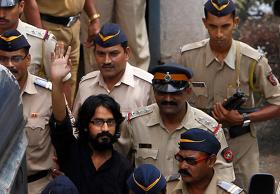
Cartoonist Aseem Trivedi released from Mumbai jail

September 12, 2012

Aseem_walks_out_of_jail


Mumbai, September 12:  Aseem Trivedi, the cartoonist jailed on charges of sedition, has left a Mumbai jail. He emerged waving his fist in the air, wearing a button-down black shirt just like when he was taken into custody on Saturday.  He was granted bail last evening by the Bombay High Court.

Mr Trivedi headed first to a shrine for BR Ambedkar, down the road from the Arthur Road jail. "Even Gandhi and Nehru have been charged with sedition. Were they not patriotic? We have no politics. The entire country will now fight against the law on sedition. I will cooperate in all court cases," he told reporters there. A press conference is scheduled for later in the afternoon.  

The weekend arrest of the 25-year-old freelance cartoonist and anti-corruption campaigner sparked a domestic and international backlash against the government, which was accused by critics of using the colonial-era sedition law to crush dissent.   

Mr Trivedi's friends say he was targeted by the government because he is a member of India Against Corruption, the movement led by activists Anna Hazare and Arvind Kejriwal.  His arrest was based on a complaint filed by a lawyer who said Mr Trivedi's cartoons lampooning corruption were offensive and disrespectful of national emblems and the constitution.

Mr Trivedi had originally refused to accept bail, stating he wanted the sedition charges against him to be dropped, but his associates later said that he plans to leave jail and campaign against an archaic sedition law.  The High Court will decide on September 14 whether the controversial charges should be removed. The Maharashtra government is also examining whether the removal of the charges is legally permissible.

Media rights group Reporters Without Borders was among those calling for the immediate release of Trivedi, one of whose cartoons depicted the national parliament as a huge toilet bowl. Another replaced the three lions in the national emblem with bloody-mouthed wolves to indicate a country being devoured by graft.


Comments

Add new comment

  • Coastaldigest.com reserves the right to delete or block any comments.
  • Coastaldigset.com is not responsible for its readers’ comments.
  • Comments that are abusive, incendiary or irrelevant are strictly prohibited.
  • Please use a genuine email ID and provide your name to avoid reject.
News Network
April 15,2020

New Delhi, Apr 15: The Union Health Ministry has identified 170 districts as COVID-19 hotspots and 207 districts as potential hotspots, officials said on Wednesday, reiterating that there has been no community transmission of the disease in the country so far.

Addressing the daily briefing to provide updates on coronavirus situation in the country, Joint Secretary in the Ministry of Health Lav Agarwal said that states have been asked to classify districts which have reported a higher number of cases as hotspots, the districts where cases have been reported as non-hotspots, and green zones where no cases have been reported.

"Hotspots are those districts which are reporting more number of cases or where the rate of growth of COVID-19 cases is high," Agarwal said, adding a detailed direction has been issued to states stating consolidated efforts are required to utilise this period of lockdown to curb the spread of the virus.

"Cabinet secretary held a video conference today with all chief secretaries, DGPs, health secretaries, collectors, SPs, municipal commissioners and CMOs where hotspots were discussed and orientation on field level implementation of containment strategy was given.

"They were told about large outbreak containment strategies, cluster containment strategies. Delineation of buffer and containment zone, parameter mapping, defining of entry and exit points were also discussed in detail," he said.

The joint secretary said movement of people will not be allowed in containment zones except for those related with essential services and special teams will search for new cases and samples will be collected and tested as per sampling criteria.

The officials said that health facilities in buffer zone outside the containment zone will be oriented and people facing SARI and influenza-like symptoms will be tested there.

"Special teams have been formed which will work in containment zone and do contact tracing and house-to-house surveys. Cases of fever, cough and breathlessness will be identified in the survey and requisite action will be taken as per protocol," Agarwal said, adding that there has been no community transmissions so far but some local outbreaks.

The total number of COVID-19 cases in India has risen to 11,439 with 1,076 fresh cases reported in the last 24 hours while the death toll stands at 377, the ministry official said.

Comments

Add new comment

  • Coastaldigest.com reserves the right to delete or block any comments.
  • Coastaldigset.com is not responsible for its readers’ comments.
  • Comments that are abusive, incendiary or irrelevant are strictly prohibited.
  • Please use a genuine email ID and provide your name to avoid reject.
Agencies
May 14,2020

New Delhi, May 14: India may witness the death of additional 1.2-6 lakh children over the next one year from preventable causes as a consequence to the disruption in regular health services due to the COVID-19 pandemic, UNICEF has warned.

The warning comes from a new study that brackets India with nine other nations from Asia and Africa that could potentially have the largest number of additional child deaths as a consequence to the pandemic.

These potential child deaths will be in addition to the 2.5 million children who already die before their fifth birthday every six months in the 118 countries included in the study.

The estimate is based on an analysis by researchers from the Johns Hopkins Bloomberg School of Public Health published in the Lancet.  

This means the global mortality rate of children dying before their fifth birthday, one of the key progress indicators in all of the global development, could potentially increase for the first time since 1960 when the data was first collected.

There were 1.04 million under-5 deaths in India in 2017, of which nearly 50% (0.57 million) were neonatal deaths. The highest number of under-5 deaths was in Uttar Pradesh (312,800 which included 165,800 neonatal deaths) and Bihar (141,500 which included 75,300 neonatal deaths).

The researchers looked at three scenarios, factoring in parameters like reduction in workforce, supplies and access to healthcare for services like family planning, antenatal care, childbirth care, postnatal care, vaccination and preventive care for early childhood. The effects are modelled for a period of three months, six months and 12 months.  

In scenario-1 marked by 10-18% reduction of coverage of all the services, the number of additional children deaths could be in the range of 30,000 plus over three months, more than 60,000 over six months and above 120,000 over the next 12 months.

Coronavirus India update: State-wise total number of confirmed cases, deaths on May 13

The numbers sharply rose to nearly 55,000; 109,000 and 219,000 respectively for scenario-2, which was associated with an 18-28% drop in all the regular services.

But in the worst-case scenario in which 40-50% of the services are not available, the number of additional deaths ballooned to 1.5 lakhs in the three months in the short-range to nearly six lakhs over a year.

The ten countries that could potentially have the largest number of additional child deaths are Bangladesh, Brazil, Congo, Ethiopia, India, Indonesia, Nigeria, Pakistan, Uganda and Tanzania.

In countries with already weak health systems, COVID-19 is causing disruptions in medical supply chains and straining financial and human resources.

Visits to health care centres are declining due to lockdowns, curfews and transport disruptions, and due to the fear of infection among the communities. Such disruptions could result in potentially devastating increases in maternal and child deaths, the UN agency warned.

Comments

Add new comment

  • Coastaldigest.com reserves the right to delete or block any comments.
  • Coastaldigset.com is not responsible for its readers’ comments.
  • Comments that are abusive, incendiary or irrelevant are strictly prohibited.
  • Please use a genuine email ID and provide your name to avoid reject.
News Network
June 27,2020

Jun 27: Alittle-known Indian IT firm offered its hacking services to help clients spy on more than 10,000 email accounts over a period of seven years.

New Delhi-based BellTroX InfoTech Services targeted government officials in Europe, gambling tycoons in the Bahamas, and well-known investors in the United States including private equity giant KKR and short seller Muddy Waters, according to three former employees, outside researchers, and a trail of online evidence.

Aspects of BellTroX's hacking spree aimed at American targets are currently under investigation by U.S. law enforcement, five people familiar with the matter told Reuters. The U.S. Department of Justice declined to comment.

Reuters does not know the identity of BellTroX's clients. In a telephone interview, the company's owner, Sumit Gupta, declined to disclose who had hired him and denied any wrongdoing.

Muddy Waters founder Carson Block said he was "disappointed, but not surprised, to learn that we were likely targeted for hacking by a client of BellTroX." KKR declined to comment.

Researchers at internet watchdog group Citizen Lab, who spent more than two years mapping out the infrastructure used by the hackers, released a report that BellTroX employees were behind the espionage campaign.

"This is one of the largest spy-for-hire operations ever exposed," said Citizen Lab researcher John Scott-Railton.

Although they receive a fraction of the attention devoted to state-sponsored espionage groups or headline-grabbing heists, "cyber mercenary" services are widely used, he said. "Our investigation found that no sector is immune."

A cache of data reviewed by Reuters provides insight into the operation, detailing tens of thousands of malicious messages designed to trick victims into giving up their passwords that were sent by BellTroX between 2013 and 2020. The data was supplied on condition of anonymity by online service providers used by the hackers after Reuters alerted the firms to unusual patterns of activity on their platforms.

The data is effectively a digital hit list showing who was targeted and when. Reuters validated the data by checking it against emails received by the targets.

On the list: judges in South Africa, politicians in Mexico, lawyers in France and environmental groups in the United States. These dozens of people, among the thousands targeted by BellTroX, did not respond to messages or declined comment.

Reuters was not able to establish how many of the hacking attempts were successful.

BellTroX's Gupta was charged in a 2015 hacking case in which two U.S. private investigators admitted to paying him to hack the accounts of marketing executives. Gupta was declared a fugitive in 2017, although the U.S. Justice Department declined to comment on the current status of the case or whether an extradition request had been issued.

Speaking by phone from his home in New Delhi, Gupta denied hacking and said he had never been contacted by law enforcement. He said he had only ever helped private investigators download messages from email inboxes after they provided him with login details.

"I didn't help them access anything, I just helped them with downloading the mails and they provided me all the details," he told Reuters. "I am not aware how they got these details but I was just helping them with the technical support."

Reuters could not determine why the private investigators might need Gupta to download emails. Gupta did not return follow-up messages. Spokesmen for Delhi police and India's foreign ministry did not respond to requests for comment.

HOROSCOPES AND PORNOGRAPHY

Operating from a small room above a shuttered tea stall in a west-Delhi retail complex, BellTroX bombarded its targets with tens of thousands of malicious emails, according to the data reviewed by Reuters. Some messages would imitate colleagues or relatives; others posed as Facebook login requests or graphic notifications to unsubscribe from pornography websites.

Fahmi Quadir's New York-based short selling firm Safkhet Capital was among 17 investment companies targeted by BellTroX between 2017 and 2019. She said she noticed a surge in suspicious emails in early 2018, shortly after she launched her fund.

Initially "it didn't seem necessarily malicious," Quadir said. "It was just horoscopes; then it escalated to pornography."

Eventually the hackers upped their game, sending her credible-sounding messages that looked like they came from her coworkers, other short sellers or members of her family. "They were even trying to emulate my sister," Quadir said, adding that she believes the attacks were unsuccessful.

U.S. advocacy groups were also repeatedly targeted. Among them were digital rights organizations Free Press and Fight for the Future, both of whom have lobbied for net neutrality. The groups said a small number of employee accounts were compromised, but the wider organizations' networks were untouched. The spying on those groups was detailed in a report by the Electronic Frontier Foundation in 2017, but has not been publicly tied to BellTroX until now.

Timothy Karr, a director at Free Press, said his organization "sees an uptick in breach attempts whenever we're engaged in heated and high-profile public policy debates." Evan Greer, deputy director of Fight for the Future, said: "When corporations and politicians can hire digital mercenaries to target civil society advocates, it undermines our democratic process."

While Reuters was not able to establish who hired BellTroX to carry out the hacking, two former employees said the company and others like it were usually contracted by private investigators on behalf of business rivals or political opponents.

Bart Santos of San Diego-based Bulldog Investigations was one of a dozen private detectives in the United States and Europe who told Reuters they had received unsolicited advertisements for hacking services out of India - including one from a person who described himself as a former BellTroX employee. The pitch offered to carry out "data penetration" and "email penetration."

Santos said he ignored those overtures, but could understand why some people didn't. "The Indian guys have a reputation for customer service," he said.


Comments

Add new comment

  • Coastaldigest.com reserves the right to delete or block any comments.
  • Coastaldigset.com is not responsible for its readers’ comments.
  • Comments that are abusive, incendiary or irrelevant are strictly prohibited.
  • Please use a genuine email ID and provide your name to avoid reject.