



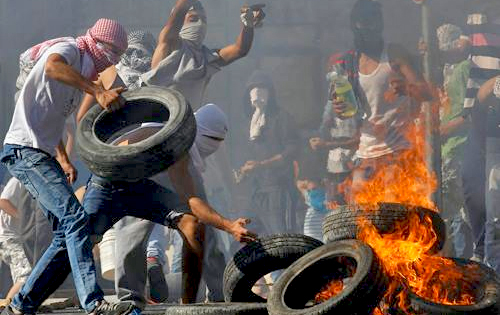
As ceasefire collapses, Israel targets top Hamas leader; death toll reached 200

July 16, 2014

Ceasefire collapses

Jul 16: Israel resumed its air strikes in the Gaza Strip on Wednesday a day after holding its fire in deference to an Egyptian-proposed cease-fire deal that failed to get Hamas militants to halt rocket attacks.

New Israeli air strikes in Gaza in the early hours of Wednesday killed several people, and destroyed the house of Mahmoud Zahar - who is believed to be in hiding elsewhere - in the first apparent targeting of a top Hamas political leader.

The week-old conflict seemed to be at a turning point on Tuesday, with Hamas defying Arab and Western calls to cease fire and Israel threatening to step up an offensive that could include an invasion of the densely populated enclave of 1.8 million.

Hamas' armed wing, the Izz el-Deen al-Qassam Brigades, rejected the ceasefire deal, a proposal that addressed in only general terms some of its key demands, and said its battle with Israel would "increase in ferocity and intensity". But Moussa Abu Marzouk, a Hamas political official who was in Cairo, said the movement, which is seeking a deal that would ease the Egyptian and Israeli border restrictions throttling Gaza's economy, had made no final decision on Cairo's proposal.

The Israeli military said that since the cease-fire deal was to have gone into effect, Hamas had fired 123 rockets at Israel, one killing a civilian - the first Israeli fatality in the fighting.

Gaza medical officials say 202 Palestinians, including at least 150 civilians, among them 31 children, have been killed.

Israel's Iron Dome anti-missile system intercepted 20 of the Hamas projectiles, including two over the Tel Aviv area, and the rest caused no damage or casualties.

Hamas and Islamic Jihad claimed responsibility for the attack against Israel's commercial capital, which has been targeted frequently since the war began, as well as for the rocket that killed the Israeli man along the border.

Israel, citing the persistent salvoes, resumed attacks in Gaza six hours after implementation of the truce was to have begun. The military said it targeted at least 20 of Hamas' hidden rocket launchers, tunnels and weapons storage facilities.

Prime Minister Benjamin Netanyahu said in broadcast remarks late on Tuesday that Israel had no choice but to "expand and intensify" its campaign on Hamas, though he did not specifically mention the possibility of a ground incursion.

The Iron Dome has shot down most projectiles liable to hit Israeli towns and cities, but the rocket salvoes have made a rush to shelters a daily routine for hundreds of thousands of people across the country.

The surge in hostilities over the past week was prompted by the murder last month of three Jewish seminary students in the Israeli-occupied West Bank and the revenge killing on July 2 of a Palestinian youth in Jerusalem. Israel said on Monday three Jews in police custody had confessed to killing the Palestinian.

KERRY CONDEMNS "BRAZEN" HAMAS ROCKET FIRE

Speaking in Vienna, US Secretary of State John Kerry supported Israel saying, "I cannot condemn strongly enough the actions of Hamas in so brazenly firing rockets, in multiple numbers, in the face of a goodwill effort (to secure) a cease-fire."

Netanyahu, whose security cabinet voted 6-2 earlier on Tuesday to accept the truce, had cautioned that Israel would respond strongly if rockets kept flying.

He said he expected the "full support from the responsible members of the international community" for any intensification of Israeli attacks in response to Hamas spurning a truce.

Other Palestinian militant groups - Islamic Jihad, the Popular Front for the Liberation of Palestine and the Democratic Front for the Liberation of Palestine - also said they had not yet agreed to the Egyptian offer.

ISRAELI GROUND ASSAULT POSSIBLE

Israel had mobilised tens of thousands of troops for a threatened Gaza invasion if the rocket volleys persisted.

"We still have the possibility of going in, under cabinet authority, and putting an end to (the rockets)," Amos Gilad, a senior Israeli defence official, said.

Under the proposal announced by Egypt's Foreign Ministry, high-level delegations from Israel and the Palestinian factions would hold separate talks in Cairo within 48 hours to consolidate the cease-fire with "confidence-building measures".

Comments

Add new comment

  • Coastaldigest.com reserves the right to delete or block any comments.
  • Coastaldigset.com is not responsible for its readers’ comments.
  • Comments that are abusive, incendiary or irrelevant are strictly prohibited.
  • Please use a genuine email ID and provide your name to avoid reject.
News Network
March 30,2020

Mar 30: Thomas Schaefer, the finance minister of Germany's Hesse state, has committed suicide apparently after becoming "deeply worried" over how to cope with the economic fallout from the coronavirus, state premier Volker Bouffier said Sunday.

Schaefer, 54, was found dead near a railway track on Saturday. The Wiesbaden prosecution's office said they believe he died by suicide.

"We are in shock, we are in disbelief and above all we are immensely sad," Bouffier said in a recorded statement.

Hesse is home to Germany's financial capital Frankfurt, where major lenders like Deutsche Bank and Commerzbank have their headquarters. The European Central Bank is also located in Frankfurt.

A visibly shaken Bouffier recalled that Schaefer, who was Hesse's finance chief for 10 years, had been working "day and night" to help companies and workers deal with the economic impact of the pandemic.

"Today we have to assume that he was deeply worried," said Bouffier, a close ally of Chancellor Angela Merkel.

"It's precisely during this difficult time that we would have needed someone like him," he added.

Popular and well-respected, Schaefer had long been touted as a possible successor to Bouffier.

Like Bouffier, Schaefer belonged to Merkel's centre-right CDU party.

He leaves behind a wife and two children.

Comments

Add new comment

  • Coastaldigest.com reserves the right to delete or block any comments.
  • Coastaldigset.com is not responsible for its readers’ comments.
  • Comments that are abusive, incendiary or irrelevant are strictly prohibited.
  • Please use a genuine email ID and provide your name to avoid reject.
Agencies
July 7,2020

Washington, Jul 7: The US House of Representatives Judiciary Committee will grill the CEOs of US tech giants Apple, Google, Facebook and Amazon during an antitrust hearing on July 27.

Apple's Tim Cook, Facebook's Mark Zuckerberg, Alphabet's Sundar Pichai and Amazon's Jeff Bezos will testify before the antitrust panel that is working on proposals to reform and regulate the digital market.

The hearing would mark the first time all four top executives testify together in front of Congress, virtually or in-person depending on the panel's call in the COVID-19 pandemic times.

"Since last June, the Subcommittee has been investigating the dominance of a small number of digital platforms and the adequacy of existing antitrust laws and enforcement," House Judiciary Committee Chairman Jerrold Nadler (D-NY) and Antitrust Subcommittee Chairman David Cicilline (D-RI) said in a statement on Monday.

"Given the central role these corporations play in the lives of the American people, it is critical that their CEOs are forthcoming. As we have said from the start, their testimony is essential for us to complete this investigation.”

The House Judiciary Committee announced its antitrust probe into the four tech giants in June last year.

Last month, the committee sent letters to technology giants Apple, Facebook, Amazon and Alphabet (Google's parent company), asking them to confirm if their chief executives will testify as part of the committee's tech competition investigation.

Committee chair David Cicilline said the documents that the investigators sought were "essential" to the probe and that requests like this were part of the "appropriate process" to obtain them.

"The only CEO who has expressed reservation about appearing, through a representative, has been Amazon," Cicilline said. "No one in this country is above the law ... nobody is above answering a congressional subpoena".

The lawmakers want the tech giants to furnish documents that have been produced in relation to other competition probes and internal communications.

The letters that the committee sent also posed questions related to possible harms to competition in the market.

In addition to the antitrust probe, Apple's App Store policies are also facing scrutiny from the US Department of Justice.

Comments

Add new comment

  • Coastaldigest.com reserves the right to delete or block any comments.
  • Coastaldigset.com is not responsible for its readers’ comments.
  • Comments that are abusive, incendiary or irrelevant are strictly prohibited.
  • Please use a genuine email ID and provide your name to avoid reject.
News Network
June 16,2020

Beijing, Jun 16: The coronavirus situation in China's capital is "extremely severe", a city official warned Tuesday, as 27 new infections were reported from Beijing where a new cluster has sparked a huge trace-and-test programme.

The COVID-19 resurgence -- believed to have started at the sprawling Xinfadi wholesale food market in the capital -- has sparked alarm as China had largely brought its outbreak under control through mass testing and lockdowns imposed earlier in the year.

The new cases took the number of confirmed infections in Beijing over the past five days to 106, as authorities locked down almost 30 communities in the city and tested tens of thousands of people.

"The epidemic situation in the capital is extremely severe," Beijing city spokesman Xu Hejian warned at a press conference.

The World Health Organization had already expressed concern about the cluster, pointing to Beijing's size and connectivity.

Officials in the capital have said they will test stall owners and managers at all of the city's food markets, restaurants and government canteens.

Beijing's coronavirus testing capacity has been expanded to 90,000 a day, according to China's official news agency Xinhua.

On Tuesday, the capital's transport commission banned taxi- and ride-hailing services from driving out of the city, Xinhua reported, in another move to try and contain the new outbreak.

All indoor sports and entertainment venues in Beijing were ordered to shut on Monday, and some other cities across China warned they would quarantine those arriving from the capital.

The National Health Commission also reported four new domestic infections in Hebei province, which surrounds Beijing, and a case reported in southwestern Sichuan province was linked to the Beijing cluster.

Authorities were also racing to track people from Beijing who had travelled to other parts of China, and those who visited the capital have been encouraged to get tested.

Beijing spokesman Xu said: "High-risk people who have left Beijing must inform local authorities immediately."

Market inspections

Authorities shut down another market on Tuesday -- Tiantaohonglian in the central Xicheng district -- after one employee there was diagnosed with COVID-19, state broadcaster CCTV reported.

Seven residential estates surrounding that market were also locked down.

In total, Beijing officials said Tuesday they have disinfected 276 agricultural markets, closed 11 markets, and disinfected more than 33,000 food and beverage businesses in a bid to stamp out the new cluster.

Officials had warned Sunday that since May 30, 200,000 people had visited the Xinfadi market -- the original site of the new outbreak.

More than 8,000 workers from Xinfadi have been tested and sent to centralised quarantine facilities.

Until this recent outbreak, most of China's cases in recent months were nationals returning home as the pandemic spread to other countries.

China's Center for Disease Control and Prevention said Monday that the virus strain found in the Beijing outbreak was a "major epidemic strain in the European countries".

While the virus was detected on chopping boards used to handle imported salmon at Xinfadi, "it does not clearly or definitely indicate it's from imported seafood", Wu Zunyou, the body's chief epidemiologist, said in an interview with state broadcaster CCTV.

"Ever since new cases suddenly emerged in Beijing, we have tried to figure out the reasons for the outbreak since there were no COVID-19 cases found over the past two months," Wu Zunyou said.

"We came up with several possibilities, and the most likely one is that the carrier of the novel coronavirus comes from outside China or other parts of China and brought it here."

On Tuesday, another eight imported cases were reported.

Comments

Add new comment

  • Coastaldigest.com reserves the right to delete or block any comments.
  • Coastaldigset.com is not responsible for its readers’ comments.
  • Comments that are abusive, incendiary or irrelevant are strictly prohibited.
  • Please use a genuine email ID and provide your name to avoid reject.