



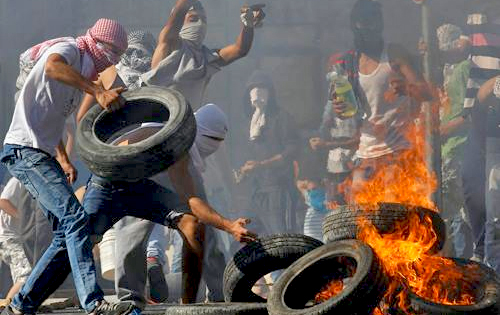
As ceasefire collapses, Israel targets top Hamas leader; death toll reached 200

July 16, 2014

Ceasefire collapses

Jul 16: Israel resumed its air strikes in the Gaza Strip on Wednesday a day after holding its fire in deference to an Egyptian-proposed cease-fire deal that failed to get Hamas militants to halt rocket attacks.

New Israeli air strikes in Gaza in the early hours of Wednesday killed several people, and destroyed the house of Mahmoud Zahar - who is believed to be in hiding elsewhere - in the first apparent targeting of a top Hamas political leader.

The week-old conflict seemed to be at a turning point on Tuesday, with Hamas defying Arab and Western calls to cease fire and Israel threatening to step up an offensive that could include an invasion of the densely populated enclave of 1.8 million.

Hamas' armed wing, the Izz el-Deen al-Qassam Brigades, rejected the ceasefire deal, a proposal that addressed in only general terms some of its key demands, and said its battle with Israel would "increase in ferocity and intensity". But Moussa Abu Marzouk, a Hamas political official who was in Cairo, said the movement, which is seeking a deal that would ease the Egyptian and Israeli border restrictions throttling Gaza's economy, had made no final decision on Cairo's proposal.

The Israeli military said that since the cease-fire deal was to have gone into effect, Hamas had fired 123 rockets at Israel, one killing a civilian - the first Israeli fatality in the fighting.

Gaza medical officials say 202 Palestinians, including at least 150 civilians, among them 31 children, have been killed.

Israel's Iron Dome anti-missile system intercepted 20 of the Hamas projectiles, including two over the Tel Aviv area, and the rest caused no damage or casualties.

Hamas and Islamic Jihad claimed responsibility for the attack against Israel's commercial capital, which has been targeted frequently since the war began, as well as for the rocket that killed the Israeli man along the border.

Israel, citing the persistent salvoes, resumed attacks in Gaza six hours after implementation of the truce was to have begun. The military said it targeted at least 20 of Hamas' hidden rocket launchers, tunnels and weapons storage facilities.

Prime Minister Benjamin Netanyahu said in broadcast remarks late on Tuesday that Israel had no choice but to "expand and intensify" its campaign on Hamas, though he did not specifically mention the possibility of a ground incursion.

The Iron Dome has shot down most projectiles liable to hit Israeli towns and cities, but the rocket salvoes have made a rush to shelters a daily routine for hundreds of thousands of people across the country.

The surge in hostilities over the past week was prompted by the murder last month of three Jewish seminary students in the Israeli-occupied West Bank and the revenge killing on July 2 of a Palestinian youth in Jerusalem. Israel said on Monday three Jews in police custody had confessed to killing the Palestinian.

KERRY CONDEMNS "BRAZEN" HAMAS ROCKET FIRE

Speaking in Vienna, US Secretary of State John Kerry supported Israel saying, "I cannot condemn strongly enough the actions of Hamas in so brazenly firing rockets, in multiple numbers, in the face of a goodwill effort (to secure) a cease-fire."

Netanyahu, whose security cabinet voted 6-2 earlier on Tuesday to accept the truce, had cautioned that Israel would respond strongly if rockets kept flying.

He said he expected the "full support from the responsible members of the international community" for any intensification of Israeli attacks in response to Hamas spurning a truce.

Other Palestinian militant groups - Islamic Jihad, the Popular Front for the Liberation of Palestine and the Democratic Front for the Liberation of Palestine - also said they had not yet agreed to the Egyptian offer.

ISRAELI GROUND ASSAULT POSSIBLE

Israel had mobilised tens of thousands of troops for a threatened Gaza invasion if the rocket volleys persisted.

"We still have the possibility of going in, under cabinet authority, and putting an end to (the rockets)," Amos Gilad, a senior Israeli defence official, said.

Under the proposal announced by Egypt's Foreign Ministry, high-level delegations from Israel and the Palestinian factions would hold separate talks in Cairo within 48 hours to consolidate the cease-fire with "confidence-building measures".

Comments

Add new comment

  • Coastaldigest.com reserves the right to delete or block any comments.
  • Coastaldigset.com is not responsible for its readers’ comments.
  • Comments that are abusive, incendiary or irrelevant are strictly prohibited.
  • Please use a genuine email ID and provide your name to avoid reject.
News Network
April 21,2020

New York, Apr 21: Oil prices plunged below zero on Monday as demand for energy collapses amid the coronavirus pandemic and traders don't want to get stuck owning crude with nowhere to store it.

Stocks were also slipping on Wall Street in afternoon trading, with the S&P 500 down 0.9%, but the market's most dramatic action was by far in oil, where benchmark U.S. crude for May delivery plummeted to negative $3.70 per barrel, as of 2:15 pm. Eastern time.

Much of the drop into negative territory was chalked up to technical reasons — the May delivery contract is close to expiring so it was seeing less trading volume, which can exacerbate swings. But prices for deliveries even further into the future, which were seeing larger trading volumes, also plunged.

Demand for oil has collapsed so much due to the coronavirus pandemic that facilities for storing crude are nearly full.

Tanks could hit their limits within three weeks, according to Chris Midgley, head of analytics at S&P Global Platts.

Benchmark U.S. crude oil for June delivery, which shows a more ”normal” price, fell 14.8% to $21.32 per barrel, as factories and automobiles around the world remain idled. Big oil producers have announced cutbacks in production in hopes of better balancing supplies with demand, but many analysts say it's not enough.

“Basically, bears are out for blood,” analyst Naeem Aslam of Avatrade said in a report. “The steep fall in the price is because of the lack of sufficient demand and lack of storage place given the fact that the production cut has failed to address the supply glut.”

Halliburton swung between gains and sharp losses, even though it reported stronger results for the first three months of 2020 than analysts expected. The oilfield engineering company said that the pandemic has created so much turmoil in the industry that it “cannot reasonably estimate” how long the hit will last. It expects a further decline in revenue and profitability for the rest of 2020, particularly in North America.

Brent crude, the international standard, was down $1.78 to $26.30 per barrel. .

In the stock market, the mild drops ate into some of the big gains made since late March, driven lately by investors looking ahead to parts of the economy possibly reopening as infections level off in hard-hit areas.

Pessimists have called the rally overdone, pointing to the severe economic pain sweeping the world and continued uncertainty about how long it will last.

The Dow Jones Industrial Average was down 364 points, or 1.5%, to 23,887. The Nasdaq was down 0.1%..

More gains from companies that are winners in the new stay-at-home economy helped limit the market's losses Amazon rose 1.4%, and Netflix jumped 3.8% as people shut in at home buy staples and look to fill their time. Clorox likewise rose toward a new record and was up 1% as households and businesses that remain open look to stay clean.

In Tokyo the Nikkei 225 fell 1.1% after Japan reported that its exports fell nearly 12% in March from a year earlier as the pandemic hammered demand in its two biggest markets, the U.S. and China.

The Hang Seng index in Hong Kong lost 0.2%, and South Korea's Kospi fell 0.8%.

European markets were modestly higher The German DAX was up 0.5%, the French CAC 40 was up 0.7% and the FTSE 100 in London gained 0.7%.

In a sign of continued caution in the market, Treasury yields remained extremely low. The yield on the 10-year Treasury slipped to 0.64% from 0.65% late Friday. It started the year near 1.90%. Bond yields drop when their prices rise, and investors tend to buy Treasurys when they're worried about the economy.

Stocks have been on a generally upward swing recently, and the S&P 500 just closed out its first back-to-back weekly gain since the market began selling off in February. Promises of massive aid for the economy and markets by the Federal Reserve and U.S. government ignited the rally, which sent the S&P 500 up as much as 28.5% since a low on March 23.

More recently, countries around the world have tentatively eased up on business-shutdown restrictions put in place to slow the spread of the virus.

But health experts warn the pandemic is far from over and new flareups could ignite if governments rush to allow ”normal” life to return prematurely.

The S&P 500 remains about 15% below its record high in February as millions more U.S. workers file for unemployment every week amid the shutdowns.

Many analysts also warn that a significant part of the recent recovery in stocks is due to the expectation among some investors that the economy will rebound sharply once economic quarantines are lifted. They're essentially predicting that a line chart of the economy will ultimately resemble the letter “V,” with a wild ride down but then a quick pivot to a vigorous recovery.

That may be to optimistic. “We caution that a U-shaped recovery is also quite likely,” where the economy bottoms out and stays at that low level for a while before recovering, strategists at Barclays warned in a recent report.

Without strong testing programs for COVID-19, businesses likely won't feel comfortable bringing back their full workforces for a while.

”With risk assets now overbought, the chance for a correction has increased,” Morgan Stanley strategists wrote in a report.

Comments

Add new comment

  • Coastaldigest.com reserves the right to delete or block any comments.
  • Coastaldigset.com is not responsible for its readers’ comments.
  • Comments that are abusive, incendiary or irrelevant are strictly prohibited.
  • Please use a genuine email ID and provide your name to avoid reject.
News Network
June 25,2020

Ottawa, Jun 25: Prime Minister Justin Trudeau took his son out for ice cream on Wednesday in his first family outing since Canada started easing out of its pandemic lockdown.

It was also Saint-Jean-Baptiste Day in Quebec province.

Wearing masks, the Canadian leader and his six-year-old son Hadrien were cheered at Chocolats Favoris in Gatineau, Quebec.

According to a pool report, Trudeau said the shop tapped into a federal emergency wage subsidy and business loan in order to weather the pandemic, and "avoid being frozen out of the frozen treat market."

Hadrien is said to have bounced with excitement, settling on a vanilla cone with a cookie topping while dad bought a vanilla cone dipped in chocolate for himself.

Father and son then headed out to the patio, where they doffed their masks to eat their cones.

Canada's provinces and territories declared states of emergency mid-March, closing schools and non-essential businesses in response to the pandemic.

Comments

Add new comment

  • Coastaldigest.com reserves the right to delete or block any comments.
  • Coastaldigset.com is not responsible for its readers’ comments.
  • Comments that are abusive, incendiary or irrelevant are strictly prohibited.
  • Please use a genuine email ID and provide your name to avoid reject.
News Network
May 20,2020

Washington, May 20: The United States recorded another 1,536 coronavirus deaths over the past 24 hours, the Johns Hopkins University tracker said.

That figure, tallied as of 8:30 pm (0030 GMT), raises to 91,845 the total number of COVID-19 deaths in the US.

The US tops the global rankings both for the highest death toll and the highest number of infections, with more than 1.5 million cases.

Comments

Add new comment

  • Coastaldigest.com reserves the right to delete or block any comments.
  • Coastaldigset.com is not responsible for its readers’ comments.
  • Comments that are abusive, incendiary or irrelevant are strictly prohibited.
  • Please use a genuine email ID and provide your name to avoid reject.