



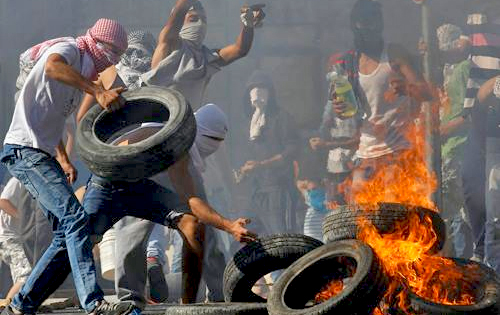
As ceasefire collapses, Israel targets top Hamas leader; death toll reached 200

July 16, 2014

Ceasefire collapses

Jul 16: Israel resumed its air strikes in the Gaza Strip on Wednesday a day after holding its fire in deference to an Egyptian-proposed cease-fire deal that failed to get Hamas militants to halt rocket attacks.

New Israeli air strikes in Gaza in the early hours of Wednesday killed several people, and destroyed the house of Mahmoud Zahar - who is believed to be in hiding elsewhere - in the first apparent targeting of a top Hamas political leader.

The week-old conflict seemed to be at a turning point on Tuesday, with Hamas defying Arab and Western calls to cease fire and Israel threatening to step up an offensive that could include an invasion of the densely populated enclave of 1.8 million.

Hamas' armed wing, the Izz el-Deen al-Qassam Brigades, rejected the ceasefire deal, a proposal that addressed in only general terms some of its key demands, and said its battle with Israel would "increase in ferocity and intensity". But Moussa Abu Marzouk, a Hamas political official who was in Cairo, said the movement, which is seeking a deal that would ease the Egyptian and Israeli border restrictions throttling Gaza's economy, had made no final decision on Cairo's proposal.

The Israeli military said that since the cease-fire deal was to have gone into effect, Hamas had fired 123 rockets at Israel, one killing a civilian - the first Israeli fatality in the fighting.

Gaza medical officials say 202 Palestinians, including at least 150 civilians, among them 31 children, have been killed.

Israel's Iron Dome anti-missile system intercepted 20 of the Hamas projectiles, including two over the Tel Aviv area, and the rest caused no damage or casualties.

Hamas and Islamic Jihad claimed responsibility for the attack against Israel's commercial capital, which has been targeted frequently since the war began, as well as for the rocket that killed the Israeli man along the border.

Israel, citing the persistent salvoes, resumed attacks in Gaza six hours after implementation of the truce was to have begun. The military said it targeted at least 20 of Hamas' hidden rocket launchers, tunnels and weapons storage facilities.

Prime Minister Benjamin Netanyahu said in broadcast remarks late on Tuesday that Israel had no choice but to "expand and intensify" its campaign on Hamas, though he did not specifically mention the possibility of a ground incursion.

The Iron Dome has shot down most projectiles liable to hit Israeli towns and cities, but the rocket salvoes have made a rush to shelters a daily routine for hundreds of thousands of people across the country.

The surge in hostilities over the past week was prompted by the murder last month of three Jewish seminary students in the Israeli-occupied West Bank and the revenge killing on July 2 of a Palestinian youth in Jerusalem. Israel said on Monday three Jews in police custody had confessed to killing the Palestinian.

KERRY CONDEMNS "BRAZEN" HAMAS ROCKET FIRE

Speaking in Vienna, US Secretary of State John Kerry supported Israel saying, "I cannot condemn strongly enough the actions of Hamas in so brazenly firing rockets, in multiple numbers, in the face of a goodwill effort (to secure) a cease-fire."

Netanyahu, whose security cabinet voted 6-2 earlier on Tuesday to accept the truce, had cautioned that Israel would respond strongly if rockets kept flying.

He said he expected the "full support from the responsible members of the international community" for any intensification of Israeli attacks in response to Hamas spurning a truce.

Other Palestinian militant groups - Islamic Jihad, the Popular Front for the Liberation of Palestine and the Democratic Front for the Liberation of Palestine - also said they had not yet agreed to the Egyptian offer.

ISRAELI GROUND ASSAULT POSSIBLE

Israel had mobilised tens of thousands of troops for a threatened Gaza invasion if the rocket volleys persisted.

"We still have the possibility of going in, under cabinet authority, and putting an end to (the rockets)," Amos Gilad, a senior Israeli defence official, said.

Under the proposal announced by Egypt's Foreign Ministry, high-level delegations from Israel and the Palestinian factions would hold separate talks in Cairo within 48 hours to consolidate the cease-fire with "confidence-building measures".

Comments

Add new comment

  • Coastaldigest.com reserves the right to delete or block any comments.
  • Coastaldigset.com is not responsible for its readers’ comments.
  • Comments that are abusive, incendiary or irrelevant are strictly prohibited.
  • Please use a genuine email ID and provide your name to avoid reject.
News Network
June 2,2020

Jun 2: A new female billionaire has emerged from one of Asia's most-expensive breakups.

Du Weimin, the chairman of Shenzhen Kangtai Biological Products Co., transferred 161.3 million shares of the vaccine maker to his ex-wife, Yuan Liping, according to a May 29 filing, immediately catapulting her into the ranks of the world's richest.

The stock was worth $3.2 billion as of Monday's close.

Yuan, 49 this year, owns the shares directly, but signed an agreement delegating the voting rights to her ex-husband, the filing shows. The Canadian citizen, who resides in Shenzhen, served as a director of Kangtai between May 2011 and August 2018. She's now the vice general manager of subsidiary Beijing Minhai Biotechnology Co. Yuan holds a bachelor's degree in economics from Beijing's University of International Business and Economics.

Kangtai shares have more than doubled in the past year and have continued their ascent since February, when the company announced a plan to develop a vaccine to fight the coronavirus. They slipped for a second day Tuesday following news of the divorce terms, losing 3.1% as of 9:43 a.m. in Hong Kong and bringing the company's market value to $12.9 billion.

Du's net worth has now dropped to about $3.1 billion from $6.5 billion before the split, excluding his pledged shares.

The 56-year-old was born into a farming family in China's Jiangxi province. After studying chemistry in college, he began working in a clinic in 1987 and became a sales manager for a biotech company in 1995, according to the prospectus of Kangtai's 2017 initial public offering. In 2009, Kangtai acquired Minhai, the company Du founded in 2004, and he became the chairman of the combined entity.

China's rapidly growing economy has been an engine for the country's richest, and Du is not the only tycoon who's had to pay a steep price for a divorce. In 2012, Wu Yajun, at one point the nation's richest woman, transferred a stake worth about $2.3 billion to her ex-husband, Cai Kui, who co-founded developer Longfor Group Holdings Ltd. In 2016, tech billionaire Zhou Yahui gave $1.1 billion of shares in his online gaming company, Beijing Kunlun Tech Co., to ex-wife Li Qiong after a civil court settlement.

Sometimes, a goodbye can be time-consuming too. South Korean tycoon Chey Tae-won's wife filed a lawsuit in December asking for a 42.3% stake in SK Holdings Co. valued at $1.2 billion. That would make her the second-largest shareholder of the company should she win the case, which is still ongoing.

The most expensive divorce in history is that of Jeff and MacKenzie Bezos. The Amazon.com Inc. founder gave 4% of the online retailer to Mackenzie, who now has a $48 billion fortune and is the world's fourth-richest woman.

Comments

Add new comment

  • Coastaldigest.com reserves the right to delete or block any comments.
  • Coastaldigset.com is not responsible for its readers’ comments.
  • Comments that are abusive, incendiary or irrelevant are strictly prohibited.
  • Please use a genuine email ID and provide your name to avoid reject.
News Network
January 28,2020

Jan 28: China said on Tuesday that 106 people had died from a new coronavirus that is spreading across the country, up from the previous toll of 81.

The number of total confirmed cases in China rose to 4,515 as of Jan. 27, the National Health Commission said in a statement, up from 2,835 reported a day earlier.

The United States warned against travel to China on Monday and Canada issued a more narrow travel warning as the death toll from the spreading coronavirus passed 100, with tens of millions stranded during the biggest holiday of the year and global markets rattled.

Global stocks fell, oil prices hit three-month lows, and China's yuan dipped to its weakest level in 2020 as investors fretted about damage to the world's second-biggest economy from travel bans and the Lunar New Year holiday, which China extended in a bid to keep people at home.

The health commission of China's Hubei province said on Tuesday that 100 people had died from the virus as of Jan. 27, according to an online statement, up from the previous toll of 76, with the number of confirmed cases in the province rose to 2,714.

Other fatalities have been reported elsewhere in China, including the first in Beijing, bringing the deal toll to 106 so far, according to the People's Daily. The state newspaper put the total number of confirmed cases in China at 4,193, though some experts suspect a much higher number.

On Monday, US President Donald Trump offered China whatever help it needed, while the State Department said Americans should "reconsider" visiting all of China due to the virus.

Canada, which has two confirmed cases of the virus and is investigating 19 more potential cases, warned its citizens to avoid travel to China's Hubei province, at the heart of the outbreak.

Authorities in Hubei province are taking increasing flak from the public over their initial response to the virus. Chinese Premier Li Keqiang visited the city of Wuhan, epicentre of the outbreak, to encourage medical workers and promise reinforcements.

Visiting Wuhan in blue protective suit and mask, Li praised medics, said 2,500 more workers would join them in the next two days, and visited the site of a new hospital to be built in days.

The most senior leader to visit Wuhan since the outbreak, Li was shown on state TV leading medical workers in chants of "Wuhan jiayou!" - an exhortation to keep their strength up.

China's ambassador to the United Nations, following a meeting with UN Secretary-General António Guterres on Monday, said "the Chinese government attaches paramount importance to prevention and control of the epidemic, and President Xi Jinping has given important instructions. ...

"China has been working with the international community in the spirit of openness, transparency and scientific coordination," he said.

Guterres said in a statement, "The UN appreciates China's effort, has full confidence in China's ability of controlling the outbreak, and stands ready to provide any support and assistance."

MOUNTING ANGER

On China's heavily censored social media, officials have faced mounting anger over the virus, which is thought to have originated from a market where wildlife was sold illegally.

Some criticised the governor of Hubei province, of which Wuhan is the capital, after he corrected himself twice during a news conference over the number of face masks being produced.

"If he can mess up the data multiple times, no wonder the disease has spread so severely," said one user of the Weibo social media platform.

In rare public self-criticism, Wuhan Mayor Zhou Xianwang said the city's management of the crisis was "not good enough" and indicated he was willing to resign.

The central Chinese city of 11 million people is in virtual lockdown and much of Hubei, home to nearly 60 million people, is under travel curbs.

Elsewhere in China, people from the region faced questioning about their movements. "Hubei people are getting discriminated against," a Wuhan resident complained on Weibo.

Cases linked to people who travelled from Wuhan have been confirmed in a dozen countries, from Japan to the United States, where authorities said they had 110 people under investigation in 26 states. Sri Lanka was the latest to confirm a case.

INVESTORS WORRIED

Investors are worried about the impact. The consensus is that in the short term, economic output will be hit as authorities limit travel and extend the week-long New Year holiday — when millions traditionally travel by rail, road and plane - by three days to limit spread of the virus.

Asian and European shares tumbled, with Japan's Nikkei average sliding 2%, its biggest one-day fall in five months. Demand spiked for safe-haven assets such as the Japanese yen and Treasury notes. European stocks fell more than 2%.

The US S&P 500 closed down nearly 1.6%.

"China is the biggest driver of global growth so this couldn't have started in a worse place," said Alec Young, FTSE Russell's managing director of global markets research.

During the 2002-2003 outbreak of Severe Acute Respiratory Syndrome (SARS), which originated in China and killed nearly 800 people globally, air passenger demand in Asia plunged 45%. The travel industry is more reliant on Chinese travellers now.

Chinese-ruled Hong Kong, which has had eight cases, banned entry to people who had visited Hubei recently.

Some European tour operators cancelled trips to China, while governments around the world worked on repatriating nationals.

Officially known as 2019-nCoV, the newly identified coronavirus can cause pneumonia, but it is still too early to know just how dangerous it is and how easily it spreads.

"What we know about this virus it that transmission occurs through human contact but we are speaking of close contact, i.e. less than a meter," said Jerome Salomon, a senior official with France's health ministry.

"Crossing someone (infected) in the street poses no threat," he said. "The risk is low when you spend a little time near that person and becomes higher when you spend a lot of time near that person."

Comments

Add new comment

  • Coastaldigest.com reserves the right to delete or block any comments.
  • Coastaldigset.com is not responsible for its readers’ comments.
  • Comments that are abusive, incendiary or irrelevant are strictly prohibited.
  • Please use a genuine email ID and provide your name to avoid reject.
Agencies
August 7,2020

Colombo, Aug 7: Sri Lankan President Gotabaya Rajapaksa's party and its allies won an overwhelming two-thirds majority in a parliament election, results showed on Friday, giving him the power to enact sweeping changes to the constitution.

The governing Sri Lanka Podujana Peramuna and its allies had won 150 seats in the 225-member parliament, according to the tally published by the election commission from Wednesday's vote.

Rajapaksa had sought a two-thirds majority in parliament to be able to restore full executive powers to the presidency, which he says are necessary to implement his agenda to make the tiny island economically and militarily secure.

He is likely to install his older brother and former President Mahinda Rajapaksa as the next prime minister. The brothers are best known for crushing the Tamil Tiger rebels fighting for a separate homeland for minority Tamils during the elder Rajapaksa's presidency in 2009.

On a congratulatory phone call from Prime Minister Narendra Modi of India, which is keen to check Chinese influence on its southern neighbour, Mahinda Rajapaksa vowed to deepen ties between the two countries.

"With the strong support of the people of Sri Lanka, I look forward to working with you closely to further enhance the long-standing cooperation between our two countries," he told Modi. "Sri Lanka and India are friends and relations."

The tourism-dependent nation of 21 million people has been struggling economically since deadly Islamist militant attacks on hotels and churches last year followed by lockdowns to slow the spread of the coronavirus. 

Comments

Add new comment

  • Coastaldigest.com reserves the right to delete or block any comments.
  • Coastaldigset.com is not responsible for its readers’ comments.
  • Comments that are abusive, incendiary or irrelevant are strictly prohibited.
  • Please use a genuine email ID and provide your name to avoid reject.