



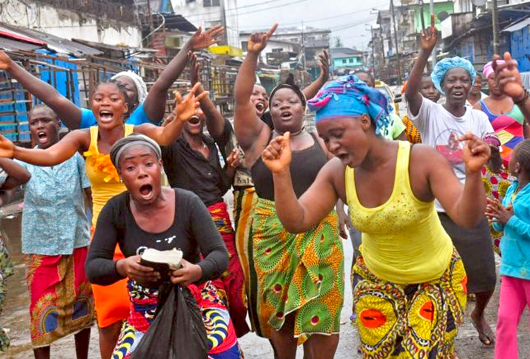
Celebration in Liberia slum as Ebola quarantine lifted

September 1, 2014

Ebola quarantine lifted

Monrovia/Conakry, Sep 1: Crowds sang and danced in the streets of a seaside neighborhood in Liberia on Saturday as the government lifted quarantine measures designed to contain the spread of the deadly Ebola virus.

Faced with the worst Ebola outbreak in history, West African governments have struggled to find an effective response. More than 1,550 people have died from the hemorrhagic fever since it was first detected in the forests of Guinea in March.

Residents of the impoverished seaside district of West Point in Monrovia were forcibly cut off from the rest of the capital in mid-August after a crowd attacked an Ebola center there, allowing the sick to flee.

The quarantine sparked protests and security forces responded with tear gas and bullets, killing a teenaged boy.

But at dawn on Saturday, the community woke up to find the soldiers and barricades gone.

"I tell God thank you. I tell everyone thank you," said Koffa, a female resident of West Point. Others danced in the streets chanting slogans like "we are free" while others rolled about on the asphalt pavement in celebration.

President Ellen Johnson-Sirleaf, a U.S.-educated Nobel Peace Prize winner, has sought to quell criticism of the government's response by issuing orders threatening officials with dismissal for failing to report for work or for fleeing the country, and has ordered an investigation into the West Point shooting.

Liberia, where infection rates are highest, plans to build five new Ebola treatment centers each with capacity for 100 beds, government and health officials said on Saturday.

In neighboring Sierra Leone, President Ernest Bai Koromo dismissed his health minister Miatta Kargbo on Friday over her handling of the epidemic which has killed more than 400 people there.

Her replacement Abubakarr Fofana on Saturday confirmed that a third doctor in the county had died from Ebola, further hampering its ability to respond to the outbreak.

"It is with a deep sense of sadness that we have lost one of our finest physicians in the line of duty at a time like when we need a lot of them to help in out fight against Ebola," he said.

Physician Dr. Sahr Rogers caught the disease while treating outpatients in the same hospital where a doctor died last month and where British nurse William Pooley was also infected.

SPREAD TO SENEGAL

Transmitted through the vomit, blood and sweat of the sick, Ebola has also spread to Nigeria and Senegal, which reported its first confirmed case on Friday - a Guinean student who was lost to authorities in his own country while under surveillance.

"His brother came from Sierra Leone where he was infected and has died. Shortly afterwards, this student left for Senegal," said Dr. Rafi Diallo, spokesman for the Guinean health ministry.

Two other members of his family - his sister and mother - have died from Ebola, Guinean health ministry sources said.

A resident in the suburb of the Senegalese capital Dakar where the student resided said on Saturday that a team of health ministry officials wearing white protective suits and masks came to spray disinfectant at his home and a local grocer's shop.

Many Dakar residents worry that the student could have spread the highly contagious virus in the three weeks since he was last reported in Guinea.

In Nigeria, where an infected traveler collapsed after arriving the Lagos airport, there have so far been 19 suspected, probable and confirmed cases and seven deaths.

"To avoid a situation like Nigeria, they need to be able to follow hundreds of contacts," said epidemiologist Jorge Castilla of the European Commission's Humanitarian Aid and Civil Protection Department in Dakar. "Whatever they do, there will probably be a second set of sick people as this guy has been here for some time."

Senegal has since closed its land border with Guinea and halted flights to Guinea, Sierra Leone and Liberia, defying advice from the World Health Organization (WHO) that there is no need for travel restrictions.

A note from the WHO and the International Civil Aviation Organization sent to health ministries on Aug. 29 said: "Lives are being unnecessarily lost because health care workers cannot travel to the affected countries, and delivery of life saving equipment and supplies is being delayed."

The World Food Programme said it needs to raise $70 million to feed 1.3 million people at risk from shortages in the Ebola-quarantined areas in West Africa, with the agency's resources already stretched by several major humanitarian crises.

Comments

Add new comment

  • Coastaldigest.com reserves the right to delete or block any comments.
  • Coastaldigset.com is not responsible for its readers’ comments.
  • Comments that are abusive, incendiary or irrelevant are strictly prohibited.
  • Please use a genuine email ID and provide your name to avoid reject.
News Network
January 19,2020

President Donald Trump gave a new justification for killing Qassim Suleimani, telling a gathering of Republican donors that the top Iranian general was "saying bad things about our country" before the strike, which led to his decision to authorise his killing. "How much are we going to listen to?" Trump said on Friday, according to remarks from a fundraiser obtained by CNN.

With his typical dramatic flourish, Trump recounted the scene as he monitored the strikes from the White House Situation Room when Suleimani was killed. The president spoke in a ballroom at his Mar-a-Lago club in Palm Beach, Florida, at a Republican event that raised $10 million for Trump's 2020 campaign.

The January 3 killing of Suleimani prompted Iran to retaliate with missile strikes against US forces in Iraq days later and almost triggered a broad war between the two countries. "They're together sir," Trump said military officials told him. "Sir, they have two minutes and 11 seconds. No emotion. Two minutes and 11 seconds to live, sir. They're in the car, they're in an armoured vehicle. Sir, they have approximately one minute to live, sir. Thirty seconds. Ten, 9, 8 ...'"

"Then all of a sudden, boom," he said. "They're gone, sir. Cutting off, I said, where is this guy?" Trump continued. "That was the last I heard from him". It was the most detailed account that Trump has given of the drone strike, which has drawn criticism from some US lawmakers because neither the president nor his advisers have provided public information to back up their statements that Suleimani presented an "imminent" threat to US.

Trump's comments came a day after he warned Iran's supreme leader Ayatollah Ali Khamenei to be "very careful with his words". According to Trump, Khamenei's speech on Friday, in which he attacked the "vicious" US and described UK, France and Germany as "America's lackeys", was a mistake.

Comments

Add new comment

  • Coastaldigest.com reserves the right to delete or block any comments.
  • Coastaldigset.com is not responsible for its readers’ comments.
  • Comments that are abusive, incendiary or irrelevant are strictly prohibited.
  • Please use a genuine email ID and provide your name to avoid reject.
News Network
April 21,2020

New York, Apr 21: Oil prices plunged below zero on Monday as demand for energy collapses amid the coronavirus pandemic and traders don't want to get stuck owning crude with nowhere to store it.

Stocks were also slipping on Wall Street in afternoon trading, with the S&P 500 down 0.9%, but the market's most dramatic action was by far in oil, where benchmark U.S. crude for May delivery plummeted to negative $3.70 per barrel, as of 2:15 pm. Eastern time.

Much of the drop into negative territory was chalked up to technical reasons — the May delivery contract is close to expiring so it was seeing less trading volume, which can exacerbate swings. But prices for deliveries even further into the future, which were seeing larger trading volumes, also plunged.

Demand for oil has collapsed so much due to the coronavirus pandemic that facilities for storing crude are nearly full.

Tanks could hit their limits within three weeks, according to Chris Midgley, head of analytics at S&P Global Platts.

Benchmark U.S. crude oil for June delivery, which shows a more ”normal” price, fell 14.8% to $21.32 per barrel, as factories and automobiles around the world remain idled. Big oil producers have announced cutbacks in production in hopes of better balancing supplies with demand, but many analysts say it's not enough.

“Basically, bears are out for blood,” analyst Naeem Aslam of Avatrade said in a report. “The steep fall in the price is because of the lack of sufficient demand and lack of storage place given the fact that the production cut has failed to address the supply glut.”

Halliburton swung between gains and sharp losses, even though it reported stronger results for the first three months of 2020 than analysts expected. The oilfield engineering company said that the pandemic has created so much turmoil in the industry that it “cannot reasonably estimate” how long the hit will last. It expects a further decline in revenue and profitability for the rest of 2020, particularly in North America.

Brent crude, the international standard, was down $1.78 to $26.30 per barrel. .

In the stock market, the mild drops ate into some of the big gains made since late March, driven lately by investors looking ahead to parts of the economy possibly reopening as infections level off in hard-hit areas.

Pessimists have called the rally overdone, pointing to the severe economic pain sweeping the world and continued uncertainty about how long it will last.

The Dow Jones Industrial Average was down 364 points, or 1.5%, to 23,887. The Nasdaq was down 0.1%..

More gains from companies that are winners in the new stay-at-home economy helped limit the market's losses Amazon rose 1.4%, and Netflix jumped 3.8% as people shut in at home buy staples and look to fill their time. Clorox likewise rose toward a new record and was up 1% as households and businesses that remain open look to stay clean.

In Tokyo the Nikkei 225 fell 1.1% after Japan reported that its exports fell nearly 12% in March from a year earlier as the pandemic hammered demand in its two biggest markets, the U.S. and China.

The Hang Seng index in Hong Kong lost 0.2%, and South Korea's Kospi fell 0.8%.

European markets were modestly higher The German DAX was up 0.5%, the French CAC 40 was up 0.7% and the FTSE 100 in London gained 0.7%.

In a sign of continued caution in the market, Treasury yields remained extremely low. The yield on the 10-year Treasury slipped to 0.64% from 0.65% late Friday. It started the year near 1.90%. Bond yields drop when their prices rise, and investors tend to buy Treasurys when they're worried about the economy.

Stocks have been on a generally upward swing recently, and the S&P 500 just closed out its first back-to-back weekly gain since the market began selling off in February. Promises of massive aid for the economy and markets by the Federal Reserve and U.S. government ignited the rally, which sent the S&P 500 up as much as 28.5% since a low on March 23.

More recently, countries around the world have tentatively eased up on business-shutdown restrictions put in place to slow the spread of the virus.

But health experts warn the pandemic is far from over and new flareups could ignite if governments rush to allow ”normal” life to return prematurely.

The S&P 500 remains about 15% below its record high in February as millions more U.S. workers file for unemployment every week amid the shutdowns.

Many analysts also warn that a significant part of the recent recovery in stocks is due to the expectation among some investors that the economy will rebound sharply once economic quarantines are lifted. They're essentially predicting that a line chart of the economy will ultimately resemble the letter “V,” with a wild ride down but then a quick pivot to a vigorous recovery.

That may be to optimistic. “We caution that a U-shaped recovery is also quite likely,” where the economy bottoms out and stays at that low level for a while before recovering, strategists at Barclays warned in a recent report.

Without strong testing programs for COVID-19, businesses likely won't feel comfortable bringing back their full workforces for a while.

”With risk assets now overbought, the chance for a correction has increased,” Morgan Stanley strategists wrote in a report.

Comments

Add new comment

  • Coastaldigest.com reserves the right to delete or block any comments.
  • Coastaldigset.com is not responsible for its readers’ comments.
  • Comments that are abusive, incendiary or irrelevant are strictly prohibited.
  • Please use a genuine email ID and provide your name to avoid reject.
News Network
June 19,2020

United Nations, Jun 19: Half of the world's children -- one billion every year -- are affected by physical, sexual or psychological violence, suffering injuries and death because countries have failed to follow established strategies to protect them, the first report of its kind from the UN has said, with experts noting that the coronavirus-related lockdowns have left far too many youngsters stuck with their abusers.

While nearly all countries (88 per cent) have laws in place to protect minors, less than half (47 per cent) say they strongly enforce them, said the Global Status Report on Preventing Violence Against Children 2020 launched on Thursday.

Because countries have failed to follow established strategies to protect children, about one billion are affected each year by physical, sexual or psychological violence, it said.

"There is never any excuse for violence against children," WHO Director-General Tedros Adhanom Ghebreyesus said.

"We have evidence-based tools to prevent it, which we urge all countries to implement. Protecting the health and well-being of children is central to protecting our collective health and well-being, now and for the future," he said.

The report -- launched by the World Health Organisation, the UNICEF, the UNESCO, the Special Representative of the UN Secretary-General on Violence against Children and the End Violence Partnership -- charted progress in 155 countries against the "INSPIRE" framework, a set of seven strategies for preventing and responding to violence against children.

The report signaled a clear need in all countries to scale up efforts to implement them. It included the first ever global homicide estimates specifically for children under 18 years of age -- previous estimates were based on data that included 18 to 19-year olds.

According to the findings, in 2017, around 40,000 children were victims of homicide.

"Violence against children has always been pervasive, and now things could be getting much worse," UNICEF Executive Director Henrietta Fore said.

"Lockdowns, school closures and movement restrictions have left far too many children stuck with their abusers, without the safe space that school would normally offer. It is urgent to scale up efforts to protect children during these times and beyond, including by designating social service workers as essential and strengthening child helplines," she said.

UNESCO Director-General Audrey Azoulay said during the COVID-19 pandemic, and the related school closures, "we have seen a rise in violence and hate online – and this includes bullying".

"Now, as schools begin to re-open, children are expressing their fears about going back to school. It is our collective responsibility to ensure that schools are safe environments for all children. We need to think and act collectively to stop violence at school and in our societies at large," Azoulay said.

Stay-at-home measures including school closures have limited the usual sources of support for families and individuals such as friends, extended family or professionals.

This further erodes victims’ ability to successfully cope with crises and the new routines of daily life. Spikes in calls to helplines for child abuse and intimate partner violence have been observed, the report said.

While online communities have become central to maintain many children's learning, support and play, an increase in harmful online behaviors including cyberbullying, risky online behavior and sexual exploitation have been identified.

“Whilst this report was being finalised, confinement measures and the disrupted provision of already limited child protection services exacerbated the vulnerability of children to various forms of violence," said Najat Maalla M’jid, Special Representative of the UN Secretary-General on Violence against Children.

Of the INSPIRE strategies, only access to schools through enrolment showed the most progress with 54 per cent of the countries reporting that a sufficient number of children in need were being reached in this way.

Between 32 per cent and 37 per cent of the countries considered that victims of violence could access support services, while 26 per cent of the countries provided programmes on parent and caregiver support; 21 per cent of the countries had programmes to change harmful norms; and 15 per cent of the countries had modifications to provide safe physical environments for children, the report said.

Although a majority of countries (83 per cent) have national data on violence against children, only 21 per cent used these to set baselines and national targets to prevent and respond to violence against children, it added.

The report said about 80 per cent of countries have national plans of action and policies but only one-fifth have plans that are fully funded or have measurable targets. A lack of funding combined with inadequate professional capacity are likely contributing factors and a reason why implementation has been slow.

"Ending violence against children is the right thing to do, a smart investment to make - and it's possible. We can and must create a world where every child can thrive," Howard Taylor of the End Violence Partnership said.

Comments

Add new comment

  • Coastaldigest.com reserves the right to delete or block any comments.
  • Coastaldigset.com is not responsible for its readers’ comments.
  • Comments that are abusive, incendiary or irrelevant are strictly prohibited.
  • Please use a genuine email ID and provide your name to avoid reject.