



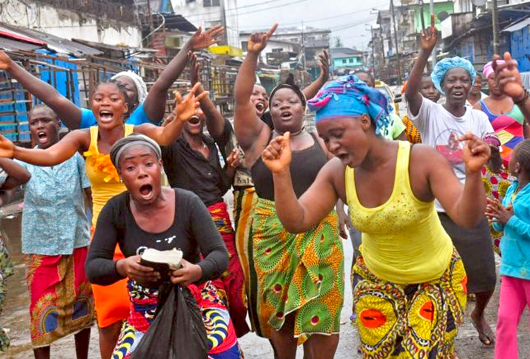
Celebration in Liberia slum as Ebola quarantine lifted

September 1, 2014

Ebola quarantine lifted

Monrovia/Conakry, Sep 1: Crowds sang and danced in the streets of a seaside neighborhood in Liberia on Saturday as the government lifted quarantine measures designed to contain the spread of the deadly Ebola virus.

Faced with the worst Ebola outbreak in history, West African governments have struggled to find an effective response. More than 1,550 people have died from the hemorrhagic fever since it was first detected in the forests of Guinea in March.

Residents of the impoverished seaside district of West Point in Monrovia were forcibly cut off from the rest of the capital in mid-August after a crowd attacked an Ebola center there, allowing the sick to flee.

The quarantine sparked protests and security forces responded with tear gas and bullets, killing a teenaged boy.

But at dawn on Saturday, the community woke up to find the soldiers and barricades gone.

"I tell God thank you. I tell everyone thank you," said Koffa, a female resident of West Point. Others danced in the streets chanting slogans like "we are free" while others rolled about on the asphalt pavement in celebration.

President Ellen Johnson-Sirleaf, a U.S.-educated Nobel Peace Prize winner, has sought to quell criticism of the government's response by issuing orders threatening officials with dismissal for failing to report for work or for fleeing the country, and has ordered an investigation into the West Point shooting.

Liberia, where infection rates are highest, plans to build five new Ebola treatment centers each with capacity for 100 beds, government and health officials said on Saturday.

In neighboring Sierra Leone, President Ernest Bai Koromo dismissed his health minister Miatta Kargbo on Friday over her handling of the epidemic which has killed more than 400 people there.

Her replacement Abubakarr Fofana on Saturday confirmed that a third doctor in the county had died from Ebola, further hampering its ability to respond to the outbreak.

"It is with a deep sense of sadness that we have lost one of our finest physicians in the line of duty at a time like when we need a lot of them to help in out fight against Ebola," he said.

Physician Dr. Sahr Rogers caught the disease while treating outpatients in the same hospital where a doctor died last month and where British nurse William Pooley was also infected.

SPREAD TO SENEGAL

Transmitted through the vomit, blood and sweat of the sick, Ebola has also spread to Nigeria and Senegal, which reported its first confirmed case on Friday - a Guinean student who was lost to authorities in his own country while under surveillance.

"His brother came from Sierra Leone where he was infected and has died. Shortly afterwards, this student left for Senegal," said Dr. Rafi Diallo, spokesman for the Guinean health ministry.

Two other members of his family - his sister and mother - have died from Ebola, Guinean health ministry sources said.

A resident in the suburb of the Senegalese capital Dakar where the student resided said on Saturday that a team of health ministry officials wearing white protective suits and masks came to spray disinfectant at his home and a local grocer's shop.

Many Dakar residents worry that the student could have spread the highly contagious virus in the three weeks since he was last reported in Guinea.

In Nigeria, where an infected traveler collapsed after arriving the Lagos airport, there have so far been 19 suspected, probable and confirmed cases and seven deaths.

"To avoid a situation like Nigeria, they need to be able to follow hundreds of contacts," said epidemiologist Jorge Castilla of the European Commission's Humanitarian Aid and Civil Protection Department in Dakar. "Whatever they do, there will probably be a second set of sick people as this guy has been here for some time."

Senegal has since closed its land border with Guinea and halted flights to Guinea, Sierra Leone and Liberia, defying advice from the World Health Organization (WHO) that there is no need for travel restrictions.

A note from the WHO and the International Civil Aviation Organization sent to health ministries on Aug. 29 said: "Lives are being unnecessarily lost because health care workers cannot travel to the affected countries, and delivery of life saving equipment and supplies is being delayed."

The World Food Programme said it needs to raise $70 million to feed 1.3 million people at risk from shortages in the Ebola-quarantined areas in West Africa, with the agency's resources already stretched by several major humanitarian crises.

Comments

Add new comment

  • Coastaldigest.com reserves the right to delete or block any comments.
  • Coastaldigset.com is not responsible for its readers’ comments.
  • Comments that are abusive, incendiary or irrelevant are strictly prohibited.
  • Please use a genuine email ID and provide your name to avoid reject.
News Network
January 25,2020

Beijing, Jan 25: The death toll due to the novel coronavirus (2019-nCoV) outbreak in China has soared to 41, while the number of infected persons were 1,287, the National Health Commission said on Saturday.

The Commission said that 444 fresh cases were reported since Friday, with 237 patients in serious conditions, while 38 had been cured and discharged from hospitals, reports Efe news.

Health authorities have carried out check-ups on 15,197 people who have come into close contact with the infected persons. Nearly 14,000 of them continue to be monitored for symptoms.

The others cases outside of China were reported in France (two), Australia (one), Thailand (four including two cured), Japan (two including one cured), South Korea (two), the US (two), Vietnam (two), Singapore (three), Nepal (one), Hong Kong (five), Macao (two) and Taiwan (three).

The symptoms of the new coronavirus, provisionally designated by the World Health Organization as 2019-nCoV, are similar to those of cold but may be accompanied by fever and fatigue, dry cough and dyspnea (shortness of breath).

The WHO has so far to declared the outbreak as an international health emergency.

Strict measures were being carried out in China, which include complete suspension of transport in around a dozen cities in Hubei province and also cancelling Chinese New Year celebrations.

Traditional events at Lama Temple and Ditan Park in Beijing were cancelled due to the risk of spreading the virus, authorities reported Friday, while the famous Forbidden City has also been closed indefinitely.

Wuhan, the capital of Hubei, where the virus was first reported, has been on lockdown since Thursday to prevent further spread of the virus and the city's authorities have begun to build a "special hospital" with 1,000 beds for infected patients.

"Construction of the special hospital with a capacity of 1,000 beds for patients with #nCoV2019 has begun in Wuhan," official China Daily said on Twitter.

The hospital in Wuhan will be based on the model of a similar facility that was built in just seven days in Beijing to deal with SARS in 2003.

Comments

Add new comment

  • Coastaldigest.com reserves the right to delete or block any comments.
  • Coastaldigset.com is not responsible for its readers’ comments.
  • Comments that are abusive, incendiary or irrelevant are strictly prohibited.
  • Please use a genuine email ID and provide your name to avoid reject.
News Network
May 21,2020

Canberra, May 21: Australian Prime Minister Scott Morrison and his Indian counterpart, Narendra Modi, are looking forward to deepening the countries' strategic relationship, with both sides expected to sign a range of pacts from defence to trade in strategic sectors amid heightened tensions with China over Beijing's response to coronavirus pandemic.

During a virtual summit, scheduled to take place on June 4, both leaders are expected to ramp up efforts to diversify Australia's export markets and find trusted suppliers of vital products and components, a local newspaper, The Australian reported on Tuesday.

The new agreements will focus on reliable supply chains in key strategic sectors, including medical goods, technology and critical minerals, amid heightened tensions with China over Beijing's response to coronavirus pandemic.

The leaders will seal a new defence agreement allowing reciprocal access to bases and co-operation on military technology projects, while a new education partnership will be on the table to help overcome Australian university reliance on Chinese students.

The talks in terms of strategic convergence, now have greater significance as COVID-19 exacerbates the strategic contest between the US and China, and forces like-minded countries to seek out reliable partners.

Australian farmers could also benefit, with talks underway on expanding agricultural exports to India, including barley, as China throws up new trade barriers, media reports stated.

The virtual summit follows the cancellation of Morrison's planned state visit to India in January due to the bushfires.

Morrison said last year, ahead of his planned visit, that India was "a natural partner for Australia", referring to the countries' "shared values" -- a point of differentiation with China.

Former Department of Foreign Affairs and Trade secretary Peter Varghese, who wrote a landmark report on the bilateral relationship in 2018, was quoted by the newspaper as saying that India would be even more important to Australia in the post-COVID world. "If one of the lessons from COVID is that countries need to spread their risk, then finding new markets or building up existing markets is a crucial part of that," he added.

Varghese noted that India, a member of the Quadrilateral Security Dialogue along with Australia, Japan and the US, was a vital strategic partner to Australia in helping "constrain China's ambitions to be the predominant power".

"That shared objective between Australia and India of not wanting to see the region dominated by China is a key component of building up our geopolitical relationship," he told The Australian.

The summit also follows recent talks between Australian Foreign Minister Marise Payne and Indian counterpart Subrahmanyam Jaishankar on the pandemic response and Australia's call for an independent inquiry, which was overwhelmingly backed at the World Health Assembly on Tuesday.

Australia wants to support India to develop a domestic critical minerals processing industry, which would provide Western nations with an alternative to sourcing the materials from China.

Meanwhile, India has strong expertise as a manufacturer of drugs and medical equipment, while Australia is a centre of biomedical research, opening the possibility for closer co-operation in the key sector, the media reported further.

Comments

Add new comment

  • Coastaldigest.com reserves the right to delete or block any comments.
  • Coastaldigset.com is not responsible for its readers’ comments.
  • Comments that are abusive, incendiary or irrelevant are strictly prohibited.
  • Please use a genuine email ID and provide your name to avoid reject.
News Network
February 6,2020

Washington, Feb 6: The US has expressed concern over the current situation of religious freedom in India and raised the issue with Indian officials, a senior State Department official has said.

The remarks came in the wake of widespread protests held across India against the Citizenship Amendment Act (CAA).

The senior State Department official, on condition of anonymity, said that he has met with officials in India about what is taking place in the nation and expressed concern.

"We are concerned about what's taking place in India. I have met with the Indian foreign minister. I've met with the Indian ambassador (to express my concern)," the official, who was recently in India, told reporters on Wednesday.

The US has also "expressed desire first to try to help and work through some of these issues", the official said as Secretary of State Mike Pompeo launched a 27-nation International Religious Freedom Alliance.

"To me, the initial step we try to do in most places is say what can we do to be of help you work through an issue to where there's not religious persecution. That's the first step, is just saying can we work with you on this," the official said.

India maintains that the Indian Constitution guarantees fundamental rights to all its citizens, including its minority communities.

It is widely acknowledged that India is a vibrant democracy where the Constitution provides protection of religious freedom, and where democratic governance and rule of law further promote and protect fundamental rights, a senior official of the Ministry of External Affairs has said.

According to the CAA, members of Hindu, Sikh, Buddhist, Jain, Parsi and Christian communities who have come from Pakistan, Bangladesh and Afghanistan till December 31, 2014 following religious persecution there will get Indian citizenship.

The Indian government has been emphasising that the new law will not deny any citizenship rights, but has been brought to protect the oppressed minorities of neighbouring countries and give them citizenship.

Defending the CAA, Prime Minister Narendra Modi last month said that the law is not about taking away citizenship, it is about giving citizenship.

"We must all know that any person of any religion from any country of the world who believes in India and its Constitution can apply for Indian citizenship through due process. There's no problem in that," he said.

Comments

Add new comment

  • Coastaldigest.com reserves the right to delete or block any comments.
  • Coastaldigset.com is not responsible for its readers’ comments.
  • Comments that are abusive, incendiary or irrelevant are strictly prohibited.
  • Please use a genuine email ID and provide your name to avoid reject.