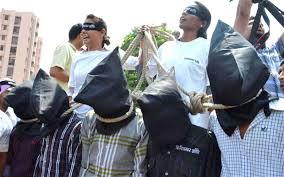
Centre asks states to implement SC order on death row convicts

February 4, 2014

New Delhi, Feb 4: The Centre today directed all states to take "urgent suitable action" in implementing the Supreme Court's guidelines for safeguarding the interest of the death row convicts.

In a communication, the Home Ministry said the court had examined several individual death row cases and commuted capital punishment of the petitioners to life imprisonment.death_row_convicts

"You are requested to take urgent suitable action for implementing the orders of the Supreme Court in your state/ Union Territories," Joint Secretary in the Home Ministry S Suresh Kumar said in the communication accessed by PTI.

The Ministry said the apex court had said legal aid should be provided to the convicts at all stages even after the rejection of mercy petition.

Hence, Superintendents of Jail are directed to intimate the rejection of mercy petitions to the nearest legal aid centre apart from intimating the convicts.

It said the convict has a constitutional right under Article 72 of the Constitution to make a mercy petition and hence the rejection of the mercy plea by the President should forthwith be communicated to the convict and his family in writing.

It would be mandatory for prison authorities to facilitate and allow a final meeting between the prisoner and his family and friends prior to his execution.

Following the hanging of Parliament attack case convict Afzal Guru about a year ago, his family members had complained that they were not informed in advance about his scheduled execution at Tihar Jail in Delhi.

The family had said they received the information only after his hanging, that too through the media.

Facing flak, the Home Ministry had claimed that they sent a letter to Guru's family in Kashmir through SpeedPost which the family received a few days after his execution.

Comments

Add new comment

  • Coastaldigest.com reserves the right to delete or block any comments.
  • Coastaldigset.com is not responsible for its readers’ comments.
  • Comments that are abusive, incendiary or irrelevant are strictly prohibited.
  • Please use a genuine email ID and provide your name to avoid reject.
News Network
May 7,2020

May 7: India is projected to record the highest number of births in the 9 months since COVID-19 was declared a pandemic in March, with more than 20 million babies expected to be born in the country between March and December, according to top UN body.

The United Nations Children's Fund (UNICEF) warned that pregnant mothers and babies born during the pandemic across the world were threatened by strained health systems and disruptions in services.

An estimated 116 million babies will be born under the shadow of COVID-19 pandemic, UNICEF said on Wednesday, ahead of Mother's Day, observed on May 10.

These babies are projected to be born up to 40 weeks after COVID-19 was recognised as a pandemic on March 11.

The highest numbers of births in the 9 months since the pandemic was declared are expected to occur in India, where 20.1 million babies are projected to be born between March 11 and December 16. Other countries with the expected highest numbers of births during this period are China (13.5 million), Nigeria (6.4 million), Pakistan (5 million) and Indonesia (4 million), it said.

"Most of these countries had high neonatal mortality rates even before the pandemic and may see these levels increase with COVID-19 conditions," UNICEF said.

It is estimated that there will be 24.1 million births in India for the January-December 2020 period.

UNICEF warned that COVID-19 containment measures can disrupt life-saving health services such as childbirth care, putting millions of pregnant mothers and their babies at great risk.

Even wealthier countries are affected by this crisis. In the US, the sixth-highest country in terms of the expected number of births, over 3.3 million babies are projected to be born between March 11 and December 16.

"New mothers and newborns will be greeted by harsh realities," UNICEF said, adding they include global containment measures such as lockdowns and curfews; health centres overwhelmed with response efforts; supply and equipment shortages; and a lack of sufficient skilled birth attendants as health workers, including midwives, are redeployed to treat COVID-19 patients.

"Millions of mothers all over the world embarked on a journey of parenthood in the world as it was. They now must prepare to bring a life into the world as it has become – a world where expecting mothers are afraid to go to health centres for fear of getting infected, or missing out on emergency care due to strained health services and lockdowns," UNICEF Executive Director Henrietta Fore said.

"It is hard to imagine how much the coronavirus pandemic has recast motherhood" Fore said.

UNICEF said its analysis was based on data from World Population Prospects 2019 of the UN Population Division.

An average full-term pregnancy typically lasts a complete 9 months, or 39 to 40 weeks. For the purposes of this estimate, the number of births for a 40-week period in 2020 was calculated.

The 40-week period of March 11 to December 16 is used in this estimate based upon the WHO's March 11 assessment that COVID-19 can be characterised as a pandemic.

UNICEF warned that although evidence suggests that pregnant mothers are not more affected by COVID-19 than others, countries need to ensure they still have access to antenatal, delivery and postnatal services.

Similarly, sick newborns need emergency services as they are at high risk of death. New families require support to start breastfeeding, and to get medicines, vaccines and nutrition to keep their babies healthy, it said.

"This is a particularly poignant Mother's Day, as many families have been forced apart during the coronavirus pandemic, but it is also a time for unity, a time to bring everyone together in solidarity. We can help save lives by making sure that every pregnant mother receives the support she needs to give birth safely in the months to come," Fore said.

Issuing an urgent appeal to governments and health care providers to save lives in the coming months, UNICEF said efforts must be made to help pregnant women receive antenatal checkups, skilled delivery care, postnatal care services, and care related to COVID-19 as needed.

Ensure health workers are provided with the necessary personal protective equipment and get priority testing and vaccination once a COVID-19 vaccine becomes available so that can deliver high quality care to all pregnant women and newborn babies during the pandemic, it said.

While it is not yet known whether the virus is transmitted from a mother to her baby during pregnancy and delivery, UNICEF advised all pregnant women to follow precautions to protect themselves from exposure to the virus.

Closely monitor themselves for symptoms of COVID-19 and seek advice from the nearest designated facility if they have concerns or experience symptoms. Pregnant women should also take the same precautions to avoid COVID -19 infection as other people: practice physical distancing, avoid physical gatherings and use online health services, it said.

UNICEF said even before COVID-19 pandemic, an estimated 2.8 million pregnant women and newborns died every year, or 1 every 11 seconds, mostly of preventable causes.

The agency called for immediate investment in health workers with the right training, who are equipped with the right medicines to ensure every mother and newborn is cared for by a safe pair of hands to prevent and treat complications during pregnancy, delivery and birth.


Comments

Add new comment

  • Coastaldigest.com reserves the right to delete or block any comments.
  • Coastaldigset.com is not responsible for its readers’ comments.
  • Comments that are abusive, incendiary or irrelevant are strictly prohibited.
  • Please use a genuine email ID and provide your name to avoid reject.
News Network
July 21,2020

New Delhi, Jul 21: The Centre has written to all states and union territories warning against the use of N-95 masks with valved respirator by people, saying these don't prevent the virus from spreading out and are "detrimental" to the measures adopted for its containment.

The Director-General of Health Services in the Ministry of Health, in a letter to the Principal Secretaries of health and medical education of states, said it has been observed that there is "inappropriate use" of N-95 masks, particularly those with valved respirator, by the public other than designated health workers.

The DGHS referred to the advisory on the use of homemade protective cover for face and mouth available on the website of the Ministry of Health.

"It is to bring to your knowledge that the use of valved respirator N-95 masks is detrimental to the measures adopted for preventing the spread of coronavirus as it does not prevent the virus from escaping out of the mask. In view of the above, I request you to instruct all concerned to follow the use of face/mouth cover and prevent inappropriate use of N-95 masks," DGHS Rajiv Garg said in the letter.

The government had in April issued an advisory on the use of homemade protective cover for face and mouth, asking people to wear it, particularly when they step out of their residences.

The advisory stressed such face covers must be washed and cleaned each day, as instructed and states that any used cotton cloth can be used to make this face cover. 

The colour of the fabric does not matter but one must ensure that the fabric is washed well in boiling water for five minutes and dried well before making the face cover. Adding salt to this water is recommended, it said.

It also listed the procedures of making such homemade masks, asking to ensure it fits the face well and there are no gaps on the sides.

It urges people to wash hands thoroughly before wearing the face cover,  switching to another fresh one as the face cover becomes damp or humid, and never reusing it after single use without cleaning it. 

"Never share the face cover with anyone. Every member in a family should have separate face cover," the advisory stated.

Comments

Add new comment

  • Coastaldigest.com reserves the right to delete or block any comments.
  • Coastaldigset.com is not responsible for its readers’ comments.
  • Comments that are abusive, incendiary or irrelevant are strictly prohibited.
  • Please use a genuine email ID and provide your name to avoid reject.
News Network
May 15,2020

New Delhi, May 15: Microsoft founder Bill Gates on Friday thanked Prime Minister Narendra Modi for the interaction and stressed that combating the coronavirus pandemic requires global collaboration.

"Thank you for the conversation and partnership PM Narendra Modi. Combating the pandemic requires global collaboration. India's role is key as the world works to minimize social and economic impact, and pave the way to vaccine, testing, and treatment access for all," Bill Gates said.

Prime Minister Narendra Modi on Thursday interacted with philanthropist and Microsoft co-founder Bill Gates and discussed the global response to Covid-19 and the importance of global coordination on scientific innovation to combat the pandemic.

The Prime Minister underlined the conscious approach that India has adopted in its fight against the health crisis - an approach based on ensuring public engagement through appropriate messaging, a PMO release said.

He explained how this people-centric bottom-up approach has helped win acceptability for physical distancing, respect for frontline workers, wearing of masks, maintaining proper hygiene, and respecting lockdown provisions.

They agreed that given India's willingness and capacity to contribute to global efforts, particularly for benefit of fellow developing countries, it was important for India to be included in the ongoing global discussions for coordinating responses to the pandemic.

The Prime Minister also suggested that the Gates Foundation could take the lead in analyzing the necessary changes in lifestyles, economic organisation, social behaviour, modes of disseminating education and healthcare, that would emerge in the post-Covid world, and the associated technological challenges that would need to be addressed.

He said that India would be happy to contribute to such an analytical exercise based on its own experiences.

Comments

Add new comment

  • Coastaldigest.com reserves the right to delete or block any comments.
  • Coastaldigset.com is not responsible for its readers’ comments.
  • Comments that are abusive, incendiary or irrelevant are strictly prohibited.
  • Please use a genuine email ID and provide your name to avoid reject.