


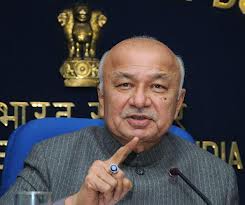
Centre looking at Gorkhaland model for Telangana?

[email protected] (J. Balaji, The Hindu)
January 22, 2013

shindeNew Delhi, Jan 22: Fearful that the splitting of Andhra Pradesh could create a cascading effect on other states, the UPA-II government is considering the creation of a Telangana Territorial Administration on the lines of Gorkhaland.

Informed sources pointed out that if that was the case, the Centre had to further amend Article 371 (D), which has already provided a special status for 10 backward districts of the Telangana region, and this could be done with the approval of two-thirds of Parliament strength.

The Centre may announce its decision on Telangana earlier than the January 28 deadline set by Union Home Minister Sushilkumar Shinde as he is scheduled to leave on a tour of Bangladesh on January 27. Without saying yes or no for Telangana, a middle path, such as the Gorkhaland model, might help the Centre as well as the Andhra Pradesh government buy peace in both the Telangana and Seemandhra regions of the State, and the Union government could qualify the decision stating that it would be on an experimental basis, the sources added.

Like Gorkhaland, the Telangana Territorial Administration, which could be formed without bifurcating Andhra Pradesh, might be an autonomous body with more financial and administrative powers and will be administered by an elected chief executive and members of the council.

By considering the Gorkhaland model for Andhra Pradesh, the Centre may unwittingly be able to douse the Gorkhaland demand. The Gorkhaland Territorial Administration in West Bengal has already warned the Centre of renewing its stir for a separate State. And the Centre believes that a separate state for Telangana may only add strength to the Gorkhaland agitation.

It may be recalled that the committee set up by the Centre to examine the demand for Telangana, headed by the former Supreme Court judge, Justice B.N. Srikrishna, had in its recommendations suggested that its sixth option “stands out as the best way forward” keeping the national perspective in mind.

The sixth option talks about keeping the State (Andhra Pradesh) united by simultaneously providing certain definite constitutional/statutory measures for the socio-economic development and political empowerment of the Telangana region — creation of a statutorily-empowered Telangana Regional Council.

“The united Andhra option is being suggested for continuing the development momentum of the three regions and keeping in mind the national perspective. With firm political and administrative management it should be possible to convey conviction to the people that this option would be in the best interest of all and would provide satisfaction to the maximum number of the people in the State.”

“It would also take care of the uncertainty over the future of Hyderabad as a bustling, educational, industrial and IT hub/destination. For management of water and irrigation resources on an equitable basis, a technical body, i.e., Water Management Board and an Irrigation Project Development Corporation in expanded role have been recommended. The above course of action should meet all the issues raised by Telangana people satisfactorily,” the Committee said in its report.

Of the 294 Assembly segments in Andhra Pradesh, 119 are located in the 10 districts of the Telangana region. Of the 42 Lok Sabha seats in the State, 17 are in the T-region.

Meanwhile, talking to The Hindu, Overseas Affairs Minister Vayalar Ravi, additional in charge of the Congress in Andhra Pradesh, said nothing on the separate State issue had been decided so far. “I told this clearly to a delegation of Congress Ministers, MPs and MLAs from the Seemandhra region when they met me demanding continuation of a united Andhra Pradesh. Similarly I am willing to meet the group from the Telangana regions too on Tuesday,” he said.

Seemandhra leaders led by Minister Shailajanath also called on senior Congress leader Digvijay Singh and Home Minister Sushil Kumar Shinde asking them not to divide A.P. at any cost.

Comments

Add new comment

  • Coastaldigest.com reserves the right to delete or block any comments.
  • Coastaldigset.com is not responsible for its readers’ comments.
  • Comments that are abusive, incendiary or irrelevant are strictly prohibited.
  • Please use a genuine email ID and provide your name to avoid reject.
Agencies
May 22,2020

Kochi, May 22: During the nationwide COVID-19 lockdown, Kerala recorded the highest number of cyber attacks followed by Punjab and Tamil Nadu, a study by anti-virus software firm K7 Computing said on Thursday.

In a statement issued in Chennai, the company said its K7 Computing's Cyber Threat Report, a comprehensive analysis of cyber attacks during the lockdown has found that Kerala recorded the highest number of cyber attacks during this period. The report analyses various cyber attacks within India during the pandemic and reveals that threat actors targeted the state with COVID-themed attacks aimed at exploiting user trust.

In Kerala, regions like Kottayam, Kannur, Kollam, and Kochi saw the highest hits with 462, 374, 236, and 147 attacks respectively, while the state as a whole saw around 2,000 attacks during the period - the highest thus far in the country.

This was followed by Punjab with 207 attacks and Tamil Nadu with 184 attacks, the company said.

The sudden surge in the frequency of attacks witnessed from February 2020 to mid-April 2020 indicates that scamsters across the world were exploiting the widespread panic around coronavirus at both the individual and corporate level.

These attacks aimed to compromise computers and mobile devices to gain access to users' confidential data, banking details, and cryptocurrency accounts.

The key threats seen during this period ranged from phishing attacks to rogue apps disguised as COVID-19 information apps that targeted users' sensitive data. Phishing attacks were noticed more in Tier-II and Tier-III cities while the metros fared better. Smaller cities saw over 250 attacks being blocked per 10,000 users.

Users from Ghaziabad and Lucknow seem to have faced almost 6 and 4 times the number of attacks as Bengaluru users.

According to the statement, a majority of the recorded attacks were phishing attacks with sophisticated campaigns that could easily snare even the most educated users. These attacks were aimed at heightening users' fears and creating a sense of urgency to take action.

K7 Labs noticed phishing attacks where scamsters posed as representatives of the United States Department of Treasury, the World Health Organization (WHO), and the Centres for Disease Control and Prevention (CDC), the company said.

Users were encouraged to visit links that would automatically download malware on the host computer such as the Agent Tesla keylogger or Lokibot information-stealing malware, infamous banking Trojans such as Trickbot or Zeus Sphinx, and even disastrous ransomware.

Other attacks included infected COVID-19 Android apps like CoronaSafetyMask that scam users with promises of masks for an upfront payment; the spyware app Project Spy; and seemingly genuine apps that are infected with dangerous malware like banking Trojans such as Ginp, Anubis and Cerberus.

"Covid-19 has created an ideal situation for various threat actors to target individuals and enterprises alike. The panic caused by the stringent lockdown measures and rapid spread of this virus has left many people looking for more information on the situation," J. Kesavardhanan, Founder and CEO of K7 Computing was quoted as saying in the statement.

"Threat actors exploit this fear to their advantage and scam users into downloading malicious software and divulging sensitive information like banking codes. The need to be cyber cautious has never been greater. This is more so in the case of corporates who have adopted a work from home policy hurriedly without adequate cyber hygiene. We have seen an increase in attacks on enterprises and SME employees as well," he added.

Such attacks are expected to continue till normalcy returns. Social engineering attacks targeted at winning users' trust will gain momentum.

Healthcare institutions, well-known government offices, and international organisations will continue to be a prime target throughout the pandemic, the statement said.

Comments

Add new comment

  • Coastaldigest.com reserves the right to delete or block any comments.
  • Coastaldigset.com is not responsible for its readers’ comments.
  • Comments that are abusive, incendiary or irrelevant are strictly prohibited.
  • Please use a genuine email ID and provide your name to avoid reject.
Agencies
February 6,2020

Washington D.C., Feb 6: An international team of astronomers has found an unusual monster galaxy that existed about 12 billion years ago when the universe was only 1.8 billion years old.

The team of astronomers was led by scientists at the University of California, Riverside.

Dubbed XMM-2599, the galaxy formed stars at a high rate and then died. Why it suddenly stopped forming stars is unclear.

"Even before the universe was 2 billion years old, XMM-2599 had already formed a mass of more than 300 billion suns, making it an ultra massive galaxy," said Benjamin Forrest, a postdoctoral researcher in the UC Riverside Department of Physics and Astronomy and the study's lead author.

"More remarkably, we show that XMM-2599 formed most of its stars in a huge frenzy when the universe was less than 1 billion years old and then became inactive by the time the universe was only 1.8 billion years old," Forrest added.

The team used spectroscopic observations from the W. M. Keck Observatory's powerful Multi-Object Spectrograph for Infrared Exploration or MOSFIRE, to make detailed measurements of XMM-2599 and precisely quantify its distance.

The study results appear in the Astrophysical Journal.

"In this epoch, very few galaxies have stopped forming stars, and none are as massive as XMM-2599," said Gillian Wilson, a professor of physics and astronomy at UCR in whose lab Forrest works.

"The mere existence of ultramassive galaxies like XMM-2599 proves quite a challenge to numerical models. Even though such massive galaxies are incredibly rare at this epoch, the models do predict them."

"The predicted galaxies, however, are expected to be actively forming stars. What makes XMM-2599 so interesting, unusual, and surprising is that it is no longer forming stars, perhaps because it stopped getting fuel or its black hole began to turn on. Our results call for changes in how models turn off star formation in early galaxies," the professor stated.

The research team found XMM-2599 formed more than 1,000 solar masses a year in stars at its peak of activity -- an extremely high rate of star formation. In contrast, the Milky Way forms about one new star a year.

"XMM-2599 may be a descendant of a population of highly star-forming dusty galaxies in the very early universe that new infrared telescopes have recently discovered," said Danilo Marchesini, an associate professor of astronomy at Tufts University and a co-author on the study.

"We have caught XMM-2599 in its inactive phase," Wilson said, who led the W. M. Keck Observatory data acquisition
Co-author Michael Cooper, a professor of astronomy at UC Irvine, said this outcome is a strong possibility.

"Perhaps during the following 11.7 billion years of cosmic history, XMM-2599 will become the central member of one of the brightest and most massive clusters of galaxies in the local universe," he said.

"Alternatively, it could continue to exist in isolation. Or we could have a scenario that lies between these two outcomes," he stated.

The study was supported by grants from the National Science Foundation and NASA.

Comments

Add new comment

  • Coastaldigest.com reserves the right to delete or block any comments.
  • Coastaldigset.com is not responsible for its readers’ comments.
  • Comments that are abusive, incendiary or irrelevant are strictly prohibited.
  • Please use a genuine email ID and provide your name to avoid reject.
Agencies
June 29,2020

New Delhi, Jun 29: Witnessing azure skies and breathable air for the last three months, Delhi on Monday recorded deterioration in its air quality, with particulate matter with diameter of 2.5 and 10 microns -- too small to be filtered out of the human body -- standing at 52 and 297 micrograms per cubic respectively.

Gufran Beig, Project Director of System of Air Quality Weather Forecasting and Research (SAFAR), said that the sudden spike in air pollution is due to a mild dust storm blowing from Rajasthan.

"Since the wind direction is changing and moist air is coming in, the air quality in Delhi will become better by tomorrow," Beig told IANS.

Central Pollution Control Board (CPCB) data showed that the overall air quality near Delhi Technical University (DTU) area stood at 326 micrograms per cubic, followed by 308 at Narela and 307 at Mundka.

Out of 36 stations, the AQI in as many as 30 stations was above 200 micrograms per cubic till 1 pm on Monday.

The System of Air Quality Weather Forecasting and Research categorises air quality in the 0-50 range as good, 51-100 as satisfactory, 101-200 as moderate, 201-300 as poor, 301-400 as very poor, and above 400 as severe.

According to SAFAR's website, "PM 10 (coarser dust particle) is the lead pollutant. AQI is likely to improve to moderate category by tomorrow, and further improvement is expected by July 1."

Researchers indicated that PM 10 and PM 2.5 will be 170 and 47 micrograms per cubic on Tuesday.

With no vehicles plying on the roads or industries shut due to the lockdown since March 25, Delhi's air quality had improved drastically.

According to a study conducted by the Indian Institute of Technology (IIT), Delhi, if the low levels of air pollution reached during the lockdown period are maintained, India's annual death toll could reduce by 6.5 lakh.

Comments

Add new comment

  • Coastaldigest.com reserves the right to delete or block any comments.
  • Coastaldigset.com is not responsible for its readers’ comments.
  • Comments that are abusive, incendiary or irrelevant are strictly prohibited.
  • Please use a genuine email ID and provide your name to avoid reject.