



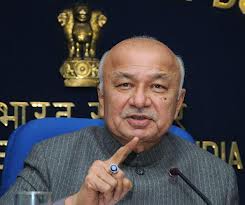
Centre looking at Gorkhaland model for Telangana?

[email protected] (J. Balaji, The Hindu)
January 22, 2013

shindeNew Delhi, Jan 22: Fearful that the splitting of Andhra Pradesh could create a cascading effect on other states, the UPA-II government is considering the creation of a Telangana Territorial Administration on the lines of Gorkhaland.

Informed sources pointed out that if that was the case, the Centre had to further amend Article 371 (D), which has already provided a special status for 10 backward districts of the Telangana region, and this could be done with the approval of two-thirds of Parliament strength.

The Centre may announce its decision on Telangana earlier than the January 28 deadline set by Union Home Minister Sushilkumar Shinde as he is scheduled to leave on a tour of Bangladesh on January 27. Without saying yes or no for Telangana, a middle path, such as the Gorkhaland model, might help the Centre as well as the Andhra Pradesh government buy peace in both the Telangana and Seemandhra regions of the State, and the Union government could qualify the decision stating that it would be on an experimental basis, the sources added.

Like Gorkhaland, the Telangana Territorial Administration, which could be formed without bifurcating Andhra Pradesh, might be an autonomous body with more financial and administrative powers and will be administered by an elected chief executive and members of the council.

By considering the Gorkhaland model for Andhra Pradesh, the Centre may unwittingly be able to douse the Gorkhaland demand. The Gorkhaland Territorial Administration in West Bengal has already warned the Centre of renewing its stir for a separate State. And the Centre believes that a separate state for Telangana may only add strength to the Gorkhaland agitation.

It may be recalled that the committee set up by the Centre to examine the demand for Telangana, headed by the former Supreme Court judge, Justice B.N. Srikrishna, had in its recommendations suggested that its sixth option “stands out as the best way forward” keeping the national perspective in mind.

The sixth option talks about keeping the State (Andhra Pradesh) united by simultaneously providing certain definite constitutional/statutory measures for the socio-economic development and political empowerment of the Telangana region — creation of a statutorily-empowered Telangana Regional Council.

“The united Andhra option is being suggested for continuing the development momentum of the three regions and keeping in mind the national perspective. With firm political and administrative management it should be possible to convey conviction to the people that this option would be in the best interest of all and would provide satisfaction to the maximum number of the people in the State.”

“It would also take care of the uncertainty over the future of Hyderabad as a bustling, educational, industrial and IT hub/destination. For management of water and irrigation resources on an equitable basis, a technical body, i.e., Water Management Board and an Irrigation Project Development Corporation in expanded role have been recommended. The above course of action should meet all the issues raised by Telangana people satisfactorily,” the Committee said in its report.

Of the 294 Assembly segments in Andhra Pradesh, 119 are located in the 10 districts of the Telangana region. Of the 42 Lok Sabha seats in the State, 17 are in the T-region.

Meanwhile, talking to The Hindu, Overseas Affairs Minister Vayalar Ravi, additional in charge of the Congress in Andhra Pradesh, said nothing on the separate State issue had been decided so far. “I told this clearly to a delegation of Congress Ministers, MPs and MLAs from the Seemandhra region when they met me demanding continuation of a united Andhra Pradesh. Similarly I am willing to meet the group from the Telangana regions too on Tuesday,” he said.

Seemandhra leaders led by Minister Shailajanath also called on senior Congress leader Digvijay Singh and Home Minister Sushil Kumar Shinde asking them not to divide A.P. at any cost.

Comments

Add new comment

  • Coastaldigest.com reserves the right to delete or block any comments.
  • Coastaldigset.com is not responsible for its readers’ comments.
  • Comments that are abusive, incendiary or irrelevant are strictly prohibited.
  • Please use a genuine email ID and provide your name to avoid reject.
News Network
January 27,2020

Mumbai, Jan 27: The country's largest car maker Maruti Suzuki India (MSI) on Monday said it has increased prices of select models by up to Rs 10,000 with immediate effect to offset the impact of rising input costs.

The price change varies across models and ranges up to 4.7 per cent (ex-showroom Delhi) and are effective from January, 27 2020, MSI said in a statement.

The price of entry level model Alto range has gone up in the range of Rs 9,000-6,000, S-Presso between Rs 1,500 to 8,000, WagonR between Rs 1,500 and Rs 4,000.

The company has also increased the price of its multi purpose vehicle Ertiga between Rs 4,000-10,000, Baleno by Rs 3,000 to 8,000 and XL6 by up to Rs 5,000 (all prices ex-showroom Delhi).

Currently, the company sells a range of vehicles starting from entry-level small car Alto to premium multi purpose vehicle XL6 with price ranging from Rs 2.89 lakh to Rs 11.47 lakh (ex-showroom Delhi).

Comments

Add new comment

  • Coastaldigest.com reserves the right to delete or block any comments.
  • Coastaldigset.com is not responsible for its readers’ comments.
  • Comments that are abusive, incendiary or irrelevant are strictly prohibited.
  • Please use a genuine email ID and provide your name to avoid reject.
Agencies
February 26,2020

New Delhi, Feb 26: With the government pushing for the disinvestment of Air India, industrial conglomerate Adani Group may emerge as one of the bidders for the debt-laden national carrier, sources said.

According to highly placed sources, the Group has held internal rounds of deliberations on whether or not to submit an Expression of Interest (EoI) and the discussions are still in the preliminary stage.

If the company actually submits an EoI, it would be a major move towards further diversification of the company which has business interests across sectors right from edible oil, food to mining and minerals. 

It also entered into airport operations and maintenance business and won bids for privatisation of six airports, Ahmedabad, Lucknow, Jaipur, Guwahati, Thiruvananthapuram and Mangaluru in 2019. 

On being contacted by IANS, the company did not comment on the matter.

Air India is one of the most important divestment proposals for the current fiscal to reach the huge Rs 2.1 lakh crore target.

The government in January restarted the divestment process of the airline and invited bids for selling 100 per cent of its equity in the state-owned airline, including Air India's 100 per cent shareholding in AI Express Ltd. and 50 per cent in Air India SATS Airport Services Private Ltd.

After its unsuccessful bid to sell Air India in 2018, the government this time has decided to offload its entire stake. In 2018, it had offered to sell its 76 per cent stake in the airline.

Of the total debt of Rs 60,074 crore as of March 31, 2019, the buyer would be required to absorb Rs 23,286 crore.

Air India, along with its subsidiary Air India Express, has a total operational fleet of 146 aeroplanes.

Further, the disinvestment department has extended the last date for submission of written queries on the Performance Information Memorandum and Share Purchase Agreement to March 6.

The last date for submission of written queries on PIM and SPA was originally set for February 11, following which the Department of Investment and Public Asset Management (DIPAM) on February 21 issued 20 clarifications on the queries raised and expected.

Any delay in the tentatively rolled out timeline would also delay DIPAM's plan to identify the pre-qualified bidders by March 31 and the financial bids invitation as well. It is expected to take more than two months after the selection of the pre-qualified bidders to complete Air India's sale.

Comments

Add new comment

  • Coastaldigest.com reserves the right to delete or block any comments.
  • Coastaldigset.com is not responsible for its readers’ comments.
  • Comments that are abusive, incendiary or irrelevant are strictly prohibited.
  • Please use a genuine email ID and provide your name to avoid reject.
Agencies
May 27,2020

Due to impacts of COVID-19, shipments of total mobile phones are forecast to decline 14.6% in 2020, while smartphone shipments will achieve a slightly slower decline of 13.7 % year over year to total 1.3 billion units this year, according to a Gartner forecast on Tuesday.

"While users have increased the use of their mobile phones to communicate with colleagues, work partners, friends and families during lockdowns, reduced disposable income will result in fewer consumers upgrading their phones," Ranjit Atwal, Senior Research Director at Gartner, said in a statement.

"As a result, phone lifetimes will extend from 2.5 years in 2018 to 2.7 years in 2020," said Atwal.

In 2020, affordable 5G phones were expected to be the catalyst to increase phone replacements, but now it is unlikely to be the case.

5G phones are now forecast to represent only 11% of total mobile phone shipments in 2020.

"The delayed delivery of some 5G flagship phones is an ongoing issue," said Annette Zimmermann, Research Vice President at Gartner.

"Moreover, the lack of 5G geographical coverage along with the increasing cost of the 5G phone contract will impact the choice of a 5G phone."

Overall, spending on 5G phones will be impacted in most regions apart from China, where continued investment in 5G infrastructure is expected, allowing providers in China to effectively market 5G phones.

The combined global shipments PCs, tablets and mobile phones are on pace to decline 13.6% in 2020, according to the forecast.

PC shipments are expected to decline 10.5% this year. Shipments of notebooks, tablets and Chromebooks are forecast to decline slower than the PC market overall in 2020.

"The forecasted decline in the PC market in particular could have been much worse," said Atwal.

"However, government lockdowns due to COVID-19 forced businesses and schools to enable millions of people to work from home and increase spending on new notebooks, Chromebooks and tablets for those workers. Education and government establishments also increased spending on those devices to facilitate e-learning."

Gartner said that 48 per cent of employees will likely work remotely at least part of the time after the COVID-19 pandemic, compared to 30 % pre-pandemic.

Overall, the work from home trend will make IT departments shift to more notebooks, tablets and Chrome devices for work.

"This trend combined with businesses required to create flexible business continuity plans will make business notebooks displace desk based PCs through 2021 and 2022," said Atwal.

Comments

Add new comment

  • Coastaldigest.com reserves the right to delete or block any comments.
  • Coastaldigset.com is not responsible for its readers’ comments.
  • Comments that are abusive, incendiary or irrelevant are strictly prohibited.
  • Please use a genuine email ID and provide your name to avoid reject.