



Champions Trophy: India settle for silver, lose 1-3 in controversial shootout to Australia

June 18, 2016

London, Jun 18: India muffed three tries in the title-deciding shootout to settle for a silver medal in the 36th Hero Champions Trophy as they lost the final 1-3 against world champions Australia, here on Friday.
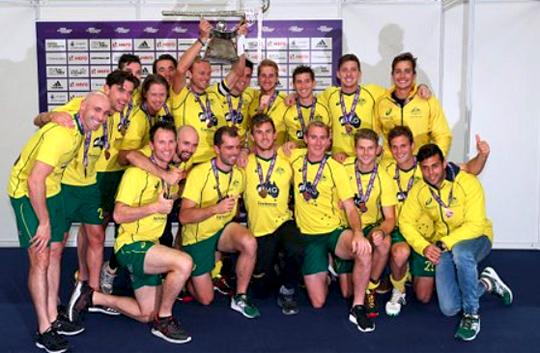
Champions

Only Harmanpreet Singh was able to score in the shootout, while SK Uthappa, SV Sunil and Surender Kumar all shot wide off the target. Just four attempts were required from the two teams as Australia had gained a winning 3-1 lead.

Aran Zalewski, Daniel Beale and Simon Orchard scored for Australia, while Trent Mitton's try was blocked by goalkeeper P.R. Sreejesh.

There was plenty of drama in the shootout as Beale's shot was re-taken after he failed to score and sought a video review. The video umpire asked the shot to be taken again, leaving Indian coach Roelant Oltmans fuming on the sidelines.

At the end of the match India protested against the second successful attempt awarded to Beale, delaying the final announcement on the result of the match.

The officials assembled to decide on India's appeal as trophies were removed from the ground and the fans also left the stadium.

After discussing the appeal for more than an hour, the jury declared that there was unintentional obstruction on part of Indian goalkeeper PR Sreejesh in the seventh second thus the re-take of the shot was justified.

The presentation ceremony was later held indoors.

Fancied Australia, looking for their 14th Champions Trophy title, faced a stiff fight from the Indians, who were playing their first final, but raised the level to come within striking distance of the title.

Australia wasted a penalty stroke in the second quarter and India failed to capitalise on their superiority in numbers when Australia were down to nine men for a short while in the third quarter.

India's lone previous medal in the Champions Trophy came 34 years ago, when they got a bronze at Amsterdam in 1982. India made the first foray into the circle in the ninth minute when Mandeep Singh broke in from the right flank and his shot rebounded off Australian goalkeeper Andrew Charter.

The ball went to Uthappa, who had the opportunity to have a measured crack at the goal, but sent a rushed reverse-hit wide to the right.

In the next minute, Australia laid seize on the Indian citadel through four successive penalty corners, but goalkeeper Sreejesh brought off two fine saves. In the end, it was defender Surender Kumar who rushed out to block the penalty corner flick and the ball went out of the circle.
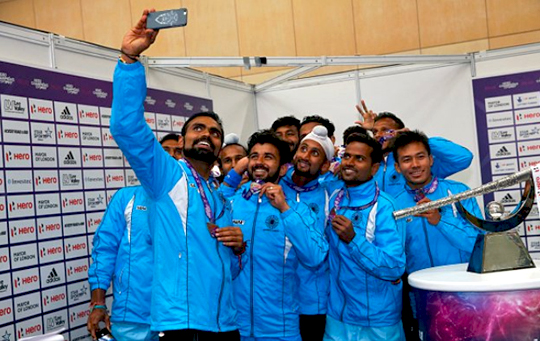
Champions1

Talwinder Singh exchanged passes with Nikkin Thimmaiah and went into the circle from left, but he got into a very narrow angle and posed no danger as he shot straight into the goalkeeper's pads.

India forced two consecutive penalty corners in the 13th minute, but goalkeeper Charter averted danger by palming away V.R. Raghunath's rising flick.

Australia got a penalty stroke three minutes into the second quarter when Glenn Turner's shot during a penalty corner hit defender Pradeep Mor's foot. The umpire immediately signalled for a penalty stroke, although the ball slowly trickled over the goalline.

Blake Govers failed to convert the penalty stroke as he flicked wide to the left and India survived the anxious moment.

Indian defender Raghunath was quick to cover some ground when unmarked Govers got a ball on top of the Indian circle in the 24th minute. Raghunath deflected out the reverse hit.

Goalkeeper Sreejesh then made another good save on a penalty corner shot before India mounted a raid after a long time on a quick counter, but only for Akashdeep Singh to send a wayward pass from top of the rival circle.

Both teams were down to 10 men for a while in the second quarter when Indian defender Pradeep and Australia's Beale were sent off following a stiff tackle.

Harmanpreet could not make the third Indian penalty corner count in the 29th minute and the title encounter remained goalless at half-time.

Raghunath's quick diagonal forward pass following an Australian penalty corner in the 37th minute saw India surge forward. The Indian strikers switched the ball around to find a leeway past the opposition defenders, who held their ground grimly.

India had a brief period of territorial dominance in the third quarter, mounting three raids into the circle and also forcing two penalty corners in as many minutes. The penalty corners did not pose a threat as the ball was not stopped on the first occasion and the feeble shot was easily cleared on the next one.

India failed to capitalise when they had an advantage in numbers as Australia were down to nine men in the third quarter with Matthew Swann and Trent Mitton shown green cards in quick succession.

At the start of the fourth quarter, Akashdeep Singh took a reverse shot from top of the circle that got palmed away by the custodian. Australian defender Matt Dawson was sent off with a yellow card in the 50th minute for a deliberate foul on Indian winger Sunil and they had to play the last 10 minutes with 10 players.

Again, India failed to capitalise from an extra player on the pitch, and the advantage was negated with three minutes remaining as Indian player Thimmaiah also had a yellow card flashed at him.

Comments

ABDUL BASHEER …
 - 
Saturday, 18 Jun 2016

CONGRATULATION...to INDIAN HOCKEY TEAM.......the best performance......

Add new comment

  • Coastaldigest.com reserves the right to delete or block any comments.
  • Coastaldigset.com is not responsible for its readers’ comments.
  • Comments that are abusive, incendiary or irrelevant are strictly prohibited.
  • Please use a genuine email ID and provide your name to avoid reject.
News Network
February 9,2020

Potchefstroom, Feb 9: Defending champions India are overwhelming favourites to win a record fifth U19 World Cup title on Sunday but a tough fight is expected from first-timers Bangladesh in an all-Asian final.

If the India squad for the 2018 edition had the likes of Prithvi Shaw and Shubman Gill, who have expectedly gone on to play for the senior team, the exploits of opener Yashasvi Jaiswal, spinner Ravi Bishnoi and pacer Kartik Tyagi in the current edition have made them overnight stars.

Irrespective of what happens in the final, India have reinforced the fact that they are undisputed leaders at the under-19 level and the cricketing structure the BCCI has developed is working better than any other board in the world.

India, who walloped arch-rivals Pakistan by 10 wickets in the semifinal Tuesday, will be playing their seventh final since 2000 when they lifted the trophy for the first time.

Having said that, success at the U-19 level doesn’t guarantee success at the highest level as not all players have the ability to go on and play for India. Some also lose their way like Unmukt Chand did after leading India to the title in 2012.

His career promised so much back then but now it has come to a stage where he is struggling to make the eleven in Uttarakhand’s Ranji Trophy team, having shifted base from Delhi last year.

Only the exceptionally talented like Shaw and Gill get to realise their dream as the competition is only getting tougher in the ever-improving Indian cricket.

India probably is the only side which fields a fresh squad in every U-19 World Cup edition and since there is no dearth of talent and a proper structure is in place, the talent keeps coming up.

“The fact that we allow a cricketer to play the U-19 World Cup only once is a big reason behind the team’s success. While most teams have cricketers who have played in the previous edition,” India U-19 fielding coach Abhay Sharma said from Potchefstroom.

“It just goes to show that the system under the visionary leadership of Rahul Dravid (NCA head) is flourishing. Credit to BCCI as well that other teams want to follow our structure.”

Heading to the mega event, India colts played about 30-odd games in different part of the world. To get used to the South African conditions, they played a quadrangular series before they played their World Cup opener against Sri Lanka.

In the final, India run into Bangladesh, a team which too has reaped the benefits of meticulous planning since their quarterfinal loss at the 2018 edition.

Though the Priyam Garg-led Indian side got the better of them in the tri-series in England and Asia Cup last year, Bangladesh has always come up with a fight and fielding coach Sharma expects it would be no different Sunday.

They are a very good side. There is a lot of mutual respect. I can tell you that,” he said.

Considering it is their maiden final, it is a bigger game for Bangladesh. If they win, it will be sweet revenge against the sub-continental giants, who have found a way to tame Bangladesh at the senior level in close finals including the 2018 Nidahas Trophy and 2016 World T20.

“We don’t want to take unwanted pressure. India is a very good side. We have to play our ‘A’ game and do well in all three departments. Our fans are very passionate about their cricket. I would want to tell them, keep supporting us,” said Bangladesh skipper Akbar Ali after their semifinal win over New Zealand.

Comments

Add new comment

  • Coastaldigest.com reserves the right to delete or block any comments.
  • Coastaldigset.com is not responsible for its readers’ comments.
  • Comments that are abusive, incendiary or irrelevant are strictly prohibited.
  • Please use a genuine email ID and provide your name to avoid reject.
Agencies
May 31,2020

London, May 31: "Jacques Kallis, Sachin Tendulkar, Virat Kohli," replied umpire Ian Gould when he was asked to name the three best batsmen he loved watching when he was officiating as an umpire.

The former ICC elite umpire said that he was unlucky to not watch Ponting bat as much as he would have liked to.

"Jacques Kallis. I loved watching Jacques. He was a very, very fine player. Sachin. And probably Virat. I was unlucky in some respects. I didn't see the best of Ricky Ponting. He was an outstanding character, outstanding captain, such a proud Australian," ESPNCricinfo quoted Gould as saying.

"But his career was just starting to wane as I came on the scene. But he was incredibly helpful, so I'm disappointed I have to leave him out. Jacques Kallis, I could sit and watch all day, Virat, the same. And Sachin, if you want someone to bat for your life, he was the man," he added.

Gould had retired from the ICC's panel of elite umpires in 2019, after standing in more than 250 international matches over a 13-year career.

Over the years, comparisons between Kohli and Sachin Tendulkar have been growing and many have picked the current Indian skipper to break the records set by Tendulkar.

Tendulkar called time on his career after registering 100 international centuries, while Kohli has 70 centuries across all formats.

While, Kallis played 166 Tests, 328 ODIs and 25 T20Is for South Africa and he is often viewed as the greatest all-rounder the game has seen.

Many pundits of the game find it hard to pick between him and Sir Garfield Sobers.

Across his career, Kallis scored 25,534 runs in his career and he also managed to take 577 wickets.

Comments

Add new comment

  • Coastaldigest.com reserves the right to delete or block any comments.
  • Coastaldigset.com is not responsible for its readers’ comments.
  • Comments that are abusive, incendiary or irrelevant are strictly prohibited.
  • Please use a genuine email ID and provide your name to avoid reject.
News Network
January 17,2020

Jan 17: Indian tennis ace Sania Mirza cruised into the women's doubles final of the Hobart International with her Ukrainian partner Nadiia Kichenok here on Friday.

Sania and Kichenok sailed past the Slovenian-Czech pair of Tamara Zidansek and Marie Bouzkova 7-6 (3) 6-2 in the semifinal contest that lasted one hour and 24 minutes.

The fifth-seeded Indo-Ukrainian combination will lock horns with second seeds Shuai Peng and Shuai Zhang of China. The Chinese pair got a walkover after Belgium's Kirsten Flipkens and Alison Van Uytvanck conceded the other semifinal match because of injury.

While Sania and Kichenok had to fight hard in the opening set, the second set was a cakewalk for the combination.

The first set was a tough contest between the two pairs, bringing the tie-breaker into the equation after it was level at 6-6.

In the tie-breaker, Sania and Kichenok upped their game by a few notches to outsmart their opponents and take the lead.

The second set was a no-contest as Saina and Kichenok broke their opponents thrice -- in the second, sixth and eighth game -- to easily pocket the set and a place in the summit clash.

Saina and Kichenok got 11 break chances out of which they converted four, while their opponents utilised two out of the five break chances that came their way.

The 33-year-old Sania is returning to the WTA circuit after two years. During her time away from the game, she battled injury breakdowns before taking a formal break in April 2018 to give birth to her son Izhaan. She is married to Pakistani cricketer Shoaib Malik.

Before the ongoing event, Sania last played at China Open in October 2017.

A trailblazer in Indian tennis, Sania is a former world No.1 in doubles and has six Grand Slam titles to her credit.

She retired from the singles competition in 2013 after becoming the most successful Indian woman tennis player.

Comments

Add new comment

  • Coastaldigest.com reserves the right to delete or block any comments.
  • Coastaldigset.com is not responsible for its readers’ comments.
  • Comments that are abusive, incendiary or irrelevant are strictly prohibited.
  • Please use a genuine email ID and provide your name to avoid reject.