



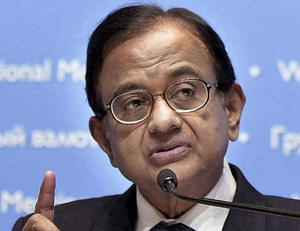
Chidambaram hits out at BJP, Narendra Modi at Davos

January 22, 2014

ChidambaramDavos, Jan 22: As India prepares for elections, Finance Minister P Chidambaram today hit out at BJP terming its economic policies as retrograde and "blood-eyed" and asked why the Opposition Party's Prime Ministerial candidate Narendra Modi never fielded a Muslim candidate.

He also expressed confidence that Rahul Gandhi would be Prime Minister if Congress comes back to power, saying the young leader as enough "fire in his belly" for the post, although it was unlikely that any party would get majority and polls were likely to throw a "very very fractured mandate".

Speaking at the World Economic Forum (WEF) Annual Meeting here, Chidambaram also took dig at Aam Aadmi Party, saying there was no place for mob-democracy in India and the country was a party-based democracy where individuals can not be bigger than a party.

On BJP being anti-muslim, Chidambaram said some sections of Muslim people may have voted for BJP, as Narendra Modi himself claims, but the fact is that Modi has never fielded any Muslim candidate ever in any election in his state. "What does that mean," he wondered.

When asked why doesn't he join BJP, Chidambaram said BJP does not represent all sections of India and it does not even have presence in many parts of the country."It has got policies that would destroy the very idea of India. Their's a blood-eyed economic model," he said.

Asked about the next Prime Minister, Chidambaram said, "nothing is impossible, but it is unlikely because Congress party is clear that if Congress is in position to form a government it will be headed by Rahul Gandhi".

In 2004 Sonia Gandhi was elected leader, but the next day she declined and another leader was chosen. That model has worked, but that does not mean that we will have same model again, he said.

"If Congress is called to form the government, I'm pretty certain in my mind that Rahul Gandhi will be the Prime Minister," he said.

Asked whether Rahul Gandhi had enough fire in his belly for the PM post, Chidambaram said: "There was enough fire in his belly when he spoke at the AICC meeting".

On upcoming general elections, Chidambaram said it may be an unfortunate event that no party is a clear winner and no one gets majority, as the elections are likely to throw a very fractured mandate.

Meanwhile, the Finance Minister said that unravelling of AAP has already begun within weeks of it coming to power in Delhi and it remains to be seen whether an "urban rejection" of mainstream parties that was seen in Delhi elections would be replicated in other parts of the country.

"One time that Mrs Gandhi stumbled and brought in an authoritative model that was at the time of Emergency, it failed and she had to go back," Chidambaram said.

In Delhi elections the rejection was for both Congress and BJP, he said, adding that one was ruling the state government and the other municipal bodies.

"But it is just a few weeks and we are seeing an unravelling of the Aam Aadmi Party," he said.

Saying that he was not privy to discussions in the state party unit regarding support to AAP, Chidambaram said Congress party was divided in its decision to give outside support to AAP and it was one section favouring the support that prevailed.

Responding to a query on how BJP can be described as following 'blood-eyed' economic model when factories were not being destroyed in Gujarat and businessmen were happy, Chidambaram said it is not about destroying factories.

Giving examples, he said that BJP is opposing multi brand retail on premise that it would kill jobs, while the fact was just the opposite.

Comments

Add new comment

  • Coastaldigest.com reserves the right to delete or block any comments.
  • Coastaldigset.com is not responsible for its readers’ comments.
  • Comments that are abusive, incendiary or irrelevant are strictly prohibited.
  • Please use a genuine email ID and provide your name to avoid reject.
News Network
April 16,2020

United Nations, Apr 16: WHO chief Tedros Adhanom Ghebreyesus has welcomed the world health body's cooperation with India to leverage strategies that helped the country win its war against polio into the response to COVID-19 outbreak, saying such joint efforts will help defeat the pandemic.

The World Health Organization (WHO) has said it will work with India's Ministry of Health and Family Welfare to leverage the strategies that helped the country eradicate polio to fight the pandemic.

Migrants who returned to UP and Bihar were hurriedly housed in schools and panchayat buildings, which were turned into quarantine centres. However, unhygienic conditions and people running away have proved to be a problem

The WHO's national polio surveillance network will be engaged to strengthen COVID-19 surveillance and its field staff will continue to support immunization and elimination of tuberculosis and other diseases.

“Great news: @MoHFW_INDIA & @WHOSEARO initiated a systematic engagement of @WHO's national polio surveillance network, and other field staff, for India's #COVID19 response, tapping into the best practices & resources that helped win its war against polio,” the WHO director-general tweeted, referring to India's Ministry of Health and Family Welfare and World Health Organization Regional Office for South-East Asia.

According to the Johns Hopkins University data, over 2 million people are infected by the virus and more than 136,000 people have died of the disease globally.

Ghebreyesus expressed gratitude to Health and Family Welfare Minister Harsh Vardhan “for his leadership and collaboration” with WHO. “Through these joint efforts we can defeat the #coronavirus and save lives. Together!”

India eliminated polio in 2014.
According to a WHO press release, Vardhan said in New Delhi that “time and again the Government of India and WHO together have shown our ability, competence and prowess to the whole world. With our combined meticulous work, done with full sincerity and dedication, we were able to get rid of polio.”

“All of you in the field – IDSP (Integrated Disease Surveillance Project), state rapid response teams and WHO - are our ‘surveillance corona warriors'. With your joint efforts we can defeat the coronavirus and save lives,” Vardhan added.

WHO South-East Asia Regional Director Poonam Khetrapal Singh said the National Polio Surveillance Project (WHO-NPSP) played a critical role in strengthening surveillance for polio that generated useful, timely and accurate data to guide policies, strategies and interventions until transmission of the poliovirus was interrupted in the country,” adding that the other WHO field staff involved with elimination of tuberculosis and neglected tropical diseases and hypertension control initiative were also significant resources.

Singh added that “it is now time to use all your experience, knowledge and skills, with the same rigor and discipline that you showed while monitoring polio activities, to support districts with surveillance, contact tracing and containment activities.”

The WHO release said strengths of the NPSP team – surveillance, data management, monitoring and supervision, and responding to local situations and challenges – will be utilized to supplement efforts of National Centre for Disease Control, IDSP and Indian Council of Medical Research to strengthen COVID-19 surveillance.

The NPSP team will also support in sharing information and best practices and help states and districts calibrate their response based on transmission scenarios and local capacities.

The WHO field staff will continue to support immunization and surveillance and elimination of Tuberculosis and Neglected Tropical Diseases, Singh said, adding, “disease outbreaks can negatively impact progress in a range of areas, from maternal and child mortality to vaccine-preventable diseases and other treatable conditions. India had been making stupendous progress in these areas and we cannot afford for India's remarkable progress to be set back or reversed.”

Comments

Add new comment

  • Coastaldigest.com reserves the right to delete or block any comments.
  • Coastaldigset.com is not responsible for its readers’ comments.
  • Comments that are abusive, incendiary or irrelevant are strictly prohibited.
  • Please use a genuine email ID and provide your name to avoid reject.
News Network
January 22,2020

Jan 22: India's ranking in the latest global Democracy Index has dropped 10 places to the 51st spot out of 167 owing to violent protests and threats to civil liberties challenging freedoms across the country.

Prime Minister Narendra Modi's government has been criticized by rights groups and western governments after shutting off the internet and mobile phone networks and detaining opposition politicians in Kashmir.

Modi’s government has also responded harshly to ongoing protests against a controversial, religion-based citizenship law. Muslims have said their neighborhoods have been targeted, while the central government has attempted to ban protests and urged TV news channels not to broadcast “anti-national” content. Some leaders in Modi’s ruling party called for “revenge” against protesters. India’s score in 2019 was its worst ranking since the EIU’s records began in 2006, and has fallen gradually since Modi was elected in 2014.

The Economist Intelligence Unit’s 2019 Democracy Index, which provides an annual comparative analysis of political systems across 165 countries and two territories, said the past year was the bleakest for democracies since the research firm began compiling the list in 2006.

“The 2019 result is even worse than that recorded in 2010, in the wake of the global economic and financial crisis,” the research group said in releasing the report on Wednesday.

The average global score slipped to 5.44 out of a possible 10 -- from 5.48 in 2018 -- driven mainly by “sharp regressions” in Latin America, Sub-Saharan Africa, the Middle East and North Africa. Apart from coup-prone Thailand, which improved its score after holding an election last year, there were also notable declines in Asia after a tumultuous period of protests and new measures restricting freedom across the region’s democracies.

Asia Declines

Hong Kong, meanwhile, fell three places to rank 75th out of 167 as more than seven months of violent and disruptive protests rocked the Asian financial hub. An aggressive police response early in the unrest, when protests were mostly peaceful, led to a “marked decline in confidence in government -- the main factor behind the decline in the territory’s score in our 2019 index,” the group said.

In Singapore, which ranked alongside Hong Kong at 75th, a new “fake news” law led to a deteriorating score on civil liberties.

“The government claims that the law was enacted simply to prevent the dissemination of false news, but it threatens freedom of expression in Singapore, as it can be used to curtail political debate and silence critics of the government,” EIU analysts said.

China’s score fell to just 2.26 in the EIU’s ranking, placing it near the bottom of the list at 153, as discrimination against minorities, repression and surveillance of the population intensified. Still, in China “the majority of the population is unconvinced that democracy would benefit the economy, and support for democratic ideals is absent,” the EIU said.

Comments

Add new comment

  • Coastaldigest.com reserves the right to delete or block any comments.
  • Coastaldigset.com is not responsible for its readers’ comments.
  • Comments that are abusive, incendiary or irrelevant are strictly prohibited.
  • Please use a genuine email ID and provide your name to avoid reject.
News Network
June 24,2020

New Delhi, Jun 24: A litre of diesel on Wednesday was more expensive than a litre of petrol after the price of the former was hiked by 48 paise on the 18th successive day of fuel price revisions. While petrol price remained unchanged for the first time since June 7, diesel prices maintained upward trajectory to touch new highs.

It is for the first time in Delhi that diesel has become more expensive than petrol. A litre of the fuel now costs ₹79.88 as against ₹79.76 for a litre of petrol, as per a report in news agency ANI.

While surging fuel prices may generate much-needed revenue for governments, it would also have a detrimental impact on household budgets. The spike in diesel prices also has a wider impact on the transport and agricultural sectors which are largely dependent on the fuel.

The widest gap between the prices of the two fuels was on June 18 of 2012 when a litre of petrol was at ₹71.16 in Delhi while diesel was at ₹40.91. On June 28, the gap between the two fuels was 31.17 per litre in Mumbai. Around that time, there was a spurt in sales of diesel passenger vehicles while demand for such vehicles has come down significantly in current times. This has also led many manufacturers to ditch diesel engines completely.

The current trend of fuel price hikes are unlikely to do demand for petrol vehicles much good either.

Daily price revisions of the two fuel had been temporarily halted for 83 days till it was resumed on June 7.

India's demand for fuel doubled in May and has been steadily rising in June with the easing of restrictions. Indian refineries have already scaled up crude processing with Indian Oil Corp, the country's top refiner, looking to operate its plants at about 90% capacity in June.

The rising fuel prices, however, have resulted in political uproar with Congress leading the charge against the central government and accusing it of penalising consumers by imposing high taxes. A demand for including fuel prices under Goods and Services Tax (GST) has also been renewed by many but it is highly unlikely that it would happen. With oil companies looking to cut back on their previous loses and governments - central as well as states - aiming to generate revenue after tumultous weeks of lockdown, fuel price hikes are likely to stay till at least the end of June.

Comments

Add new comment

  • Coastaldigest.com reserves the right to delete or block any comments.
  • Coastaldigset.com is not responsible for its readers’ comments.
  • Comments that are abusive, incendiary or irrelevant are strictly prohibited.
  • Please use a genuine email ID and provide your name to avoid reject.