



IS chief Baghdadi escapes Iraqi Army's final assault: UK

November 4, 2016

London, Nov 4: Islamic State's reclusive chief Abu Bakr al-Baghdadi has escaped from the terrorist group's stronghold of Mosul as the Iraqi Army advanced for a final assault, British foreign secretary Boris Johnson said today.is
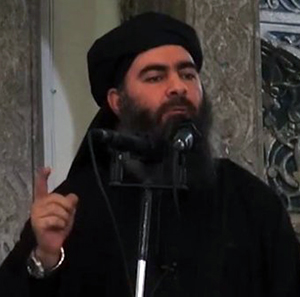
He said western intelligence sources believe Baghdadi is no longer in Mosul, The Guardian reported.

Baghdadi yesterday broke his year-long silence and issued an audio recording, urging his jihadists to continue their fight to the end in Mosul, where he was believed to be hiding.

Johnson, in an unusual reference to intelligence, said Baghdadi's audio recording was "cruelly ironic since some of the intelligence we have suggests he had himself vacated the scene and is yet using internet media to encourage others to take part in violence."

The battle for Mosul was expected to end in a decisive defeat for the terrorist group, but Baghdadi's escape is likely to complicate matters for Iraqi and coalition forces.

Johnson said the recapture of Mosul, in the face of IS's "scorched earth campaign", would take time and represented "the coalition's greatest challenge", according to the report.

If Baghdadi, who surprised the world by establishing the caliphate after capturing Mosul in June 2014, were to be killed, IS would have to choose a new caliph, but no successor would have the authority and prestige of the reclusive leader.

There is widespread concern that, despite a year of planning, there is little agreement among the many ethnic groups in the region on the future political structure of Mosul or the surrounding Nineveh province.

Giving an update to British parliament on the fight against IS, Johnson also said efforts were under way to prevent sectarian violence being unleashed as the group was ousted from Mosul and surrounding towns such as Tal Afar.

He said 30,000 civilians had fled the city and the UN had plans in place for as many as 90,000 refugees. But he accepted there were also reports that citizens would be used as human shields to raise the human cost of Iraqi Army incursions deeper into the city.

Mosul is a multi-ethnic city, but the large Sunni population is fearful that liberation will lead to massacres by Shia militias determined to take reprisals against those who collaborated with IS.

The anti-IS offensive is dependent on US-led air strikes and the presence of US special forces.

Comments

Wellwisher
 - 
Saturday, 5 Nov 2016

No strange, where he will escape, his God fathers
Israel,americans taken him to their HQ for their next target.
But all things observed by one for final justice.
Long Live Mankind.

Add new comment

  • Coastaldigest.com reserves the right to delete or block any comments.
  • Coastaldigset.com is not responsible for its readers’ comments.
  • Comments that are abusive, incendiary or irrelevant are strictly prohibited.
  • Please use a genuine email ID and provide your name to avoid reject.
News Network
April 10,2020

Melbourne, Apr 10: Scientists have identified six drug candidates from more than 10,000 compounds that may help treat COVID-19.

The research, published in the journal Nature, tested the efficacy of approved drugs, drug candidates in clinical trials and other compounds.

"Currently there are no targeted therapeutics or effective treatment options for COVID-19," said Professor Luke Guddat from the University of Queensland in Australia.

"In order to rapidly discover lead compounds for clinical use, we initiated a programme of high-throughput drug screening, both in laboratories and also using the latest computer software to predict how different drugs bind to the virus," Guddat said.

The project targeted the main COVID-19 virus enzyme, known as the main protease or Mpro, which plays a pivotal role in mediating viral replication, the researchers said.

This makes it an attractive drug target for this virus, and as people don't naturally have this enzyme, compounds that target it are likely to have low toxicity, they said.

"We add the drugs directly to the enzyme or to cell cultures growing the virus and assess how much of each compound is required to stop the enzyme from working or to kill the virus. If the amount is small, then we have a promising compound for further studies," said Guddat.

After assaying thousands of drugs, researchers found of the six that appear to be effective in inhibiting the enzyme, one is of particular interest.

"We're particularly looking at several leads that have been subjected to clinical trials including for the prevention and treatment of various disorders such as cardiovascular diseases, arthritis, stroke, atherosclerosis and cancer," Guddat said.

Researchers said compounds that are already along the pipeline to drug discovery are preferred, as they can be further tested as antivirals at an accelerated rate compared to new drug leads that would have to go through this process from scratch.

"With continued and up-scaled efforts we are optimistic that new candidates can enter the COVID-19 drug discovery pipeline in the near future," Guddat said.

Comments

Add new comment

  • Coastaldigest.com reserves the right to delete or block any comments.
  • Coastaldigset.com is not responsible for its readers’ comments.
  • Comments that are abusive, incendiary or irrelevant are strictly prohibited.
  • Please use a genuine email ID and provide your name to avoid reject.
Agencies
January 12,2020

Washington, Jan 12: The US State Department has described the recent visit of envoys of 15 countries to Jammu and Kashmir as an "important step" but expressed concern over the continued detention of political leaders and restrictions on internet in the region.

Alice Wells, the Acting Assistant Secretary of State for South Asia, tweeted on Saturday that she was "closely following" the visit of the envoys to Kashmir, describing it an "important step".

Wells, who will be visiting India this week, added: "We remain concerned by detention of political leaders and residents and Internet restrictions. We look forward to a return to normalcy."

The group of diplomats made a two-day visit to the Union Territory on Thursday and Friday to see the conditions thereafter Jammu and Kashmir's special constitutional status was removed last August.

While some US politicians and media have criticised the action by Prime Minister Narendra Modi's government, the US has officially appeared to support the abrogation of the Constitution's Article 370 on the special status.

Last October, Wells told the House of Representatives Subcommittee on Asia and the Pacific that the State Department supported the objectives behind it, while not directly mentioning the abrogation.

"The Indian government has argued that its decision on Article 370 was driven by a desire to increase economic development, reduce corruption, and uniformly apply all national laws in Jammu and Kashmir, particularly in regard to women and minorities.

"While we support these objectives, the Department remains concerned about the situation in the Kashmir Valley, where daily life for the nearly eight million residents has been severely impacted since August 5," she had said.

Washington has banked on India's democratic institutions - the judiciary and public debates - being able to steer the country.

Bearing this out, the Supreme Court last week ordered the government to review its decision to shut down the internet in Kashmir, which it declared was a fundamental right, thus taking a step to address Wells's concern.

Comments

Add new comment

  • Coastaldigest.com reserves the right to delete or block any comments.
  • Coastaldigset.com is not responsible for its readers’ comments.
  • Comments that are abusive, incendiary or irrelevant are strictly prohibited.
  • Please use a genuine email ID and provide your name to avoid reject.
News Network
May 24,2020

Beijing, May 24: The Chinese virology institute in the city where COVID-19 first emerged has three live strains of bat coronavirus on-site, but none match the new contagion wreaking chaos across the world, its director has said.

Scientists think COVID-19 -- which first emerged in Wuhan and has killed some 340,000 people worldwide -- originated in bats and could have been transmitted to people via another mammal.

But the director of the Wuhan Institute of Virology told state broadcaster CGTN that claims made by US President Donald Trump and others that the virus could have leaked from the facility were "pure fabrication".

"Now we have three strains of live viruses... But their highest similarity to SARS-CoV-2 only reaches 79.8 percent," she said, referring to the coronavirus strain that causes COVID-19.

US demands immediate start to WHO review

The United States called on the World Health Organisation on Friday to begin working immediately on investigating the source of the novel coronavirus, as well as its handling of the response to the pandemic.

One of their research teams, led by Professor Shi Zhengli, has been researching bat coronaviruses since 2004 and focused on the "source tracing of SARS", the strain behind another virus outbreak nearly two decades ago.

"We know that the whole genome of SARS-CoV-2 is only 80 percent similar to that of SARS. It's an obvious difference," she said.

"So, in Professor Shi's past research, they didn't pay attention to such viruses which are less similar to the SARS virus."

Conspiracy rumours that the biosafety lab was involved in the outbreak swirled online for months before Trump and US Secretary of State Mike Pompeo brought the theory into the mainstream by claiming that there is evidence the pathogen came from the institute.

The lab has said it received samples of the then-unknown virus on December 30, determined the viral genome sequence on January 2 and submitted information on the pathogen to the WHO on January 11.

Wang said in the interview that before it received samples in December, their team had never "encountered, researched or kept the virus."

"In fact, like everyone else, we didn't even know the virus existed," she said. "How could it have leaked from our lab when we never had it?"

The World Health Organization said Washington had offered no evidence to support the "speculative" claims.

In an interview with Scientific American, Shi said the SARS-CoV-2 genome sequence did not match any of the bat coronaviruses her laboratory had previously collected and studied.

Comments

Add new comment

  • Coastaldigest.com reserves the right to delete or block any comments.
  • Coastaldigset.com is not responsible for its readers’ comments.
  • Comments that are abusive, incendiary or irrelevant are strictly prohibited.
  • Please use a genuine email ID and provide your name to avoid reject.