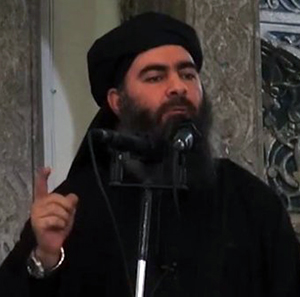
IS chief Baghdadi escapes Iraqi Army's final assault: UK

November 4, 2016

London, Nov 4: Islamic State's reclusive chief Abu Bakr al-Baghdadi has escaped from the terrorist group's stronghold of Mosul as the Iraqi Army advanced for a final assault, British foreign secretary Boris Johnson said today.is

He said western intelligence sources believe Baghdadi is no longer in Mosul, The Guardian reported.

Baghdadi yesterday broke his year-long silence and issued an audio recording, urging his jihadists to continue their fight to the end in Mosul, where he was believed to be hiding.

Johnson, in an unusual reference to intelligence, said Baghdadi's audio recording was "cruelly ironic since some of the intelligence we have suggests he had himself vacated the scene and is yet using internet media to encourage others to take part in violence."

The battle for Mosul was expected to end in a decisive defeat for the terrorist group, but Baghdadi's escape is likely to complicate matters for Iraqi and coalition forces.

Johnson said the recapture of Mosul, in the face of IS's "scorched earth campaign", would take time and represented "the coalition's greatest challenge", according to the report.

If Baghdadi, who surprised the world by establishing the caliphate after capturing Mosul in June 2014, were to be killed, IS would have to choose a new caliph, but no successor would have the authority and prestige of the reclusive leader.

There is widespread concern that, despite a year of planning, there is little agreement among the many ethnic groups in the region on the future political structure of Mosul or the surrounding Nineveh province.

Giving an update to British parliament on the fight against IS, Johnson also said efforts were under way to prevent sectarian violence being unleashed as the group was ousted from Mosul and surrounding towns such as Tal Afar.

He said 30,000 civilians had fled the city and the UN had plans in place for as many as 90,000 refugees. But he accepted there were also reports that citizens would be used as human shields to raise the human cost of Iraqi Army incursions deeper into the city.

Mosul is a multi-ethnic city, but the large Sunni population is fearful that liberation will lead to massacres by Shia militias determined to take reprisals against those who collaborated with IS.

The anti-IS offensive is dependent on US-led air strikes and the presence of US special forces.

Comments

Wellwisher
 - 
Saturday, 5 Nov 2016

No strange, where he will escape, his God fathers
Israel,americans taken him to their HQ for their next target.
But all things observed by one for final justice.
Long Live Mankind.

Add new comment

  • Coastaldigest.com reserves the right to delete or block any comments.
  • Coastaldigset.com is not responsible for its readers’ comments.
  • Comments that are abusive, incendiary or irrelevant are strictly prohibited.
  • Please use a genuine email ID and provide your name to avoid reject.
News Network
May 30,2020

Washington, May 30: President Donald Trump said Friday he would strip several of Hong Kong's special privileges with the United States and bar some Chinese students from US universities in anger over Beijing's bid to exert control in the financial hub.

In a day of concerted action, the United States and Britain also raised alarm at the UN Security Council over a controversial new security law for Hong Kong, angering Beijing which said the issue had no place at the world body.

In a White House appearance that Trump had teased for a day, the US president attacked China over its treatment of the former British colony, saying it was "diminishing the city's longstanding and proud status."

"This is a tragedy for the people of Hong Kong, the people of China and indeed the people of the world," Trump said.

Trump also said he was terminating the US relationship with the World Health Organization, which he has accused of pro-China bias in its management of the coronavirus crisis.

But Trump was light on specifics and notably avoided personal criticism of President Xi Jinping, with whom he has boasted of having a friendship even as the two powers feud over a rising range of issues.

"I am directing my administration to begin the process of eliminating policy that gives Hong Kong different and special treatment," Trump said.

"This will affect the full range of agreements, from our extradition treaty to our export controls on dual-use technologies and more, with few exceptions," he said.

Secretary of State Mike Pompeo on Wednesday informed Congress that the Trump administration would no longer consider Hong Kong to be separate under US law, but it was up to Trump to spell out the consequences.

China this week pressed ahead on a law that would ban subversion and other perceived offenses against its rule in Hong Kong, which was rocked by months of massive pro-democracy protests last year.

US restricts students

In one move that could have long-reaching consequences, Trump issued an order to ban graduate students from US universities who are connected to China's military.

"For years, the government of China has conducted elicit espionage to steal our industrial secrets, of which there are many," Trump said.

Hawkish Republicans have been clamoring to kick out Chinese students enrolled in sensitive fields. The FBI in February said it was investigating 1,000 cases of Chinese economic espionage and technological theft.

But any move to deter students is unwelcome for US universities, which rely increasingly on tuition from foreigners and have already been hit hard by the COVID-19 shutdown.

China has been the top source of foreign students to the United States for the past decade with nearly 370,000 Chinese at US universities, although Trump's order will not directly affect undergraduates.

Critics say Trump has been eager to fan outrage about China to deflect attention from his own handling of the coronavirus pandemic that has killed more than 100,000 people in the United States, the highest number of deaths of any country.

Chuck Schumer, the top Democrat in the Senate, called Trump's announcement "just pathetic."

Eliot Engel, a Democrat who heads the House Foreign Affairs Committee, noted that Trump treaded lightly on Hong Kong during last year's protests as he sought a trade deal with Xi.

"Now, the president wants to shift the blame for his failures onto China, so he's doing the right thing for the wrong reason," Engel said.

Trump's order could also trigger retaliation. China in March expelled US journalists after the Trump administration tightened visa rules for staff at Chinese state media.

Clash at UN

The United States and Britain earlier in the day urged China to reconsider the Hong Kong law during talks at the UN Security Council, where China wields a veto -- making any formal session, let alone action against Beijing, impossible.

The Western allies raised Hong Kong in an informal, closed-door videoconference where China cannot block the agenda.

They said China was violating an international commitment as the 1984 handover agreement with Britain, in which Beijing promised to maintain the financial hub's separate system until at least 2047, was registered with the United Nations.

"The United States is resolute, and calls upon all UN members states to join us in demanding that the PRC immediately reverse course and honor its international legal commitments to this institution and to the Hong Kong people," said US Ambassador Kelly Craft, referring to the People's Republic of China.  

China demanded that the United States and Britain "immediately stop interfering in Hong Kong affairs," saying the law did not fall under the Security Council's mandate.

"Any attempt to use Hong Kong to interfere in China's internal matters is doomed to fail," warned a statement from China's UN mission.

"There was no consensus, no formal discussion in the Security Council, and the US and the UK's move came to nothing," it said.


Comments

Add new comment

  • Coastaldigest.com reserves the right to delete or block any comments.
  • Coastaldigset.com is not responsible for its readers’ comments.
  • Comments that are abusive, incendiary or irrelevant are strictly prohibited.
  • Please use a genuine email ID and provide your name to avoid reject.
Agencies
February 4,2020

As the deadly coronavirus has spread worldwide, it has carried with it xenophobia -- and Asian communities around the world are finding themselves subject to suspicion and fear.

When a patient on Australia's Gold Coast refused to shake the hand of her surgeon Rhea Liang, citing the virus that has killed hundreds, the medic's first response was shock.

But after tweeting about the incident and receiving a flood of responses, the respected doctor learned her experience was all too common.

There has been a spike in reports of anti-Chinese rhetoric directed at people of Asian origin, regardless of whether they have ever visited the centre of the epidemic or been in contact with the virus.

Chinese tourists have reportedly been spat at in the Italian city of Venice, a family in Turin was accused of carrying the disease, and mothers in Milan have used social media to call for children to be kept away from Chinese classmates.

In Canada, a white man was filmed telling a Chinese-Canadian woman "you dropped your coronavirus" in the parking lot of a local mall.

In Malaysia, a petition to "bar Chinese people from entering our beloved country" received almost 500,000 signatures in one week.

The incidents are part of what the Australasian College for Emergency Medicine has described as "misinformation" which it says is fuelling "racial profiling" where "deeply distressing assumptions are being made about 'Chinese' or 'Asian-looking' people." Disease has long been accompanied by suspicions of foreigners -- from Irish immigrants being targeted in the Typhoid Mary panic of 1900s America to Nepali peacekeepers being accused of bringing cholera to earthquake-struck Haiti in the last decade.

"It's a common phenomenon," said Rob Grenfell, director of health and biosecurity for Australia's science and research agency CSIRO.

"With outbreaks and epidemics along human history, we've always tried to vilify certain subsets of the population," he said, comparing the behaviour to 1300s plague-ridden medieval Europe, where foreigners and religious groups were often blamed.

"Sure it emerged in China," he said of the coronavirus, "but that's no reason to actually vilify Chinese people." In a commentary for the British Medical Journal, doctor Abraar Karan warned this behaviour could discourage people with symptoms from coming forward.

Claire Hooker, a health lecturer at the University of Sydney, said the responses from governments may have compounded prejudice.

The World Health Organisation has warned against "measures that unnecessarily interfere with international travel and trade", but this has not stopped scores of countries from introducing travel bans.

The tiny Pacific nation of Micronesia has banned its citizens from visiting mainland China altogether.

"Travel bans respond largely to people's fears," said Hooker, and while sometimes warranted, they often "have the effect of cementing an association between Chinese people and scary viruses".

Abbey Shi, a Shanghai-born student in Sydney, said the attitude shown by some of her peers has "become almost an attack on students who are Chinese".

While Australia's conservative government has banished its citizens returning from Wuhan -- the central Chinese city at the epicentre of the virus -- to a remote island for quarantine, thousands of students still stuck in China risk their studies being torpedoed.

"Right now it looks like they have to miss the semester's start and potentially the whole year, because of the way the courses are set up," Shi said.

According to Hooker, studies in Toronto on the impact of Severe Acute Respiratory Syndrome, or SARS -- another global coronavirus outbreak in 2002 -- showed the impact of xenophobic sentiment often lasted much longer than the public health scare.

"While there may be a cessation of direct forms of racism as news about the disease dies down, it takes quite a bit of time for economic recovery and people continue to feel unsafe," she said.

People may not rush back to Chinese businesses or restaurants, and may even heed some of the more outlandish viral social media disinformation -- such as one popular post imploring people to avoid eating noodles for their own safety.

"In one sense you might think the effects lasted from the last coronavirus to this one because the representation as China being a place where diseases come from has been persistent," Hooker said.

Comments

Add new comment

  • Coastaldigest.com reserves the right to delete or block any comments.
  • Coastaldigset.com is not responsible for its readers’ comments.
  • Comments that are abusive, incendiary or irrelevant are strictly prohibited.
  • Please use a genuine email ID and provide your name to avoid reject.
News Network
May 12,2020

London, May 12: British Prime Minister Boris Johnson has warned that a mass vaccine for the novel coronavirus may be over a year away and, in the worst-case scenario, may in fact never be found.

In his foreword to the government’s new 50-page guidance on a step by step easing of the lockdown measures in place to control the spread of the deadly virus, the UK prime minister lays out plans for businesses to gradually start reopening with “COVID-19 Secure” measures of social distancing and for the public to use “good solid British common sense” as the economy is unlocked.

“A mass vaccine or treatment may be more than a year away,” said Johnson, highlighting the work being done in the UK by scientists at Oxford University and Imperial College London towards this mission.

“Indeed, in a worst-case scenario, we may never find a vaccine. So our plan must countenance a situation where we are in this, together, for the long haul, even while doing all we can to avoid that outcome,” he said.

Admitting that a vaccine or drug-based treatment is the only “feasible long-term solution”, he said the UK has accelerated this with “promising” vaccine development programmes and a collaboration between Oxford University and pharma major AstraZeneca was a vital step that could help rapidly advance the manufacture of a Covid-19 vaccine when it is ready.

As part of global efforts, he flagged the GBP 388 million in aid funding for research into vaccines, tests and treatment, including GBP 250m to the Coalition for Epidemic Preparedness Innovations.

“But while we hope for a breakthrough, hope is not a plan,” he said, as he unveiled his plan for starting to lift lockdown restrictions from this week in phases.

Following a televised address to the nation on Sunday night and a statement in Parliament on Monday, the guidance comes into effect in public life across England from Wednesday when people will be allowed one-to-one contact with people other than those they live with, as long as they remain outside and two metres apart.

They are allowed to play sport with a friend or family member from outside their household or socialise with them in the open air for the first time in more than six weeks since the lockdown was imposed.

People are still advised to work from home where possible but start heading into work where necessary, in sectors such as construction and manufacturing, keeping the social distancing norms in place.

Under the step by step plan, by the start of next month non-essential shops will also reopen, with some hairdressers, pubs and cinemas to follow from July. However, as part of a Covid-19 Alert System, if infection rates are seen to be rising again, restrictions would be tightened “possibly at short notice”.

Fines for breaching the new rules will also be increased to GBP 100 and will double for each repeat offence, up to a maximum of GBP 3,200.

Johnson said: "I must ask the country to be patient with a continued disruption to our normal way of life, but to be relentless in pursuing our mission to build the systems we need. The worst possible outcome would be a return to the virus being out of control – with the cost to human life, and – through the inevitable re-imposition of severe restrictions – the cost to the economy. We must stay alert, control the virus, and in doing so, save lives.

“Then, as vaccines and treatment become available, we will move to another new phase, where we will learn to live with Covid-19 for the longer term without it dominating our lives.”

The devolved administrations of Scotland and Wales are putting their own measures in place and keeping the “stay at home” message in place, rather than switch to the new “stay alert” message.

The UK government’s latest messaging has come under attack from the Opposition and other sections of society over a feared lack of clarity for the general public.

Comments

Add new comment

  • Coastaldigest.com reserves the right to delete or block any comments.
  • Coastaldigset.com is not responsible for its readers’ comments.
  • Comments that are abusive, incendiary or irrelevant are strictly prohibited.
  • Please use a genuine email ID and provide your name to avoid reject.