


IS chief Baghdadi escapes Iraqi Army's final assault: UK

November 4, 2016

London, Nov 4: Islamic State's reclusive chief Abu Bakr al-Baghdadi has escaped from the terrorist group's stronghold of Mosul as the Iraqi Army advanced for a final assault, British foreign secretary Boris Johnson said today.is
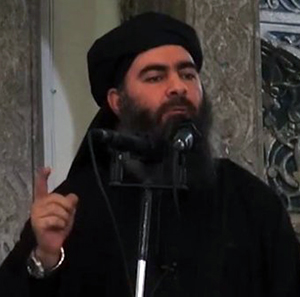
He said western intelligence sources believe Baghdadi is no longer in Mosul, The Guardian reported.

Baghdadi yesterday broke his year-long silence and issued an audio recording, urging his jihadists to continue their fight to the end in Mosul, where he was believed to be hiding.

Johnson, in an unusual reference to intelligence, said Baghdadi's audio recording was "cruelly ironic since some of the intelligence we have suggests he had himself vacated the scene and is yet using internet media to encourage others to take part in violence."

The battle for Mosul was expected to end in a decisive defeat for the terrorist group, but Baghdadi's escape is likely to complicate matters for Iraqi and coalition forces.

Johnson said the recapture of Mosul, in the face of IS's "scorched earth campaign", would take time and represented "the coalition's greatest challenge", according to the report.

If Baghdadi, who surprised the world by establishing the caliphate after capturing Mosul in June 2014, were to be killed, IS would have to choose a new caliph, but no successor would have the authority and prestige of the reclusive leader.

There is widespread concern that, despite a year of planning, there is little agreement among the many ethnic groups in the region on the future political structure of Mosul or the surrounding Nineveh province.

Giving an update to British parliament on the fight against IS, Johnson also said efforts were under way to prevent sectarian violence being unleashed as the group was ousted from Mosul and surrounding towns such as Tal Afar.

He said 30,000 civilians had fled the city and the UN had plans in place for as many as 90,000 refugees. But he accepted there were also reports that citizens would be used as human shields to raise the human cost of Iraqi Army incursions deeper into the city.

Mosul is a multi-ethnic city, but the large Sunni population is fearful that liberation will lead to massacres by Shia militias determined to take reprisals against those who collaborated with IS.

The anti-IS offensive is dependent on US-led air strikes and the presence of US special forces.

Comments

Wellwisher
 - 
Saturday, 5 Nov 2016

No strange, where he will escape, his God fathers
Israel,americans taken him to their HQ for their next target.
But all things observed by one for final justice.
Long Live Mankind.

Add new comment

  • Coastaldigest.com reserves the right to delete or block any comments.
  • Coastaldigset.com is not responsible for its readers’ comments.
  • Comments that are abusive, incendiary or irrelevant are strictly prohibited.
  • Please use a genuine email ID and provide your name to avoid reject.
News Network
May 20,2020

London, May 20: The current physical distancing guidelines of 6 feet may be insufficient to prevent COVID-19 transmission, according to a study which says a mild cough in low wind speeds can propel saliva droplets by as much as 18 feet.

Researchers, including those from the University of Nicosia in Cyprus, said a good baseline for studying the airborne transmission of viruses, like the one behind the COVID-19 pandemic, is a deeper understanding of how particles travel through the air when people cough.

In the study, published in the journal Physics of Fluids, they said even with a slight breeze of about four kilometres per hour (kph), saliva travels 18 feet in 5 seconds.

"The droplet cloud will affect both adults and children of different heights," said study co-author Dimitris Drikakis from the University of Nicosia.

According to the scientists, shorter adults and children could be at higher risk if they are located within the trajectory of the saliva droplets.

They said saliva is a complex fluid, which travels suspended in a bulk of surrounding air released by a cough, adding that many factors affect how saliva droplets travel in the air.

These factors, the study noted, include the size and number of droplets, how they interact with one another and the surrounding air as they disperse and evaporate, how heat and mass are transferred, and the humidity and temperature of the surrounding air.

In the study, the scientists created a computer simulation to examine the state of every saliva droplet moving through the air in front of a coughing person.

The model considered the effects of humidity, dispersion force, interactions of molecules of saliva and air, and how the droplets change from liquid to vapour and evaporate, along with a grid representing the space in front of a coughing person.

Each grid, the scientists said, holds information about variables like pressure, fluid velocity, temperature, droplet mass, and droplet position.

The study analysed the fates of nearly 1,008 simulated saliva droplets, and solved as many as 3.7 million equations.

"The purpose of the mathematical modelling and simulation is to take into account all the real coupling or interaction mechanisms that may take place between the main bulk fluid flow and the saliva droplets, and between the saliva droplets themselves," explained Talib Dbouk, another co-author of the study.

However, the researchers added that further studies are needed to determine the effect of ground surface temperature on the behaviour of saliva in air.

They also believe that indoor environments, especially ones with air conditioning, may significantly affect the particle movement through air.

This work is important since it concerns safety distance guidelines, and advances the understanding of the transmission of airborne diseases, Drikakis said.

Comments

Add new comment

  • Coastaldigest.com reserves the right to delete or block any comments.
  • Coastaldigset.com is not responsible for its readers’ comments.
  • Comments that are abusive, incendiary or irrelevant are strictly prohibited.
  • Please use a genuine email ID and provide your name to avoid reject.
News Network
January 3,2020

Islamabad, Jan 3: The United Arab Emirates has extended USD 200 million aid to Pakistan for the development of the small and medium-sized enterprises in the country, Finance Adviser to Prime Minister Imran Khan said.

The announcement came after Abu Dhabi Crown Prince Sheikh Mohamed Bin Zayed Al Nahyan concluded his one-day visit to the country on Thursday.

"The money will be spent on small business promotion and jobs. This support is testimony to the expanding economic relations and friendship between our countries," the adviser, Abdul Hafeez Shaikh, on Thursday said.

The Crown Prince directed the Khalifa Fund for Enterprise Development to allocate USD 200 million in order to assist the Pakistani government's efforts to create a stable and balanced national economy that will help achieve the country's sustainable development, Dawn News reported on Friday.

During the visit, the prince met Prime Minister Khan and held talks on bilateral, regional and international issues.

The UAE is Pakistan's largest trading partner in the Middle East and a major source of investments. The UAE is also among Pakistan's prime development partners in education, health and energy sectors.

It hosts more than 1.6 million expatriate Pakistani community, which contributes remittances of around USD 4.5 billion annually to the GDP.

This is the Crown Prince's second visit to Pakistan since Khan took office in August 2018. He had last visited Pakistan on January 6 last year, just weeks after his country offered USD 3 billion financial assistance to Pakistan to deal with its balance of payment crisis.

The Crown Prince's visit was considered by experts as an attempt to woo Pakistan against the backdrop of recent developments when Saudi Arabia and UAE apparently used pressure to stop Pakistan from attending the Kuala Lumpur summit held last month.

The summit from December 19-21 was seen by Saudis as an attempt to create a new bloc in the Muslim world that could become an alternative to the dysfunctional Organisation of Islamic Cooperation led by the Gulf Kingdom.

Comments

Add new comment

  • Coastaldigest.com reserves the right to delete or block any comments.
  • Coastaldigset.com is not responsible for its readers’ comments.
  • Comments that are abusive, incendiary or irrelevant are strictly prohibited.
  • Please use a genuine email ID and provide your name to avoid reject.
News Network
February 12,2020

Saint Martin's Island, Feb 12: At least 15 women and children drowned and more than 50 others were missing after a boat overloaded with Rohingya refugees sank off southern Bangladesh as it tried to reach Malaysia Tuesday, officials said.

Some 138 people -- mainly women and children -- were packed on a trawler barely 13 metres (40 feet) long, trying to cross the Bay of Bengal, a coast guard spokesman told news agency.

"It sank because of overloading. The boat was meant to carry maximum 50 people. The boat was also loaded with some cargo," another coast guard spokesman, Hamidul Islam, added.

Nearly one million Rohingya live in squalid camps near Bangladesh's border with Myanmar, many fleeing the neighbouring country after a 2017 brutal military crackdown.

With few opportunities for jobs and education in the camps, thousands have tried to reach other countries like Malaysia and Thailand by attempting the hazardous 2,000-kilometre journey.

In the latest incident, 71 people have been rescued including 46 women. Among the dead, 11 were women and the rest children.

Anwara Begum said two of her sons, aged six and seven, drowned in the tragedy.

"We were four of us in the boat... Another child (son, aged 10) is very sick," the 40-year-old told news agency.

Fishermen tipped off the coast guard after they saw survivors swimming and crying for help in the sea.

The boat's keel hit undersea coral in shallow water off Saint Martin's Island, Bangladesh's southernmost territory, before it sank, survivors said.

"We swam in the sea before boats came and rescued us," said survivor Mohammad Hossain, 20.

Coast guard commander Sohel Rana said three survivors, including a Bangladeshi, were detained over human trafficking allegations.

An estimated 25,000 Rohingya left Bangladesh and Myanmar on boats in 2015 trying to get to Thailand, Malaysia and Indonesia. Hundreds drowned when overloaded boats sank.

Begum said her family paid a Bangladeshi trafficker $450 per head to be taken to Malaysia.

"We're first taken to a hill where we stayed for five days. Then they used three small trawlers to take us to a large trawler, which sank," she said.

Shakirul Islam, a migration expert whose group works with Rohingya to raise awareness against trafficking, said desperation in the camps was making refugees want to leave.

"It was a tragedy waiting to happen," he said.

"They just want to get out, and fall victim to traffickers who are very active in the camps."

Islam said in the past two months dozens of Rohingya reported approaches from traffickers to his OKUP migration rights group.

"Human smuggling and trafficking in the Bay of Bengal is particularly difficult to address as it requires concerted effort from multiple states," the Bangladesh head of UN agency the International Organization for Migration, Giorgi Gigauri, told news agency.

"The gaps in coordination are easily exploited by criminal networks."

Since last year, Bangladeshi authorities have picked up over 500 Rohingya from rickety fishing trawlers or coastal villages as they waited to board boats.

Trafficking often increases during the November-March period when the sea is safest for the small trawlers used by traffickers.

Bangladesh and Myanmar signed a repatriation deal to send back some Rohingya to their homeland, but none have agreed to return because of safety fears.

The charity Save the Children called on Myanmar to "take all necessary steps to ensure the Rohingya community can return to their homes in a safe and dignified manner".

"The tragic drowning of women and children... should be a wake-up call for us all," the group's Athena Rayburn said in a statement.

Comments

Add new comment

  • Coastaldigest.com reserves the right to delete or block any comments.
  • Coastaldigset.com is not responsible for its readers’ comments.
  • Comments that are abusive, incendiary or irrelevant are strictly prohibited.
  • Please use a genuine email ID and provide your name to avoid reject.