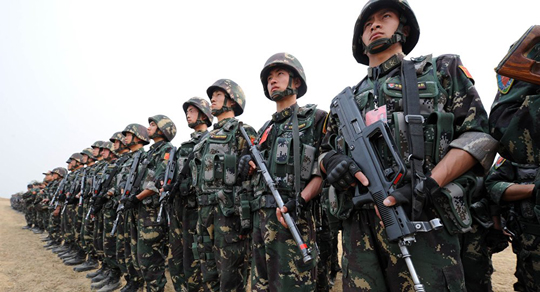
China accuses Indian border guards of crossing into its territory

Agencies
June 27, 2017

Beijing, Jun 27: China has accused Indian border guards of crossing into its territory from the state of Sikkim on India’s northeastern border with Tibet, the Chinese foreign and defence ministries have said, complicating an already difficult relationship.

China

Geng Shuang, a spokesman with China’s foreign ministry, said Indian guards “obstructed normal activities” by Chinese forces on the border and called on India to withdraw immediately, according to a ministry statement late on Monday.

He urged India to respect China’s territorial integrity and the border treaties signed by the two countries, and said China had already suspended official pilgrimages at the Nathu La Pass, which lies on the frontier between Sikkim state and Tibet. Nathu La connects India to Hindu and Buddhist sites in the region and was the site of a fierce border clash between Chinese and Indian troops in 1967. China’s Defence Ministry said in a separate statement India’s military had obstructed work on a road, a move it described as seriously threatening peace on the border.

“China is dedicated to developing bilateral relations, and will staunchly defend its legitimate rights,” it said. “China hopes India will meet it halfway, not do anything to complicate the border issues and jointly maintain the good momentum of relations,” the defence ministry said.

Ties between China and India have long been frosty as a result of long-term territorial disputes, as well as Beijing’s support of Pakistan, and Indian leaders declined to attend China’s “Belt and Road” summit aimed at boosting regional economic and political ties last month.

Chinese President Xi Jinping told Indian Prime Minister Narendra Modi earlier this month that the two countries should work to “appropriately” manage their differences. A visit in April by Tibetan spiritual leader the Dalai Lama, who Beijing brands a separatist, to a region controlled by India but claimed by China also stoked tensions between the two countries.

The Indian government has since taken steps to cool tensions, rejecting an Australian request to take part in joint naval exercises with the United States and Japan last month to avoid agonising China. Modi is expected to visit China in September to attend a summit of the BRICS nations, which groups Brazil, Russia, India, China and South Africa.

Comments

Add new comment

  • Coastaldigest.com reserves the right to delete or block any comments.
  • Coastaldigset.com is not responsible for its readers’ comments.
  • Comments that are abusive, incendiary or irrelevant are strictly prohibited.
  • Please use a genuine email ID and provide your name to avoid reject.
News Network
January 3,2020

New Delhi, Jan 3: US aviation regulator Federal Aviation Administration on Thursday warned America's airlines and their pilots that there is risk involved in operating flights in Pakistan airspace due to "extremist or militant activity", according to an official document.

"Exercise caution during flight operations. There is a risk to US civil aviation operating in the territory and airspace of Pakistan due to extremist/militant activity," said the US Federal Aviation Administration (FAA) in a notice to airmen (NOTAM) dated December 30, 2019.

The NOTAM is applicable to all US-based airlines and US-based pilots.

The US regulator said in its NOTAM that there continues to be a risk to US civil aviation sector from attacks against airports and aircraft in Pakistan, particularly for aircraft on the ground and aircraft operating at low altitudes, including during the arrival and departure phases of flights.

"The ongoing presence of extremist/militant elements operating in Pakistan poses a continued risk to US civil aviation from small-arms fire, complex attacks against airports, indirect weapons fire, and anti-aircraft fire, any of which could occur with little or no warning," it said.

The FAA said that while, to date, there have been no reports of man-portable air defense systems or Manpads being used against the civil aviation sector in Pakistan, some extremist or terrorist groups operating there are suspected of having access to these Manpads.

"As a result, there is potential risk for extremists/militants to target civil aviation in Pakistan with Manpads," it said.

The regulator added that pilots or airlines must report safety or security incidents - which may happen in Pakistan - to the FAA.

Pakistan on July 16 last year opened its airspace for India after about five months of restrictions imposed in the wake of a standoff with New Delhi.

Following the Balakot airstrikes by the Indian Air Force, Pakistan had closed its airspace on February 26 last year.

Pakistan in October last year had denied India's request to allow Prime Minister Narendra Modi's VVIP flight to use its airspace for his visit to Saudi Arabia over the Jammu and Kashmir issue.

Comments

Add new comment

  • Coastaldigest.com reserves the right to delete or block any comments.
  • Coastaldigset.com is not responsible for its readers’ comments.
  • Comments that are abusive, incendiary or irrelevant are strictly prohibited.
  • Please use a genuine email ID and provide your name to avoid reject.
News Network
January 28,2020

Jan 28: China said on Tuesday that 106 people had died from a new coronavirus that is spreading across the country, up from the previous toll of 81.

The number of total confirmed cases in China rose to 4,515 as of Jan. 27, the National Health Commission said in a statement, up from 2,835 reported a day earlier.

The United States warned against travel to China on Monday and Canada issued a more narrow travel warning as the death toll from the spreading coronavirus passed 100, with tens of millions stranded during the biggest holiday of the year and global markets rattled.

Global stocks fell, oil prices hit three-month lows, and China's yuan dipped to its weakest level in 2020 as investors fretted about damage to the world's second-biggest economy from travel bans and the Lunar New Year holiday, which China extended in a bid to keep people at home.

The health commission of China's Hubei province said on Tuesday that 100 people had died from the virus as of Jan. 27, according to an online statement, up from the previous toll of 76, with the number of confirmed cases in the province rose to 2,714.

Other fatalities have been reported elsewhere in China, including the first in Beijing, bringing the deal toll to 106 so far, according to the People's Daily. The state newspaper put the total number of confirmed cases in China at 4,193, though some experts suspect a much higher number.

On Monday, US President Donald Trump offered China whatever help it needed, while the State Department said Americans should "reconsider" visiting all of China due to the virus.

Canada, which has two confirmed cases of the virus and is investigating 19 more potential cases, warned its citizens to avoid travel to China's Hubei province, at the heart of the outbreak.

Authorities in Hubei province are taking increasing flak from the public over their initial response to the virus. Chinese Premier Li Keqiang visited the city of Wuhan, epicentre of the outbreak, to encourage medical workers and promise reinforcements.

Visiting Wuhan in blue protective suit and mask, Li praised medics, said 2,500 more workers would join them in the next two days, and visited the site of a new hospital to be built in days.

The most senior leader to visit Wuhan since the outbreak, Li was shown on state TV leading medical workers in chants of "Wuhan jiayou!" - an exhortation to keep their strength up.

China's ambassador to the United Nations, following a meeting with UN Secretary-General António Guterres on Monday, said "the Chinese government attaches paramount importance to prevention and control of the epidemic, and President Xi Jinping has given important instructions. ...

"China has been working with the international community in the spirit of openness, transparency and scientific coordination," he said.

Guterres said in a statement, "The UN appreciates China's effort, has full confidence in China's ability of controlling the outbreak, and stands ready to provide any support and assistance."

MOUNTING ANGER

On China's heavily censored social media, officials have faced mounting anger over the virus, which is thought to have originated from a market where wildlife was sold illegally.

Some criticised the governor of Hubei province, of which Wuhan is the capital, after he corrected himself twice during a news conference over the number of face masks being produced.

"If he can mess up the data multiple times, no wonder the disease has spread so severely," said one user of the Weibo social media platform.

In rare public self-criticism, Wuhan Mayor Zhou Xianwang said the city's management of the crisis was "not good enough" and indicated he was willing to resign.

The central Chinese city of 11 million people is in virtual lockdown and much of Hubei, home to nearly 60 million people, is under travel curbs.

Elsewhere in China, people from the region faced questioning about their movements. "Hubei people are getting discriminated against," a Wuhan resident complained on Weibo.

Cases linked to people who travelled from Wuhan have been confirmed in a dozen countries, from Japan to the United States, where authorities said they had 110 people under investigation in 26 states. Sri Lanka was the latest to confirm a case.

INVESTORS WORRIED

Investors are worried about the impact. The consensus is that in the short term, economic output will be hit as authorities limit travel and extend the week-long New Year holiday — when millions traditionally travel by rail, road and plane - by three days to limit spread of the virus.

Asian and European shares tumbled, with Japan's Nikkei average sliding 2%, its biggest one-day fall in five months. Demand spiked for safe-haven assets such as the Japanese yen and Treasury notes. European stocks fell more than 2%.

The US S&P 500 closed down nearly 1.6%.

"China is the biggest driver of global growth so this couldn't have started in a worse place," said Alec Young, FTSE Russell's managing director of global markets research.

During the 2002-2003 outbreak of Severe Acute Respiratory Syndrome (SARS), which originated in China and killed nearly 800 people globally, air passenger demand in Asia plunged 45%. The travel industry is more reliant on Chinese travellers now.

Chinese-ruled Hong Kong, which has had eight cases, banned entry to people who had visited Hubei recently.

Some European tour operators cancelled trips to China, while governments around the world worked on repatriating nationals.

Officially known as 2019-nCoV, the newly identified coronavirus can cause pneumonia, but it is still too early to know just how dangerous it is and how easily it spreads.

"What we know about this virus it that transmission occurs through human contact but we are speaking of close contact, i.e. less than a meter," said Jerome Salomon, a senior official with France's health ministry.

"Crossing someone (infected) in the street poses no threat," he said. "The risk is low when you spend a little time near that person and becomes higher when you spend a lot of time near that person."


Comments

Add new comment

  • Coastaldigest.com reserves the right to delete or block any comments.
  • Coastaldigset.com is not responsible for its readers’ comments.
  • Comments that are abusive, incendiary or irrelevant are strictly prohibited.
  • Please use a genuine email ID and provide your name to avoid reject.
News Network
April 21,2020

New York, Apr 21: Oil prices plunged below zero on Monday as demand for energy collapses amid the coronavirus pandemic and traders don't want to get stuck owning crude with nowhere to store it.

Stocks were also slipping on Wall Street in afternoon trading, with the S&P 500 down 0.9%, but the market's most dramatic action was by far in oil, where benchmark U.S. crude for May delivery plummeted to negative $3.70 per barrel, as of 2:15 pm. Eastern time.

Much of the drop into negative territory was chalked up to technical reasons — the May delivery contract is close to expiring so it was seeing less trading volume, which can exacerbate swings. But prices for deliveries even further into the future, which were seeing larger trading volumes, also plunged.

Demand for oil has collapsed so much due to the coronavirus pandemic that facilities for storing crude are nearly full.

Tanks could hit their limits within three weeks, according to Chris Midgley, head of analytics at S&P Global Platts.

Benchmark U.S. crude oil for June delivery, which shows a more ”normal” price, fell 14.8% to $21.32 per barrel, as factories and automobiles around the world remain idled. Big oil producers have announced cutbacks in production in hopes of better balancing supplies with demand, but many analysts say it's not enough.

“Basically, bears are out for blood,” analyst Naeem Aslam of Avatrade said in a report. “The steep fall in the price is because of the lack of sufficient demand and lack of storage place given the fact that the production cut has failed to address the supply glut.”

Halliburton swung between gains and sharp losses, even though it reported stronger results for the first three months of 2020 than analysts expected. The oilfield engineering company said that the pandemic has created so much turmoil in the industry that it “cannot reasonably estimate” how long the hit will last. It expects a further decline in revenue and profitability for the rest of 2020, particularly in North America.

Brent crude, the international standard, was down $1.78 to $26.30 per barrel. .

In the stock market, the mild drops ate into some of the big gains made since late March, driven lately by investors looking ahead to parts of the economy possibly reopening as infections level off in hard-hit areas.

Pessimists have called the rally overdone, pointing to the severe economic pain sweeping the world and continued uncertainty about how long it will last.

The Dow Jones Industrial Average was down 364 points, or 1.5%, to 23,887. The Nasdaq was down 0.1%..

More gains from companies that are winners in the new stay-at-home economy helped limit the market's losses Amazon rose 1.4%, and Netflix jumped 3.8% as people shut in at home buy staples and look to fill their time. Clorox likewise rose toward a new record and was up 1% as households and businesses that remain open look to stay clean.

In Tokyo the Nikkei 225 fell 1.1% after Japan reported that its exports fell nearly 12% in March from a year earlier as the pandemic hammered demand in its two biggest markets, the U.S. and China.

The Hang Seng index in Hong Kong lost 0.2%, and South Korea's Kospi fell 0.8%.

European markets were modestly higher The German DAX was up 0.5%, the French CAC 40 was up 0.7% and the FTSE 100 in London gained 0.7%.

In a sign of continued caution in the market, Treasury yields remained extremely low. The yield on the 10-year Treasury slipped to 0.64% from 0.65% late Friday. It started the year near 1.90%. Bond yields drop when their prices rise, and investors tend to buy Treasurys when they're worried about the economy.

Stocks have been on a generally upward swing recently, and the S&P 500 just closed out its first back-to-back weekly gain since the market began selling off in February. Promises of massive aid for the economy and markets by the Federal Reserve and U.S. government ignited the rally, which sent the S&P 500 up as much as 28.5% since a low on March 23.

More recently, countries around the world have tentatively eased up on business-shutdown restrictions put in place to slow the spread of the virus.

But health experts warn the pandemic is far from over and new flareups could ignite if governments rush to allow ”normal” life to return prematurely.

The S&P 500 remains about 15% below its record high in February as millions more U.S. workers file for unemployment every week amid the shutdowns.

Many analysts also warn that a significant part of the recent recovery in stocks is due to the expectation among some investors that the economy will rebound sharply once economic quarantines are lifted. They're essentially predicting that a line chart of the economy will ultimately resemble the letter “V,” with a wild ride down but then a quick pivot to a vigorous recovery.

That may be to optimistic. “We caution that a U-shaped recovery is also quite likely,” where the economy bottoms out and stays at that low level for a while before recovering, strategists at Barclays warned in a recent report.

Without strong testing programs for COVID-19, businesses likely won't feel comfortable bringing back their full workforces for a while.

”With risk assets now overbought, the chance for a correction has increased,” Morgan Stanley strategists wrote in a report.

Comments

Add new comment

  • Coastaldigest.com reserves the right to delete or block any comments.
  • Coastaldigset.com is not responsible for its readers’ comments.
  • Comments that are abusive, incendiary or irrelevant are strictly prohibited.
  • Please use a genuine email ID and provide your name to avoid reject.