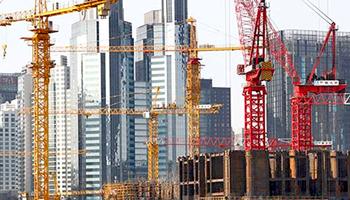
China to create new city Xiongan New Area; to be 3 times larger than New York

April 4, 2017

New Delhi/Beijing, Apr 4: China has announced that it would establish the Xiongan New Area in Hebei Province, similar to those established in Shenzhen and Shanghai.

chinacityThe New Area, about 100 km southwest of downtown Beijing, will span three counties that sit at the center of the triangular area formed by Beijing, Tianjin and Hebei`s provincial capital Shijiazhuang.

Xiongan New Area “will eventually cover an area nearly three times that of New York,” the Guardian quoting official sources said.

This is another new area with national significance after the Shenzhen Special Economic Zone and the Shanghai Pudong New Area, according to a circular issued by the Communist Party of China (CPC) Central Committee and the State Council.

The move is a "major historic and strategic choice made by the CPC Central Committee with Comrade Xi Jinping as the core," said the circular.

The move will help phase out non-capital functions from Beijing, explore a new model of optimized development in densely-populated areas, and restructure the urban layout in the region, according to the circular.

The New Area will cover around 100 square km initially and will be expanded to 200 square km in mid-term and about 2,000 square km in the long-term.

It is the latest step in China`s efforts to reduce traffic, air pollution, and population growth in overcrowded, smoggy Beijing.

Authorities hope that the Xiongan New Area will be a new centre for growth in the world`s second-largest economy, which last year expanded at its slowest rate in a quarter of a century.

The decision to set up Xiongan New Area is a key stroke in solving urban woes and creating new growth, said a commentary carried by the website of the People`s Daily, flagship newspaper of the CPC.

Xiongan and Tongzhou will form "two wings" for Beijing and create new room of development for the Beijing-Tianjin-Hebei region, the commentary said.

Comments

Add new comment

  • Coastaldigest.com reserves the right to delete or block any comments.
  • Coastaldigset.com is not responsible for its readers’ comments.
  • Comments that are abusive, incendiary or irrelevant are strictly prohibited.
  • Please use a genuine email ID and provide your name to avoid reject.
Agencies
February 4,2020

As the deadly coronavirus has spread worldwide, it has carried with it xenophobia -- and Asian communities around the world are finding themselves subject to suspicion and fear.

When a patient on Australia's Gold Coast refused to shake the hand of her surgeon Rhea Liang, citing the virus that has killed hundreds, the medic's first response was shock.

But after tweeting about the incident and receiving a flood of responses, the respected doctor learned her experience was all too common.

There has been a spike in reports of anti-Chinese rhetoric directed at people of Asian origin, regardless of whether they have ever visited the centre of the epidemic or been in contact with the virus.

Chinese tourists have reportedly been spat at in the Italian city of Venice, a family in Turin was accused of carrying the disease, and mothers in Milan have used social media to call for children to be kept away from Chinese classmates.

In Canada, a white man was filmed telling a Chinese-Canadian woman "you dropped your coronavirus" in the parking lot of a local mall.

In Malaysia, a petition to "bar Chinese people from entering our beloved country" received almost 500,000 signatures in one week.

The incidents are part of what the Australasian College for Emergency Medicine has described as "misinformation" which it says is fuelling "racial profiling" where "deeply distressing assumptions are being made about 'Chinese' or 'Asian-looking' people." Disease has long been accompanied by suspicions of foreigners -- from Irish immigrants being targeted in the Typhoid Mary panic of 1900s America to Nepali peacekeepers being accused of bringing cholera to earthquake-struck Haiti in the last decade.

"It's a common phenomenon," said Rob Grenfell, director of health and biosecurity for Australia's science and research agency CSIRO.

"With outbreaks and epidemics along human history, we've always tried to vilify certain subsets of the population," he said, comparing the behaviour to 1300s plague-ridden medieval Europe, where foreigners and religious groups were often blamed.

"Sure it emerged in China," he said of the coronavirus, "but that's no reason to actually vilify Chinese people." In a commentary for the British Medical Journal, doctor Abraar Karan warned this behaviour could discourage people with symptoms from coming forward.

Claire Hooker, a health lecturer at the University of Sydney, said the responses from governments may have compounded prejudice.

The World Health Organisation has warned against "measures that unnecessarily interfere with international travel and trade", but this has not stopped scores of countries from introducing travel bans.

The tiny Pacific nation of Micronesia has banned its citizens from visiting mainland China altogether.

"Travel bans respond largely to people's fears," said Hooker, and while sometimes warranted, they often "have the effect of cementing an association between Chinese people and scary viruses".

Abbey Shi, a Shanghai-born student in Sydney, said the attitude shown by some of her peers has "become almost an attack on students who are Chinese".

While Australia's conservative government has banished its citizens returning from Wuhan -- the central Chinese city at the epicentre of the virus -- to a remote island for quarantine, thousands of students still stuck in China risk their studies being torpedoed.

"Right now it looks like they have to miss the semester's start and potentially the whole year, because of the way the courses are set up," Shi said.

According to Hooker, studies in Toronto on the impact of Severe Acute Respiratory Syndrome, or SARS -- another global coronavirus outbreak in 2002 -- showed the impact of xenophobic sentiment often lasted much longer than the public health scare.

"While there may be a cessation of direct forms of racism as news about the disease dies down, it takes quite a bit of time for economic recovery and people continue to feel unsafe," she said.

People may not rush back to Chinese businesses or restaurants, and may even heed some of the more outlandish viral social media disinformation -- such as one popular post imploring people to avoid eating noodles for their own safety.

"In one sense you might think the effects lasted from the last coronavirus to this one because the representation as China being a place where diseases come from has been persistent," Hooker said.


Comments

Add new comment

  • Coastaldigest.com reserves the right to delete or block any comments.
  • Coastaldigset.com is not responsible for its readers’ comments.
  • Comments that are abusive, incendiary or irrelevant are strictly prohibited.
  • Please use a genuine email ID and provide your name to avoid reject.
News Network
April 17,2020

Paris, Apr 17: The number of coronavirus-related deaths in France has increased by 753 to 17,920 over the past 24 hours, with the total case count now standing at 108,847, Jerome Salomon, the head of the state health agency, said on Thursday.

On Wednesday, the country reported a total of 106,206 cases, including a record 1,438 new fatalities. Salomon specified that it was not the daily death toll, as the data had been compiled over the last three-day weekend.

"The total number of victims since March 1 is 17,920," Salomon said at a briefing on Thursday.
He noted that 11,060 of them had died in hospitals, and 6,860 others in social and medical-social facilities.

President Emmanuel Macron on Monday extended nationwide movement restrictions, which had been introduced due to the epidemic, until May 11. Afterwards, the country is set to gradually reopen kindergartens, schools and universities.

Comments

Add new comment

  • Coastaldigest.com reserves the right to delete or block any comments.
  • Coastaldigset.com is not responsible for its readers’ comments.
  • Comments that are abusive, incendiary or irrelevant are strictly prohibited.
  • Please use a genuine email ID and provide your name to avoid reject.
Agencies
July 8,2020

Washington D.C, Jul 8:  US Secretary of State, Mike Pompeo on Tuesday (local time) announced visa restrictions on some Chinese officials under the Reciprocal Access to Tibet Act, 2018.

"Today I am announcing visa restrictions on PRC government and Chinese Communist Party officials determined to be "substantially involved in the formulation or execution of policies related to access for foreigners to Tibetan areas," pursuant to the Reciprocal Access to Tibet Act of 2018," Pompeo said.

"Access to Tibetan areas is increasingly vital to regional stability, given the PRC's human rights abuses there, as well as Beijing's failure to prevent environmental degradation near the headwaters of Asia's major rivers," he said.

The US Secretary of State pointed out that Beijing has continued "systematically to obstruct travel to the Tibetan Autonomous Region (TAR) and other Tibetan areas" by U.S. diplomats and other officials, journalists, and tourists, while PRC officials and other citizens enjoy far greater access to the United States.

"The United States will continue to work to advance the sustainable economic development, environmental conservation, and humanitarian conditions of Tibetan communities within the People's Republic of China and abroad," he said.

Pompeo said US also remains "committed to supporting meaningful autonomy for Tibetans, respect for their fundamental and unalienable human rights, and the preservation of their unique religious, cultural, and linguistic identity".

"In the spirit of true reciprocity, we will work closely with the U.S. Congress to ensure U.S. citizens have full access to all areas of the People's Republic of China, including the TAR and other Tibetan areas," he said.

Comments

Add new comment

  • Coastaldigest.com reserves the right to delete or block any comments.
  • Coastaldigset.com is not responsible for its readers’ comments.
  • Comments that are abusive, incendiary or irrelevant are strictly prohibited.
  • Please use a genuine email ID and provide your name to avoid reject.