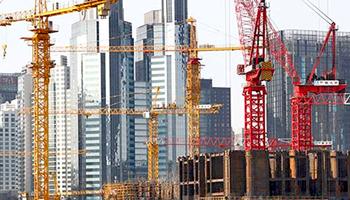
China to create new city Xiongan New Area; to be 3 times larger than New York

April 4, 2017

New Delhi/Beijing, Apr 4: China has announced that it would establish the Xiongan New Area in Hebei Province, similar to those established in Shenzhen and Shanghai.

chinacityThe New Area, about 100 km southwest of downtown Beijing, will span three counties that sit at the center of the triangular area formed by Beijing, Tianjin and Hebei`s provincial capital Shijiazhuang.

Xiongan New Area “will eventually cover an area nearly three times that of New York,” the Guardian quoting official sources said.

This is another new area with national significance after the Shenzhen Special Economic Zone and the Shanghai Pudong New Area, according to a circular issued by the Communist Party of China (CPC) Central Committee and the State Council.

The move is a "major historic and strategic choice made by the CPC Central Committee with Comrade Xi Jinping as the core," said the circular.

The move will help phase out non-capital functions from Beijing, explore a new model of optimized development in densely-populated areas, and restructure the urban layout in the region, according to the circular.

The New Area will cover around 100 square km initially and will be expanded to 200 square km in mid-term and about 2,000 square km in the long-term.

It is the latest step in China`s efforts to reduce traffic, air pollution, and population growth in overcrowded, smoggy Beijing.

Authorities hope that the Xiongan New Area will be a new centre for growth in the world`s second-largest economy, which last year expanded at its slowest rate in a quarter of a century.

The decision to set up Xiongan New Area is a key stroke in solving urban woes and creating new growth, said a commentary carried by the website of the People`s Daily, flagship newspaper of the CPC.

Xiongan and Tongzhou will form "two wings" for Beijing and create new room of development for the Beijing-Tianjin-Hebei region, the commentary said.

Comments

Add new comment

  • Coastaldigest.com reserves the right to delete or block any comments.
  • Coastaldigset.com is not responsible for its readers’ comments.
  • Comments that are abusive, incendiary or irrelevant are strictly prohibited.
  • Please use a genuine email ID and provide your name to avoid reject.
Agencies
February 12,2020

London, Feb 12: Fugitive liquor baron Vijay Mallya returned to the courtroom here on Wednesday, the second day of hearing at the UK High Court, where the former billionaire has appealed against the extradition decision of Westminster Magistrates Court in December 2018.

On being asked about his expectations from the lengthy appeals process against the extradition order as today is the last day for Mallya to present his defence, the embattled former Kingfisher Airlines boss replied, "I have no clue. You see. I'll also see it. Let's not get into a speculative game."

When asked on what would happen if Mallya loses the case and has to return to India, the liquor baron responded: "We do have arguments."

The UK High Court, on Tuesday, had also heard Mallya's appeal against the Westminster Magistrates' Court order extraditing him to India to face alleged fraud and money laundering charges amounting to Rs 9,000 crore.

Mallya was present in the court along with his counsel Clare Montgomery during the hearing. Officials from Enforcement Directorate (ED) and Central Bureau of Investigation (CBI) along with counsel Mark Summers representing the Indian government were also present.

When the judge asked if there was a timeline in the case, Clare said," This is a very dense case," involving multiple individuals and organisations and that not everything had been taken into account by the magistrate Emma Arbuthnot in her ruling against Mallya.

Montgomery contended that the magistrate's ruling had been riddled with "multiple errors". She also brought into question the admissibility of documents submitted by the Indian government - including witness statements and emails that proved crucial in the ruling by judge Arbuthnot, who found "clear evidence of misapplication of loan funds" and that there was a prima facie case of fraud against Mallya.

As she had done throughout the trial, Montgomery continued to assert that Mallya had not acted in a fraudulent manner or run a pyramid and that the collapse of Kingfisher Airlines was, in fact, the failure of a business in difficult economic circumstances.

She also reiterated concerns about the conduct of the Central Bureau of Investigation (CBI) in bringing charges against Mallya, claiming that the tycoon had been made a scapegoat.

Montgomery also stated that the Indian government had presented the loan taken out by Kingfisher Airlines, not as a simple business loan but was part of a larger and elaborate attempt at defrauding the banks by Mallya and Kingfisher Airlines management.

This, Montgomery contended, was but one example of a wider misinterpretation of the case by judge Arbuthnot.

The High Court justices reprimanded Montgomery for concentrating on the evidence - in essence rehashing the case presented at the lower court - rather than the apparent "mistakes" made by judge Arbuthnot in her ruling.

Mallya remains on bail of £650,000 as he has done throughout this legal process.

The Crown Prosecution Service which is representing the Government of India will present its case for the extradition of Mallya on Wednesday.

The 63-year-old businessman fled India in March 2016 and has been living in the UK since then.

Comments

Add new comment

  • Coastaldigest.com reserves the right to delete or block any comments.
  • Coastaldigset.com is not responsible for its readers’ comments.
  • Comments that are abusive, incendiary or irrelevant are strictly prohibited.
  • Please use a genuine email ID and provide your name to avoid reject.
News Network
June 26,2020

Washington, Jun 26: The US is reviewing its global deployment of forces to ensure it is postured appropriately to counter the People's Liberation Army, given the increasing threat posed by China to Asian countries like India, Malaysia, Indonesia, and the Philippines, Secretary of State Mike Pompeo said on Thursday.

Mr Pompeo made those remarks in response to a question during the virtual Brussels Forum 2020 of the German Marshall Fund.

"We're going to make sure we're postured appropriately to counter the PLA. We think that the challenge of our times, and we're going to make sure we have resources in place to do that," Mr Pompeo said.
 
The force posture review is being done at the direction of President Donald Trump, as part of which the US is reducing the number of its troops in Germany from about 52,000 to 25,000, he said.

Mike Pompeo said that the force posture would be dictated by the ground realities.

"In certain places there will be fewer American resources. There'll be other places - I just talked about the threat from the Chinese Communist Party, so now threats to India, threats to Vietnam, threats to Malaysia, Indonesia, South China Sea challenges, the Philippines," he said.

"To the extent that that changed, the difference in what the US decided to do impacts adversely a threat some place, it may be that other nations need to step up and take responsibility for their own defense in ways that they hadn't done previously. So, we want to do this in full consultation with all of our partners all around the world, and certainly our friends in Europe," Mr Pompeo said.

President Trump is being criticised for reducing troops from Germany. His critics say that this will increase the threat from Russia to Europe.

Mike Pompeo, however, did not agree with that argument.

It has been a long time since there has been a strategic review of our force posture all across the world. The US undertook that starting about 2.5 years ago, whether that was our forces in Africa, our forces in Asia, the force we have in the Middle East and in Europe, he said.

"We began to say these are often decisions that were made in a different time. Should we reallocate those a different way? Should we have a different composition of those forces? Everyone always wants to talk about ground troops. I get it. I was a young tank officer. You described that. There's nothing I like as much as a good M1 tank.

"But it's often the case that the capacity to deter Russia or other adversaries isn''t determined any longer by just having a bunch of folks garrisoned someplace. So, we really went to back fundamentally relook, what is the nature of the conflict, what''s the nature of the threat, and how should we allocate our resources, whether that''s our resources in the intelligence community, our resources from the Air Force or the Marines and Army," Mr Pompeo said.

Last week, Mike Pompeo criticised the Chinese Army for "escalating" the border tension with India and militarising the strategic South China Sea. He also described the ruling Communist Party of China (CPC) as a "rogue actor".

"Our broad set of allocation of security apparatus, our ability to counter cyber threats, how do we allocate them? What''s the best way to do this? And the decision that you see the president made with respect to Germany is an outcome from a collective set of decisions about how we''re going to posture our resources around the world," said the top American diplomat on Thursday.

Changes in force posture is being taken in consultations with allies and friends, Mr Pompeo said.

"President Trump has spoken to this. (Defense) Secretary (Mark) Esper will be in London today and in Brussels tomorrow. We''ll talk about our plan and how we''re thinking about delivering it," he said.

"But you should understand this, and I hope our European partners will understand this as well. When you see what we ultimately conclude, how we ultimately deliver on the statements of the president made, that they''re aimed squarely at what we believe to be democracies'' fundamental interest and certainly America's most fundamental interest," Mr Pompeo said.

Earlier this month, Mike Pompeo had said that China's actions, be it on the India border, or in Hong Kong or in the South China Sea, were part of the behaviour of the ruling Communist Party in Beijing in the recent past.

China has been fast expanding military and economic influence in the Indo-Pacific region, triggering concern in various countries of the region and beyond.

China is engaged in hotly contested territorial disputes in both the South China Sea and the East China Sea. Beijing has built up and militarised many of the islands and reefs it controls in the region. Both areas are stated to be rich in minerals, oil and other natural resources and are vital to global trade.


Comments

Add new comment

  • Coastaldigest.com reserves the right to delete or block any comments.
  • Coastaldigset.com is not responsible for its readers’ comments.
  • Comments that are abusive, incendiary or irrelevant are strictly prohibited.
  • Please use a genuine email ID and provide your name to avoid reject.
Agencies
July 9,2020

The new visa regulations requiring international students in the US with an F-1 visa to take at least one in-person course or face the prospect of deportation is likely to "cause uncertainties and difficulties" for some students, the Indian Embassy has said.

"These new modifications at a time when many of the US universities and colleges are yet to announce their plans for the new academic year are likely to cause uncertainties and difficulties for some Indian students wishing to pursue their studies in the US," said a spokesperson of the Indian Embassy.

Responding to media queries, the spokesperson said the Indian government has taken up the matter with concerned US officials.

At the India US Foreign Office Consultations held on July 7, Foreign Secretary Harsh Vardhan Shringla conveyed India's concerns on the matter to Under Secretary of State for Political Affairs David Hale.

According to a recent report of Student and Exchange Visitor Program (SEVP), there were 1,94,556 Indian students enrolled in various academic institutions of the US in January this year. Of these 1,26,132 were males and 68,405 were females.

Noting that partnership in higher education is a key component of the strong people-to-people ties between India and the US, the spokesperson said in the last two decades Indian students in American universities and colleges have been the harbingers of a strong partnership between technology and innovation sectors between the two countries.

The spokesperson hoped that the US authorities would provide adequate flexibility in their visa rule, keeping in mind the extraordinary circumstances created by the COVID-19 pandemic for the Indian students community.

We continue to engage all the stakeholders in the matters, including the US administration officials, Congressional leaders, universities and colleges as well as the Indian students community in the US as we move forward towards the 2020-21 academic year to further strengthen our bilateral partnership in higher education, the spokesperson said.

Announced by the SEVP on July 6, the new rules provide temporary exemptions for nonimmigrant students on F-1 and M-1 visas taking online classes due to the COVID-19 pandemic for the fall semester of the 2020 academic year.

While these modifications do provide some flexibility for US universities and colleges to adopt a hybrid model -- that is a mixture of online and in person classes -- they also restrict international students on F-1 and M-1 visas from taking courses entirely online, the spokesperson said.

Comments

Add new comment

  • Coastaldigest.com reserves the right to delete or block any comments.
  • Coastaldigset.com is not responsible for its readers’ comments.
  • Comments that are abusive, incendiary or irrelevant are strictly prohibited.
  • Please use a genuine email ID and provide your name to avoid reject.