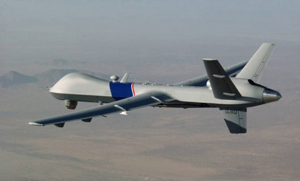
China developing stealth drones to evade anti-aircraft missiles

March 9, 2017

Beijing, Mar 9: China's largest missile maker is developing military drones with stealth abilities that can evade anti-aircraft weapons, the official China Daily said on Thursday, in another advance for the country's ambitious military modernisation programme.

drones"Drones have become an indispensable weapon in modern warfare because they can play an important role in high-resolution reconnaissance, long-distance precision strikes, anti-submarine operations and aerial combat," Wei Yiyin, deputy general manager of China Aerospace Science and Industry Corp, told the English language newspaper.

Insisting it has no hostile intent, China is investing billions of dollars to update ageing equipment and develop new weapons, including stealth fighters and aircraft carriers.

Its heavy defence spending, however, has unnerved a region already on guard over Beijing's more assertive approach to disputes in the South and East China Seas and over self-ruled Taiwan, claimed by China as a wayward province.

Wei told the newspaper his company was also developing near-space and long-range endurance drones.

The paper described China Aerospace Science and Industry Corp as the country's sole producer of cruise missiles, and said the drones also resembled cruise missiles.

China has stepped up research into military drones, hoping to take market share from the United States and Israel with its cheaper technology and willingness to sell to countries that Western states are reluctant to deal with.

Comments

Add new comment

  • Coastaldigest.com reserves the right to delete or block any comments.
  • Coastaldigset.com is not responsible for its readers’ comments.
  • Comments that are abusive, incendiary or irrelevant are strictly prohibited.
  • Please use a genuine email ID and provide your name to avoid reject.
News Network
February 26,2020

Feb 26: Looking out over the world’s largest cricket stadium, the seats jammed with more than 100,000 people, India’s prime minister heaped praise on his American visitor.

“The leadership of President Trump has served humanity,” Prime Minister Narendra Modi said Monday, highlighting Trump’s fight against terrorism and calling his 36-hour visit to India a watershed in India-U.S. relations.

The crowds cheered. Trump beamed.

“The ties between India and the U.S. are no longer just any other partnership,” Modi said. “It is a far greater and closer relationship.”

India, it seems, loves Donald Trump. It seemed obvious from the thousands who turned out to wave as his motorcade snaked through the city of Ahmedabad, and from the tens of thousands who filled the city’s new stadium. It seemed obvious from the hug that Modi gave Trump after he descended from Air Force One, and from the hundreds of billboards proclaiming Trump’s visit.

But it’s not so simple.

Because while Trump is genuinely popular in India, his clamorous and carefully choreographed welcome was also about Asian geopolitics, China’s growing power and a masterful Indian politician who gave his American visitor exactly what he wanted.

Modi “is doing this not necessarily because he loves Trump,” said Tanvi Madan, the director of the India Project at the Brookings Institution in Washington, D.C. “It’s very much about Trump as the leader of the U.S. and recognizing what it is that Trump himself likes.”

Trump likes crowds — big crowds — and the foot soldiers of India’s political parties have long known how to corral enough people to make any politician look popular. In a city like Ahmedabad, the capital of Modi’s home state of Gujarat and the center of his power base, it wouldn’t take much effort to fill a cavernous sports stadium. It was more surprising that a handful of seats remained empty, and that some in the stands had left even before Trump had finished his speech.

For India, good relations with the U.S. are deeply important: They signal that India is a serious global player, an issue that has long been important to New Delhi, and help cement an alliance that both nations see as a counterweight to China’s rise.

“For both countries, their biggest rival is China,” said John Echeverri-Gent, a professor at the University of Virginia whose research often focuses on India. “China is rapidly expanding its presence in the Indian Ocean, which India has long considered its backyard and its exclusive realm for security concerns.”

“It’s very clearly a major concern for both India and the United States,” he said.

Trump isn’t the first U.S. president that Modi has courted. In 2015, then-President Barack Obama was the first American chief guest at India’s Republic Day parade, a powerful symbolic gesture. Obama also got a Modi hug, and the media in both countries were soon writing about the two leaders’ “bromance.”

Trump is popular in India, even if some of that is simply because he’s the U.S. president. A 2019 Pew Research Center poll showed that 56% of Indians had confidence in Trump’s abilities in world affairs, one of only a handful of countries where he has that level of approval. But Obama was also popular: Before he left office, he had 58% approval in world affairs among Indians.

The Pew poll also indicated that Trump’s support was higher among supporters of Modi’s Hindu nationalist party.

That’s not surprising. Both men have fired up their nationalist bases with anti-Muslim rhetoric and government policies, from Trump’s travel bans to Modi’s crackdown in Kashmir, India’s only Muslim-majority state.

And Trump’s Indian support is far from universal. Protests against his trip roiled cities from New Delhi to Hyderabad to the far northeastern city of Gauhati, although those demonstrations were mostly overshadowed by protests over a new Indian citizenship law that Modi backs.

Modi, who is widely popular in India, has faced weeks of protests over the law, which provides fast track naturalization for some foreign-born religious minorities — but not Muslims. While Trump talked about ties with India on Tuesday, Hindus and Muslims fought in violent clashes that left at least 10 people dead over two days.

In some ways, Modi and Trump are powerful echoes of each other.

They have overlapping political styles. Both are populists who see themselves as brash, rule-breaking outsiders who disdain their countries’ traditional elites. Both are seen by their critics as having authoritarian leanings. Both surround themselves with officials who rarely question their decisions.

But are they friends?

Trump says yes. “Really, we feel very strongly about each other,” he said at a New Delhi press briefing.

But many observers aren’t so sure.

“The question is how much of this is real chemistry, as opposed to what I’d call planned chemistry” orchestrated for diplomatic reasons, said Madan. “It’s so hard to know if you’re not in the room.”

Certainly, Modi understands America’s importance to India. While the two countries continue to bicker about trade issues, the prime minister organized a welcome that impressed even India’s news media, which have watched countless choreographed mass political rallies.

“There is no other country for whose leader India would hold such an event, and for which an Indian prime minister would lavish such rhetoric,” the Hindustan Times said in an editorial.

“The spectacle and the sound were worth a thousand agreements.”

Comments

Add new comment

  • Coastaldigest.com reserves the right to delete or block any comments.
  • Coastaldigset.com is not responsible for its readers’ comments.
  • Comments that are abusive, incendiary or irrelevant are strictly prohibited.
  • Please use a genuine email ID and provide your name to avoid reject.
News Network
June 11,2020

Jun 11: The total death toll in the US from the novel coronavirus pandemic could hit the grim figure of 200,000 by September and expecting a dramatic decrease in COVID-19 cases in the country will be a "wishful thinking , an eminent Indian-American professor has warned.

Ashish Jha, the head of Harvard's Global Health Institute, told CNN on Wednesday that he is not trying to scare people to stay at home rather urged everyone to wear masks, adhere to the social distancing rules and called for ramping up testing and tracing infrastructure.

Anybody who's expecting a dramatic decrease in cases is almost surely engaging in wishful thinking. And if it (COVID numbers) stays just flat for the next three months, we're going to hit 200,000 deaths sometime in September and that is just awful, Jha said.

Jha said the 200,000 death toll is not just a guess . Currently 800-1000 people are dying daily in America from the virus and all data suggest that the situation is going to get worse.

We're gonna have increases, but even if we assume that it's going to be flat all summer, that nothing is going to get worse... even if we pick that low number of 800 a day, that is 25,000 (deaths) a month in three and a half months. We're going to add another 88,000 people and we will hit 200,000 sometime in September, Jha said.

The United States is by far the hardest-hit country in the global pandemic, in terms of both confirmed infections and deaths.

According to data by the Johns Hopkins University, the number of coronavirus cases in the US currently is nearly two million and about 112,900 people have died in the country, the most in the world.

When asked about an improvement in states like New York, which had been the epicenter of the COVID19 pandemic in the US, Jha said while coronavirus cases are declining in New York, New Jersey, Connecticut and Massachusetts, the numbers are increasing in states such as Arizona, Florida, Texas, North and South Carolina while the country as a whole is pretty flat.

He said, people should take measures as that will help suppress the virus and ensure people could get back outside safely but he voiced concern that this was not the situation in reality.

We're not doing that and so we're going to unfortunately have another 25,000 deaths a month until September, and then it'll keep going. It's not going to magically disappear. We've got a turn around. This is not the future I want, he said.

Jha said he had expected the situation to improve in the summer months but on the contrary the numbers have continued to rise even in the warm weather.

Summer was supposed to be our better months - warmer weather, people outside, a little less transmission. This is not the time (summer) I was expecting a lot more cases. We're seeing a lot more cases, especially in states like Arizona where the numbers look really scary, he said.

Jha added that he was hopeful that maybe the summer months would give us more of a break. I think I may have been too optimistic on that.

Comments

Add new comment

  • Coastaldigest.com reserves the right to delete or block any comments.
  • Coastaldigset.com is not responsible for its readers’ comments.
  • Comments that are abusive, incendiary or irrelevant are strictly prohibited.
  • Please use a genuine email ID and provide your name to avoid reject.
News Network
May 8,2020

New York, May 8: An Indian-American father and daughter, both doctors in New Jersey, have died due to the COVID-19, with Governor Phil Murphy describing their demise as “particularly tough" and hailed them for dedicating their lives for others.

Satyender Dev Khanna, 78, was a surgeon who served both on staff and as the head of the surgical departments for multiple hospitals across New Jersey for decades.

Priya Khanna, 43, was a double board-certified in both internal medicine and nephrology. She was Chief of Residents at Union Hospital, now part of RWJ Barnabas Health.

"Dr Satyender Dev Khanna and Dr Priya Khanna were father and daughter. They both dedicated their lives to helping others. This is a family dedicated to health and medicine. Our words cannot amply express our condolences," New Jersey Governor Murphy tweeted on Thursday.

“Both dedicated their lives to helping others and we lost both of them to COVID-19,” Murphy said during a press conference on Thursday, saying their demise is a "particularly tough one.”

Satyender passed away at the Clara Maass Medical Center where he had worked for more than 35 years.

Murphy described him as a "pioneering doctor” who was one of the first surgeons to perform laparoscopic surgery in the state. He is being remembered by colleagues as a “gentle and caring physician."

“And for a doctor, I'm not one, but I would bet, I don't think there could be a more fitting way to be remembered, or a nurse or a healthcare worker of any kind,” Murphy said, adding that the doctor had a passion for bicycling, and he often found peace from the hustle of the hospital in biking along the Jersey Shore.

Priya did all of her medical training in New Jersey and then did her fellowship in nephrology in South Jersey with the Cooper Health System. Like her father, she too worked at Clara Maass, where she died.

She was also Medical Director at two dialysis centres in Essex County and “took pride” in teaching the next generation of doctors, Murphy said, adding that the ICU physician who cared for Priya Khanna was trained and taught by her as well.

Follow live developments on the coronavirus pandemic here

“Priya will be remembered as a caring and selfless person who put others first. And even while in the hospital, fighting her own battle, she continued to check up on her mom and dad and her family,” Murphy said.

“This is a family, by the way, dedicated to health and medicine,” he said.

The governor spoke with Satyender's wife Komlish Khanna, who is a paediatrician. The couple has two more daughters - Sugandha Khanna, an emergency medicine physician and Anisha Khanna, a paediatrician.

“Unbelievable. Our words cannot amply express our condolences nor, I am sure, can they express the pain that the Khanna family is feeling. But I hope that the fact that our entire state mourns with them is some small comfort. And we mourn everyone we have lost. We commit in their memory to saving as many lives as we can,” Murphy said.

Comments

Add new comment

  • Coastaldigest.com reserves the right to delete or block any comments.
  • Coastaldigset.com is not responsible for its readers’ comments.
  • Comments that are abusive, incendiary or irrelevant are strictly prohibited.
  • Please use a genuine email ID and provide your name to avoid reject.