



China dismisses Trump-Taiwan call as 'small trick by Taiwan'

December 3, 2016

Beijing, Dec 3: China today played down US President- elect Donald Trump's telephone talk with Taiwanese President Tsai Ing-wen, dismissing it as a "small trick by Taiwan" that cannot change the One-China framework or damage Sino-US ties.
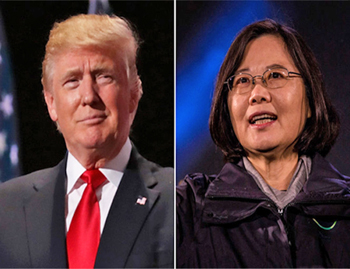
taiwan"I do not think it will change the One-China policy that the US government has insisted on applying over the years," Chinese Foreign Minister Wang Yi said after unprecedented move by US President-elect, Hong Kong-based Phoenix TV reported.

"The One-China policy is the cornerstone of the healthy development of China-US relations and we hope this political foundation will not be interfered with or damaged," Wang said after Trump spoke to Tsai, a striking break with decades of US diplomatic practice not to directly speak with Taiwan leader.

While Trump's call caught China by surprise, Wang's quick reaction played down expectations of a strong reaction from Beijing which wants to establish full contacts with Trump administration after he formally takes over power next month.

Like most of the countries in the world, US too pursued a so-called "One-China" policy since 1979, when it shifted its diplomatic recognition by formally recognising People's Republic of China (PRC) instead of Taiwan which broke off with mainland in 1949 after the formation of the PRC.

However, US continues to maintain low-key contacts with Taiwan including supplying military hardware to it.

China is trying to open up its channels with Trump as President Xi Jinping yesterday met former US Secretary of State Henry Kissinger who is widely regarded as part of back channel diplomacy between both the countries.

In his meeting with Kissinger, Xi said China hopes for sustained, healthy and stable ties with the US.

He said the mutual benefits of relations between the two countries outweigh their differences, and China is willing to work with the US for a smooth transition following last month's presidential election.

Xi said China and the US should continuously promote the new type of major power relations, and strengthen their coordination on international affairs.

Kissinger, a regular visitor to China, said the US-China relationship is important to the two countries, as well as the world as a whole. He hoped he can keep playing an active role in boosting the relationship.

"As a trailblazer for China-US ties, Kissinger paid a secret visit to China in 1971 which paved way for the establishment of China-US diplomatic ties in 1979," state-run Xinhua said in its report on Xi-Kissinger meeting.

A statement from Trump's transition team said he spoke with Tsai, who offered her congratulations.

Trump tweeted later: "The President of Taiwan CALLED ME today to wish me congratulations on winning the Presidency. Thank you!"

The Taiwanese presidential office also issued a statement saying Trump and Tsai discussed issues affecting Asia and the future of US relations with Taiwan.

Comments

Add new comment

  • Coastaldigest.com reserves the right to delete or block any comments.
  • Coastaldigset.com is not responsible for its readers’ comments.
  • Comments that are abusive, incendiary or irrelevant are strictly prohibited.
  • Please use a genuine email ID and provide your name to avoid reject.
News Network
May 6,2020

Washington, May 6: The Chinese Army is indulging in aggressive behaviour in the South China Sea and the Chinese Communist Party has ramped up its disinformation campaign to try to shift the blame on coronavirus and burnish its image, US Defense Secretary Mark Esper said on Tuesday.

"While the Chinese Communist Party ramps up its disinformation campaign to try to shift blame and burnish its image, we continue to see aggressive behaviour by the PLA in the South China Sea, from threatening a Philippine Navy ship to sinking a Vietnamese fishing boat and intimidating other nations from engaging in offshore oil and gas development," Esper told reporters at a Pentagon news conference.

Last week, two US Navy ships conducted freedom of navigation operations in the South China Sea to send a clear message to Beijing that America will continue to protect the freedom of navigation and commerce for all nations large and small, he said.

Many countries, Esper said, have turned inward to recover from the pandemic and in the meantime, America's strategic competitors are attempting to exploit this crisis to their benefit at the expense of others.

Responding to a question, he said the Chinese have not been transparent from the beginning on the coronavirus pandemic.

"If they had been more transparent, more open, upfront in terms of giving us access, the reporting, giving us access not to the people on the ground but to the virus they had so we could understand it, we would probably be in a far different place right now. But where we are now is this," Esper said.

China needs to allow the United States in to talk to early patients, Chinese researchers and scientists, and to have access, he added.

Instead, Esper alleged that the Chinese are trying to capitalise on this by promoting their own image that somehow, China is the good guy here.

"Despite everything they did or, more importantly, failed to do, now they want to go out and say well, here's masks. We will give you masks, provide this, or provide that, we will provide you funding. Look at all the good things we are doing," he said.

"Yet, what we know is that they provide masks, they provide supplies. In many cases, it is not good. It does not do what it is supposed to do. It is broken equipment. Also, the strings attached are enormous in many cases. So, they are telling a country you can take these masks, but please, put out publicly how good China is, how great we are doing, et cetera, et cetera," Esper said.

"So there is a number of things they are doing to try and burnish their image. That is just two of them right there," he said.

The Chinese are also doing a lot of strong-arming behind the scenes, Esper said and referred to the war of words between China and Australia. He said he plans to talk to his Australian counterpart later in the day.

"All these activities are going on. It is straight from the Chinese playbook. Once again, it is just a little bit more obvious this time with what they are doing and how they are using a combination of compelling and coercion and everything else to try and shape the narrative and burnish the image of the Chinese Communist Party," Esper said.

Comments

Add new comment

  • Coastaldigest.com reserves the right to delete or block any comments.
  • Coastaldigset.com is not responsible for its readers’ comments.
  • Comments that are abusive, incendiary or irrelevant are strictly prohibited.
  • Please use a genuine email ID and provide your name to avoid reject.
News Network
February 6,2020

Beijing, Feb 6: The number of confirmed fatalities from China's coronavirus outbreak rose to at least 560, after authorities in hardest-hit Hubei province reported 70 new deaths on February 6.

In its daily update, the health commission in Hubei also confirmed the number of confirmed infections in the outbreak has reached 28,018 nationwide with 3,694 new cases reported.

The epidemic, which has spiralled into a global health emergency, is believed to have emerged in December from a market that sold wild game in Hubei's capital Wuhan.

Hu Lishan, an official in Wuhan, warned Wednesday that despite building a hospital from scratch and converting public buildings to accommodate thousands of extra patients, there was still a "severe" lack of beds in the region.

There was also a shortage of "equipment and materials," he told reporters, adding that officials were looking to convert other hotels and schools in the city into treatment centres.

Authorities in several other cities in China have placed restrictions on the number of people allowed to leave their homes.

Global concerns have also risen about the virus, with cases confirmed in more than 20 countries.

Comments

Add new comment

  • Coastaldigest.com reserves the right to delete or block any comments.
  • Coastaldigset.com is not responsible for its readers’ comments.
  • Comments that are abusive, incendiary or irrelevant are strictly prohibited.
  • Please use a genuine email ID and provide your name to avoid reject.
News Network
February 26,2020

Feb 26: Looking out over the world’s largest cricket stadium, the seats jammed with more than 100,000 people, India’s prime minister heaped praise on his American visitor.

“The leadership of President Trump has served humanity,” Prime Minister Narendra Modi said Monday, highlighting Trump’s fight against terrorism and calling his 36-hour visit to India a watershed in India-U.S. relations.

The crowds cheered. Trump beamed.

“The ties between India and the U.S. are no longer just any other partnership,” Modi said. “It is a far greater and closer relationship.”

India, it seems, loves Donald Trump. It seemed obvious from the thousands who turned out to wave as his motorcade snaked through the city of Ahmedabad, and from the tens of thousands who filled the city’s new stadium. It seemed obvious from the hug that Modi gave Trump after he descended from Air Force One, and from the hundreds of billboards proclaiming Trump’s visit.

But it’s not so simple.

Because while Trump is genuinely popular in India, his clamorous and carefully choreographed welcome was also about Asian geopolitics, China’s growing power and a masterful Indian politician who gave his American visitor exactly what he wanted.

Modi “is doing this not necessarily because he loves Trump,” said Tanvi Madan, the director of the India Project at the Brookings Institution in Washington, D.C. “It’s very much about Trump as the leader of the U.S. and recognizing what it is that Trump himself likes.”

Trump likes crowds — big crowds — and the foot soldiers of India’s political parties have long known how to corral enough people to make any politician look popular. In a city like Ahmedabad, the capital of Modi’s home state of Gujarat and the center of his power base, it wouldn’t take much effort to fill a cavernous sports stadium. It was more surprising that a handful of seats remained empty, and that some in the stands had left even before Trump had finished his speech.

For India, good relations with the U.S. are deeply important: They signal that India is a serious global player, an issue that has long been important to New Delhi, and help cement an alliance that both nations see as a counterweight to China’s rise.

“For both countries, their biggest rival is China,” said John Echeverri-Gent, a professor at the University of Virginia whose research often focuses on India. “China is rapidly expanding its presence in the Indian Ocean, which India has long considered its backyard and its exclusive realm for security concerns.”

“It’s very clearly a major concern for both India and the United States,” he said.

Trump isn’t the first U.S. president that Modi has courted. In 2015, then-President Barack Obama was the first American chief guest at India’s Republic Day parade, a powerful symbolic gesture. Obama also got a Modi hug, and the media in both countries were soon writing about the two leaders’ “bromance.”

Trump is popular in India, even if some of that is simply because he’s the U.S. president. A 2019 Pew Research Center poll showed that 56% of Indians had confidence in Trump’s abilities in world affairs, one of only a handful of countries where he has that level of approval. But Obama was also popular: Before he left office, he had 58% approval in world affairs among Indians.

The Pew poll also indicated that Trump’s support was higher among supporters of Modi’s Hindu nationalist party.

That’s not surprising. Both men have fired up their nationalist bases with anti-Muslim rhetoric and government policies, from Trump’s travel bans to Modi’s crackdown in Kashmir, India’s only Muslim-majority state.

And Trump’s Indian support is far from universal. Protests against his trip roiled cities from New Delhi to Hyderabad to the far northeastern city of Gauhati, although those demonstrations were mostly overshadowed by protests over a new Indian citizenship law that Modi backs.

Modi, who is widely popular in India, has faced weeks of protests over the law, which provides fast track naturalization for some foreign-born religious minorities — but not Muslims. While Trump talked about ties with India on Tuesday, Hindus and Muslims fought in violent clashes that left at least 10 people dead over two days.

In some ways, Modi and Trump are powerful echoes of each other.

They have overlapping political styles. Both are populists who see themselves as brash, rule-breaking outsiders who disdain their countries’ traditional elites. Both are seen by their critics as having authoritarian leanings. Both surround themselves with officials who rarely question their decisions.

But are they friends?

Trump says yes. “Really, we feel very strongly about each other,” he said at a New Delhi press briefing.

But many observers aren’t so sure.

“The question is how much of this is real chemistry, as opposed to what I’d call planned chemistry” orchestrated for diplomatic reasons, said Madan. “It’s so hard to know if you’re not in the room.”

Certainly, Modi understands America’s importance to India. While the two countries continue to bicker about trade issues, the prime minister organized a welcome that impressed even India’s news media, which have watched countless choreographed mass political rallies.

“There is no other country for whose leader India would hold such an event, and for which an Indian prime minister would lavish such rhetoric,” the Hindustan Times said in an editorial.

“The spectacle and the sound were worth a thousand agreements.”

Comments

Add new comment

  • Coastaldigest.com reserves the right to delete or block any comments.
  • Coastaldigset.com is not responsible for its readers’ comments.
  • Comments that are abusive, incendiary or irrelevant are strictly prohibited.
  • Please use a genuine email ID and provide your name to avoid reject.