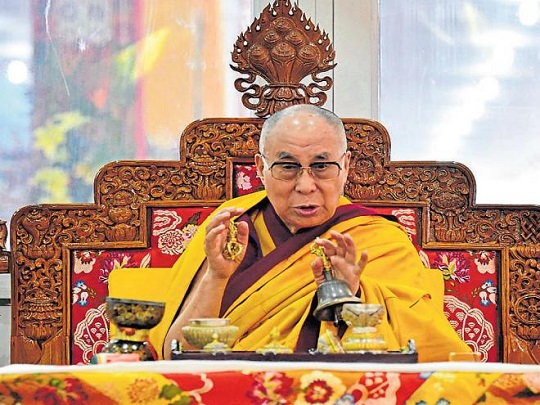
China warns India over invite to Dalai Lama to Buddhist meet

March 20, 2017

Beijing, Mar 20: China today warned India not to go against its "core concerns" to avoid "disruption" in bilateral ties after New Delhi invited the Tibetan spiritual leader Dalai Lama to an international Buddhist seminar in Bihar.

dalailama

"In recent days the Indian side, in total disregard of China's stern representation and strong opposition, insisted on inviting the 14th Dalai Lama to attend the international conference on Buddhism held by the Indian government," Foreign Ministry spokesperson Hua Chunying told reporters here.

"China is strongly dissatisfied and firmly opposed to it," she said.

"We urge the Indian side to clearly see the anti-China splittist nature of the Dalai group and honour its commitment on Tibet and related questions, respect China's core concerns and avoid China-India relations from being further disrupted and undermined," she said.
The 81-year-old Dalai Lama inaugurated an international seminar on Buddhism on March 17 in Rajgir in Bihar's Nalanda district, about 100 km from the capital Patna.

Buddhist monks and scholars from various countries participated in the seminar 'Buddhism in 21st Century'.

Earlier this month, China had objected to India permitting the Dalai Lama to visit Arunachal Pradesh which it regards as Southern Tibet.

China is strongly opposed tothe Dalai Lamavisiting disputed areas, Foreign Ministry spokesman Geng Shuang had said.

"China's position on eastern section of China-India border dispute is consistent and clear. TheDalaiclique has long been engaging in anti-China separatist activities and its record on the border question is not that good," he had said.

China views the Nobel Peace laureate, who fled into exile in India after a failed uprising against Chinese rule in 1959, as a dangerous separatist.

China in the past held talks with him for reconciliation after he fled from Tibet. But no such talks were held after President Xi Jinping took over as the new leader in 2012 and Beijing kept pressure on various countries not to host him.

Comments

Add new comment

  • Coastaldigest.com reserves the right to delete or block any comments.
  • Coastaldigset.com is not responsible for its readers’ comments.
  • Comments that are abusive, incendiary or irrelevant are strictly prohibited.
  • Please use a genuine email ID and provide your name to avoid reject.
Agencies
July 1,2020

The ILO has warned that if another Covid-19 wave hits in the second half of 2020, there would be global working-hour loss of 11.9 percent - equivalent to the loss of 340 million full-time jobs.

According to the 5th edition of International Labour Organisation (ILO) Monitor: Covid-19 and the world of work, the recovery in the global labour market for the rest of the year will be uncertain and incomplete.

The report said that there was a 14 percent drop in global working hours during the second quarter of 2020, equivalent to the loss of 400 million full-time jobs.

The number of working hours lost across the world in the first half of 2020 was significantly worse than previously estimated. The highly uncertain recovery in the second half of the year will not be enough to go back to pre-pandemic levels even in the best scenario, the agency warned.

The baseline model – which assumes a rebound in economic activity in line with existing forecasts, the lifting of workplace restrictions and a recovery in consumption and investment – projects a decrease in working hours of 4.9 percent (equivalent to 140 million full-time jobs) compared to last quarter of 2019.

It says that in the pessimistic scenario, the situation in the second half of 2020 would remain almost as challenging as in the second quarter.

“Even if one assumes better-tailored policy responses – thanks to the lessons learned throughout the first half of the year – there would still be a global working-hour loss of 11.9 per cent at the end of 2020, or 340 million full-time jobs, relative to the fourth quarter of 2019,” it said.

The pessimistic scenario assumes a second pandemic wave and the return of restrictions that would significantly slow recovery. The optimistic scenario assumes that workers’ activities resume quickly, significantly boosting aggregate demand and job creation. With this exceptionally fast recovery, the global loss of working hours would fall to 1.2 per cent (34 million full-time jobs).

The agency said that under the three possible scenarios for recovery in the next six months, “none” sees the global job situation in better shape than it was before lockdown measures began.

“This is why we talk of an uncertain but incomplete recovery even in the best of scenarios for the second half of this year. So there is not going to be a simple or quick recovery,” ILO Director-General Guy Ryder said.

The new figures reflect the worsening situation in many regions over the past weeks, especially in developing economies. Regionally, working time losses for the second quarter were: Americas (18.3 percent), Europe and Central Asia (13.9 percent), Asia and the Pacific (13.5 percent), Arab States (13.2 percent), and Africa (12.1 percent).

The vast majority of the world’s workers (93 per cent) continue to live in countries with some sort of workplace closures, with the Americas experiencing the greatest restrictions.

During the first quarter of the year, an estimated 5.4 percent of global working hours (equivalent to 155 million full-time jobs) were lost relative to the fourth quarter of 2019. Working- hour losses for the second quarter of 2020 relative to the last quarter of 2019 are estimated to reach 14 per cent worldwide (equivalent to 400 million full-time jobs), with the largest reduction (18.3 per cent) occurring in the Americas.

The ILO Monitor also found that women workers have been disproportionately affected by the pandemic, creating a risk that some of the modest progress on gender equality made in recent decades will be lost, and that work-related gender inequality will be exacerbated.

The severe impact of Covid-19 on women workers relates to their over-representation in some of the economic sectors worst affected by the crisis, such as accommodation, food, sales and manufacturing.

Globally, almost 510 million or 40 percent of all employed women work in the four most affected sectors, compared to 36.6 percent of men, it said.

The report said that women also dominate in the domestic work and health and social care work sectors, where they are at greater risk of losing their income and of infection and transmission and are also less likely to have social protection.

The pre-pandemic unequal distribution of unpaid care work has also worsened during the crisis, exacerbated by the closure of schools and care services.

Even as countries have adopted policy measures with unprecedented speed and scope, the ILO Monitor highlights some key challenges ahead, including finding the right balance and sequencing of health, economic and social and policy interventions to produce optimal sustainable labour market outcomes; implementing and sustaining policy interventions at the necessary scale when resources are likely to be increasingly constrained and protecting and promoting the conditions of vulnerable, disadvantaged and hard-hit groups to make labour markets fairer and more equitable.

“The decisions we adopt now will echo in the years to come and beyond 2030. Although countries are at different stages of the pandemic and a lot has been done, we need to redouble our efforts if we want to come out of this crisis in a better shape than when it started,” Ryder said. 

Comments

Add new comment

  • Coastaldigest.com reserves the right to delete or block any comments.
  • Coastaldigset.com is not responsible for its readers’ comments.
  • Comments that are abusive, incendiary or irrelevant are strictly prohibited.
  • Please use a genuine email ID and provide your name to avoid reject.
News Network
April 27,2020

Seoul/South Korea, Apr 27: North Korean leader Kim Jong Un is "alive and well", a top security adviser to the South's President Moon Jae-in said, downplaying rumours over Kim's health following his absence from a key anniversary.
"Our government position is firm," said Moon's special adviser on national security Moon Chung-in, in an interview with CNN on Sunday. "Kim Jong Un is alive and well."

The adviser said that Kim had been staying in Wonsan -- a resort town in the country's east -- since April 13, adding: "No suspicious movements have so far been detected."

Conjecture about Kim's health has grown since his conspicuous absence from the April 15 celebrations for the birthday of his grandfather Kim Il Sung, the North's founder -- the most important day in the country's political calendar.

Kim has not made a public appearance since presiding over a Workers' Party politburo meeting on April 11, and the following day state media reported him inspecting fighter jets at an air defence unit.

North Korean leader Kim Jong Un was not gravely ill, two South Korean government sources said on Tuesday, following reports he had undergone a cardiovascular procedure and was now in "grave danger."

His absence unleashed a series of unconfirmed media reports over his condition, which officials in Seoul previously poured cold water on.

"We have nothing to confirm and no special movement has been detected inside North Korea as of now," the South's presidential office said in a statement last week.

South Korea's unification minister Kim Yeon-chul reiterated Monday that remained the case, adding the "confident" conclusion was drawn from "a complex process of intelligence gathering and assessment".

'Grave danger'

Daily NK, an online media outlet run mostly by North Korean defectors, has reported Kim was undergoing treatment after a cardiovascular procedure earlier this month.

Citing an unidentified source inside the country, it said Kim, who is in his mid-30s, had needed urgent treatment due to heavy smoking, obesity and fatigue.

Soon afterwards, CNN reported that Washington was "monitoring intelligence" that Kim was in "grave danger" after undergoing surgery, quoting what it said was an anonymous US official.

US President Donald Trump on Thursday rejected reports that Kim was ailing but declined to state when he was last in touch with him.

On Monday, the official Rodong Sinmun newspaper reported that Kim had sent a message of thanks to workers on the giant Wonsan Kalma coastal tourism project.

It was the latest in a series of reports in recent days of statements issued or actions taken in Kim's name, although none has carried any pictures of him.

Satellite images reviewed by 38North, a US-based think tank, showed a train probably belonging to Kim at a station in Wonsan last week.

It cautioned that the train's presence did not "indicate anything about his health" but did "lend weight" to reports he was staying on the country's eastern coast.

Reporting from inside the isolated North is notoriously difficult, especially regarding anything to do with its leadership, which is among its most closely guarded secrets.

Previous absences from the public eye on Kim's part have prompted speculation about his health.

In 2014 he dropped out of sight for nearly six weeks before reappearing with a cane. Days later, the South's spy agency said he had undergone surgery to remove a cyst from his ankle.

Comments

Add new comment

  • Coastaldigest.com reserves the right to delete or block any comments.
  • Coastaldigset.com is not responsible for its readers’ comments.
  • Comments that are abusive, incendiary or irrelevant are strictly prohibited.
  • Please use a genuine email ID and provide your name to avoid reject.
Agencies
May 25,2020

The Japan government on Monday decided to lift the state of emergency for COVID-19 in Tokyo and four other prefectures of the country, the only places where the measure implemented to curb the pandemic had remained in force.

The lifting of the alert was backed by the coronavirus advisory panel and will be formally approved by the government later day, the economic revitalization minister and head of the working group to coordinate Japan's fight against COVID-19, Yasutoshi Nishimura, said.

The Japanese authorities made the decision after taking into account the number of infections and the situation of the health system in Tokyo, the three neighbouring prefectures of Chiba, Kanagawa and Saitama and the northern Hokkaido, the only ones where the state of emergency declared more than a month ago to control the pandemic remained in effect, reports Efe news.

The health alert was initially declared in Tokyo and six other prefectures on April 17 and subsequently extended across the country.

It allowed local authorities to ban large-scale public events and close bars and restaurants at night, among other measures, while the government has launched a campaign to encourage teleworking and staying at home.

The government resorted to this measure for the first time in the country's recent history to contain the spread of the virus and is now withdrawing it after a sustained slowdown in infections throughout the archipelago, where around 16,600 confirmed COVID-19 cases and 839 deaths have been recorded, according to the latest data.

The group of experts advising the government appreciated the efforts made by citizens to comply with the recommendations to achieve the target of reducing interpersonal contact by 80 percent, top government spokesperson Yoshihide Suga said at a press conference on Monday.

The recommendation for citizens to avoid unnecessary trips outside and the request for non-essential businesses to close were not mandatory nor accompanied by fines or other penalties for non-compliance, unlike the stricter containment measures implemented in other countries.

The government plans to formally approve the lifting of the state of emergency on Monday after consulting with other political parties in parliament and another meeting with the advisory panel, following which Japanese Prime Minister Shinzo Abe will hold a press conference.

The government had already decided to lift the emergency in 39 prefectures on May 14 after they reported a marked decrease in the number of infections, leaving out the more populated regions such as Tokyo and Osaka.

To avoid new outbreaks of the virus, Abe has urged people to become accustomed to a "new lifestyle" that includes maintaining social distancing, the use of masks outside as well as a series of guidelines for the reopening of shops, restaurants and public facilities.

Comments

Add new comment

  • Coastaldigest.com reserves the right to delete or block any comments.
  • Coastaldigset.com is not responsible for its readers’ comments.
  • Comments that are abusive, incendiary or irrelevant are strictly prohibited.
  • Please use a genuine email ID and provide your name to avoid reject.