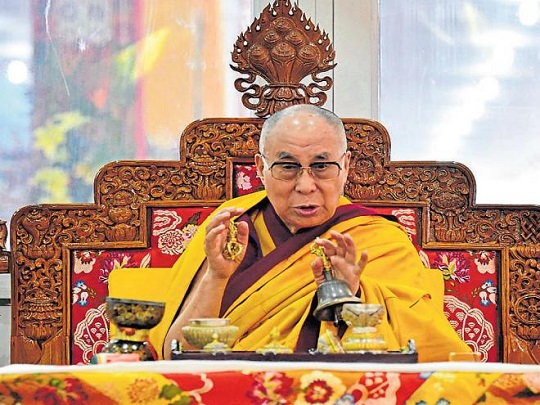
China warns India over invite to Dalai Lama to Buddhist meet

March 20, 2017

Beijing, Mar 20: China today warned India not to go against its "core concerns" to avoid "disruption" in bilateral ties after New Delhi invited the Tibetan spiritual leader Dalai Lama to an international Buddhist seminar in Bihar.

dalailama

"In recent days the Indian side, in total disregard of China's stern representation and strong opposition, insisted on inviting the 14th Dalai Lama to attend the international conference on Buddhism held by the Indian government," Foreign Ministry spokesperson Hua Chunying told reporters here.

"China is strongly dissatisfied and firmly opposed to it," she said.

"We urge the Indian side to clearly see the anti-China splittist nature of the Dalai group and honour its commitment on Tibet and related questions, respect China's core concerns and avoid China-India relations from being further disrupted and undermined," she said.
The 81-year-old Dalai Lama inaugurated an international seminar on Buddhism on March 17 in Rajgir in Bihar's Nalanda district, about 100 km from the capital Patna.

Buddhist monks and scholars from various countries participated in the seminar 'Buddhism in 21st Century'.

Earlier this month, China had objected to India permitting the Dalai Lama to visit Arunachal Pradesh which it regards as Southern Tibet.

China is strongly opposed tothe Dalai Lamavisiting disputed areas, Foreign Ministry spokesman Geng Shuang had said.

"China's position on eastern section of China-India border dispute is consistent and clear. TheDalaiclique has long been engaging in anti-China separatist activities and its record on the border question is not that good," he had said.

China views the Nobel Peace laureate, who fled into exile in India after a failed uprising against Chinese rule in 1959, as a dangerous separatist.

China in the past held talks with him for reconciliation after he fled from Tibet. But no such talks were held after President Xi Jinping took over as the new leader in 2012 and Beijing kept pressure on various countries not to host him.

Comments

Add new comment

  • Coastaldigest.com reserves the right to delete or block any comments.
  • Coastaldigset.com is not responsible for its readers’ comments.
  • Comments that are abusive, incendiary or irrelevant are strictly prohibited.
  • Please use a genuine email ID and provide your name to avoid reject.
News Network
February 19,2020

London, Feb 19: UK Home Secretary Priti Patel today announced the launch of the Britain's new points-based visa system, aimed at attracting the "brightest and the best" from the world, including from India, and cutting down numbers of cheap, low-skilled workers coming to the country.

The new system will come into force from January 1, 2021 at the end of the transition period after the UK's exit from the European Union (EU) last month, which will formally end free movement of people within the economic bloc for the UK as a non-member.

The new post-Brexit system, which will apply equally to the EU and non-EU countries like India, is based on assigning points for specific skills, qualifications, salaries and professions, with visas only awarded to those who gain enough points.

"Today is a historic moment for the whole country. We're ending free movement, taking back control of our borders and delivering on the people's priorities by introducing a new UK points-based immigration system, which will bring overall migration numbers down," said Ms Patel, the senior-most Indian-origin Cabinet minister.

"We will attract the brightest and the best from around the globe, boosting the economy and our communities, and unleash this country's full potential," Ms Patel, in charge of the UK's visa and immigration system, said.

The UK Home Office said the new system is a direct response to the 2016 referendum in favour of Brexit, which was seen as a vote to end the country's reliance on cheap migrant labour and reduce overall levels of migration with tighter security.

"The new single global system will treat the EU and non-EU citizens equally. It will give top priority to those with the highest skills and the greatest talents, including scientists, engineers and academics," the Home Office said.

The Global Talent Scheme, a fast-track visa to be in operation from Friday, will also apply to the EU citizens from next year to allow highly-skilled scientists and researchers to come to the UK without a job offer.

Professor Alice Gast, President of Imperial College London, said: "British science is global. The new post-study work and Global Talent visas will help us to attract the world's brightest students and researchers, wherever they come from."

"From the race to develop a coronavirus vaccine to clean energy, British science's international collaborations drive innovation and excellence."

The government said the points threshold for the new system will be carefully set to attract the talent the UK needs. Skilled workers will need to meet a number of relevant criteria, including specific skills and the ability to speak English, to be able to work in the UK. All applicants will be required to have a job offer and, in line with the Migration Advisory Committee''s (MAC) recommendations, the minimum salary threshold will be set at 25,600 pounds - lower than the previous 30,000 pounds level for Tier 2 work visas.

The new points-based system will also expand the skills threshold for skilled workers.

Those looking to live and work in the UK will need to be qualified up to A-level or equivalent, rather than degree-level under the current system. This will provide greater flexibility and ensure UK business has access to a wide pool of skilled workers, the Home Office said.

In line with the British Prime Minister Boris Johnson's manifesto commitment in the December 2019 General Election, there will be no specific route for low-skilled workers.

"It is estimated 70 per cent of the existing EU workforce would not meet the requirements of the skilled worker route, which will help to bring overall numbers down in future," the Home Office said.

Student visa routes will also be points-based and be opened up to EU citizens from next year.

Those wishing to study in the UK will need to demonstrate that they have an offer from an approved educational institution, that they can support themselves financially and that they speak English.

To address the specific labour concerns of the agricultural sector reliant on seasonal workers from the EU, the Seasonal Workers Pilot will be expanded in time for the 2020 harvest from 2,500 to 10,000 places.

EU citizens and other non-visa nationals will not require a visa to enter the UK when visiting the UK for up to six months.

However, the use of national identity cards will be phased out for travel to the UK and the Home Office highlighted that as part of its post-Brexit offer, those EU citizens resident in the UK by December 31 2020 can still apply to settle in the UK through the EU Settlement Scheme until June 2021.


Comments

Add new comment

  • Coastaldigest.com reserves the right to delete or block any comments.
  • Coastaldigset.com is not responsible for its readers’ comments.
  • Comments that are abusive, incendiary or irrelevant are strictly prohibited.
  • Please use a genuine email ID and provide your name to avoid reject.
News Network
May 25,2020

Islamabad, May 25: Pakistan’s coronavirus cases on Monday reached 56,349 with 1,748 new patients while the death toll climbed to 1,167, the health ministry said.

The Ministry of National Health Services reported that 22,491 cases were diagnosed in Sindh, 20,077 in Punjab, 7,905 in Khyber-Pakhtunkhwa, 3,407 in Balochistan, 1,641 in Islamabad, 619 in Gilgit-Baltistan and 209 in Pakistan-occupied Kashmir.

So far 1,167 people have died of the COVID-19 including 34 who lost their lives in the last 24 hours. A total of 17,482 patients have recovered from the deadly contagion.

The authorities have conducted 483,656 tests in the country, including 10,049 on Sunday. The trajectory showed that the number was steadily going up with authorities fearing a rise in cases in the wake of the easing of lockdown before Eid which was observed in the country on Sunday.

Comments

Add new comment

  • Coastaldigest.com reserves the right to delete or block any comments.
  • Coastaldigset.com is not responsible for its readers’ comments.
  • Comments that are abusive, incendiary or irrelevant are strictly prohibited.
  • Please use a genuine email ID and provide your name to avoid reject.
Agencies
February 4,2020

As the deadly coronavirus has spread worldwide, it has carried with it xenophobia -- and Asian communities around the world are finding themselves subject to suspicion and fear.

When a patient on Australia's Gold Coast refused to shake the hand of her surgeon Rhea Liang, citing the virus that has killed hundreds, the medic's first response was shock.

But after tweeting about the incident and receiving a flood of responses, the respected doctor learned her experience was all too common.

There has been a spike in reports of anti-Chinese rhetoric directed at people of Asian origin, regardless of whether they have ever visited the centre of the epidemic or been in contact with the virus.

Chinese tourists have reportedly been spat at in the Italian city of Venice, a family in Turin was accused of carrying the disease, and mothers in Milan have used social media to call for children to be kept away from Chinese classmates.

In Canada, a white man was filmed telling a Chinese-Canadian woman "you dropped your coronavirus" in the parking lot of a local mall.

In Malaysia, a petition to "bar Chinese people from entering our beloved country" received almost 500,000 signatures in one week.

The incidents are part of what the Australasian College for Emergency Medicine has described as "misinformation" which it says is fuelling "racial profiling" where "deeply distressing assumptions are being made about 'Chinese' or 'Asian-looking' people." Disease has long been accompanied by suspicions of foreigners -- from Irish immigrants being targeted in the Typhoid Mary panic of 1900s America to Nepali peacekeepers being accused of bringing cholera to earthquake-struck Haiti in the last decade.

"It's a common phenomenon," said Rob Grenfell, director of health and biosecurity for Australia's science and research agency CSIRO.

"With outbreaks and epidemics along human history, we've always tried to vilify certain subsets of the population," he said, comparing the behaviour to 1300s plague-ridden medieval Europe, where foreigners and religious groups were often blamed.

"Sure it emerged in China," he said of the coronavirus, "but that's no reason to actually vilify Chinese people." In a commentary for the British Medical Journal, doctor Abraar Karan warned this behaviour could discourage people with symptoms from coming forward.

Claire Hooker, a health lecturer at the University of Sydney, said the responses from governments may have compounded prejudice.

The World Health Organisation has warned against "measures that unnecessarily interfere with international travel and trade", but this has not stopped scores of countries from introducing travel bans.

The tiny Pacific nation of Micronesia has banned its citizens from visiting mainland China altogether.

"Travel bans respond largely to people's fears," said Hooker, and while sometimes warranted, they often "have the effect of cementing an association between Chinese people and scary viruses".

Abbey Shi, a Shanghai-born student in Sydney, said the attitude shown by some of her peers has "become almost an attack on students who are Chinese".

While Australia's conservative government has banished its citizens returning from Wuhan -- the central Chinese city at the epicentre of the virus -- to a remote island for quarantine, thousands of students still stuck in China risk their studies being torpedoed.

"Right now it looks like they have to miss the semester's start and potentially the whole year, because of the way the courses are set up," Shi said.

According to Hooker, studies in Toronto on the impact of Severe Acute Respiratory Syndrome, or SARS -- another global coronavirus outbreak in 2002 -- showed the impact of xenophobic sentiment often lasted much longer than the public health scare.

"While there may be a cessation of direct forms of racism as news about the disease dies down, it takes quite a bit of time for economic recovery and people continue to feel unsafe," she said.

People may not rush back to Chinese businesses or restaurants, and may even heed some of the more outlandish viral social media disinformation -- such as one popular post imploring people to avoid eating noodles for their own safety.

"In one sense you might think the effects lasted from the last coronavirus to this one because the representation as China being a place where diseases come from has been persistent," Hooker said.

Comments

Add new comment

  • Coastaldigest.com reserves the right to delete or block any comments.
  • Coastaldigset.com is not responsible for its readers’ comments.
  • Comments that are abusive, incendiary or irrelevant are strictly prohibited.
  • Please use a genuine email ID and provide your name to avoid reject.