


Chinese Communist Party officials harden rhetoric on Muslims

March 13, 2017

Beijing, Mar 13: China's ruling Communist Party is hardening its rhetoric on Islam, with top officials making repeated warnings about the spectre of global religious extremism seeping into the country and the need to protect traditional Chinese identity.
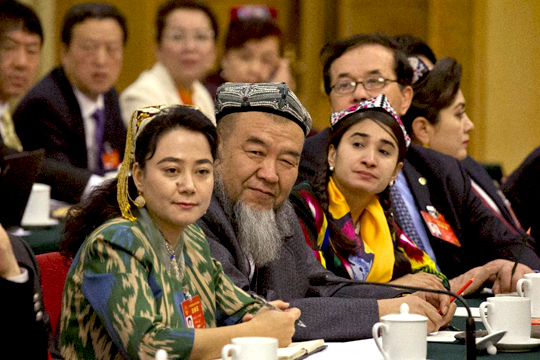
Chinese

Shaerheti Ahan, a top political and legal affairs party official in Xinjiang, today became the latest official from a predominantly Muslim region to warn political leaders gathered in Beijing for this month's National People's Congress about China becoming destabilised by the "international anti-terror situation".

Over the past year, President Xi Jinping has directed the party to "Sinicise" the country's ethnic and religious minorities, while regional leaders in Xinjiang, home to the Uighur (pronounced WEE-gur) ethnic minority, have ramped up surveillance measures, police patrols and demonstrations amid an uptick in violence blamed on Islamic separatists.

Although some scholars question whether global jihadi networks have indeed penetrated the country, top Chinese officials, including those overseeing areas outside Xinjiang, are increasingly echoing certain strands of international discourse to back up claims that Islamic extremism is growing worldwide and needs to be rolled back.

Officials from Ningxia Hui Autonomous Region, which has an ethnic Hui population that is predominantly Muslim but, unlike Xinjiang, rarely sees separatist or religious violence, warned similarly this past week about the perils of Islamic extremism. Speaking at a regional meeting open to the media, Ningxia Communist Party secretary Li Jianguo drew comparisons to the policies of President Donald Trump's administration to make his point.

"What the Islamic State and extremists push is jihad, terror, violence," Li said. "This is why we see Trump targeting Muslims in a travel ban. It doesn't matter whether anti-Muslim policy is in the interests of the US or it promotes stability, it's about preventing religious extremism from seeping into all of American culture."

Wu Shimin, a former ethnic affairs official from Ningxia, said that ideological work must be strengthened in the region to promote a Chinese identity among its Hui population, the descendants of Muslim traders plying the Silk Road centuries ago.

"The roots of the Hui are in China," Wu said. "To discuss religious consciousness, we must first discuss Chinese consciousness. To discuss the feelings of minorities, we must first discuss the feelings of the Chinese people."

Mohammed al-Sudairi, a doctoral student at the University of Hong Kong and an expert on Islam in China, said the comments by Ningxia party officials reflected the increasingly anti-Islamic rhetoric that has been rolled out over the past year by the top leadership in Beijing.

Comments

Add new comment

  • Coastaldigest.com reserves the right to delete or block any comments.
  • Coastaldigset.com is not responsible for its readers’ comments.
  • Comments that are abusive, incendiary or irrelevant are strictly prohibited.
  • Please use a genuine email ID and provide your name to avoid reject.
Agencies
February 17,2020

Islamabad, Feb 17: Prime Minister Imran Khan on Monday warned that Pakistan may face another refugee crisis if the international community failed to take notice of the current situation in India.

Speaking at the two-day refugee summit in Islamabad on 40 years of hosting Afghan refugees in Pakistan, he said India’s "ultranationalist ideology going unchecked could lead to destruction and the region could become a flashpoint", The Express Tribune quoted him as saying.

Khan said if the international community does not take notice of this situation, it will create another refugee crisis for Pakistan as Muslims of India will move to Pakistan.

"This is not the India of Jawaharlal Nehru and Mahatma Gandhi. The United Nations (UN) must play its role otherwise it will become a very big problem in the future," Duniya News quoted Khan as saying.

He said said that Prime Minister Narendra Modi’s statement that India can destroy Pakistan in 11 days is not a responsible statement by a premier of a nuclear state with a huge population, the paper reported.

Khan made the statement in the presence of visiting UN Secretary General Antonio Guterres, who was also attending the summit.

He said because of the "Hindutva" ideology, Kashmiris have been lockdown for over 200 days. He alleged under the same ideology, the BJP-led government passed two discriminatory nationalistic legislations, targeting 200 million Muslims in India.

Khan was referring to India's Citizenship (Amendment) Act and the revocation of the special status to Jammu and Kashmir.

The new citizenship law passed by the Indian Parliament in December 2019 offers citizenship to non-Muslim persecuted religious minorities from Pakistan, Bangladesh and Afghanistan.

The Indian government has maintained that the CAA is an internal matter of the country and stressed that the goal is to protect the oppressed minorities of neighbouring countries.

India revoked Jammu and Kashmir's special status on August 5. Reacting to India's move, Pakistan downgraded diplomatic ties with New Delhi and expelled the Indian High Commissioner.

India has always maintained that Jammu and Kashmir is its integral part and ruled out any third party mediation, including either from the UN or the US, saying it is a bilateral issue with Pakistan.

Comments

Add new comment

  • Coastaldigest.com reserves the right to delete or block any comments.
  • Coastaldigset.com is not responsible for its readers’ comments.
  • Comments that are abusive, incendiary or irrelevant are strictly prohibited.
  • Please use a genuine email ID and provide your name to avoid reject.
Agencies
June 9,2020

Wuhan, Jun 9: China on Tuesday dismissed as "incredibly ridiculous" a Harvard study, which pointed to a surge in traffic outside Wuhan hospitals from August 2019 suggesting that the coronavirus hit the area far earlier than reported.

A whitepaper on coronavirus released by China on Sunday said the virus was first noticed on December 17 and Chinese virologists confirmed human-to-human transmission on January 19, prompting authorities to impose lockdown of Wuhan from January 23.

US President Donald Trump and leaders of several countries have accused China of not being transparent in reporting the deadly disease, leading to huge human casualties and economic crisis across the world.

The new study by Harvard researchers says satellite images show an increase in traffic outside five hospitals in Wuhan from late August to December.

The traffic spike coincided with a rise in online searches for information on symptoms like "cough" and "diarrhoea".

China said the study was "ridiculous" and based on "superficial" information, BBC reported.

It is believed that the virus first appeared in China some time in November. Authorities reported a cluster of pneumonia cases with an unknown cause to the World Health Organization (WHO) on December 31.

"Clearly, there was some level of social disruption taking place well before what was previously identified as the start of the novel coronavirus pandemic," Dr John Brownstein, who led the research, told ABC news.

The study has not been peer-reviewed.

The researchers examined commercial satellite data from outside five Wuhan hospitals, comparing data from late summer and autumn 2018 to the same time period in 2019.

In one case, researchers counted 171 cars parked at one of Wuhan''s largest hospitals, Tianyou Hospital, in October 2018.

Satellite data from the same time in 2019 showed 285 vehicles in the same place, an increase of 67 per cent.

A surge in online searches for words associated with the symptoms of coronavirus on the Chinese search engine Baidu seemed to emerge at the same time.

"This is all about a growing body of information pointing to something taking place in Wuhan at the time," Dr Brownstein said.

"Many studies are still needed to fully uncover what took place and for people to really learn about how these disease outbreaks unfold and emerge in populations. So this is just another point of evidence," he said.

Asked for her reaction at the media briefing, Chinese Foreign Ministry spokeswoman Hua Chunying dismissed the findings as "incredibly ridiculous".

"I think it is ridiculous, incredibly ridiculous, to come up with this conclusion based on superficial observations such as traffic volume," she said.

"(I have) Not seen the research you mentioned. If the conclusion is drawn based on traffic volumes (and) other superficial observations, it won’t be a sound conclusion," she said and referred to the allegations about the COVID-19 originating from the Wuhan Institute of Virology (WIV) by Trump.

"That allegation was proved to be wrong," she said.

When pointed out that China says it respects science based inquiry and Harvard is one of the top universities in the world, Hua said, "on the origin of virus there are lot of conspiracy theories against China”.

"That is very unfair. At the moment, the pressing task is to enhance coordination to contain the spread of the virus. Someday, I am sure the truth will be out. China deserves a fair and objective evaluation," she said and referred to the whitepaper released by the Chinese government detailing evolution of coronavirus in Wuhan and how Beijing handled the situation.

Recently, the World Health Assembly (WHA), the decision-making body of Geneva-based World Health Organization (WHO), passed a resolution to probe the origin of the virus. China also backed the resolution.

As of Monday, the overall confirmed cases on the mainland had reached 83,043, including 58 patients who were still being treated, with no one in severe condition, China’s National Health Commission, (NHC) said.

Altogether 78,351 people had been discharged after recovery and 4,634 people had died of the disease, it said.

Comments

Add new comment

  • Coastaldigest.com reserves the right to delete or block any comments.
  • Coastaldigset.com is not responsible for its readers’ comments.
  • Comments that are abusive, incendiary or irrelevant are strictly prohibited.
  • Please use a genuine email ID and provide your name to avoid reject.
News Network
July 1,2020

Melbourne, July 1: Authorities will lock down around 300,000 people in suburbs north of Melbourne for a month from late on Wednesday to contain the risk of infection after two weeks of double-digit rises in new coronavirus cases in Australia's second-most populous state.

Australia has fared better than many countries in the pandemic, with around 7,830 cases and 104 deaths, but the recent surge has stoked fears of a second wave of COVID-19, echoing concerns expressed in other countries.

Globally, coronavirus cases exceeded 10 million on Sunday, a major milestone in the spread of a disease that has killed more than half a million people in seven months.

From midnight, more than 30 suburbs in Australia's second-biggest city will return to stage three restrictions, the third-strictest level in curbs to control the pandemic. That means residents will be confined to home except for grocery shopping, health appointments, work or caregiving, and exercise.

The restrictions will be accompanied by a testing blitz that authorities hope will extend to half the population of the area affected, and for which borders will be patrolled, authorities said. The measures come as curbs ease across the rest of the state of Victoria, with restaurants, gyms and cinemas reopening in recent weeks.

Victoria recorded 73 fresh cases on Tuesday from 20,682 tests, following an increase of 75 cases on Monday. State premier Daniel Andrews warned on Wednesday that the return of broader restrictions across city remained a possibility.

"If we all stick together these next four weeks, we can regain control of that community transmission ... across metropolitan Melbourne," Andrews said at a briefing. "Ultimately if I didn't shut down those postcodes I'd be shutting down all postcodes. We want to avoid that."

Victoria's spike in cases has been linked to staff members at hotels housing returned travellers for which quarantine protocols were not strictly followed. Victorian state authorities have announced an investigation into the matter.

Some other Australian states and territories are preparing to open borders, but applying limits and quarantine measures to citizens of Victoria as the school holiday season gets under way.

South Australia, the country's fifth most populous state, has had just three new cases in the past month. But citing the spike in coronavirus infections, on Tuesday it cancelled its scheduled reopening to other parts of the nation.

New South Wales (NSW), Australia's most populous state, has stopped short of closing its borders to all Victorians, but those holidaying from hotspot areas - not permitted under NSW rules - can be handed a fine of A$11,000 ($7,596) or jailed if they are detected, state authorities said.

The delays reopening internal borders cast doubts over a federal plan to set up "travel bubble" with neighbouring New Zealand that would allow movement between the two countries.

Comments

Add new comment

  • Coastaldigest.com reserves the right to delete or block any comments.
  • Coastaldigset.com is not responsible for its readers’ comments.
  • Comments that are abusive, incendiary or irrelevant are strictly prohibited.
  • Please use a genuine email ID and provide your name to avoid reject.