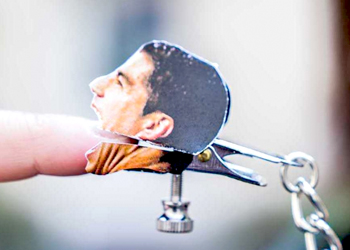
Chinese website sells 'Suarez bite' bottle openers

July 6, 2014

Suarez bite bottleBeijing, Jul 6: Chinese online stores are cheekily trying to cash in on Uruguay striker Luis Suarez's notorious bite of an opponent at the World Cup by selling bottle openers with his image.

Liverpool forward Suarez was given a four month ban from football for sinking his teeth into Italy defender Giorgio Chiellini during their final group match in Brazil last month.

He was also suspended for nine internationals and fined 100,000 Swiss francs (112,000 dollars) for what was his third offence of biting an opposition player.

Popular Chinese retail website Taobao has retailers offering bottle openers in a cartoon image of Suarez, looking angry with his mouth wide open, for 16.80 yuan ($2.70).

The China Daily newspaper reported that the products were proving popular.

"I came up with the idea the night I watched the game and saw the bite," Wang Lin, who owns an e-shop on Taobao.com, told the paper.

"It has been a good sales idea, the only problem being that the manufacturing process cannot keep up with demand," he added.

The bottle openers are not the first fun response to Suarez's bite -- an online Swedish sex shop unveiled a "Suarez nipple clamp" in the form of the footballer's head, teeth bared, for 33 euros ($45).

Uruguay have lodged an appeal against the ban on Suarez who later apologised for his actions.

Comments

Add new comment

  • Coastaldigest.com reserves the right to delete or block any comments.
  • Coastaldigset.com is not responsible for its readers’ comments.
  • Comments that are abusive, incendiary or irrelevant are strictly prohibited.
  • Please use a genuine email ID and provide your name to avoid reject.
Agencies
January 10,2020

Indian enterprises were flooded with a whopping 14.6 crore malware threats in 2019 - a growth of 48 per cent (year-on-year) compared to 2018, a new report said on Friday.

Manufacturing, BFSI (banking, financial services and insurance), education, healthcare, IT/ITES, and the government were the most at-risk industries in the country, said the report from Seqrite, the enterprise arm of Pune-based IT security firm Quick Heal Technologies.

Interestingly, almost a quarter (23 per cent) of the threats were identified through 'Signatureless behaviour-based' detection by Seqrite, indicating how a growing number of cybercriminals were deploying new or previously unknown threat vectors to compromise enterprise security.

"With the latest Seqrite annual threat report, we want to empower CIOs, CISOs, business leaders and all key public stakeholders with the insights they need to combat the growing complexity of the threat landscape," said Sanjay Katkar, Joint Managing Director and CTO, Quick Heal Technologies.

The most prominent trend was the drastic increase in the volume, intensity, and sophistication of cyber-attack campaigns targeting Indian enterprises in 2019.

The rapid integration of IoT devices, BYOD (bring your own device), and third-party APIs into enterprise networks has created newer security vulnerabilities that might go unnoticed until a major breach occurs.

Threat researchers at Seqrite observed several large-scale advanced persistent threats (APT) attacks deployed against organisations in the government sector.

"The entry of nation-states and organised cybercrime cells into the fray is expected to add more complication to this situation and will require Indian government bodies and corporate enterprises to shore up their cyber defence strategies in 2020 and beyond," the report noted.

More alarming, however, was the continued lack of security awareness amongst enterprises and government organisations.

"Unsecured Remote Desktop Protocol (RDP) and Server Message Block (SMB) protocols continued to be targeted through brute-force attacks," said the report.

Spear phishing attack campaigns leveraging Office exploits and infected macros were also used extensively by cybercriminals to gain access to enterprise networks and steal critical data.

"India's digital journey depends on ensuring robust cybersecurity for all stakeholders within the enterprise ecosystem," said Katkar.

The sharp spike should be a cause of concern for CIOs and CISOs in the country, especially given the growing digital penetration within their enterprise networks.

"With network vulnerabilities and potential entry points increasing at a rapid pace, threat actors are expected to leverage artificial intelligence (AI) capabilities to power their malware campaigns in the future to capitalise on newer attack vectors," the report added.

Comments

Add new comment

  • Coastaldigest.com reserves the right to delete or block any comments.
  • Coastaldigset.com is not responsible for its readers’ comments.
  • Comments that are abusive, incendiary or irrelevant are strictly prohibited.
  • Please use a genuine email ID and provide your name to avoid reject.
Agencies
March 12,2020

Thiruvananthapuram, Mar 12: In the wake of COVID-19 outbreak, Internet service providers in Kerala have agreed to step up the network capacity by 30 to 40 per cent of the present capacity to meet the demand, especially in view of the spurt in work-at-home mode.

"The decision was made at a meeting of representatives of various telecom service providers in Kerala circle and officials of the Telecommunication Department convened by the Secretary, Electronics and IT, following a direction by Chief Minister Pinarayi Vijayan to look into the issue," said a press release by the IT Department.

The decision will be beneficial for those working in IT institutions. The government has come out with a set of suggestions to avoid social gatherings at public places in view of coronavirus spread. Telecom service providers have assured the government that they are well equipped to face the current situation.

The major part of Internet consumption in Kerala is made available through local servers. Moreover, global Internet traffic is very low as compared to the overall consumption. So, increasing the capacity won't be difficult, service providers informed.

"Complaints regarding the low availability of the Internet due to the spurt in consumption of the Internet can be made to the service providers to their complaint redressal number or inform state government call centre (155300). But complaints regarding the insufficiency in the current network infrastructure should be strictly avoided," said the release.

The IT Department will also demand daily reports from various telecom service providers. By analysing these reports, steps for remedies will be taken after bringing the sudden increase in consumption to the service providers.

Comments

Add new comment

  • Coastaldigest.com reserves the right to delete or block any comments.
  • Coastaldigset.com is not responsible for its readers’ comments.
  • Comments that are abusive, incendiary or irrelevant are strictly prohibited.
  • Please use a genuine email ID and provide your name to avoid reject.
Agencies
January 22,2020

New Delhi, Jan 22: "Don't get into a trap. Your security is in your hands," the Border Security Force (BSF) has said issuing its social media rules for its officers and men. It has directed them not to use 42 mobile applications and show caution while using Facebook, Twitter and WhatsApp.

"Be cautious while using social media," said the BSF in a circular issued recently.

"Before using WhatsApp, Facebook, Twitter and other social media platforms, one needs to keep in mind that you are border guarding force and Central Civil Services (Conduct) Rules rule duly are applicable," it said.

It further pointed out that by commenting/writing about or forwarding unverified reports and rumours one violates laws of land.

"Several times unverified reports would be presented in way that they are absolutely true and start believing it. Seeing such post always use your commonsense and never get into the trap (sic.)," it state adding that the anti-national elements uses social media to propagate their agenda to cause unrest in India.

A picture clicked by Border Security Force personnel and posted on a social media platform remains there for always. Therefore, one should use officially approved pictures about any incident or untoward incidents related to Border Security Force, stated the circular. It pointed that unauthorised persons should not engage into taking pictures of the incidents.

It also highlighted how through social media, a few BSF personnel have fallen into trap of espionage racket carried out by enemy countries.

"Our security and respect is in our hands. Always think twice whether you are doing correct by accepting friendship requests from unknown persons, especially women and girls," it cautioned the troopers and officers.

It also highlighted that while going on leave and joining back the force, always follow the rules and regulations laid out for safety and security. "This is for your own safety," it stressed in the end.

The BSF has also issued a list of 42 mobile applications that needs to be completely avoided by serving BSF officers and jawans.

They are MI store, Weibo, Wechat, Shareit, Truecaller, UC News, UC Browser, Beautyplus, NewsDog, Viva Video - QU video Inc, Parallel Space, Apus Browser, Perfect Corp, Virus Cleaner - HI Security Lab, CM browser, MI Community, DU recorder, Vault Hide - No mobile Security, Youcam Makeup, Cachecleaner DU Apps Studio, DU battery saver, DU privacy, 360 security, DU Browser,Clean master - Cheeta Mobile, Baidu Translate, Wonder Camera - Bindu Inc, ES Ifle Explorer, Photo Wonder, QQ international , QQ music, QQ Mail, AA player, QQ News Feed, Wesync, QQ security Center, Selfie City, Mail Master, Mi Video Call -Xaomi and QQ launcher.


Comments

Add new comment

  • Coastaldigest.com reserves the right to delete or block any comments.
  • Coastaldigset.com is not responsible for its readers’ comments.
  • Comments that are abusive, incendiary or irrelevant are strictly prohibited.
  • Please use a genuine email ID and provide your name to avoid reject.