


Christian school vandalism: PM Modi summons Delhi police chief, orders strict action

February 13, 2015

New Delhi, Feb 13: Prime Minister Narendra Modi on Friday summoned Delhi Police Commissioner BS Bassi after a “theft” at a convent school in south Delhi.
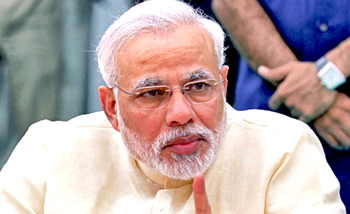
Modi summonsExpressing "deep concern and anguish" over the rising crime rate in the capital, the PM directed Bassi to come down hard on those involved in such attacks.

The Prime Minister further asked the Police Commissioner to speedily investigate the recent incidents of vandalism and ensure that the guilty are brought to book.

Modi also spoke over telephone to Union Home Secretary LC Goyal and asked him to "pay special attention to the rising incidents of crime, and vandalism, and to work towards ensuring the safety and security of women in the capital," an official release said here.

The PM summoned Bassi hours after Human Resource Development Minister Smriti Irani, an alumnus of the institution, visited the Holy Child Auxilium School in south Delhi's Vasant Vihar and urged Union Home Minister Rajnath Singh to look into the matter.

Delhi Chief Minister-designate Arvind Kejriwal has also condemned the attack.

Talking to reporters, Bassi said: "The Prime Minister told me to take strict action against the perpetrators of such attacks.”

Unidentified persons had allegedly vandalised the school in South Delhi's Vasant Vihar in the wee hours even as police and school authorities claimed it to be a case of robbery.

Police said the office of the school principal was vandalised and wires of CCTV were cut. After the incident, the school was shut down this morning.

"We are investigating and have registered a case in this regard," said a senior official.

This is the sixth incident in three months on Christian establishments in the national capital.

Police, however, claimed that it was a case of robbery as a donation box was missing."The school's donation box which is at a distance from the church has been robbed. It is an incident of robbery and we suspect that it is an insider's job who knew where the cameras were installed.”

"It is not a case of desecration, as per our preliminary investigation," Bassi told reporters.

School authorities also claimed it to be a case of robbery.

"When the maid came to open the school, administrative office and principal's office were open. We found that six CCTVs were damaged and the principal's office was found ransacked, all cupboards were ransacked and all papers were thrown away. Around Rs 12,000 cash is also missing," Sister Lucy, school's principal, said.

She also said that the cameras inside the corridor were destroyed but the cameras outside are intact and the police are investigating.

However, Father Dominic Emanuel, spokesperson of the Delhi Catholic Archdiocese, said that this is sixth such attack on a christian institution.

"In the morning, the CCTVs were found destroyed and principal's office ransacked. Some money is also missing but am not sure about the amount. We are very surprised that this is sixth such attack on a christian institution. Why are our religious places and institutions being attacked," he said.

However, Bassi said of the six incidents reported, four have been solved and it was found that attacks were not connected with each other.

Meanwhile, HRD minister Smriti Irani, who is an alumna of the same school, visited the campus around noon and met the school principal.

She, however, did not respond to queries from the battery of reporters outside the school premises.

Comments

Add new comment

  • Coastaldigest.com reserves the right to delete or block any comments.
  • Coastaldigset.com is not responsible for its readers’ comments.
  • Comments that are abusive, incendiary or irrelevant are strictly prohibited.
  • Please use a genuine email ID and provide your name to avoid reject.
News Network
June 9,2020

Jun 9: Prime Minister Narendra Modi wants all 1.3 billion Indians to be “vocal for local” — meaning, to not just use domestically made products but also to promote them. As an overseas citizen living in Hong Kong, I’m doing my bit by very vocally demanding Indian mangoes on every trip to the grocery. But half the summer is gone, and not a single slice so far.

My loss is due to India’s COVID-19 lockdown, which has severely pinched logistics, a perennial challenge in the huge, infrastructure-starved country. But more worrying than the disruption is the fruity political response to it. Rather than being a wake-up call for fixing supply chains, the pandemic seems to be putting India on an isolationist course. Why?

Granted that the liberal view that trade is good and autarky bad isn’t exactly fashionable anywhere right now. What makes India’s lurch troublesome is that the pace and direction of economic nationalism may be set by domestic business interests. The Indian liberals, many of whom are Western-trained academics, authors and — at least until a few years ago — policy makers, want a more competitive economy. They will be powerless to prevent the slide.

Modi’s call for a self-reliant India has been echoed by Home Minister Amit Shah, the cabinet’s unofficial No. 2, in a television interview. If Indians don’t buy foreign-made goods, the economy will see a jump, he said. The strategy — although it’s too nebulous yet to call it that — has a geopolitical element. A military standoff with China is under way, apparently triggered by India’s completion of a road and bridge near the common border in the tense Himalayan region of Ladakh. It’s very expensive to fight even a limited war there. With India’s economy flattened by COVID, New Delhi may be looking for ways to restore the status quo and send Beijing a signal.

Economic boycotts, such as Chinese consumers’ rejection of Japanese goods over territorial disputes in the East China Sea, are well understood as statecraft. In these times, it’s not even necessary to name an enemy. An undercurrent of popular anger against China, the source of both the virus and India’s biggest bilateral trade deficit, is supposed to do the job. But is it ever that easy?

A hastily introduced policy to stock only local goods in police and paramilitary canteens became a farcical exercise after the list of banned items ended up including products by the local units of Colgate-Palmolive Co., Nestle SA, and Unilever NV, which have had significant Indian operations for between 60 and 90 years, as well as Dabur India Ltd., a New Delhi-based maker of Ayurveda brands. The since-withdrawn list demonstrates the practical difficulty of bureaucrats trying to find things in a globalized world that are 100% indigenous.

Free-trade champions fret that the prime minister, whom they saw as being on their side six years ago, is acting against their advice to dismantle statist controls on land, labor and capital to help make the country more competitive. Engage with the world more, not less, they caution. But Modi also has to satisfy the Rashtriya Swayamsevak Sangh, the umbrella Hindu organisation that gets him votes. Its backbone of small traders, builders and businessmen — the RSS admits only men — was losing patience with the anemic economy even before the pandemic. Now, they’re in deep trouble, because India’s broken financial system won’t deliver even state-guaranteed loans to them.

The U.S.-China tensions — over trade, intellectual property, COVID responsibility and Hong Kong’s autonomy — offer a perfect backdrop. A dire domestic economy and trouble at the border provide the foreground. Big business will dial economic nationalism up and down to hit a trifecta of goals: Block competition from the People's Republic; make Western rivals fall in line and do joint ventures; and tap deep overseas capital markets. The first goal is being achieved with newly placed restrictions on investment from any country that shares a land border with India. The second aim is to be realized by corporate lobbying to influence India's whimsical economic policies. As for the third objective, with the regulatory environment becoming tougher for U.S.-listed Chinese companies like Alibaba Group Holding Ltd., an opportunity may open up for Indian firms.

All this may bring India Shenzhen-style enclaves of manufacturing and trade, but it will concentrate economic power in fewer hands, something that worries liberals. They’re moved by the suffering of India’s low-wage workers, who have borne the brunt of the COVID shutdown. But when their vision of a more just society and fairer income distribution prompts them to make common cause with the ideological Left, they’re quickly repelled by the Marxist voodoo that all cash, property, bonds and real estate held by citizens or within the nation “must be treated as national resources available during this crisis.” Who will invest in a country that does that instead of just printing money?

At the same time, when liberals look to the business class, they see a sudden swelling of support for ideas like a universal basic income. They wonder if this isn’t a ploy by industry to outsource part of the cost of labor to the taxpayer. Slogans like Modi’s vocal-for-local stir the pot and thicken the confusion. The value-conscious Indian consumer couldn’t give two hoots for calls to buy Indian, but large firms will know how to exploit economic nationalism. One day soon, I’ll get my mangoes — from them.

Comments

Add new comment

  • Coastaldigest.com reserves the right to delete or block any comments.
  • Coastaldigset.com is not responsible for its readers’ comments.
  • Comments that are abusive, incendiary or irrelevant are strictly prohibited.
  • Please use a genuine email ID and provide your name to avoid reject.
News Network
July 10,2020

United Nations, Jul 10: India is a "good example" as solar auctions have seen popularity amidst the height of the COVID-19 pandemic, UN chief Antonio Guterres said on Thursday, underlining that renewable energy is the only energy source expected to grow in 2020 and offers more jobs than the fossil fuel industry.

In his remarks to the International Energy Agency "Clean Energy Transition Summit'', UN Secretary-General Guterres urged the international community to commit to further usage of coal and to end all external financing of coal in the developing world.

"Coal has no place in COVID-19 recovery plans. Nations must commit to net-zero emissions by 2050 and submit more ambitious national climate plans before COP-26 next year," he said.

"The seeds of change are there. Renewable energy is the only energy source expected to grow in 2020. Solar auctions have seen popularity amidst the height of the pandemic. India serves as a good example. Renewables offer three times more jobs than the fossil fuel industry," Mr Guterres said.

Last month, Adani Green Energy said it has bagged the first of its kind manufacturing-linked solar contract worth Rs 45,000 crore from the Solar Energy Corporation of India (SECI) to develop 8 GW electricity generation capacity and 2 GW equipment manufacturing facility in the country.

Mr Guterres said he has asked all countries to consider six climate positive actions as they rescue, rebuild and reset their economies.

"We need to make our societies more resilient. We need green jobs and sustainable growth," he said, adding that bailout support to sectors such as industry, aviation and shipping should be conditioned on alignment with the goals of the Paris Agreement.

Countries also need to stop wasting money on fossil fuel subsidies and place a price on carbon, he said, noting that countries need to consider climate risk in their decision making.

"Every financial decision must take account of environmental and social impacts. Overall, we need to work together," he said.

Comments

Add new comment

  • Coastaldigest.com reserves the right to delete or block any comments.
  • Coastaldigset.com is not responsible for its readers’ comments.
  • Comments that are abusive, incendiary or irrelevant are strictly prohibited.
  • Please use a genuine email ID and provide your name to avoid reject.
News Network
July 23,2020

New Delhi, Jul 23: A Delhi court Thursday allowed 198 Indonesians to walk free on payment of varying fines, after they accepted mild charges under the plea bargain process, related to various violations including visa norms while attending the Tablighi Jamaat event here during the COVID-19 lockdown.

Metropolitan Magistrate Vasundhara Azad allowed 100 Indonesians to walk free on payment of a fine of Rs 7,000 each, said advocates Ashima Mandla, Fahim Khan and Ahmed Khan, appearing for them.

Metropolitan Magistrate Swati Sharma allowed 98 Indonesians to walk free on payment of a fine of Rs 5,000 each.

The court directed the 98 Indonesians to deposit their fines to PM CARES Fund.

The Sub-divisional magistrate of Defence Colony, who was the complainant in the case, Assistant Commissioner of Police of Lajpat Nagar and Inspector of Nizamuddin said they have no objection to it.

However, one Indonesian did not plead guilty to the charges against them and claimed trial before the court.

Under plea bargaining, the accused plead guilty to the offence praying for a lesser punishment. The Criminal Procedure of Code allows for plea bargaining in cases where the maximum punishment is 7-year imprisonment; offences don''t affect the socio-economic conditions of the society and the offence is not committed against a woman or a child below 14 years.

The foreigners were chargesheeted for attending the religious congregation at Nizamuddin Markaz event in the national capital by allegedly violating visa conditions, indulging in missionary activities illegally and violating government guidelines, issued in the wake of Covid-19 outbreak in the country.

They were granted bail earlier by the court on a personal bond of Rs 10,000 each.

Comments

Add new comment

  • Coastaldigest.com reserves the right to delete or block any comments.
  • Coastaldigset.com is not responsible for its readers’ comments.
  • Comments that are abusive, incendiary or irrelevant are strictly prohibited.
  • Please use a genuine email ID and provide your name to avoid reject.