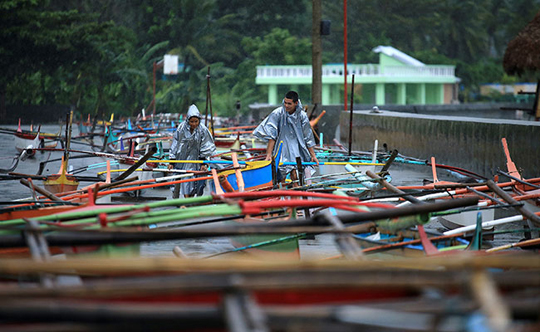
Christmas Typhoon Nock-Ten Threatens Philippine Capital

December 26, 2016

Manila, Dec 26: A powerful typhoon threatened to bring heavy rains and winds to the heavily-populated Philippine capital as it dragged its way across the archipelago on Monday, spoiling the Christmas holidays.

typhoon

Typhoon Nock-Ten, which made landfall on the eastern island province of Catanduanes on Sunday, is forecast to move westward towards the country's heartland, packing winds of 230 kilometres (143 miles) per hour, the government weather station said.

More than 218,000 people have already fled their homes while 48 domestic and international flights were cancelled, the civil defence office said, as the unusually late typhoon marred Christmas celebrations in the largely Christian nation.

So far there have been no reports of casualties after the government took measures to prepare communities even before the storm hit.

Nock-Ten, which is moving northwest at 20 kilometres per hour, is expected to affect Manila and the surrounding area later in the day before exiting the main island of Luzon on Monday afternoon, the government weather station said.

The bustling metropolis of about 13 million was eerily quiet the day after Christmas with the usual holiday revellers staying indoors as Nock-Ten approached.

The civil defence office said the capital could suffer "heavy to intense rains, flashfloods and severe winds," with rescue boats ready to be deployed in case the rivers overflow.

"Our local disaster councils are on red alert. We have pre-positioned relief supplies and rescue and (road) clearing equipment in Metro Manila," said Mina Marasigan, spokeswoman of the country's disaster monitoring council.

The coastguard on Sunday ordered the beaches south of Manila to be cleared of holidaymakers by Monday, while residents of the capital's seaside slums were warned to leave their homes.

The storm previously cut off electricity to millions and forced government agencies to order evacuations of whole communities in the eastern region of Bicol which felt the brunt of the storm on Christmas day.

"They intentionally cut off electricity (in Bicol) because of the strong winds so no one would be accidentally electrocuted if the power lines are knocked down," Marasigan told AFP.

- Wet Christmas -

"Government workers in the Bicol region, particularly those involved in disaster relief and operations, are working round-the-clock even on Christmas Day as typhoon Nina (the local name of Nock-Ten) maintains its strength and continues to pose a serious threat to Bicol region," President Rodrigo Duterte's spokesman Martin Andanar said in a statement.

Marasigan said hundreds of people in Bicol celebrated Christmas day in evacuation centres where many had to make do with emergency food packs.

Some local officials had offered roast pigs -- the traditional Filipino holiday fare -- to entice constituents to go to evacuation centres, Marasigan said.

Some 20 typhoons or lesser storms strike the Philippines each year, routinely killing hundreds of people, and Bicol is often the first region to be hit.

It prides itself on having sharpened its disaster response to minimise casualties.

Mammoth tsunami-like waves devastated the city of Tacloban and nearby areas when super typhoon Haiyan struck the central Philippines in November 2013, leaving 7,350 people dead or missing.

Comments

Add new comment

  • Coastaldigest.com reserves the right to delete or block any comments.
  • Coastaldigset.com is not responsible for its readers’ comments.
  • Comments that are abusive, incendiary or irrelevant are strictly prohibited.
  • Please use a genuine email ID and provide your name to avoid reject.
News Network
February 26,2020

Feb 26: China’s massive travel restrictions, house-to-house checks, huge isolation wards and lockdowns of entire cities bought the world valuable time to prepare for the global spread of the new virus.

But with troubling outbreaks now emerging in Italy, South Korea and Iran, and U.S. health officials warning Tuesday it’s inevitable it will spread more widely in America, the question is: Did the world use that time wisely and is it ready for a potential pandemic?

“It’s not so much a question of if this will happen anymore, but rather more a question of exactly when this will happen — and how many people in this country will have severe illness,” said Dr. Nancy Messonnier of the U.S. Centers for Disease Control and Prevention.

Some countries are putting price caps on face masks to combat price gouging, while others are using loudspeakers on trucks to keep residents informed. In the United States and many other nations, public health officials are turning to guidelines written for pandemic flu and discussing the possibility of school closures, telecommuting and canceling events.

Countries could be doing even more: training hundreds of workers to trace the virus’ spread from person to person and planning to commandeer entire hospital wards or even entire hospitals, said Dr. Bruce Aylward, the World Health Organization’s envoy to China, briefing reporters Tuesday about lessons learned by the recently returned team of international scientists he led.

“Time is everything in this disease,” Aylward said. “Days make a difference with a disease like this.”

The U.S. National Institutes of Health’s infectious disease chief, Dr. Anthony Fauci, said the world is “teetering very, very close” to a pandemic. He credits China’s response for giving other nations some breathing room.

China locked down tens of millions of its citizens and other nations imposed travel restrictions, reducing the number of people who needed health checks or quarantines outside the Asian country.

It “gave us time to really brush off our pandemic preparedness plans and get ready for the kinds of things we have to do,” Fauci said. “And we’ve actually been quite successful because the travel-related cases, we’ve been able to identify, to isolate” and to track down those they came in contact with.

With no vaccine or medicine available yet, preparations are focused on what’s called “social distancing” — limiting opportunities for people to gather and spread the virus.

That played out in Italy this week. With cases climbing, authorities cut short the popular Venice Carnival and closed down Milan’s La Scala opera house. In Japan, Prime Minister Shinzo Abe called on companies to allow employees to work from home, while the Tokyo Marathon has been restricted to elite runners and other public events have been canceled.

Is the rest of the world ready?

In Africa, three-quarters of countries have a flu pandemic plan, but most are outdated, according to authors of a modeling study published last week in The Lancet medical journal. The slightly better news is that the African nations most connected to China by air travel — Egypt, Algeria and South Africa — also have the most prepared health systems on the continent.

Elsewhere, Thailand said it would establish special clinics to examine people with flu-like symptoms to detect infections early. Sri Lanka and Laos imposed price ceilings for face masks, while India restricted the export of personal protective equipment.

India’s health ministry has been framing step-by-step instructions to deal with sustained transmissions that will be circulated to the 250,000 village councils that are the most basic unit of the country’s sprawling administration.

Vietnam is using music videos on social media to reach the public. In Malaysia, loudspeakers on trucks blare information through the streets.

In Europe, portable pods set up at United Kingdom hospitals will be used to assess people suspected of infection while keeping them apart from others. France developed a quick test for the virus and has shared it with poorer nations. German authorities are stressing “sneezing etiquette” and Russia is screening people at airports, railway stations and those riding public transportation.

In the U.S., hospitals and emergency workers for years have practiced for a possible deadly, fast-spreading flu. Those drills helped the first hospitals to treat U.S. patients suffering from COVID-19, the disease caused by the virus.

Other hospitals are paying attention. The CDC has been talking to the American Hospital Association, which in turn communicates coronavirus news daily to its nearly 5,000 member hospitals. Hospitals are reviewing infection control measures, considering using telemedicine to keep potentially infectious patients from making unnecessary trips to the hospital and conserving dwindling supplies of masks and gloves.

What’s more, the CDC has held 17 different calls reaching more than 11,000 companies and organizations, including stadiums, universities, faith leaders, retailers and large corporations. U.S. health authorities are talking to city, county and state health departments about being ready to cancel mass gathering events, close schools and take other steps.

The CDC’s Messonnier said Tuesday she had contacted her children’s school district to ask about plans for using internet-based education should schools need to close temporarily, as some did in 2009 during an outbreak of H1N1 flu. She encouraged American parents to do the same, and to ask their employers whether they’ll be able to work from home.

“We want to make sure the American public is prepared,” Messonnier said.

How prepared are U.S. hospitals?

“It depends on caseload and location. I would suspect most hospitals are prepared to handle one to two cases, but if there is ongoing local transmission with many cases, most are likely not prepared just yet for a surge of patients and the ‘worried well,’” Dr. Jennifer Lighter, a pediatric infectious diseases specialist at NYU Langone in New York, said in an email.

In the U.S., a vaccine candidate is inching closer to first-step safety studies in people, as Moderna Inc. has delivered test doses to Fauci’s NIH institute. Some other companies say they have candidates that could begin testing in a few months. Still, even if those first safety studies show no red flags, specialists believe it would take at least a year to have something ready for widespread use. That’s longer than it took in 2009, during the H1N1 flu pandemic — because that time around, scientists only had to adjust regular flu vaccines, not start from scratch.

The head of the World Health Organization, Tedros Adhanom Ghebreyesus, said the U.N. health agency’s team in China found the fatality rate between 2% and 4% in the hard-hit city of Wuhan, the virus’ epicenter, and 0.7% elsewhere.

The world is “simply not ready,” said the WHO’s Aylward. “It can get ready very fast, but the big shift has to be in the mindset.”

Aylward advised other countries to do “really practical things” now to get ready.

Among them: Do you have hundreds of workers lined up and trained to trace the contacts of infected patients, or will you be training them after a cluster pops up?

Can you take over entire hospital wards, or even entire hospitals, to isolate patients?

Are hospitals buying ventilators and checking oxygen supplies?

Countries must improve testing capacity — and instructions so health workers know which travelers should be tested as the number of affected countries rises, said Johns Hopkins University emergency response specialist Lauren Sauer. She pointed to how Canada diagnosed the first traveler from Iran arriving there with COVID-19, before many other countries even considered adding Iran to the at-risk list.

If the disease does spread globally, everyone is likely to feel it, said Nancy Foster, a vice president of the American Hospital Association. Even those who aren’t ill may need to help friends and family in isolation or have their own health appointments delayed.

“There will be a lot of people affected even if they never become ill themselves,” she said.

Comments

Add new comment

  • Coastaldigest.com reserves the right to delete or block any comments.
  • Coastaldigset.com is not responsible for its readers’ comments.
  • Comments that are abusive, incendiary or irrelevant are strictly prohibited.
  • Please use a genuine email ID and provide your name to avoid reject.
News Network
March 28,2020

Washington, Mar 28: The world is in the face of a devastating impact due to the coronavirus pandemic and has clearly entered a recession, the International Monetary Fund said on Friday, but projected a recovery next year.

"We have reassessed the prospects for growth for 2020 and 2021. It is now clear that we have entered a recession as bad or worse than in 2009. We do project recovery in 2021," IMF Managing Director Kristalina Georgieva told reporters at a news conference.

Georgieva was addressing the press after a meeting of governing body of the IMF, the International Monetary and Financial Committee. Representing 189 members, the body met virtually to discuss the unprecedented challenge posed to the world by COVID-19.

The key to recovery in 2021, she said, is only if the international community succeeds in containing the virus everywhere and prevent liquidity problems from becoming a solvency issue.

"The US is in recession, as is the rest of the advanced economies of the world. And in a big chunk of developed and emerging markets in developing economies. How severe? We are working now on our projections for 2020, Georgieva said in response to a question.

The new projections are expected in the next few weeks.

Stressing that while containment is the main reason for the economy to stand still and get into a recession, she said containment is very necessary to come out of this period and step in to recovery. "Until the virus is not contained, it would be very difficult to go to the lives we love."

"A key concern about a long-lasting impact of the sudden stop of the world economy is the risk of a wave of bankruptcies and layoffs that not only can undermine the recovery. But can erode the fabric of our societies," the IMF chief said.

To avoid this from happening, many countries have taken far-reaching measures to address the health crisis and to cushion its impact on the economy, both on the monetary and on the fiscal side, she said.

The IMF chief said 81 emergency financing requests, including 50 from lower-income countries, have been received. She said current estimate for the overall financial needs of emerging markets is 2.5 trillion dollars.

"We believe this is on the lower end. We do know that their own reserves and domestic resources will not be sufficient," she added.

The G-20, a day earlier, reported fiscal measures totalling some 5 trillion dollars or over 6 per cent of the global GDP.

Responding to another question, Georgieva said the IMF is projecting recession for 2020.

"We do expect it to be quite deep and we are very much urging countries to step up containment measures aggressively so we can shorten the duration of this period of time when the economy is in standstill," she said.

"And also to apply well-targeted measures, primarily focusing on the health system to absorb that enormous stress that comes from coronavirus. And on people, businesses and the financial system, I am very pleased to say that when we went through countries' responses, that sense of targeted fiscal measures is there and are also very impressive to see the size of these measures," she added.

"Countries are doing all they can on the fiscal and on the monetary front. We have heard from our members' very impressive decisions taken over the last days," the IMF chief said.

"We also want to caution that as we are responding now, we want to make the recession as possibly short and not too deep. We also want to think about what is going to follow the recovery and make sure that we are putting forward measures that can be supportive in this regard," she said.

Comments

Add new comment

  • Coastaldigest.com reserves the right to delete or block any comments.
  • Coastaldigset.com is not responsible for its readers’ comments.
  • Comments that are abusive, incendiary or irrelevant are strictly prohibited.
  • Please use a genuine email ID and provide your name to avoid reject.
News Network
April 11,2020

Washington, Apr 11: China is considered a developing country, make the United States too a developing one, US President Donald Trump said on Friday, alleging that Beijing has taken advantage of his country.

"China has been unbelievably taken advantage of us and other countries. You know, for instance, they are considered a developing nation. I said well then make us a developing nation too,” Trump told reporters at his daily White House news conference on coronavirus.

The president was responding to a question on China.

“They get big advantages because they are a developing nation. India, a developing nation. The United States is a big developed nation. Well, we have plenty of development to do,” he said.

Reiterating that United States was taken advantage of by the World Trade Organization, Trump said the Chinese economy started booming after it joined WTO with the help of the US.

“If you look at the history of China, it was only since they went into the WTO that they became a rocket ship with their economy. They were flatlined for years and years,” he said.

“Frankly, for many, many decades. And it was only when they came into the WTO that they became a rocket ship because they took advantage of all -- I'm not even blaming them. I'm saying how stupid were the people that stood here and allowed it to happen,” he said.

For latest updates on coronavirus outbreak, click  here

The Trump Administration will now allow that to happen, he said.

“If they don't treat us fairly, will leave. But now we're starting to win cases,” he said.

Alleging that China has taken advantage of the United States for 30 years, he said, China has taken advantage of the US through WTO and using rules that are unfair to the United States.

"They should have never been allowed it, this should have never been allowed to happen", he added.

“When China joined and was allowed to join under those circumstances the WTO, that was a very bad day for the United States because they have rules and regulations that were far different and far easier than our rules and regulations,” he said.

“Plus. They took advantage of them down to the last. China took advantage of them like few people would even think to take advantage of them and again they are considered right a developing nation,” he added.

The United States, he rued, is not considered a developing nation.

“The were given advantages (for being a developing nation). For many years China has ripped off the United States. Then I came along and right now, as you know, China is paying 25 percent," said Trump, adding that the US is now gaining "billions and billions and billions of dollars in tariffs from China”.

The US is not paying, he asserted.

“Not every country is China but China would devalue their currency and they would also pour out money and they essentially were paying most of those tariffs not us,” he said.

Comments

Add new comment

  • Coastaldigest.com reserves the right to delete or block any comments.
  • Coastaldigset.com is not responsible for its readers’ comments.
  • Comments that are abusive, incendiary or irrelevant are strictly prohibited.
  • Please use a genuine email ID and provide your name to avoid reject.