


Christmas Typhoon Nock-Ten Threatens Philippine Capital

December 26, 2016

Manila, Dec 26: A powerful typhoon threatened to bring heavy rains and winds to the heavily-populated Philippine capital as it dragged its way across the archipelago on Monday, spoiling the Christmas holidays.
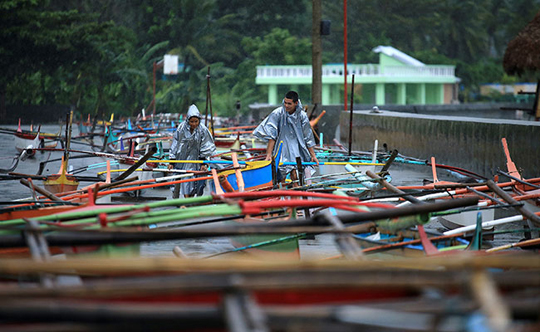
typhoon

Typhoon Nock-Ten, which made landfall on the eastern island province of Catanduanes on Sunday, is forecast to move westward towards the country's heartland, packing winds of 230 kilometres (143 miles) per hour, the government weather station said.

More than 218,000 people have already fled their homes while 48 domestic and international flights were cancelled, the civil defence office said, as the unusually late typhoon marred Christmas celebrations in the largely Christian nation.

So far there have been no reports of casualties after the government took measures to prepare communities even before the storm hit.

Nock-Ten, which is moving northwest at 20 kilometres per hour, is expected to affect Manila and the surrounding area later in the day before exiting the main island of Luzon on Monday afternoon, the government weather station said.

The bustling metropolis of about 13 million was eerily quiet the day after Christmas with the usual holiday revellers staying indoors as Nock-Ten approached.

The civil defence office said the capital could suffer "heavy to intense rains, flashfloods and severe winds," with rescue boats ready to be deployed in case the rivers overflow.

"Our local disaster councils are on red alert. We have pre-positioned relief supplies and rescue and (road) clearing equipment in Metro Manila," said Mina Marasigan, spokeswoman of the country's disaster monitoring council.

The coastguard on Sunday ordered the beaches south of Manila to be cleared of holidaymakers by Monday, while residents of the capital's seaside slums were warned to leave their homes.

The storm previously cut off electricity to millions and forced government agencies to order evacuations of whole communities in the eastern region of Bicol which felt the brunt of the storm on Christmas day.

"They intentionally cut off electricity (in Bicol) because of the strong winds so no one would be accidentally electrocuted if the power lines are knocked down," Marasigan told AFP.

- Wet Christmas -

"Government workers in the Bicol region, particularly those involved in disaster relief and operations, are working round-the-clock even on Christmas Day as typhoon Nina (the local name of Nock-Ten) maintains its strength and continues to pose a serious threat to Bicol region," President Rodrigo Duterte's spokesman Martin Andanar said in a statement.

Marasigan said hundreds of people in Bicol celebrated Christmas day in evacuation centres where many had to make do with emergency food packs.

Some local officials had offered roast pigs -- the traditional Filipino holiday fare -- to entice constituents to go to evacuation centres, Marasigan said.

Some 20 typhoons or lesser storms strike the Philippines each year, routinely killing hundreds of people, and Bicol is often the first region to be hit.

It prides itself on having sharpened its disaster response to minimise casualties.

Mammoth tsunami-like waves devastated the city of Tacloban and nearby areas when super typhoon Haiyan struck the central Philippines in November 2013, leaving 7,350 people dead or missing.

Comments

Add new comment

  • Coastaldigest.com reserves the right to delete or block any comments.
  • Coastaldigset.com is not responsible for its readers’ comments.
  • Comments that are abusive, incendiary or irrelevant are strictly prohibited.
  • Please use a genuine email ID and provide your name to avoid reject.
News Network
May 21,2020

Canberra, May 21: Australian Prime Minister Scott Morrison and his Indian counterpart, Narendra Modi, are looking forward to deepening the countries' strategic relationship, with both sides expected to sign a range of pacts from defence to trade in strategic sectors amid heightened tensions with China over Beijing's response to coronavirus pandemic.

During a virtual summit, scheduled to take place on June 4, both leaders are expected to ramp up efforts to diversify Australia's export markets and find trusted suppliers of vital products and components, a local newspaper, The Australian reported on Tuesday.

The new agreements will focus on reliable supply chains in key strategic sectors, including medical goods, technology and critical minerals, amid heightened tensions with China over Beijing's response to coronavirus pandemic.

The leaders will seal a new defence agreement allowing reciprocal access to bases and co-operation on military technology projects, while a new education partnership will be on the table to help overcome Australian university reliance on Chinese students.

The talks in terms of strategic convergence, now have greater significance as COVID-19 exacerbates the strategic contest between the US and China, and forces like-minded countries to seek out reliable partners.

Australian farmers could also benefit, with talks underway on expanding agricultural exports to India, including barley, as China throws up new trade barriers, media reports stated.

The virtual summit follows the cancellation of Morrison's planned state visit to India in January due to the bushfires.

Morrison said last year, ahead of his planned visit, that India was "a natural partner for Australia", referring to the countries' "shared values" -- a point of differentiation with China.

Former Department of Foreign Affairs and Trade secretary Peter Varghese, who wrote a landmark report on the bilateral relationship in 2018, was quoted by the newspaper as saying that India would be even more important to Australia in the post-COVID world. "If one of the lessons from COVID is that countries need to spread their risk, then finding new markets or building up existing markets is a crucial part of that," he added.

Varghese noted that India, a member of the Quadrilateral Security Dialogue along with Australia, Japan and the US, was a vital strategic partner to Australia in helping "constrain China's ambitions to be the predominant power".

"That shared objective between Australia and India of not wanting to see the region dominated by China is a key component of building up our geopolitical relationship," he told The Australian.

The summit also follows recent talks between Australian Foreign Minister Marise Payne and Indian counterpart Subrahmanyam Jaishankar on the pandemic response and Australia's call for an independent inquiry, which was overwhelmingly backed at the World Health Assembly on Tuesday.

Australia wants to support India to develop a domestic critical minerals processing industry, which would provide Western nations with an alternative to sourcing the materials from China.

Meanwhile, India has strong expertise as a manufacturer of drugs and medical equipment, while Australia is a centre of biomedical research, opening the possibility for closer co-operation in the key sector, the media reported further.

Comments

Add new comment

  • Coastaldigest.com reserves the right to delete or block any comments.
  • Coastaldigset.com is not responsible for its readers’ comments.
  • Comments that are abusive, incendiary or irrelevant are strictly prohibited.
  • Please use a genuine email ID and provide your name to avoid reject.
Agencies
January 9,2020

Washington, Jan 9: The U.S. and Iran stepped back from the brink of possible war Wednesday as President Donald Trump signaled he would not retaliate militarily for Iran's missile strikes on Iraqi bases housing U.S. troops. No one was harmed in the strikes, but U.S. forces in the region remained on high alert.

Speaking from the White House, Trump seemed intent on deescalating the crisis, which spiralled after he authorized the assassination of Iran's top general, Qassem Soleimani. Iran responded overnight by firing more than a dozen missiles at two installations in Iraq, its most direct assault on America since the 1979 seizure of the U.S. Embassy in Tehran.

Trump's takeaway was that “Iran appears to be standing down, which is a good thing for all parties concerned and a very good thing for the world.”

The region remained on edge, however, and American troops including a quick-reaction force dispatched over the weekend were on high alert. Hours after Trump spoke, an ‘incoming’ siren went off in Baghdad's Green Zone after what seemed to be small rockets “impacted” the diplomatic area, a Western official said. There were no reports of casualties.

Iran's Supreme Leader Ayatollah Ali Khamenei said the overnight strike was not necessarily the totality of Iran's response. “Last night they received a slap,” Khamenei said. “These military actions are not sufficient (for revenge). What is important is that the corrupt presence of America in this region comes to an end.”

The strikes had pushed Tehran and Washington perilously close to all-out conflict and left the world waiting to see whether the American president would respond with more military force. Trump, in his nine-minute, televised address, spoke of a robust U.S. military with missiles that are “big, powerful, accurate, lethal and fast.'' But then he added: “We do not want to use it."

Iran for days had been promising to respond forcefully to Soleimani's killing, but its limited strike on two bases--one in the northern Iraqi city of Irbil and the other at Ain al-Asad in western Iraq--appeared to signal that it too was uninterested in a wider clash with the U.S. Foreign minister Mohammad Javad Zarif tweeted that the country had “concluded proportionate measures in self-defence.”

Trump said the U.S. was “ready to embrace peace with all who seek it.” That marked a sharp change in tone from his warning a day earlier that “if Iran does anything that they shouldn't be doing, they're going to be suffering the consequences, and very strongly.”

Trump opened his remarks at the White House by reiterating his promise that “Iran will never be allowed to have a nuclear weapon.” Iran had announced in the wake of Soleimani's killing that it would no longer comply with any of the limits on uranium enrichment in the 2015 nuclear deal crafted to keep it from building a nuclear device.

The president, who had earlier pulled the U.S. out of the deal, seized on the moment of calm to call for negotiations toward a new agreement that would do more to limit Iran's ballistic missile programmes and constrain regional proxy campaigns like those led by Soleimani.

Trump spoke of new sanctions on Iran, but it was not immediately clear what those would be.

Comments

Add new comment

  • Coastaldigest.com reserves the right to delete or block any comments.
  • Coastaldigset.com is not responsible for its readers’ comments.
  • Comments that are abusive, incendiary or irrelevant are strictly prohibited.
  • Please use a genuine email ID and provide your name to avoid reject.
News Network
July 20,2020

Islamabad, Jul 20: Six advisors of Pakistan Prime Minister Imran Khan posses dual citizenships and several of top 20 aides have admitted of owning movable and immovable assets worth millions of dollars abroad.

The list was published on the official website of Pakistan government's cabinet division.
All the dual nationals were working as special assistants to the prime minister (SAPM). 

These people include SAPM on Overseas Pakistanis Syed Zulfiqar Abbas Bukhari (UK), SAPM on Power Division Shahzad Qasim (US), SAPM on Petroleum Nadeem Babar (US), SAPM on Political Affairs Shahbaz Gill (US), SAPM on Parliamentary Coordination Nadeem Afzal Gondal (Canada) and SAPM on Digital Pakistan Tania Aidrus (Canadian citizenship by birth).

According to Gulf News report, the wealthiest SAPM is Power Division and Mineral Resources Assistant Shahzad Syed Qasim who has assets worth over Rs 4 billion followed by SAPM on Petroleum Nadeem Babar with assets worth Rs 2.75 billion. Meanwhile, Adviser for Overseas Pakistanis Syed Zulfiqar Abbas Bukhari's net assets is estimated over Rs 2 billion.

Giving further details of the wealthiest SAPM, the official website stated that the PM's aide on Power Division and Coordination of Marketing and Development of Mineral Resources owns assets in Pakistan, UAE and US. His three properties in UAE include two villas in Jumeirah Golf Estates and Sienna Lakes, Jumeirah Golf Estates and an apartment at Park Towers, DIFC - all worth Dh20,688,000. He has three cars in the UAE worth Dh400,000 and in the US, he has property worth US$865,000 while he has Rs 4 billion in various local and foreign bank accounts and retirement funds including $2.1 million in US.

Meanwhile, Nadeem Babbar, who is Special Assistant on Petroleum Division, owns assets worth over Rs 2.7 billion, including several properties in Pakistan and abroad and stakes in more than 30 local and foreign companies.

The Gulf News further reported that in the list Dr Moeed Yusuf's, Special Assistant to the Prime Minister on National Security Division and Strategic Policy Planning, the name was also included but was later withdrawn as it was clarified that he had the US residency and only holds the citizenship of Pakistan as per the affidavit submitted to the government. "I have not returned to the US since I took up my current responsibility, have no employment or income in the US nor do I have any millions worth properties abroad" Dr Yusuf was quoted as saying.

The latest list on PM Imran Khan's advisors possessing dual nationalities has sparked strong criticisms by the Opposition leaders.

Comments

Add new comment

  • Coastaldigest.com reserves the right to delete or block any comments.
  • Coastaldigset.com is not responsible for its readers’ comments.
  • Comments that are abusive, incendiary or irrelevant are strictly prohibited.
  • Please use a genuine email ID and provide your name to avoid reject.