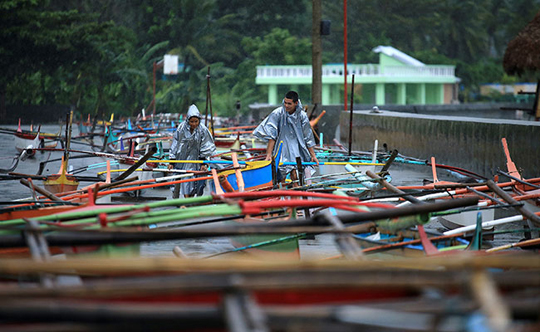
Christmas Typhoon Nock-Ten Threatens Philippine Capital

December 26, 2016

Manila, Dec 26: A powerful typhoon threatened to bring heavy rains and winds to the heavily-populated Philippine capital as it dragged its way across the archipelago on Monday, spoiling the Christmas holidays.

typhoon

Typhoon Nock-Ten, which made landfall on the eastern island province of Catanduanes on Sunday, is forecast to move westward towards the country's heartland, packing winds of 230 kilometres (143 miles) per hour, the government weather station said.

More than 218,000 people have already fled their homes while 48 domestic and international flights were cancelled, the civil defence office said, as the unusually late typhoon marred Christmas celebrations in the largely Christian nation.

So far there have been no reports of casualties after the government took measures to prepare communities even before the storm hit.

Nock-Ten, which is moving northwest at 20 kilometres per hour, is expected to affect Manila and the surrounding area later in the day before exiting the main island of Luzon on Monday afternoon, the government weather station said.

The bustling metropolis of about 13 million was eerily quiet the day after Christmas with the usual holiday revellers staying indoors as Nock-Ten approached.

The civil defence office said the capital could suffer "heavy to intense rains, flashfloods and severe winds," with rescue boats ready to be deployed in case the rivers overflow.

"Our local disaster councils are on red alert. We have pre-positioned relief supplies and rescue and (road) clearing equipment in Metro Manila," said Mina Marasigan, spokeswoman of the country's disaster monitoring council.

The coastguard on Sunday ordered the beaches south of Manila to be cleared of holidaymakers by Monday, while residents of the capital's seaside slums were warned to leave their homes.

The storm previously cut off electricity to millions and forced government agencies to order evacuations of whole communities in the eastern region of Bicol which felt the brunt of the storm on Christmas day.

"They intentionally cut off electricity (in Bicol) because of the strong winds so no one would be accidentally electrocuted if the power lines are knocked down," Marasigan told AFP.

- Wet Christmas -

"Government workers in the Bicol region, particularly those involved in disaster relief and operations, are working round-the-clock even on Christmas Day as typhoon Nina (the local name of Nock-Ten) maintains its strength and continues to pose a serious threat to Bicol region," President Rodrigo Duterte's spokesman Martin Andanar said in a statement.

Marasigan said hundreds of people in Bicol celebrated Christmas day in evacuation centres where many had to make do with emergency food packs.

Some local officials had offered roast pigs -- the traditional Filipino holiday fare -- to entice constituents to go to evacuation centres, Marasigan said.

Some 20 typhoons or lesser storms strike the Philippines each year, routinely killing hundreds of people, and Bicol is often the first region to be hit.

It prides itself on having sharpened its disaster response to minimise casualties.

Mammoth tsunami-like waves devastated the city of Tacloban and nearby areas when super typhoon Haiyan struck the central Philippines in November 2013, leaving 7,350 people dead or missing.

Comments

Add new comment

  • Coastaldigest.com reserves the right to delete or block any comments.
  • Coastaldigset.com is not responsible for its readers’ comments.
  • Comments that are abusive, incendiary or irrelevant are strictly prohibited.
  • Please use a genuine email ID and provide your name to avoid reject.
News Network
July 1,2020

As Peru begins to ease its strict coronavirus lockdown, the country's biggest LGBTQ nightclub opened its doors on Tuesday, but there will be no nighttime revellers; its dance floor will instead be filled with shelves stocked with groceries.

Instead of slinging cocktails at the bar or dancing on stage, ValeTodo Downtown's famed staff of drag queens will sell customers daily household products as the space reopens as a market while nightclubs are ordered to remain closed.

The Peruvian government will lift the lockdown in most regions of the country at the beginning of July but will keep borders closed, as well as nightclubs and bars.

The lockdown has been a struggle for the club's 120 employees like drag queen Belaluh McQueen. Her life completely changed when the government announced the quarantine. Her nights were spent at home, rather than performing as a dancer at the club in vivid-coloured costumes.

"I was very depressed because I have been doing this art for years, but you have to adapt to new challenges for the future," said McQueen, who is identified by her stage name.

Now McQueen is back to work as a grocery store employee, wearing a sequined suit, high heels and a mask. A DJ will play club music as patrons shop. "We have a new job opportunity," McQueen added.

Renamed as Downtown Market, the club, which has been a mainstay hallmark of the local LGBTQ community, ushered in its reopening with an inauguration ceremony.

"Before, I used to come here to dance and have a good time, but now we come to buy," said Alexandra Herrera, a regular attendee of the club. "The thing is to reinvent yourself."

The club's general manager, Claudia Achuy, said that the pandemic impacted the heart of Lima nightlife, but she chose to reopen as a market rather than risk cutting staff. "If we had just stayed as a nightclub we did not have a close horizon or a way of working," Achuy said.

Peru's confirmed coronavirus cases rose to 282,364 with 9,504 associated deaths on Monday, according to government data. It has the second-highest outbreak in Latin America after Brazil, according to a Reuters tally.

Comments

Add new comment

  • Coastaldigest.com reserves the right to delete or block any comments.
  • Coastaldigset.com is not responsible for its readers’ comments.
  • Comments that are abusive, incendiary or irrelevant are strictly prohibited.
  • Please use a genuine email ID and provide your name to avoid reject.
News Network
February 9,2020

Wuhan, Feb 9: President Xi Jinping strode onstage before an adoring audience in the Great Hall of the People in Beijing less than three weeks ago, trumpeting his successes in steering China through a tumultuous year and promising "landmark" progress in 2020.

"Every single Chinese person, every member of the Chinese nation, should feel proud to live in this great era," he declared to applause on the day before the Lunar New Year holiday. "Our progress will not be halted by any storms and tempests."

Xi made no mention of a dangerous new coronavirus that had already taken tenacious hold in the country. As he spoke, the government was locking down Wuhan, a city of 11 million people, in a frantic attempt to stop the virus spreading from its epicenter.

The coronavirus epidemic, which has killed more than 800 people in China as of Sunday and sickened tens of thousands, comes as Xi has struggled with a host of other challenges: a slowing economy, huge protests in Hong Kong, an election in Taiwan that rebuffed Beijing and a protracted trade war with the United States.

Now Xi faces an accelerating health crisis that is also a political one: a profound test of the authoritarian system he has built around himself over the past seven years. As the Chinese government struggles to contain the virus amid rising public discontent with its performance, the changes that Xi has ushered in could make it difficult for him to escape blame.

"It’s a big shock to the legitimacy of the ruling party. I think it could be only second to the June 4 incident of 1989. It’s that big," said Rong Jian, a writer about politics in Beijing, referring to the armed crackdown on Tiananmen Square protesters that year.

"There’s no doubt about his control over power," he added, "but the manner of control and its consequences have hurt his legitimacy and reputation."

Xi himself has recognized what is at stake, calling the outbreak "a major test of China’s system and capacity for governance."

Yet as China’s battle with the coronavirus intensified, Xi put the country’s No. 2 leader, Li Keqiang, in charge of a leadership group handling the emergency, effectively turning him into the public face of the government’s response. It was Li Keqiang who traveled to Wuhan to visit doctors.

Xi, by contrast, receded from public view for several days. That was not without precedent, though it stood out in this crisis, after previous Chinese leaders had used times of disaster to try to show a more common touch. State television and newspapers almost always lead with fawning coverage of Xi’s every move.

That retreat from the spotlight, some analysts said, signaled an effort by Xi to insulate himself from a campaign that may falter and draw public ire. Yet Xi has consolidated power, sidelining or eliminating rivals, so there are few people left to blame when something goes wrong.

"Politically, I think he is discovering that having total dictatorial power has a downside, which is that when things go wrong or have a high risk of going wrong, then you also have to bear all the responsibility," said Victor Shih, an associate professor at the University of California San Diego who studies Chinese politics.

Much of the country’s population has been told to stay at home, factories remain closed, and airlines have cut service. Experts warn that the coronavirus could slam the economy if not swiftly contained.

The government is also having trouble controlling the narrative. Xi now faces unusually sharp public discontent that even China’s rigorous censorship apparatus has been unable to stifle entirely.

The death of an ophthalmologist in Wuhan, Dr. Li Wenliang, who was censured for warning his medical school classmates of the spread of a dangerous new disease in December, has unleashed a torrent of pent-up public grief and rage over the government’s handling of the crisis. Chinese academics have launched at least two petitions in the wake of Li’s death, each calling for freedom of speech.

State media still portray Xi as ultimately in control, and there’s no sign that he faces a serious challenge from within the party leadership. The crisis, though, has already tainted China’s image as an emerging superpower — efficient, stable and strong — that could eventually rival the United States.

How much the crisis might erode Xi’s political standing remains to be seen, but it could weaken his position in the long run as he prepares to take a likely third term as Communist Party general secretary in 2022.

In 2018, Xi won approval to remove the constitutional limits on his term as the country’s president, making his plan for another five-year term seem all but certain.

If Xi comes out of this crisis politically insecure, the consequences are unpredictable. He may become more open to compromise within the party elite. Or he may double down on the imperious ways that have made him China’s most powerful leader in generations.

"Xi’s grip on power is not light," said Jude Blanchette, the Freeman Chair in China Studies at the Center for Strategic and International Studies.

"While the ham-fisted response to this crisis undoubtedly adds a further blemish to Xi’s tenure in office," Blanchette added, "the logistics of organizing a leadership challenge against him remain formidable."

In recent days, despite a dearth of public appearances, state media have portrayed Xi as a tireless commander-in-chief. This week they began calling the government’s fight against the virus the "people’s war," a phrase used in the official readout of Xi’s telephone call with President Donald Trump on Friday.

There are increasing signs that the propaganda this time is proving less than persuasive.

The Lunar New Year reception in Beijing where Xi spoke became a source of popular anger, a symbol of a government slow to respond to the suffering in Wuhan. Xi and other leaders appear to have been caught off guard by the ferocity of the epidemic.

Senior officials would almost certainly have been informed of the emerging crisis by the time national health authorities told the World Health Organization on Dec. 31, but neither Xi nor other officials in Beijing informed the public.

Xi’s first acknowledgment of the epidemic came Jan. 20, when brief instructions were issued under his name. His first public appearance after the lockdown of Wuhan on Jan. 23 came two days later, when he presided over a meeting of the Communist Party’s top body, the Politburo Standing Committee, which was shown at length on Chinese television. "We’re sure to be able to win in this battle," he proclaimed.

Back then, the death toll was 106. As it rose, Xi allowed other officials to take on more visible roles. Xi’s only appearances have been meeting foreign visitors in the Great Hall of the People or presiding over Communist Party meetings.

On Jan. 28, Xi met with the executive director of the World Health Organization, Dr. Tedros Adhanom Ghebreyesus, and told Tedros that he "personally directed" the government’s response. Later reports in state media omitted the phrase, saying instead that Xi’s government was "collectively directing" the response.

Since nothing about how Xi is portrayed in state media happens by accident, the tweak suggested a deliberate effort to emphasize shared responsibility.

Xi did not appear on official broadcasts again for a week — until a highly scripted meeting Wednesday with the authoritarian leader of Cambodia, Hun Sen.

There is little evidence that Xi has given up power behind the scenes. Li Keqiang, the premier in formal charge of the leadership group for the crisis, and other officials have said that they take their orders from Xi. The group is filled with officials who work closely under Xi, and its directives emphasize his authority.

"The way the epidemic is being handled now from the top just doesn’t fit with the argument that there’s been a clear shift toward more collective, consultative leadership," said Holly Snape, a British Academy Fellow at the University of Glasgow who studies Chinese politics.

The scale of discontent and the potential challenges for Xi could be measured by repeated references online to the nuclear accident at Chernobyl. Many of them came under the guise of viewer reviews of the popular television miniseries of the same name, which is still available for streaming inside China.

"In any era, any country, it’s the same. Cover everything up," one reviewer wrote.

The Soviet Union of 1986, however, was a different country than China in 2020.

The Soviet state was foundering when Chernobyl happened, said Sergey Radchenko, a professor of international relations at Cardiff University in Wales who has written extensively on Soviet and Chinese politics.

"The Chinese authorities, by contrast, are demonstrating an ability to cope, a willingness to take unprecedented measures — logistical feats that may actually increase the regime’s legitimacy," he added.

Radchenko compared Xi’s actions to those of previous leaders in moments of crisis: Mao Zedong after the Cultural Revolution or Deng Xiaoping after the Tiananmen Square crackdown.

"He’s doing what Mao and Deng would have done in similar circumstances: stepping back into the shadows while remaining firmly in charge."


Comments

Add new comment

  • Coastaldigest.com reserves the right to delete or block any comments.
  • Coastaldigset.com is not responsible for its readers’ comments.
  • Comments that are abusive, incendiary or irrelevant are strictly prohibited.
  • Please use a genuine email ID and provide your name to avoid reject.
News Network
July 17,2020

Jul 17: US President Donald Trump has said that he wants to do everything possible to keep peace for the people of India and China, according to his spokesperson

Over the past several weeks, the Trump administration has come out in support of India against China.

“He (Trump) said I love the people of India and I love the people of China and I want to do everything possible to keep the peace for the people,” White House Press Secretary Kayleigh McEnany told reporters at a news conference here on Thursday.

She was responding to a question on Trump’s message to India, which recently had a standoff with China in eastern Ladakh along the Line of Actual Control.

Earlier in the day, White House Economic Advisor Larry Kudlow described India as a great ally, saying President Trump is a great friend of Prime Minister Narendra Modi.

On Wednesday, Secretary of State Mike Pompeo said that India has been a great partner of the US.

“India has been a great partner… They are an important partner of ours. I have a great relationship with my foreign minister counterpart. We talked frequently about a broad range of issues. We talked about the conflict they had along the border with China. We've talked about the risk that emanates from the Chinese telecommunication infrastructure there,” Pompeo told reporters in response to a question.

Travelling in Europe, US National Security Advisor Robert O’Brien told reporters that China has been very aggressive with India.

O’Brien said that India is a democracy and is a great friend of the United States. Prime Minister “Modi and President Trump have a super relationship,” he said.

“In fact, it was the last foreign trip that I took with the president before the COVID-19 crisis hit, was to India, and we had a great reception of the Indian people there. We have a lot in common with them, we speak English, we're democracies. We've got a growing, very strong relationship with India,” O’Brien said.

Welcoming the White House statement, Al Mason, co-chair of the Trump Victory Indian American Finance Committee, said that unlike his predecessor, President Trump has come out openly in support of India.

“Most of the Indian-Americans have observed that every earlier president - be it a Democrat or Republican, like Clinton or Bush Senior or Bush Jr or Obama have been very scared to side with India openly, for fear of hurting China.

“Only President Trump has had the courage to say that… I love India, America respects India… US stands with India - and that also, to over one billion Indians in India at the Namaste Trump rally held in India… and that too… near India’s neighbour China,” Mason said in a statement.

“And he is consistent in his love for India and Indian-Americans,” he added.

Comments

Add new comment

  • Coastaldigest.com reserves the right to delete or block any comments.
  • Coastaldigset.com is not responsible for its readers’ comments.
  • Comments that are abusive, incendiary or irrelevant are strictly prohibited.
  • Please use a genuine email ID and provide your name to avoid reject.