


Clinton, Trump trade barbs in final pitch as US goes to polls

November 8, 2016

Washington, Nov 8: Hillary Clinton and Donald Trump traded barbs in their final pitch to voters as the curtain came down on the ugliest campaign in US history and voting began today in the knife-edge polls that will elect America's first woman president or put a political outsider in office.
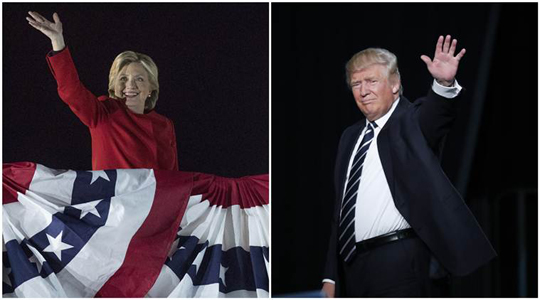
us polls copy

Fighting for every single vote at stake, Democratic nominee Clinton and her Republican rival Trump made their last minute forceful argument before the American people with their own vision for the world's largest economy.

Clinton, 69, was joined by husband Bill as she addressed a massive rally in Raleigh in the key battle ground state of North Carolina, which was entertained by Lady Gaga.

Trump, 70, made a last minute scheduled stop in Michigan to address thousands of his supporters hoping that he might be able to swing this state from the Democrats.

The two rallies ended around 1AM (local time), just six hours before opening of the polling booths in the East Coast.

An estimated 200 million people are eligible to cast their votes to elect the country's 45th president along with hundreds of Congressmen and members of state legislatures and local civic bodies.

More than 42 million have already voted using the "early voting" provision of the American electoral system.

Clinton and Trump crisscrossed several stops in key battleground states on the final day of campaigning which the US media has termed as the "ugliest" and the most divisive till date.

"This election is basically between division and unity in our country. It's between strong and steady leadership or a loose cannon who could put everything at risk. It is between an economy that works for everyone or one that is even more stacked for those at the top," Clinton told a cheering crowd in Raleigh, North Carolina.

"None of us, none of us, want to wake up on Wednesday morning and wish we had done more," she said, which she repeated in her other election rallies including the one in Philadelphia, which was also addressed by US President Barack Obama and First Lady Michelle.

"Years from today, when your kids and grandkids ask what you did in 2016, when everything was on the line, I want you to be able to say that you did vote, you voted for an inclusive, big-hearted, open-minded country and a future that will make sure that we all keep moving together," she said.

"Because I do believe we are stronger together; and you voted for an America where we build bridges, not walls; and, maybe most importantly, you voted in great numbers to demonstrate conclusively, once and for all, that, yes, love trumps hate. Let's get out and vote," Clinton said.

Latest poll indicated that while the election seems to have tightened in the last few days, Clinton maintains a slight lead over Trump. Almost all major polls are predicting a victory for Clinton, but Trump appeared confident of winning some of the key battleground states and thus wrest the White House from the Democrats after a gap of eight years.

"Do you want America to be ruled by the corrupt political class. Or do you want to be ruled by you, the people," Trump said in Michigan.

"Political establishment has brought distraction of factories and jobs," Trump said. "Tomorrow the working class will strike back," he said in New Hampshire and in Michigan he declared "today is the Independence Day".

Trump kicked off his Monday engagements with a rally in Florida. "We're going to be one country. We're not going to be a divided nation anymore, we're a divided nation. We are a divided nation. We will also cancel billions and billions of dollars in global warming payments to the United Nations where those payments disappear. And we're going to use all that money to invest in the infrastructure and we could even say the environmental infrastructure of our country," Trump said.

The Republican presidential nominee would be spending the election day in New York. His 'victory rally' has been schedule at a hotel in New York, a few kilometres away from the 'victory rally' of Clinton. Trump's election journey has been sensational as from a rank political outsider he has come close to becoming the US President.

This year, the Republican field began with a long list of 17 candidates, including Indian-origin Louisiana governor Bobby Jindal, New Jersey Governor Chris Christie and former Florida governor Jeb Bush. The Democratic field, on the other hand, was not as crowded, with just Hillary Clinton and Senator Bernie Sanders in the race.

Unlike India, in the US campaigning can be done even as voting continues. Every state would start counting the votes as polling concludes. One of the main highlight of the last few weeks has been the electioneering blitz by Obama. In the last 10 days, he addressed as many as 17 rallies -- rare for an outgoing President.

In the last phase of the campaign, the Clinton campaign also brought in popular singers, which Trump alleged was a move to attract crowd. The two campaigns have different theme. While 'Make America Great Again' is the theme of Trump, 'Stronger Together' is Clinton's slogan.

Both the candidates have said they would accept the results of the elections, but reserve the right to challenge in case of close results. The new president would be sworn in on January 20. Till then the winner of the November 8 general election would be called president-elect and would have a transition team in place working from Washington DC.

The first ballots in the US presidential polls were cast today in a sleepy hamlet in New Hampshire, traditionally the first in the nation to vote on election day, with Democratic candidate Clinton winning the contest. Clinton registered her first 'win' in the 2016 elections by four votes to two against her Republican rival Donald Trump soon after midnight in the remote northeastern part of the US. Voters also cast ballots early today in two other small New Hampshire communities, Hart's Location and Millsfield.

Comments

Add new comment

  • Coastaldigest.com reserves the right to delete or block any comments.
  • Coastaldigset.com is not responsible for its readers’ comments.
  • Comments that are abusive, incendiary or irrelevant are strictly prohibited.
  • Please use a genuine email ID and provide your name to avoid reject.
News Network
May 5,2020

May 5: Global coronavirus deaths reached 250,000 on Monday after recorded infections topped 3.5 million, a news agency tally of official government data showed, although the rate of fatalities has slowed.

North America and European countries accounted for most of the new deaths and cases reported in recent days, but numbers were rising from smaller bases in Latin America, Africa and Russia.

Globally, there were 3,062 new deaths and 61,923 new cases over the past 24 hours, taking total cases to 3.58 million.

That easily exceeds the estimated 140,000 deaths worldwide in 2018 caused by measles, and compares with around 3 million to 5 million cases of severe illness caused annually by seasonal influenza, according to the World Health Organization (WHO).

While the current trajectory of COVID-19 falls far short of the 1918 Spanish flu, which infected an estimated 500 million people, killing at least 10% of patients, experts worry the available data is underplaying the true impact of the pandemic.

The concerns come as several countries begin to ease strict lockdowns that have been credited with helping contain the spread of the virus.

"We could easily have a second or a third wave because a lot of places aren't immune," Peter Collignon, an infectious diseases physician and microbiologist at Canberra Hospital, told Reuters. He noted the world was well short of herd immunity, which requires around 60% of the population to have recovered from the disease.

The first death linked to COVID-19 was reported on Jan. 10 in Wuhan, China after the coronavirus first emerged there in December. Global fatalities grew at a rate of 1-2% in recent days, down from 14% on March 21, according to the Reuters data.

DEATH RATE ANOMALIES

Mortality rates from recorded infections vary greatly from country to country.

Collignon said any country with a mortality rate of more than 2% almost certainly had underreported case numbers. Health experts fear those ratios could worsen in regions and countries less prepared to deal with the health crisis.

"If your mortality rate is higher than 2%, you've missed a lot of cases," he said, noting that countries overwhelmed by the outbreak were less likely to conduct testing in the community and record deaths outside of hospitals.

In the United States, around half the country's state governors partially reopened their economies over the weekend, while others, including New York Governor Andrew Cuomo, declared the move was premature.

In Britain, Prime Minister Boris Johnson, who battled COVID-19 last month, has said the country was over the peak but it was still too early to relax lockdown measures.

Even in countries where the suppression of the disease has been considered successful, such as Australia and New Zealand which have recorded low daily rates of new infections for weeks, officials have been cautious.

Australian Prime Minister Scott Morrison has predicated a full lifting of curbs on widespread public adoption of a mobile phone tracking app and increased testing levels.

Comments

Add new comment

  • Coastaldigest.com reserves the right to delete or block any comments.
  • Coastaldigset.com is not responsible for its readers’ comments.
  • Comments that are abusive, incendiary or irrelevant are strictly prohibited.
  • Please use a genuine email ID and provide your name to avoid reject.
News Network
May 19,2020

May 19: A Chinese laboratory has been developing a drug it believes has the power to bring the coronavirus pandemic to a halt.

The outbreak first emerged in China late last year before spreading across the world, prompting an international race to find treatments and vaccines.

A drug being tested by scientists at China's prestigious Peking University could not only shorten the recovery time for those infected, but even offer short-term immunity from the virus, researchers say.

Sunney Xie, director of the university's Beijing Advanced Innovation Center for Genomics, told AFP that the drug has been successful at the animal testing stage.

"When we injected neutralising antibodies into infected mice, after five days the viral load was reduced by a factor of 2,500," said Xie.

"That means this potential drug has (a) therapeutic effect."

The drug uses neutralising antibodies -- produced by the human immune system to prevent the virus infecting cells -- which Xie's team isolated from the blood of 60 recovered patients.

A study on the team's research, published Sunday in the scientific journal Cell, suggests that using the antibodies provides a potential "cure" for the disease and shortens recovery time.

Xie said his team had been working "day and night" searching for the antibody.

"Our expertise is single-cell genomics rather than immunology or virology. When we realised that the single-cell genomic approach can effectively find the neutralising antibody we were thrilled."

He added that the drug should be ready for use later this year and in time for any potential winter outbreak of the virus, which has infected 4.8 million people around the world and killed more than 315,000.

"Planning for the clinical trial is underway," said Xie, adding it will be carried out in Australia and other countries since cases have dwindled in China, offering fewer human guinea pigs for testing.

"The hope is these neutralised antibodies can become a specialised drug that would stop the pandemic," he said.

China already has five potential coronavirus vaccines at the human trial stage, a health official said last week.

But the World Health Organization has warned that developing a vaccine could take 12 to 18 months.

Scientists have also pointed to the potential benefits of plasma -- a blood fluid -- from recovered individuals who have developed antibodies to the virus enabling the body's defences to attack it.

More than 700 patients have received plasma therapy in China, a process which authorities said showed "very good therapeutic effects".

"However, it (plasma) is limited in supply," Xie said, noting that the 14 neutralising antibodies used in their drug could be put into mass production quickly.

Using antibodies in drug treatments is not a new approach, and it has been successful in treating several other viruses such as HIV, Ebola and Middle East Respiratory Syndrome (MERS).

Xie said his researchers had "an early start" since the outbreak started in China before spreading to other countries.

Ebola drug Remdesivir was considered a hopeful early treatment for COVID-19 -- clinical trials in the US showed it shortened the recovery time in some patients by a third -- but the difference in mortality rate was not significant.

The new drug could even offer short-term protection against the virus.

The study showed that if the neutralising antibody was injected before the mice were infected with the virus, the mice stayed free of infection and no virus was detected.

This may offer temporary protection for medical workers for a few weeks, which Xie said they are hoping to "extend to a few months".

More than 100 vaccines for COVID-19 are in the works globally, but as the process of vaccine development is more demanding, Xie is hoping that the new drug could be a faster and more efficient way to stop the global march of the coronavirus.

"We would be able to stop the pandemic with an effective drug, even without a vaccine," he said.

Comments

Add new comment

  • Coastaldigest.com reserves the right to delete or block any comments.
  • Coastaldigset.com is not responsible for its readers’ comments.
  • Comments that are abusive, incendiary or irrelevant are strictly prohibited.
  • Please use a genuine email ID and provide your name to avoid reject.
Agencies
June 12,2020

Kabul, Jun 12: A blast in a mosque during Friday prayers in the western part of capital Kabul has killed at least four people and wounded many more, Afghanistan's interior ministry said.

"Explosives placed inside the Sher Shah Suri Mosque exploded during Friday prayers," said a statement issued by the ministry, which added that the mosque's prayer leader Mofleh Frotan was among those killed.

Interior ministry spokesman Tariq Arian said police have cordoned off the area and helped move the wounded to ambulances and nearby hospitals.

No group immediately claimed responsibility for the attack but a mosque attack earlier this month was claimed by an ISIL (or ISIS) group affiliate, headquartered in eastern Afghanistan's Nangarhar province.

"Interestingly, every time you have the peace process gaining some momentum and pace, you have these kinds of attacks in the country," Habib Wardak, a national security analyst based in Kabul, told Al Jazeera.

"The Islamic State group claimed responsibility for the attack that happened last week on a mosque in Kabul, so despite the fact that you have these news and press conference from the government that they have eliminated ISIL, how can they conduct such sophisticated operations?"

Friday's blast had parallels to one earlier this month, when an explosion tore apart a famous Kabul mosque and led to the death of renowned Afghan cleric Maulvi Ayaz Niazi.

"In this attack, the imam seems to be the target, not the rest of the crowd. These are the imams who have supported the peace process with the Taliban movement," Wardak said.

"The other political aspect for these kinds of attacks is that there are peace spoilers trying to convey a message that peace with the Taliban will not eradicate violence in the country because you have ISIL."

Violence has spiked in recent weeks in Afghanistan with most of the attacks claimed by the ISIL affiliate.

The United States blamed the armed group for a horrific attack last month on a maternity hospital in the capital that killed 24 people, including two infants and several new mothers.

The ISIL affiliate also took responsibility for an attack on a bus carrying journalists in Kabul on May 30, killing two.

It also claimed credit for an attack on the funeral of a strongman loyal to the government last month that killed 35 people.

Meanwhile, the US is attempting to broker peace talks between the Afghan government and the Taliban to end 18 years of war.

Washington's peace envoy Zalmay Khalilzad was in the region earlier this week trying to resuscitate a US peace deal with the Taliban.

The peace deal signed in February calls for the withdrawal of the US and NATO troops from Afghanistan in return for a commitment by the Taliban to not launch attacks on the US or its allies.

Comments

Add new comment

  • Coastaldigest.com reserves the right to delete or block any comments.
  • Coastaldigset.com is not responsible for its readers’ comments.
  • Comments that are abusive, incendiary or irrelevant are strictly prohibited.
  • Please use a genuine email ID and provide your name to avoid reject.