


Clinton, Trump trade barbs in final pitch as US goes to polls

November 8, 2016

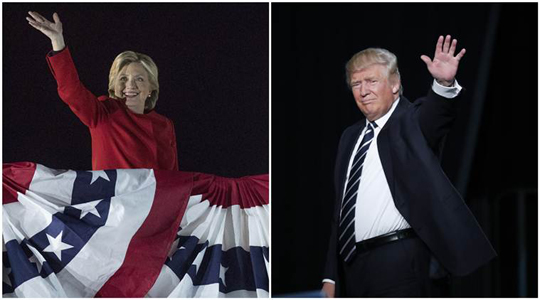
Washington, Nov 8: Hillary Clinton and Donald Trump traded barbs in their final pitch to voters as the curtain came down on the ugliest campaign in US history and voting began today in the knife-edge polls that will elect America's first woman president or put a political outsider in office.
us polls copy

Fighting for every single vote at stake, Democratic nominee Clinton and her Republican rival Trump made their last minute forceful argument before the American people with their own vision for the world's largest economy.

Clinton, 69, was joined by husband Bill as she addressed a massive rally in Raleigh in the key battle ground state of North Carolina, which was entertained by Lady Gaga.

Trump, 70, made a last minute scheduled stop in Michigan to address thousands of his supporters hoping that he might be able to swing this state from the Democrats.

The two rallies ended around 1AM (local time), just six hours before opening of the polling booths in the East Coast.

An estimated 200 million people are eligible to cast their votes to elect the country's 45th president along with hundreds of Congressmen and members of state legislatures and local civic bodies.

More than 42 million have already voted using the "early voting" provision of the American electoral system.

Clinton and Trump crisscrossed several stops in key battleground states on the final day of campaigning which the US media has termed as the "ugliest" and the most divisive till date.

"This election is basically between division and unity in our country. It's between strong and steady leadership or a loose cannon who could put everything at risk. It is between an economy that works for everyone or one that is even more stacked for those at the top," Clinton told a cheering crowd in Raleigh, North Carolina.

"None of us, none of us, want to wake up on Wednesday morning and wish we had done more," she said, which she repeated in her other election rallies including the one in Philadelphia, which was also addressed by US President Barack Obama and First Lady Michelle.

"Years from today, when your kids and grandkids ask what you did in 2016, when everything was on the line, I want you to be able to say that you did vote, you voted for an inclusive, big-hearted, open-minded country and a future that will make sure that we all keep moving together," she said.

"Because I do believe we are stronger together; and you voted for an America where we build bridges, not walls; and, maybe most importantly, you voted in great numbers to demonstrate conclusively, once and for all, that, yes, love trumps hate. Let's get out and vote," Clinton said.

Latest poll indicated that while the election seems to have tightened in the last few days, Clinton maintains a slight lead over Trump. Almost all major polls are predicting a victory for Clinton, but Trump appeared confident of winning some of the key battleground states and thus wrest the White House from the Democrats after a gap of eight years.

"Do you want America to be ruled by the corrupt political class. Or do you want to be ruled by you, the people," Trump said in Michigan.

"Political establishment has brought distraction of factories and jobs," Trump said. "Tomorrow the working class will strike back," he said in New Hampshire and in Michigan he declared "today is the Independence Day".

Trump kicked off his Monday engagements with a rally in Florida. "We're going to be one country. We're not going to be a divided nation anymore, we're a divided nation. We are a divided nation. We will also cancel billions and billions of dollars in global warming payments to the United Nations where those payments disappear. And we're going to use all that money to invest in the infrastructure and we could even say the environmental infrastructure of our country," Trump said.

The Republican presidential nominee would be spending the election day in New York. His 'victory rally' has been schedule at a hotel in New York, a few kilometres away from the 'victory rally' of Clinton. Trump's election journey has been sensational as from a rank political outsider he has come close to becoming the US President.

This year, the Republican field began with a long list of 17 candidates, including Indian-origin Louisiana governor Bobby Jindal, New Jersey Governor Chris Christie and former Florida governor Jeb Bush. The Democratic field, on the other hand, was not as crowded, with just Hillary Clinton and Senator Bernie Sanders in the race.

Unlike India, in the US campaigning can be done even as voting continues. Every state would start counting the votes as polling concludes. One of the main highlight of the last few weeks has been the electioneering blitz by Obama. In the last 10 days, he addressed as many as 17 rallies -- rare for an outgoing President.

In the last phase of the campaign, the Clinton campaign also brought in popular singers, which Trump alleged was a move to attract crowd. The two campaigns have different theme. While 'Make America Great Again' is the theme of Trump, 'Stronger Together' is Clinton's slogan.

Both the candidates have said they would accept the results of the elections, but reserve the right to challenge in case of close results. The new president would be sworn in on January 20. Till then the winner of the November 8 general election would be called president-elect and would have a transition team in place working from Washington DC.

The first ballots in the US presidential polls were cast today in a sleepy hamlet in New Hampshire, traditionally the first in the nation to vote on election day, with Democratic candidate Clinton winning the contest. Clinton registered her first 'win' in the 2016 elections by four votes to two against her Republican rival Donald Trump soon after midnight in the remote northeastern part of the US. Voters also cast ballots early today in two other small New Hampshire communities, Hart's Location and Millsfield.

Comments

Add new comment

  • Coastaldigest.com reserves the right to delete or block any comments.
  • Coastaldigset.com is not responsible for its readers’ comments.
  • Comments that are abusive, incendiary or irrelevant are strictly prohibited.
  • Please use a genuine email ID and provide your name to avoid reject.
News Network
June 9,2020

Washington, Jun 9: When epidemiologists talked about "flattening the curve," they probably didn't mean it this way: the US hit its peak coronavirus caseload in April, but since that time the graph has been on a seemingly unending plateau.

That's unlike several other hard-hit countries which have successfully pushed down their numbers of new cases, including Spain and Italy, which now have bell-shaped curves.

Experts say the prolonged nature of the US epidemic is the result of the cumulative impact of regional outbreaks, as the virus that started out primarily on the coasts and in major cities moves inward.

Layered on top of that are the effects of lifting lockdowns in parts of the country that are experiencing rising cases, as well as a lapse in compliance with social distancing guidelines because of economic hardship, and in some cases a belief that the threat is overstated.

"The US is a large country both in geography and population, and the virus is at very different stages in different parts of the country," Tom Frieden, a former director of the Centers for Disease Control and Prevention told AFP.

The US saw more than 35,000 new cases for several days in April. While that figure has declined, it has still been exceeding 20,000 regularly in recent days.

By contrast, Italy was regularly hitting more than 5,000 cases per day in March but is currently experiencing figures in the low hundreds.

"We did not act quickly and robustly enough to stop the virus spreading initially, and data indicate that it travelled from initial hotspots along major transport routes into other urban and rural areas," added Frieden, now CEO of the non-profit Resolve to Save Lives.

To wit: the East Coast states of New York, New Jersey and Massachusetts accounted for about 50 percent of all cases until about a month or so ago -- but now the geographic footprint of the US epidemic has shifted to the Midwest and southeast, including Florida.

Another key problem, said Jennifer Nuzzo, an epidemiologist at Johns Hopkins, is that the United States is still not doing enough testing, contact tracing and isolation.

After coming late to the testing party -- for reasons ranging from technical issues to regulatory hurdles -- the US has now conducted more COVID-19 tests than any other country.

It even has one of the highest per capita rates per country of 62 per 1,000 people, according to the website ourworldindata.org -- better than Germany (52 per 1,000) and South Korea (20 per 1,000).

But according to Nuzzo, these numbers are misleading, because "the amount of testing that a country should do should be scaled to the size of its epidemic.

"The United States has the largest epidemic in the world so obviously we need to do a lot more testing than any other country."

For Johns Hopkins, the more important metric is the positivity rate -- that is, out of all tests conducted, how many came back positive for COVID-19.

As of June 7, the United States had an average daily positivity rate of 14 percent, well above the World Health Organization guideline of 5 percent over two weeks before social distancing guidelines should be relaxed.

By contrast, Germany, which has tested far fewer people in relation to its population, has a positivity rate of 5 percent.

Even if testing were scaled up, carrying out tests in of itself does very little good without the next steps -- finding out who was exposed and then asking them to isolate.

Here also, too many US states are lagging woefully behind.

Texas, which is experiencing a surge in cases after relaxing its lockdown, is a case in point. The state targeted hiring a modest 4,000 tracers by June, but according to local reports is still more than a thousand shy of even that goal.

Opt-in app based efforts have also been slow to get off the ground.

Then there is the fact that some people are growing tired of lockdowns, while others don't have the economic luxury of being able to stay home for prolonged periods.

The government sent some 160 million Americans a single stimulus check of up to $1,200 back in April but it's not clear whether more will be forthcoming.

Still others, particularly in so-called red states under Republican leadership, have chafed under restrictions and mask-wearing guidelines that they see as an affront to their personal freedom.

"The US is kind of on the extreme of the individual liberty side," Sten Vermund, dean of the Yale School of Public Health, told AFP.

Part of this has to do with mixed messaging from Republican leaders, including President Donald Trump, said Nuzzo.

"We have had at the highest political level an assertion that this is a situation that's been overblown, and that maybe certain protective behaviors are not necessary," she said.

More recently, tens of thousands of people across the country have taken to the streets to protest the killing on an unarmed black man by police, risking coronavirus infection to demonstrate against the public health threat of racialized state violence.

Comments

Add new comment

  • Coastaldigest.com reserves the right to delete or block any comments.
  • Coastaldigset.com is not responsible for its readers’ comments.
  • Comments that are abusive, incendiary or irrelevant are strictly prohibited.
  • Please use a genuine email ID and provide your name to avoid reject.
News Network
June 2,2020

Oakland, Jun 2: Facebook employees are using Twitter to register their frustration over CEO Mark Zuckerberg's decision to leave up posts by President Donald Trump that suggested protesters in Minneapolis could be shot.

While Twitter demoted and placed a warning on a tweet about the protests that read, in part, that “when the looting starts the shooting starts,” Facebook has let it stand, with Zuckerberg laying out his reasoning in a Facebook post Friday.

“I know many people are upset that we've left the President's posts up, but our position is that we should enable as much expression as possible unless it will cause imminent risk of specific harms or dangers spelled out in clear policies,” Zuckerberg wrote.

Trump's comment evoked the civil-rights era by borrowing a phrase used in 1967 by Miami's police chief to warn of an aggressive police response to unrest in black neighborhoods.

On Monday, Facebook employees staged a virtual “walkout” to protest the company's decision not to touch the Trump posts according to a report in the New York Times, which cited anonymous senior employees at Facebook.

The Times report says “dozens” of Facebook workers “took the day off by logging into Facebook's systems and requesting time off to support protesters across the country." “I work at Facebook and I am not proud of how we're showing up.

The majority of coworkers I've spoken to feel the same way. We are making our voice heard,” tweeted Jason Toff, a director of product management at Facebook who's been at the company for a year.

Toff, who has a verified Twitter account, had 131,400 “likes” and thousands of retweets of his comment. He did not immediately respond to a message seeking comment on Monday.

“I don't know what to do, but I know doing nothing is not acceptable. I'm a FB employee that completely disagrees with Mark's decision to do nothing about Trump's recent posts, which clearly incite violence. I'm not alone inside of FB.

There isn't a neutral position on racism,” tweeted another employee, design manager Jason Stirman.

Stirman did not immediately respond to a request for comment on Monday. Sara Zhang, a product designer at the company, tweeted that Facebook's “decision to not act on posts that incite violence ignores other options to keep our community safe.

The policy pigeon holes us into addressing harmful user-facing content in two ways: keep content up or take it down.” “I believe that this is a self-imposed constraint and implore leadership to revisit the solution,” she continued. Zhang declined to comment to The Associated Press.

Representatives for Facebook did not immediately respond to messages for comment.

Twitter has historically taken stronger stances than its larger rival, including a complete ban on political advertisements that the company announced last November.

That's partly because Facebook, a much larger company with a broader audience,targeted by regulators over its size and power, has more to lose. And partly because the companies' CEOs don't always see eye to eye on their role in society.

Over the weekend, Twitter changed the background and logo if its main Twitter account to black from its usual blue in support of the Black Lives Matter protesters and added a #blacklivesmatter hashtag. Facebook did the same with its own logo on its site, though without the hashtag.

Comments

Add new comment

  • Coastaldigest.com reserves the right to delete or block any comments.
  • Coastaldigset.com is not responsible for its readers’ comments.
  • Comments that are abusive, incendiary or irrelevant are strictly prohibited.
  • Please use a genuine email ID and provide your name to avoid reject.
Agencies
June 7,2020

Moscow, Jun 7: OPEC, Russia and allies agreed on Saturday to extend record oil production cuts until the end of July, prolonging a deal that has helped crude prices double in the past two months by withdrawing almost 10% of global supplies from the market.

The group, known as OPEC+, also demanded countries such as Nigeria and Iraq, which exceeded production quotas in May and June, compensate with extra cuts in July to September.

OPEC+ had initially agreed in April that it would cut supply by 9.7 million barrels per day (bpd) during May-June to prop up prices that collapsed due to the coronavirus crisis. Those cuts were due to taper to 7.7 million bpd from July to December.

“Demand is returning as big oil-consuming economies emerge from pandemic lockdown. But we are not out of the woods yet and challenges ahead remain,” Saudi Energy Minister Prince Abdulaziz bin Salman told the video conference of OPEC+ ministers.

Benchmark Brent crude climbed to a three-month high on Friday above $42 a barrel, after diving below $20 in April. Prices still remain a third lower than at the end of 2019.

“Prices can be expected to be strong from Monday, keeping their $40 plus levels,” said Bjornar Tonhaugen from Rystad Energy.

Saudi Arabia, OPEC’s de facto leader, and Russia have to perform a balancing act of pushing up oil prices to meet their budget needs while not driving them much above $50 a barrel to avoid encouraging a resurgence of rival U.S. shale production.

It was not immediately clear whether Saudi Arabia, the United Arab Emirates and Kuwait would extend beyond June their additional, voluntary cuts of 1.18 million bpd, which are not part of the deal.

BULGING INVENTORIES

The April deal was agreed under pressure from U.S. President Donald Trump, who wants to avoid U.S. oil industry bankruptcies.

Trump, who previously threatened to pull U.S. troops out of Saudi Arabia if Riyadh did not act, spoke to the Russian and Saudi leaders before Saturday’s talks, saying he was happy with the price recovery.

While oil prices have partially recovered, they are still well below the costs of most U.S. shale producers. Shutdowns, layoffs and cost cutting continue across the United States.

“I applaud OPEC-plus for reaching an important agreement today which comes at a pivotal time as oil demand continues to recover and economies reopen around the world,” U.S. Energy Secretary Dan Brouillette wrote on Twitter after the extension.

As global lockdowns ease, oil demand is expected to exceed supply sometime in July but OPEC has yet to clear 1 billion barrels of excess oil inventories accumulated since March.

Rystad’s Tonhaugen said Saturday’s decisions would help OPEC reduce inventories at a rate of 3 million to 4 million bpd in July-August. “The quicker stocks fall, the higher prices will get,” he said.

Nigeria’s petroleum ministry said Abuja backed the idea of compensating for its excessive output in May and June.

Iraq, with one of the worst compliance rates in May, agreed to extra cuts although it was not clear how Baghdad would reach agreement with oil majors on curbing Iraqi output.

Iraq produced 520,000 bpd above its quota in May, while overproduction by Nigeria was 120,000 bpd, Angola’s was 130,000 bpd, Kazakhstan’s was 180,000 bpd and Russia’s was 100,000 bpd, OPEC+ data showed.

OPEC+’s joint ministerial monitoring committee, known as the JMMC, will meet monthly until December to review the market, compliance and recommend levels of cuts. JMMC’s next meeting is scheduled for June 18.

OPEC and OPEC+ will hold their next scheduled meetings on Nov. 30-Dec. 1.

Comments

Add new comment

  • Coastaldigest.com reserves the right to delete or block any comments.
  • Coastaldigset.com is not responsible for its readers’ comments.
  • Comments that are abusive, incendiary or irrelevant are strictly prohibited.
  • Please use a genuine email ID and provide your name to avoid reject.