Mangalore’s Bohras: Blend of Modernity and Tradition

[email protected] (Abrar Ahmed Khan)
December 20, 2012
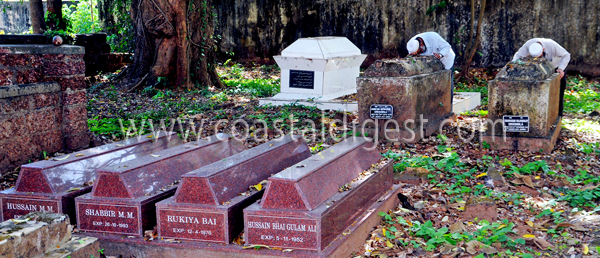
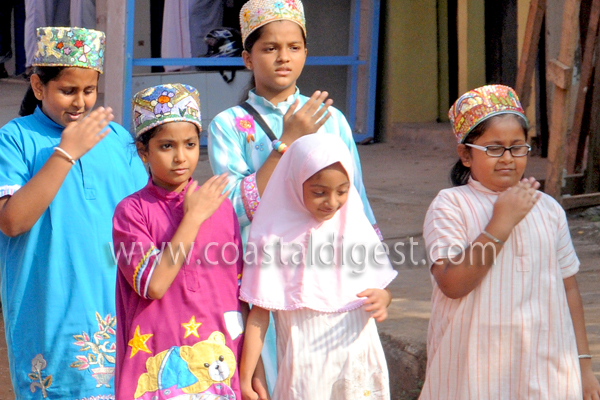
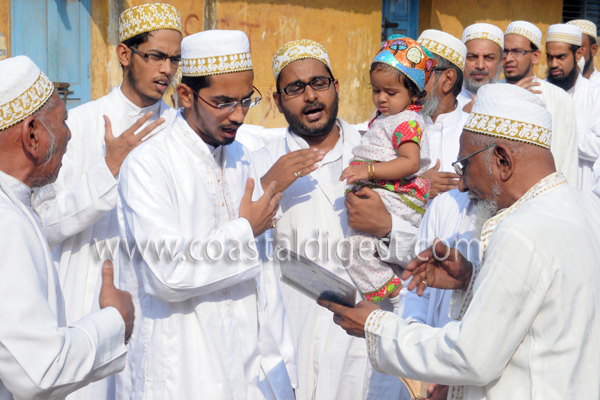
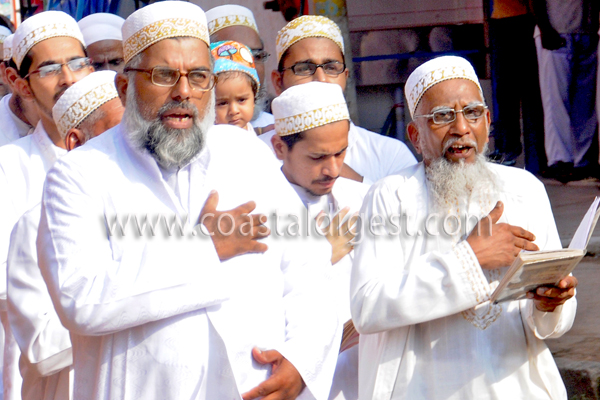
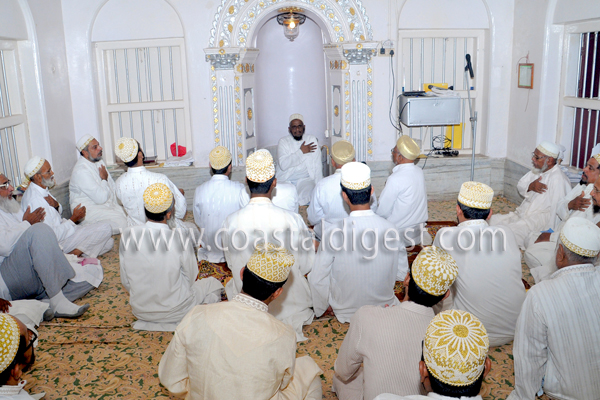
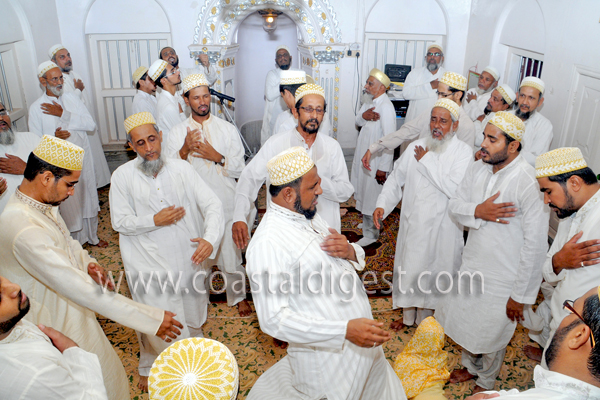
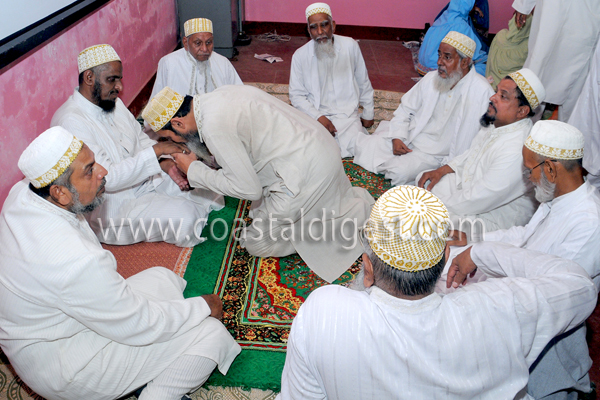
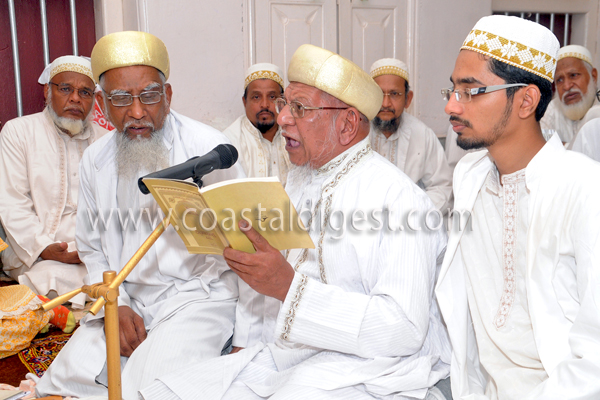
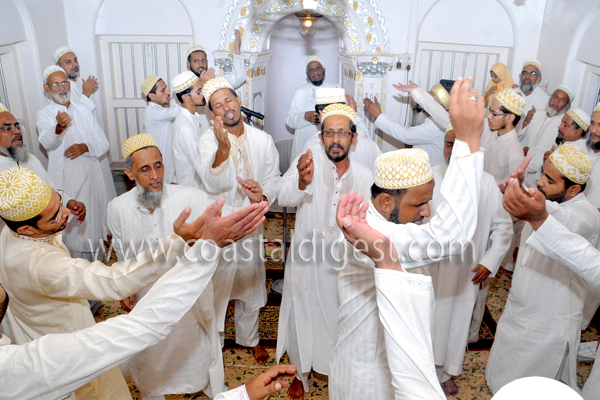
A walk around the Bhatkal Bazaar street after dusk in Mangalore’s Bunder/Kudroli area in early Muharram and one gets to listen to a few singing voices emanating from an oldish looking building. A closer peep through the window of that prayer-house, and you have scenes of men in white wearing differently looking kurtas reciting poetry in Gujarati and Urdu,  the sound produced by slapping of their palms against their chests(maatham) sounding like a background beat for the poem (marasya) being sung. The little group busy with its ‘majlis’ (gathering) is hard to spot in the populated Bunder area, just the way the community itself has been in living in Mangalore – unnoticed.


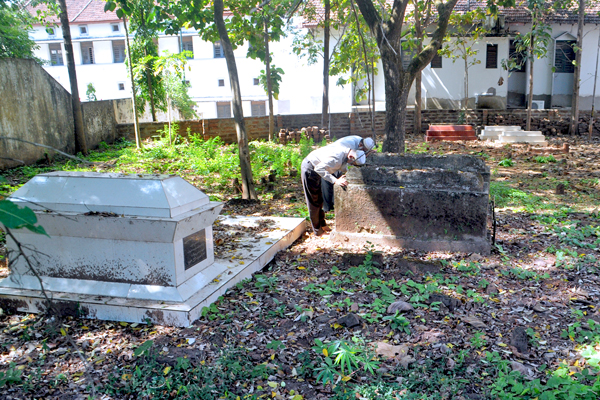
The minuscule Bohra community has been living in Mangalore since about three and a half centuries. Hardly possessing strength of 85-90 people, this Gujarati ghetto living in Mangalore is the only Bohra contingent one would find across the entire coastal strip of Dakshina Kannada, Udupi and Uttara Kannada districts.


“About 350 years ago, our ancestors came to Mangalore for trade from a place called Khambaat (Cambay) and Surat in Gujarat. That also happens to be a coastal region like Mangalore and we came here via sea route. Our people would take back roof tiles from here as Mangalore was known for its tiles back then. In return they would sell perfumes. Some of them liked Mangalore and saw business opportunity here and settled down. The Bunder area was the gateway for all the trade and even today all of us are housed in this Bunder/Kudroli area itself. There are 18 families here in Mangalore and this is the only Bohra group you will find around. We do not have any presence in Bhatkal either. Originally there were 10-12 houses but our tally grew with 4-5 additional families joining us some ten years ago. These families came for hardware business, hailing from Siddhpur in Gujarat”, says Juzer Ibrahim Kagzi, a member of the Mangalorean Bohra community and a trader at the Bibi Alabi Road.
bohra__1

bohra__2

bohra__3

bohra__4

bohra__5

bohra__6

bohra__9

bohra__10

bohra__11

bohra__12

bohra__13

bohra__14

bohra__15

bohra__17

bohra__20

bohra__19

The Bohras are predominantly traders. “Trade has always been our forte and here in Mangalore too, we are more into trade. We are a rich community worldwide. We are peace loving people and are normally not associated with violence and riots. As traders we have got adopted to Mangalore well. Although our mother tongue remains Gujarati, we speak Beary, Tulu, Kannada, Malayalam etc with ease. However, one finds many Arabic words mixed in our Gujarati and that way our language is slightly different from the one spoken by Gujarati Hindus”, says Mr. Kagzi.


A look at the calendar at Mr. Kagzi’s shop and one gets to see a glimpse of the Gujarati connection that the community has. The calendar with Gujarati text and numerals, referred to as the ‘Misri’ calendar, is of great importance to Bohras. “We only follow the Misri calendar. Although the months and dates are Hijri dates, the calendar is called ‘Misri’ because of its Egyptian link. Egyptians were expert astronomers and we refer to this calendar in terms of the change of months etc unlike others for whom sighting of the moon is of greater importance. That is the reason why there is no question of 29 fasts in Ramadan for us. Our Ramadan is of complete 30 days and we celebrate Eid on the very day of Eid mentioned in the Misri calendar. However, one must not confuse Arab tradition as being different from the Egyptian tradition. At the time of the Prophet Muhammad (pbuh), Egypt was part of the larger Arab landscape”, reveals Mr. Kagzi.


The entire Bohra community in Mangalore belongs to the Dawoodi Bohra clan. A noteworthy feature of the community is its effort in maintaining a distinct identity and bonding. Says Musthansir, Secretary, Bohra Association, Mangalore: “As a community, we Bohras give a lot of importance to brotherhood and remaining organized. Many Bohra students from other parts of the world, especially from the African continent come down to Mangalore and Manipal to study. Our Bohra organizational structure is such that each of those students or any Bohra coming down to our place here will first find out where the Bohra community centre is. Our prayer sessions and ‘majlis’ sessions are such that it is mandatory for each and every Bohra to attend them. No Bohra goes away without coming in contact with us. Besides, all Bohras around the world have an ‘E-Jamaath Card’ with them as a common identity proof. No matter which part of the world he may be in, a scan of his E-Jamaath Card and his entire bio data will be available. This system was introduced 10 years ago. Our community is completely computerized. Our headquarters which provides us these identity cards is in Mumbai”.


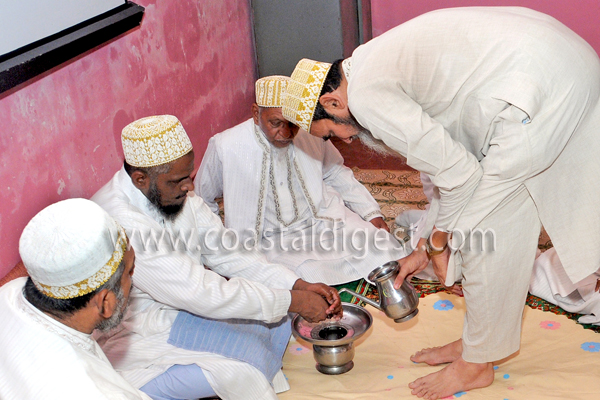
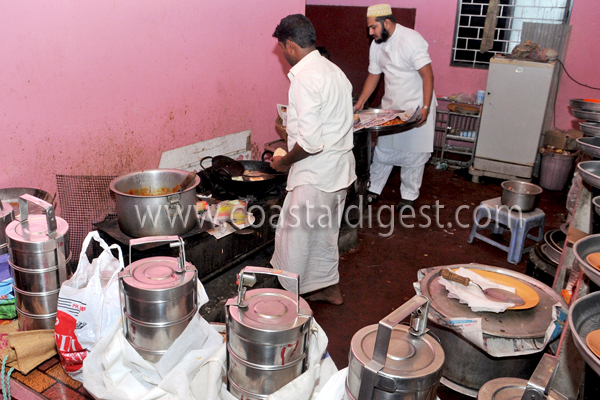
That apart, another interesting system in place in the Bohra society is the supply of food for all Bohra families from a common centre. “We Bohras do not cook food except on Sundays. We get food from the community centre. In every Bohra society all around the world, this system has now come into force. We have a community centre here in Mangalore too called Faizul Burhaniyya, from where food is supplied to all Bohra families living in the city. Each family places its tiffin boxes at the centre and they are returned back full of food. Normally breakfast and dinner needs are fulfilled through this system. Since most of us are traders, we have lunch outside. But otherwise, it is the food that comes from the centre that we all eat”, says Mr. Musthansir.


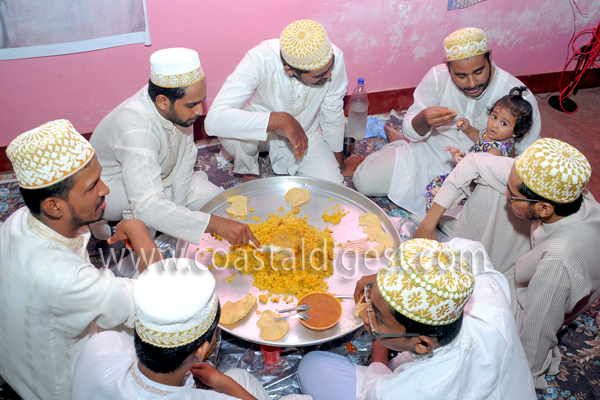
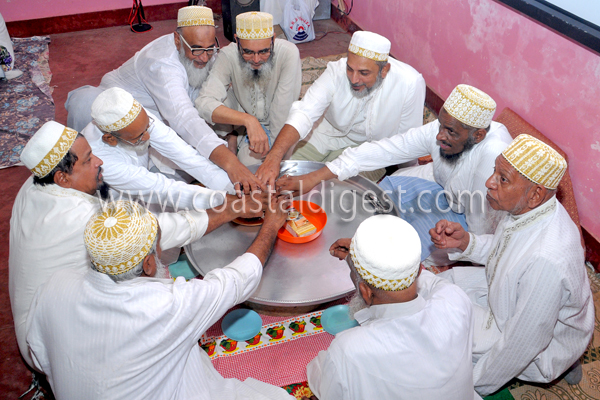
The Bohras of Mangalore love their food. “We are passionate eaters. We have a royal breakfast and a good dinner. The lunch is rather light. From kheemas, omlettes, jam and chapattis to a host of other delicious dishes, our breakfast is normally heavy. We believe that the morning food intake has to be a heavy one”, grins Mr. Kagzi. Appetite apart, the Bohras hold values and traditions of dining in high esteem. “We take food keeping the Sunnah (method) of Prophet Muhammad (pbuh) in mind. We sit together and eat in one Thaal (plate). Not a single grain of food is to be left alone and thrown into the wash basin. Salt and head covering are inseparable aspects of our dining. The first thing to be tasted is salt and so should be the case at the end. No Bohra will eat without the topi (cap) on his head. When someone eats without a topi and without salt, we consider it inferior in our circles. Also, you are not likely to find a Bohra without a beard. We develop a sense of tradition among our children this way”, discloses Mr. Kagzi.


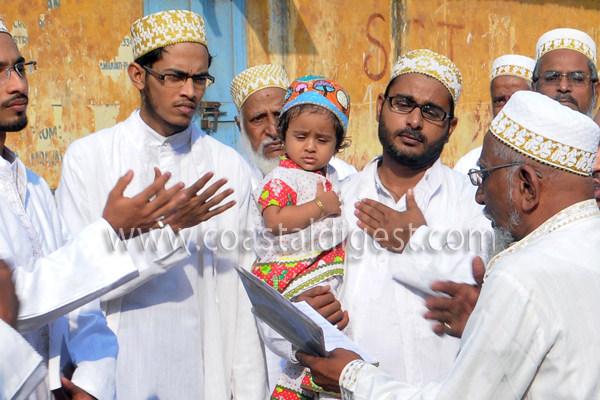
The ‘topi’ or the skull caps that Bohras wear also have some distinctness about them. All Bohras wear a white uniform styled topi with a unique design accentuated with the borders made of either golden or silver threads. “The topi is one of our objects of identity. We can recognize a Bohra merely with the topi’, says Mr. Kagzi. Another distinct attire worn by Bohras is the white overcoat called as the ‘Imaami Libaas’. “The ‘Imaami Libaas’ is worn by Bohras on special prayer meetings. We generally wear white ‘Imaami Libaas’ as Prophet Muhammad (pbuh) liked white. Likewise, in all major important events like weddings, festivals, funerals etc, it is mandatory for us to wear the ‘Imaami Libaas’. You will not find Bohras wearing suits etc in weddings. Generally no pants or jeans are entertained with the ‘Imaami Libaas’. It is always the traditional ‘Izaar’. We keep stitching new Imaami Libaas for ourselves. Men would have 15-20 Imaami Libaas dresses with them. Other than that, on the occasion of Shab-e-Baraat, and Lailat-ul-Qadr, we make it a point that we pray on these nights wearing new clothes. We always keep separate clothes for ‘Namaaz’. The women too have dozens of traditional clothes with them. Unlike the usual burkha, they wear what is called as the ‘Rida’. The Ridas are expensive. Our women generally do not prefer black. They go for other colours. Some women will possess about a hundred Ridas”, says he.


Bohra women also visit the masjid to offer prayers. “There is no restriction on women. They will have a separate section to pray in the prayer house. It is not compulsory for them to come but they are not stopped from visiting the prayer house”, says Mr. Musthansir.


The Mangalorean Bohra community prays in a 350 year old prayer house located in the Bunder/Kudroli area. A priest, referred to as ‘Janaab Saheb’ by the Bohras, leads prayers and ‘majlis’ meetings. “The ‘Janaab Saheb’ is revered greatly by us. He is appointed and sent by the head of the community called as the ‘Daai-e-Mutlaq’. He takes care of the Imaamat responsibilities besides teaching our children Quran and other aspects of religion”, adds Mr. Musthansir.


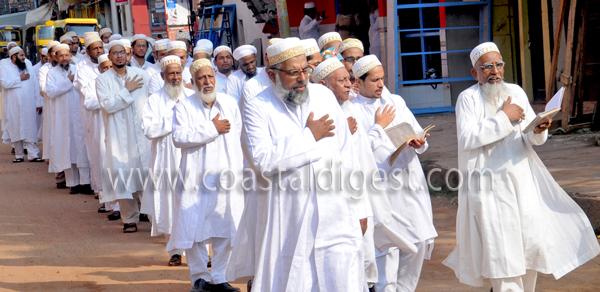
For a community with apparent leanings towards the Shia school of thought, the month of Muharram is of great significance to Bohras. The Islamic new year on the first day of Muharram is celebrated in a grand way. “The Islamic new year is a pompous affair in Bohra circles. That day, we will have about 50 dishes on our dining menu comprising of samosas, cutlets, sweets, fruits, meat, curds, fish etc. The idea behind this is that we ask Allah to feed us throughout the year with all his different bounties”, says Mr. Kagzi. A key aspect for Bohras is that the fish brought from the market must be alive. “It is only after we touch it saying Bismillah (In the name of Allah) does it become Halaal (permissible) to eat. The fishermen wait for this opportunity and sell live fish to us at a high price that day because they know we will be coming for it”, jokes Mr. Kagzi. The first day of Muharram apart, ‘majlis’ sessions are held everyday at the prayer house for ten days and on the tenth day (ashura), the day on which Hazrath Imaam Hussain (ra), the grandson of Prophet Muhammad (pbuh) was martyred, a procession is taken out along the streets of Bunder wherein all members of the local Bohra community participate.


Although based in Mangalore for long, one does not find Bohras having matrimonial alliances with other Muslim communities in the region like the Bearys or even the Katchi Memon family in Mangalore which also has Gujarati roots. “We look for alliances in our own circles from other cities like Hyderabad, Secunderabad, Mumbai, Surat etc”, says Mr. Kagzi.


Mangalore has always been known for its multi-culturalism. The Bohra community too has over the years been a part of this multi-ethnic mixture of ingredients, with its little ‘Gujju’ flavour, and continues to be so.


Comments

Add new comment

  • Coastaldigest.com reserves the right to delete or block any comments.
  • Coastaldigset.com is not responsible for its readers’ comments.
  • Comments that are abusive, incendiary or irrelevant are strictly prohibited.
  • Please use a genuine email ID and provide your name to avoid reject.
Ram Puniyani
August 9,2020

Contrary to present impression that Muslims are separatists due to whom the partition of India took place, the truth is that Muslims contributed to freedom movement and upheld India’s composite culture in equal measure. The partition process, mainly due to British policy of ‘divide and rule’ well assisted by Hindu and Muslim communalists is being hidden from the popular vision in India and Muslims in general are held responsible for the same. Not only that the communal historiography introduced by British to pursue their policies has become the bedrock of communal politics and worsening of the perceptions about Muslims is in progress in India.

Yet another example of this has been a series of tweets by the bureaucrat, who is close to retirement, K. Nageshwar Rao. Contrary to the service rules he has made statements, through his tweets which are appreciative of RSS-BJP and demonise the stalwarts Muslim leaders who not only contributed to the freedom movement but also later gave valuable service in laying the foundation of Independent India. As per Rao, his tweets he accuses Maulana Azad and the other Muslim Education ministers of “deracination of Hindus”. After naming “Maulana Abul Kalam Azad — 11 years (1947-58)”; “Humayun Kabir, M C Chagla & Fakruddin Ali Ahmed — 4 years (1963-67)”; and, “Nurul Hassan — 5 years (1972-77)”, he posts: “Remaining 10 years other Leftists like VKRV Rao.”

He points out that their policies were meant to “1. Deny Hindus their knowledge, 2. Vilify Hinduism as collection of superstitions, 3. Abrahamise Education, 4. Abrahamise Media & Entertainment, 5. Shame Hindus about their identity!  and 6. Bereft of the glue of Hinduism Hindu society dies.”

Then he goes on to praise RSS-BJP for bringing the glory back to Hindus. These statements of his on one hand promote the Hate and on the other tantamount to political statement, which civil servants should not by making. CPM politburo member Brinda Karat has written a letter to Home Minister Amit Shah to take suitable action against the erring bureaucrat.

Rao begins with Maulana Abul kalam Azad. Surely Azad was one of the major leaders of freedom movement, who was also the youngest President of INC, in 1923 and later between 1940 to 1945. He opposed the partition process tooth and nail till the very last. As the Congress President in 1923 he wrote a remarkable Para, symbolizing the urge for Hindu Muslim unity, “If an angel descends from heaven and offers me Swaraj in 24 hours on condition that I give up Hindu Muslim Unity, I will refuse. Swaraj we will get sooner or later; its delay will be a loss for India, but loss of Hindu Muslim unity will be a loss for human kind”. His biographer Syeda Hamid points out “He spoke without an iota of doubt about how debacle of Indian Muslims has been the result of the colossal mistakes committed by Muslim League’s misguided leadership. He exhorted Muslims to make common cause with their Hindu, Sikh, Christian fellow countrymen.” He was the one who promoted the translation of Hindu scriptures Ramayan and Mahabharat in to Persian.

Surely Mr. Rao, neither has read Azad or read about him nor knows his contributions to making of Modern India. While today, the ideological formation to which Mr. Rao seems to be pledging his commitment is critical of all that happened during Nehru era, it was during this period when as education minister Azad was shepherding the formations of IITs, Academies of Science, Lalit kala Academies. It was during this period that the efforts to promote Indian composite culture were undertaken through various steps.

The other stalwarts who are under the hammer have been outstanding scholars and giants in their own field of education. Humayun Kabir, Nurul Hasan, Dr.Zakir Husssain gave matchless ideas and practical contributions in different fields of education. One can say that contrary to the accusations, India could match up to the Computer era, software and associate things, due to creation of large manpower in these areas mainly due to these foundations which were laid down particularly in the field of education during this period.

The charge that these ‘Muslim’ education ministers white washed the bloody Islamic rule is a blind repetition of the offshoot of communal historiography introduced by British. While Kings were ruling for power and wealth, their courts had Hindus and Muslim both officers. The jaundiced vision sees this as a bloody Islamic rule but as a matter of fact the syncretic culture and traditions developed precisely this period. It was during this period that Bhakti Traidtion with Kabir, Tukaram, Namdeo, Tulsidas flourished. It was during this period that humane values of Sufi saints reached far and wide. It was during this period that poets like Rahim and Raskhan produced their classic literature n praise of Hindu Gods.

We also need to remind ourselves that large number of Muslims participated in the freedom Movement. Two scholars Shamsul Islam and Nasir Ahmad have come out with books on the myriad such freedom fighters, to recall just a few names. Khan Abdul Gaffar Khan, Zakir Hussain, Syed Mohammad Sharfuddin Kadri, Bakht Khan, Muzzafar Ahmad, Mohammad Abdir Rahman,, Abbas Ali, Asaf Ali, Yusuf Mehrali, Maulana Mazahrul Hague.

These are just a few of the names. The movement, led by Gandhi, definitely laid the foundations where composite Indian culture and respect for all religions, others’ religion was paramount and this is what created Indian fraternity, one of the values which finds its place in the preamble of Indian Constitution.

This blaming of Education ministers who were Muslims is an add-on to the process of Islamophobia in India. So for there have been many actions of Muslim kings which are selectively presented as being bloody, now the post Independent History, where glorious contributions have been made by Muslim leaders are being used to further deepen the divisive process. We need to pay respects to builders of modern India, irrespective of their religion.

Comments

Add new comment

  • Coastaldigest.com reserves the right to delete or block any comments.
  • Coastaldigset.com is not responsible for its readers’ comments.
  • Comments that are abusive, incendiary or irrelevant are strictly prohibited.
  • Please use a genuine email ID and provide your name to avoid reject.
Ram Puniyani
January 14,2020

In the beginning of January 2020 two very disturbing events were reported from Pakistan. One was the attack on Nankana Sahib, the holy shrine where Sant Guru Nanak was born. While one report said that the place has been desecrated, the other stated that it was a fight between two Muslim groups. Prime Minister of Pakistan Imran Khan condemned the incident and the main accused Imran Chisti was arrested. The matter related to abduction and conversion of a Sikh girl Jagjit Kaur, daughter of Pathi (One who reads Holy Guru Granth Sahib in Gurudwara) of the Gurudwara. In another incident one Sikh youth Ravinder Singh, who was out on shopping for his marriage, was shot dead in Peshawar.

While these condemnable attacks took place on the Sikh minority in Pakistan, BJP was quick enough to jump to state that it is events like this which justify the Citizenship Amendment Act (CAA). Incidentally CAA is the Act which is discriminatory and relates to citizenship with Religion, which is not as per the norms of Indian constitution. There are constant debates and propaganda that population of Hindus has come down drastically in Pakistan and Bangla Desh. Amit Shah, the Home minister stated that in Pakistan the population of Hindus has come down from 23% at the time of partition to 3.7% at present. And in Bangla Desh it has come down from 22% to present 8%.

While not denying the fact that the religious minorities are getting a rough deal in both these countries, the figures which are presented are totally off the mark. These figures don’t take into consideration the painful migrations, which took place at the time of partition and formation of Bangla Desh later. Pakistan census figures tell a different tale. Their first census was held in 1951. As per this census the overall percentage of Non Muslim in Pakistan (East and West together) was 14.2%, of this in West Pakistan (Now Pakistan) it was 3.44 and in Eat Pakistan it was 23.2. In the census held in Pakistan 1998 it became 3.72%. As far as Bangla Desh is concerned the share of Non Muslims has gone down from 23.2 (1951) to 9.6% in 2011.

The largest minority of Pakistan is Ahmadis, (https://minorityrights.org/country/pakistan/) who are close to 4 Million and are not recognised as Muslims in Pakistan. In Bangla Desh the major migrations of Hindus from Bangla Desh took place in the backdrop of Pakistan army’s atrocities in the then East Pakistan.

As far as UN data on refugees in India it went up by 17% between 2016-2019 and largest numbers were from Tibet and Sri Lanka.  (https://www.un.org/en/development/desa/population/migration/publication…)

The state of minorities is in a way the index of strength of democracy. Most South Asian Countries have not been able to sustain democratic values properly. In Pakistan, the Republic began with Jinnah’s classic speech where secularism was to be central credo of Pakistan. This 11th August speech was in a way what the state policy should be, as per which people of all faiths are free to practice their religion. Soon enough the logic of ‘Two Nation theory” and formation of Pakistan, a separate state for Muslim took over. Army stepped in and dictatorship was to reign there intermittently. Democratic elements were suppressed and the worst came when Zia Ul Haq Islamized the state in collusion with Maulanas. The army was already a strong presence in Pakistan. The popular formulation for Pakistan was that it is ruled by three A’s, Army, America and Allah (Mullah).

Bangla Desh had a different trajectory. Its very formation was a nail in the coffin of ‘two nation theory’; that religion can be the basis of a state. Bangla Desh did begin as a secular republic but communal forces and secular forces kept struggling for their dominance and in 1988 it also became Islamic republic. At another level Myanmar, in the grip of military dictatorship, with democratic elements trying to retain their presence is also seeing a hard battle. Democracy or not, the army and Sanghas (Buddhist Sang has) are strong, in Myanmar as well. The most visible result is persecution of Rohingya Muslims.

Similar phenomenon is dominating in Sri Lanka also where Budhhist Sanghas and army have strong say in the political affairs, irrespective of which Government is ruling. Muslim and Christian minorities are a big victim there, while Tamils (Hindus, Christians etc.) suffered the biggest damage as ethnic and religious minorities. India had the best prospect of democracy, pluralism and secularism flourishing here. The secular constitution, the outcome of India’s freedom struggle, the leadership of Gandhi and Nehru did ensure the rooting of democracy and secularism in a strong way.

India so far had best democratic credentials amongst all the south Asian countries. Despite that though the population of minorities rose mainly due to poverty and illiteracy, their overall marginalisation was order of the day, it went on worsening with the rise of communal forces, with communal forces resorting to identity issues, and indulging in propaganda against minorities.

While other South Asian countries should had followed India to focus more on infrastructure and political culture of liberalism, today India is following the footsteps of Pakistan. The retrograde march of India is most visible in the issues which have dominated the political space during last few years. Issues like Ram Temple, Ghar Wapasi, Love Jihad, Beef-Cow are now finding their peak in CAA.

India’s reversal towards a polity with religion’s identity dominating the political scene was nicely presented by the late Pakistani poetess Fahmida Riaz in her poem, Tum bhi Hum Jaise Nikle (You also turned out to be like us). While trying to resist communal forces has been an arduous task, it is becoming more difficult by the day. This phenomenon has been variously called, Fundamentalism, Communalism or religious nationalism among others. Surely it has nothing to do with the religion as practiced by the great Saint and Sufi traditions of India; it resorts mainly to political mobilization by using religion as a tool.

Comments

Ashi
 - 
Tuesday, 14 Jan 2020

If Malaysia implement similar NRC/CAA, India and China are the loser.

Add new comment

  • Coastaldigest.com reserves the right to delete or block any comments.
  • Coastaldigset.com is not responsible for its readers’ comments.
  • Comments that are abusive, incendiary or irrelevant are strictly prohibited.
  • Please use a genuine email ID and provide your name to avoid reject.
Ram Puniyani
January 9,2020

‘Go to Pakistan’ has probably been most often used phrase used against Muslims in India. Recently in yet another such incident the SP of Meerut, UP has been in the news and a video is circulating where he, Akhilesh Narayan Singh, is allegedly using the jibe ‘Go to Pakistan’. In the video he is seen shouting at protestors at Lisari Gate area in Meerut, “The ones (protestors) wearing those black or yellow armbands, tell them to go to Pakistan”. His seniors stood by him calling it ‘natural reaction to shouting of pro Pakistan slogans. Many BJP leaders like Uma Bhararti also defended the officer. Breaking ranks with fellow politicians, Mukhtar Abbas Naqvi of BJP, criticised the said officer and asked for suitable action against him. Interestingly this is same Naqvi, who earlier when the beef related arguments were going on; had stated that those who want to eat beef can go to Pakistan.

Interestingly this is probably the first time that any BJP leader has opposed the use of this jibe against the Indian Muslims. True to the dominance of trolls who support divisive politics, Naqvi has been trolled on the issue. As such vibe ‘Go to Pakistan’ has been a strong tool in the hands of aggressive elements to demonise Muslims in general and to humiliate those with Muslim names. One recalls that when due to the rising intolerance in the society many eminent writers, film makers were returning their awards, Aamir Khan said that his wife Kiran Rao is worried about their son. Immediately BJP worthies like Giriraj Singh pounced on him that he can go to Pakistan.

The strategy of BJP combine has been on one hand to use this ‘go to Pakistan’ to humiliate Muslims on the other from last few years another Pakistan dimension has been added. Those who are critical of the policies of BJP-RSS have on one hand been called as anti National and on the other it is being said that ‘they are speaking the language of Pakistan’.

Use of Pakistan to label the Muslims and dissidents here in India has been a very shrewd tool in the hands of communal forces. One remembers that the ‘cricket nationalism’ was also the one to use it. In case of India-Pakistan cricket match, the national hysteria, which it created, was also aiming at Indian Muslims. What was propagated was that Indian Muslims cheer for Pakistan victory and they root for Pakistan. There was an unfortunate grain of truth in this as a section of disgruntled, alienated Muslim did that. That was not the total picture, as most Indian Muslims were cheering for Indian victory. Many a Muslim cricketers contributed massively to Indian cricket victories. The cricket legends like Nawab Mansoor Ali Khan Pataudi, Irfan Pathan, and Mohammad Azaruddin are just the few among the long list of those who brought glories for India in the field of cricket.

Even in matters of defence there are legions of Muslims who contributed to Indian efforts in the war against Pakistan all through. Abdul Hamid’s role in 1965 India Pak war and the role of Muslim soldiers in Kargil war will be part of Indian military history. There have been generals in army who contributed in many ways for the role which military has been playing in service of the nation. General Zamiruddin Shah, when asked to handle Gujarat carnage, does recount how despite the lack of support from local administration for some time, eventually the military was able to quell the violence in some ways.

During freedom movement Muslims were as much part of the struggle against British rule as any other community. While the perception has been created that Muslims were demanding Pakistan, the truth is somewhere else. It was only the elite section of Muslims who supported the politics of Muslim League and later the same Muslim League could mobilize some other section and unleash the violence like ‘Direct Action’ in Kolkata, which in a way precipitated the actual process of partition, which was the goal of British and aim of Muslim League apart from this being the outcome of ‘Two Nation theory’.

Not much is popularized about the role of great number of Muslims who were part of National movement, who steadfastly opposed the idea and politics which led to the sad partition of the subcontinent. Few excellent accounts of the role of Muslims in freedom movement like Syed Nasir Ahmad, Ubaidur Rahman, Satish Ganjoo and Shamsul Islam are few of these not too well know books which give the outline of the great Muslim freedom fighters like Khan Abdul Gaffar Khan, Maulana Abul Kalam Azad, Ansari Brothers, Ashfaqulla Khan.

Immediately after partition tragedy the communal propaganda did the overdrive to blame the whole partition process on Muslim separatism, this totally undermined the fact that how poor Muslims had taken out massive marches to oppose the Lahore Resolution of separate Pakistan moved by Mohammad Ali Jinnah. The whole Muslim community started being seen as the homogenous, ‘The other’ and other misconceptions started against the community, the one’s relating them to atrocities of Muslim kings started being made as the part of popular folklore, leading the Hate against them. This Hate in turn laid the foundation of violence and eventual ghettoisation of this community.

The interactive-syncretism prevalent in India well presented by Gandhi-Nehru was pushed to the margins as those believing in pluralism did not actively engage with the issue. The economic marginalization of this community, coupled with the increasing insecurity in turn led to some of them to identify with Pakistan, and this small section was again presented as the representative of the whole Muslim community.

Today the battle of perception is heavily tilted against the Muslim community. It is a bit of a surprise as Naqvi is differing from his other fellow colleagues to say that the action should be taken against the erring police officer. The hope is that all round efforts are stepped up to combat the perception constructed against this religious minority in India. 

Comments

Prakash SS
 - 
Thursday, 9 Jan 2020

it is very much understandable if Pakistan is bad country our PM Namo would never visited without any invitation, that time Pakistan was good he prised their Mutton biriyani and Karak chai in pakistan. we feel something is wrong with our PM and his chelas. 

Add new comment

  • Coastaldigest.com reserves the right to delete or block any comments.
  • Coastaldigset.com is not responsible for its readers’ comments.
  • Comments that are abusive, incendiary or irrelevant are strictly prohibited.
  • Please use a genuine email ID and provide your name to avoid reject.