



Will Congress make a difference?

[email protected] (Mathihalli Madan Mohan)
May 10, 2013
congress11
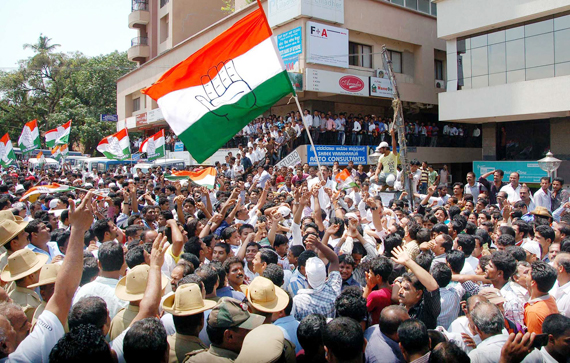
The victory in Karnataka would not have come at more appropriate psychological time for Congress than now. The Congress has been literally having a torrid time, with parliament deadlocked over the latest round of controversies revolving round the charges of corruption leveled against the Union Railway Minister, Mr Bansal and faux pas committed by the Union Law Minister Mr Ashwan Kumar in vetting the report before the CBI was to submit the same as per the directive of the Supreme Court. The Supreme Court has become furious over the indiscretion committed by the Law Minister and the Congress  finds it unable to handle the situation in parliament, with the opposition braying for the head of not only the two ministers but of the Prime Minister too. This naturally had spoiled the mood of the party, which was preparing to take on the BJP at the next hustings to Lok Sabha due any time from now.

Under the circumstances, the happy tidings from Karnataka, has come as a balm to soothe the ruffled nerves of the party leaders. What has made the party savour the occasion, has been that the victory was not snatched, but got in on a platter as it were from the BJP and the party had not even made one single effort to wear the mantle. Its peformanance as the principal opposition party as pathetic to put it mildly. It was a case of disenchanted people turning to the Congress once again mainly because of the TINA (there is no other alternative) factor.

After the poll results, it has been turn for the national BJP to go through the embarrassing moments. Its southern edifice has fallen like a pack of cards. And this is not a good omen for the party, which is increasingly flexing its muscle for the major electoral battle that lies ahead and has been dreaming of replacing the Congress led UPA at the Centre.

Very few in Congress however appear to have understood the real implications of the mandate.  The vote in Karnataka has been a vote for better governance essentially and for political stability to boot, the two factors which have obviously taken a holiday right from 2004.  The Congress is now required to put person who can govern well and provide political stability. And this is hard task by any standards for the Congress. There has been sudden spurt in the aspirants who want to don the mantle of the Chief Ministership. The main aspirant has been the Leader of the Opposition Mr Siddaramaiah, an OBC leader who has been waiting in the  side wings too long to take over as the Chief Minister. The denial of the coveted post during the Janata Dal regime by his one time mentor turned bete noire Devegowda made him embrace the Congress and here too he has been put on a long and unending probation. The name of Mr Mallikarjun Kharge, the Dalit leader, who has a record of nine straight wins to the assembly and success  in the only loksabha election he contested last  time, is also doing rounds. Mr Kharge is currently the Union Minister for Labour and Employment and it was because of the initiative taken by him, that the Centre agreed to provide special status for the backward region of Hyderabad Karnataka, to which he belongs  through a constitutional amendments. In any exigency the former Chief Ministers, Mr Krishna and Mr Veerappa Moily , who is Union Minister are not averse to come back to take over the mantle.  The whole dilemma facing the Congress is to have a man at the helm of affairs in Karnataka, capable of getting large number of Congress MPs elected from Karnataka, since numbers are important for the party to rule at New Delhi.

Besides the track record of the Congress shows that it has often slipped up on the question of providing good governance. Ever since the first non Congress government was formed in Karnataka in 1983, the electorate has been averse to giving second term to any party, which has not delivered goods. That’s how the Janata Dal lost power in 1989, and 1994 and it was the Congress turn to face the music and pay for its lapses, when the people trusted them in rule in 1989 and 1999. In 1989, the dissidence in the Congress resulted in state having three Chief Minister and during the regime of the third Chief Minister Mr Moily, the Congress was shown the door.  Disenchanted with the perpetual quarrel within the Janata Dal which resulted in the split of the parent party, the electorate gave marching orders to the party in 1999. Mr Krishna who came as the new Chief Minister proved to be disappointment.  In his desire to turn Bangalore into Singapore, Mr Krishna turned a blind eye to the people’s problems. He catered to the needs of the urbanites and elites, while leaving the rural people in the lurch. So much was his disdain for the ruralites that Krishna chose to conduct meetings to review the drought in the interiors in the air-conditioned meeting halls rather than going to the field. The disconnect between the government and the governed was total.

In 2004 election, where no party got the majority, the electorate had punished the Congress by denying the party the status of single largest party in the assembly, which went to  the BJP. And the efforts made by the Congress to circumvent the mandate and rule the state through coalition experiment with a regional party, the JDS ended in a disaster. The JDS gave a slip to Congress and left the coalition to form a new coalition with BJP, which also did not last long because of their mutual suspicion among the coalition partner. The government literally drifted aimlessly during this tenure.

So the electorate chose to trust the BJP which was waiting in the wings for an opportunity to govern in the 2008 elections. The people simply believed the BJP and its leader Mr Yeddyurappa who made an emotionally charged plea to give his party an opportunity. The people obliged and put the party in power. The people also tolerated the unethical manner in which Yeddyyurappa sought to firm up his majority. And at one time, it looked as if Yeddyurappa and his party would be around at the helm of affairs for long time in Karnataka.

When the BJP hoisted the saffron flag for the first time in Karnataka, it was a history being created. The party, for the first time was able to break the geographical barrier in travelling south of Vindhyas in expanding its political base.  The BJP’s national leadership thought year 2008 was going to be watershed year for the party plan to expand the base away from its traditional pockets in North India.

The BJP regime proved to be classical case of disaster of unmitigated dimensions. For the first three years of the regime, that is upto 2011, everything was going fine for the BJP.   It all started with Lokayukta indicting the government and the Chief Minister with regard to the illegal mining affairs. And Mr Yeddyurappa in his anxiety to wriggle out of the situation messed up the issues further. The things moved with such frenetic speed that the damage was done before one could realise it. The tale of misgovernanance of the Yeddyurappa regime is too recent to merit repetition. The last straw to break the back was the manner in which Yeddyurappa quit the party in a huff after he unsuccessfully tried to install himself as the Chief Minister from which he had been asked to quit earlier by the party high command.

It appeared that Yeddyurappa was overpowered by an exaggerated notion of self importance and placed himself above the party and parted company to dismantle the party apparatus, which he had earlier tried to build. It was case of mentor turning out to be tormentor.

By floating his own person centric party with the sole aim of getting back the chief minister’s post, Yeddyurappa might have proved that he was too important within the party to be ignored. He managed to dismantle the party in the election as has been seen but his own party could not make much headway. It spoiled the chances of the parent party but had no capacity to emerge as a political force to be reckoned with. He had cut the branch of the tree on which he was sitting and he fell along with the branch too on the face. It would take long long time for the BJP to pick up the pieces to put its house in order once again.

An interesting aspect of the election, was the unobtrusive manner in which the electorate brought about the change punishing Yeddyurappa, and   his present and former political outfits but gave only a modest majority for the Congress to deliver the goods in the days to come.

The poll turn out reached the highest peak with around 71% of the 4.36 crore exercising the franchise, which is a record for Karnataka so far. Among the electorate, there were 36 lakhs newly enrolled voters, who had had no political baptism so far.  And this section, whose presence was hardly  taken  cognisance by  any political party, had helped the BJP in the last three election to bridge yawning gap as far as the voting base is concerned and brought it on level with Congress in  just three elections of 1999, 2004 and 2008. And all the while the Congress had not been able to get a single vote extra over and above its base of around 90 lakhs, while the BJP had enjoyed the bonanza exclusively.

This time around 3.08 crore voters exercised their franchise, which meant that an additional 48 lakhs had exercised franchise, made up of 36 lakh new voters, who would never miss the maiden opportunity to cast their votes and another 12 lakhs of senior voters who came out of the comforts of their house to do their duty and to clearly send out a message for the parties to perform or perish. It was as though a virtual tsunami   of people’s power had descended.

And it came about in a quiet manner. The curbs placed by the Election Commission, in transporting voters to the booths had denied them a facility to which they were used to. They came on their own walking and braving the scorching sun to cast their votes on a hot sunny day. The people’s majesty was in view in correcting the aberrations that had been kept in. The BJP lost more than what Yeddyurappa and another breakaway group led by Sriramulu could nibble at the base of the BJP. The first time voters, for the first time in ten years, were looking beyond the BJP for extending their patronage. It is this which brought about the needed change with requisite message loud and clear.

The author is a senior journalist and columnist based in Hubli

Comments

Add new comment

  • Coastaldigest.com reserves the right to delete or block any comments.
  • Coastaldigset.com is not responsible for its readers’ comments.
  • Comments that are abusive, incendiary or irrelevant are strictly prohibited.
  • Please use a genuine email ID and provide your name to avoid reject.
Wafa Sultana
April 4,2020

Over the last couple of days when the world was occupied with unifying efforts to fight the deadly Covid19 pandemic, sections of Indian media provided viewers a familiar scapegoat – the Indian Muslims – who are often stereotyped as a community being constantly at loggerheads with the citizenry and the State. Biased media channels were quick to resort to blaming the entire Muslim community for the spread of the disease in the country, thanks to an ill-timed Tablighi Jamaat gathering at its international headquarters in Delhi’s Nizamuddin. Unsurprisingly, the opprobrium was also marked by a sudden spike in WhatsApp forwards of videos with people wearing skullcaps licking spoons and performing Sufi breathing rituals, suggesting some sort of wild conspiracy on the part of the community to spread the virus.  Some media channels were quick to formulate, hypothesize and provide loose definitions of a newly discovered form of Jihad i.e. ‘Corona Jihad ’ thereby vilifying the Islamic faith and its followers.

While the investigation on the culpability of the organizers of the Nizamuddin event is still ongoing, there is enough information to suggest that the meeting was held before any lockdown was in force, and the problem began when there was no way of getting people out once the curfew was announced. Be that as it may, there is little doubt that organizing a meet of such a scale when there is a global pandemic smacks of gross misjudgment, and definitely the organizers should be held accountable if laws or public orders were defied. Attendees who attempt to defy quarantine measures must be dealt with strictly. However, what is alarming is that the focus and narrative have now shifted from the unfortunate event at Nizamuddin to the Tablighi Jamaat itself.

For those not familiar with the Tablighi Jamaat, the organization was founded in 1926 in Mewat by scholar Maulana Mohammad Ilyas. The Jamaat’s main objective was to get Muslim youth to learn and practice pristine Islam shorn of external influences. This is achieved through individuals dedicating time for moral and spiritual upliftment secluded from the rest of the world for a brief period of time. There is no formal membership process. More senior and experienced participants typically travel from one mosque to other delivering talks on religious topics, inviting local youth to attend and then volunteer for a spiritual retreat for a fixed number of days to a mosque in a nearby town or village to present the message to their co-religionists. Contrary to ongoing Islamophobic rhetoric, the movement does not actively proselytize. The focus is rather on getting Muslims to learn the teachings and practices of Islam.  This grassroots India-based movement has now grown to almost all countries with substantial Muslim populations. Its annual meets, or ‘ijtemas’ are among the largest Islamic congregations in the world after the annual Haj. One of the reasons for its popularity and wide network in the subcontinent and wordwide is the fact that it has eschewed the need for scholarly intervention, focusing on peer learning of fundamental beliefs and practice rather than high-falutin ideological debates. The Tablighi Jamaat also distinguishes itself from other Islamic movements through its strictly apolitical nature, with a focus on individual self-improvement rather than political mobilization. Hardships and difficulty in the world are expected to be face through ‘sabr’ (patience) and ‘dua’ (supplication),  than through quest for political power or influence. In terms of ideology, it is very much based on mainstream Sunni Islamic principles derived from the Deobandi school.

So, why is all this background important in the current context? While biased media entities have expectedly brought out their Islamophobic paraphernalia out for full display, more neutral commentators have tried to paint the Tablighi Jamaat as a fringe group and have tried to distance it from 'mainstream Muslims'. While the intent is no doubt innocent, this is a trap we must not fall into. This narrative, unfortunately, is also gaining ground due to apathy some Muslims have for the group, accusing it of being “disconnected from the realities of the world”. Unlike other Muslim organizations and movements, the Tablighi Jamat, by virtue of its political indifference, does not boast of high-profile advocates and savvy spokespersons who can defend it in mainstream or social media.  The use of adjectives such as 'outdated' and 'orthodox' by liberal columnists to describe the Jamaat feeds into the malignant attempt to change the narrative from the control of the spread of the pandemic due to the Nizamuddin gathering to 'raison d'etre' of the organization itself.

A large mainstream religious group like the Tablighi Jamaat with nearly a hundred-year history, normally considered to be peaceful, apolitical and minding its own business is now suddenly being villainized owing to unfortunate circumstances. Biased media reactions filled with disgust and hate seem to feed the Indian public conscience with a danngerous misconception - to be a nominal Muslim is okay but being a practicing one is not.  For those committed to the truth and fighting the spread of Islamophobia, the temptation to throw the entire Tablighi Jamaat under the bus must be resisted.

The writer is a lawyer and research scholar at Qatar University. Her research interests include Islamic law and politics.

Comments

zahoorahmed
 - 
Saturday, 4 Apr 2020

great article! provides a great perspective on tableeg jamat

Add new comment

  • Coastaldigest.com reserves the right to delete or block any comments.
  • Coastaldigset.com is not responsible for its readers’ comments.
  • Comments that are abusive, incendiary or irrelevant are strictly prohibited.
  • Please use a genuine email ID and provide your name to avoid reject.
Ram Puniyani
January 26,2020

During last couple of decades we have been witnessing the coming up of various statues in different parts of the country. There is diverse political logic and different set of political tendencies for erecting these statues. When Mayawati was UP CM, she got multiple of her own statues made, in addition to many statues of major dalit icons, irrespective of the criticism against that act. As per her strategy it was a symbol of identity of dalit assertion. The biggest statue to come up was that of Sardar Vallabh Bhai Patel, a lifelong Congressman, whom RSS combine is trying to appropriate. This statue of Unity was ‘Made in China’. The clever trick was that the same forces were behind this statue, which was banned by Patel in the aftermath of Gandhi murder. Interestingly while currently BJP is blaming Congress for Partition of India, ironically it was Sardar Patel who was in the committee which gave final stamp of approval for the partition of India.

There is also a talk in UP, where the Ram temple campaign yielded rich electoral dividends for BJP, to have tallest statue of Lord Ram in Ayodhya. In a state where children are dying in hospitals due to lack of Oxygen cylinders, a huge budgetary allocation will be required for such project. While on statues one should also remember that in Maharashtra a tall statue of Chatrapati Shivaji Maharaj is underway in Arabian Sea, near Mumbai. Only few voices of protest against it came up, e.g. that of renowned journalist, now, MP, Kumar Ketkar, whose house was vandalised for his opposing the move on the grounds that same massive amount can be utilized for welfare-development activities in the state.

On the back of this comes a comparatively low budget 114 feet tall statue of Jesus Christ in Karnataka, in Kappala hills Harobele village, where Christian pilgrims have been thronging from last several centuries. The land for this has been donated by Congress leader Shivaprasad and his brother, a Congress MP. It is planned to be carved out from a single rock. The plan of this statue is being opposed by those who have been behind most of the statue projects so far. Hindu Jagran Vedike, VHP, RSS are up in arms saying that they will not let this come up. There are various arguments cited for this opposition. It is being said that this was a place of worship of Lord Munnieshwara (a form of Lord Shiva).

More than this it is being argued that Shivakumar is trying to please his Italian boss in the party. Also that this will bring back the period of slavery of foreign rule, the colonial rule of British. As such this opposition is more in tune with the ideology of RSS combine, which has been for a statue here and a statue there. Their politics regards Christianity as a ‘foreign religion’! It is true that in Citizenship Amendment Act, they have not excluded Christianity while other religion, which they regard as ‘Foreign’ i.e. Islam. Here they are using a different logic, that the countries from where persecuted minorities are coming, are Muslim countries, Pakistan, Afghanistan and Bangla Desh.

In India the major targeting by RSS combine has been against Muslims, but Christians are also not spared. Starting in the decade of 1980, an intense propaganda has been going on that Christian Missionaries are converting. As RSS affiliate Vanvasi Kalyan Ashram became active in Adivasi areas, the likes of Swami Aseemanand, Swami Laxmanand and followers of Aasaram bapu spread out in Tribal areas. They started their programs to popularise Shabri and Hanuman, with congregations like Shabri Kumbh being regularly organized in these areas. The aim was to Hinduize the people in those areas.

The first major anti Christian violence came up in the ghastly form of burning alive of Pastor Graham Steward Stains along with his two minor sons Timothy and Philip. RSS affiliate Bajrang Dal's Dara Siingh aka Rajendra Pal was behind this and he is serving the life term for that. At the same time Wadhva Commission was appointed to investigate this crime which shook the country and President K.R. Narayan termed it as the one belonging to the inventory of the black deeds of human history.

The Wadhva commission report pointed out that there was no statistical significant change in the region where the pastor was working. Similarly the national figures tell us that the Christian population, if at all, has marginally declined in last five decades as per the census figures. They stand like this, percentage of Christians in population, 1971-2.60, 1981- 2.44, 1991-2.34, 2001-2.30 and 2011-2.30. There are arguments that some people are converting to Christianity but are not revealing their religion. This may be true in case of miniscule percentage of dalits, who may not reveal there conversion, as they stand to loose reservation provisions if they convert.

The anti Christian violence is scattered and is below the radar most of the places. There was massive valence in Kandhamal, Orissa, when on the pretext that Christians have murdered Swami Laxmananand, a massive violence was unleashed in 2008. On regular basis prayer meetings of Christians are attacked on the pretext that these are attempts at conversion. While there is a huge demand for the schools and colleges run by Christian groups, in Adivasis areas and remote areas the work of Swamis is on.

Now the trend is to dump Christian traditions. Since Ramnath Kovind became President, the usual practice of Carol Singers visiting Rashtrapati Bhavan has been stopped. In the army retreat so far ‘Abide with me’ by Scottish poet, Henri Francis Lyte, a Christian song, a favourite of Gandhi, has been dropped. The Christian minorities have perceived the threat in various forms. Currently they are as much part of the protests against CAA, NPR and NRIC as any other community.

While statues and identity issues cannot have primacy over the social development issues, it cannot be selective. To oppose Jesus Christ statue while spending fortunes for other statues is a part of the agenda of RSS combine, which is unfolding itself in various forms. opposition to Jesus Christ statue being yet another step in the direction.

Comments

Add new comment

  • Coastaldigest.com reserves the right to delete or block any comments.
  • Coastaldigset.com is not responsible for its readers’ comments.
  • Comments that are abusive, incendiary or irrelevant are strictly prohibited.
  • Please use a genuine email ID and provide your name to avoid reject.
Ram Puniyani
March 14,2020

In the wake of Citizenship Amendment Act (CAA) UN High Commissioner, Michele Bachelet, has filed an intervention in the Supreme Court petition challenging the constitutionality of the Citizenship Amendment Act, as she is critical of CAA. Responding to her, India’s Foreign Minister S. Jai Shanker strongly rebutted her criticism, saying that the body (UNHCR) has been wrong and is blind to the problem of cross border terrorism. The issue on hand is the possibility of scores of people, mainly Muslims, being declared as stateless. The problem at hand is the massive exercise of going through the responses/documents from over 120 crore of Indian population and screening documents, which as seen in Assam, yield result which are far from truthful or necessary.

The issue of CAA has been extensively debated and despite heavy critique of the same by large number of groups and despite the biggest mass opposition ever to any move in Independent India, the Government is determined on going ahead with an exercise which is reminiscent of the dreaded regimes which are sectarian and heartless to its citizens, which have indulged in extinction of large mass of people on grounds of citizenship, race etc. The Foreign minister’s assertion is that it is a matter internal to India, where India’s sovereignty is all that matters! As far as sovereignty is concerned we should be clear that in current times any sovereign power has to consider the need to uphold the citizenship as per the principle of non-discrimination which is stipulated in Art.26 of the International Covenant on Civil and Political (ICCPR) rights.

Can such policies, which affect large number of people and are likely to affect their citizenship be purely regarded as ‘internal’? With the World turning into a global village, some global norms have been formulated during last few decades. The norms relate to Human rights and migrations have been codified. India is also signatory to many such covenants in including ICCPR, which deals with the norms for dealing with refugees from other countries. One is not talking of Chicago speech of Swami Vivekanand, which said that India’s greatness has been in giving shelter to people from different parts of the World; one is also not talking of the Tattariaya Upanishad’s ‘Atithi Devovhav’ or ‘Vasudhaiva Kutumbkam’ from Mahaupanishad today.

What are being talked about are the values and opinions of organizations which want to ensure to preserve of Human rights of all people Worldwide. In this matter India is calling United Nations body as ‘foreign party’; having no locus standi in the case as it pertains to India’s sovereignty. The truth is that since various countries are signatories to UN covenants, UN bodies have been monitoring the moves of different states and intervening at legal level as Amicus (Friend of the Court) to the courts in different countries and different global bodies. Just to mention some of these, UN and High Commissioner for Human Rights has often submitted amicus briefs in different judicial platforms. Some examples are their intervention in US Supreme Court, European Court of Human Rights, International Criminal Court, and the Inter-American Court of Human Rights. These are meant to help the Courts in areas where UN bodies have expertise.

 Expertise on this has been jointly formulated by various nations. These interventions also remind the nations as to what global norms have been evolved and what are the obligations of individual states to the values which have evolved over a period of time. Arvind Narrain draws our attention to the fact that, “commission has intervened in the European Court of Human Rights in cases involving Spain and Italy to underscore the principle of non-refoulement, which bars compulsory expulsion of illegal migrants… Similarly, the UN has intervened in the International Criminal Court in a case against the Central African Republic to explicate on the international jurisprudence on rape as a war crime.”

From time to time organizations like Amnesty International and Human Rights Watch have been monitoring the status of Human rights of different countries. This puts those countries in uncomfortable situation and is not welcome by those establishments. How should this contradiction between ‘internal matter’, ‘sovereignty’ and the norms for Human rights be resolved? This is a tough question at the time when the freedom indices and democratic ethos are sliding downwards all over the world. In India too has slid down on the scale of these norms.

In India we can look at the intervention of UN body from the angle of equality and non discrimination. Democratic spirit should encourage us to have a rethink on the matters which have been decided by the state. In the face of the greatest mass movement of Shaheen bagh, the state does need to look inwards and give a thought to international morality, the spirit of global family to state the least.

The popular perception is that when Christians were being persecuted in Kandhmal the global Christian community’s voice was not strong enough. Currently in the face of Delhi carnage many a Muslim majority countries have spoken. While Mr. Modi claims that his good relations with Muslim countries are a matter of heartburn to the parties like Congress, he needs to relook at his self gloating. Currently Iran, Malaysia, Indonesia and many Muslim majority countries have spoken against what Modi regime is unleashing in India. Bangladesh, our neighbor, has also seen various protests against the plight of Muslims in India. More than the ‘internal matter’ etc. what needs to be thought out is the moral aspect of the whole issue. We pride ourselves in treading the path of morality. What does that say in present context when while large section of local media is servile to the state, section of global media has strongly brought forward what is happening to minorities in India.   

The hope is that Indian Government wakes up to its International obligations, to the worsening of India’s image in the World due to CAA and the horrific violence witnessed in Delhi.

Comments

Add new comment

  • Coastaldigest.com reserves the right to delete or block any comments.
  • Coastaldigset.com is not responsible for its readers’ comments.
  • Comments that are abusive, incendiary or irrelevant are strictly prohibited.
  • Please use a genuine email ID and provide your name to avoid reject.