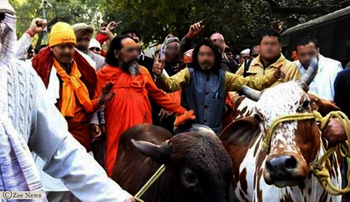
Cow vigilantes have no place in India: Modi govt tells Supreme Court

Agencies
July 21, 2017

New Delhi, Jul 21: The Centre on Friday informed Supreme Court that it does not support any kind of cow vigilantism in any state and no such group has any place in the country as per the procedure of law. The Apex Court then asked all the states to file an affidavit in the matter asking them how they will prevent cow vigilantism.Cowvigilantes

On the other hand, the BJP-ruled states Gujarat and Jharkhand told the top court that action has been taken against those involved in violence related to cow vigilantism.

A petition seeking a ban on cow vigilante groups across the nation was filed in the apex court.The petitioner had alleged that the vigilante groups have unleashed terror on Minority and Dalit communities, where the Centre has proven ineffective in training terror, unleashed by these groups.

Earlier the Court had sought a response from Centre and other states on the issue. Many cases of harassment and violence in the name of "gau raksha" (cow protection) were recorded, on which the nation stands divided.Prime Minister Narendra Modi, in June, had condemned the attacks in the name of cow vigilantism saying, "Killing people in the name of cow is unacceptable. No one has the right to take law into his/her hands. We belong to a land of non-violence. Violence is not the solution to any problem."

Earlier Parliamentary Affairs Minister Ananth Kumar after the all-party meeting had said, "Prime Minister Modi has asked the State Governments to take strict action against the anti-social elements creating violence in the name of cow vigilantism and punish them strictly."

Comments

imran ali
 - 
Monday, 24 Jul 2017

mai jana chahta hu sir maine passport b lga rkha h bt kuch process age nhi badh rhi ..call me 8858408885

Add new comment

  • Coastaldigest.com reserves the right to delete or block any comments.
  • Coastaldigset.com is not responsible for its readers’ comments.
  • Comments that are abusive, incendiary or irrelevant are strictly prohibited.
  • Please use a genuine email ID and provide your name to avoid reject.
Agencies
May 8,2020

Washington D.C., May 8: The prime time for brain development in a child's life is the first year, where the infant spends most of the time asleep. It is the time when neural connections form and sensory memories are encoded.

However, when sleep is disrupted, as occurs more often among children with autism, brain development may be affected, too.

New research led by the University of Washington finds that sleep problems in a baby's first 12 months may not only precede an autism diagnosis but also may be associated with altered growth trajectory in a key part of the brain, the hippocampus.

The study, which was published in the American Journal of Psychiatry, researchers report that in a sample of more than 400 taken of 6- to 12-month-old infants, those who were later diagnosed with autism were more likely to have had difficulty falling asleep.

It also states that this sleep difficulty was associated with altered growth trajectories in the hippocampus.

"The hippocampus is critical for learning and memory, and changes in the size of the hippocampus have been associated with poor sleep in adults and older children.

As many as 80 per cent of the children with autism spectrum disorder have sleep problems," said Annette Estes, director of the UW Autism Center and senior author of the study.

"In our clinical experience, parents have a lot of concerns about their children's sleep, and in our work on early autism intervention, we observed that sleep problems were holding children and families back," added Estes, who is also a UW professor of speech and hearing sciences.

"It could be that altered sleep is part-and-parcel of autism for some children. One clue is that behavioural interventions to improve sleep don't work for all children with autism, even when their parents are doing everything just right. This suggests that there may be a biological component to sleep problems for some children with autism," said Estes.

To consider links among sleep, brain development, and autism, researchers at the IBIS Network looked at MRI scans of 432 infants, surveyed parents about sleep patterns, and measured cognitive functioning using a standardized assessment.

At the outset of the study, infants were classified according to their risk for developing autism: Those who were at higher risk of developing autism -- about two-thirds of the study sample -- had an older sibling who had already been diagnosed.

Infant siblings of children with autism have a 20 per cent chance of developing autism spectrum disorder -- a much higher risk than children in the general population.

In the current study, 127 of the 432 infants were identified as "low risk" at the time the MRI scans were taken because they had no family history of autism.

They later evaluated all the participants at 24 months of age to determine whether they had developed autism. Of the roughly 300 children originally considered "high familial risk," 71 were diagnosed with autism spectrum disorder at that age.

Problems with sleep were more common among the infants later diagnosed with an autism spectrum disorder, as were larger hippocampi. No other subcortical brain structures were affected, including the amygdala, which is responsible for certain emotions and aspects of memory, or the thalamus, a signal transmitter from the spinal cord to the cerebral cortex.

The authors note that while parents reported more sleep difficulties among infants who developed autism compared to those who did not, the differences were very subtle and only observed when looking at group averages across hundreds of infants.

Sleep patterns in the first years of life change rapidly as infants transition from sleeping around the clock to a more adult-like sleep/wake cycle. Until further research is completed, Estes said, it is not possible to interpret challenges with sleep as an early sign of increased risk for autism.


Comments

Add new comment

  • Coastaldigest.com reserves the right to delete or block any comments.
  • Coastaldigset.com is not responsible for its readers’ comments.
  • Comments that are abusive, incendiary or irrelevant are strictly prohibited.
  • Please use a genuine email ID and provide your name to avoid reject.
News Network
May 22,2020
Bengaluru, May 22: Evacuation planes from Male in Maldives and Doha in Qatar landed in Bengaluru with returnees from Karnataka after they were stranded for two months due to suspension of international flights since March 23 and the extended lockdown, an official said on Friday.
 
"An Air-India flight (#0266) with 152 passengers from Male and its subsidiary Express flight (IX-0822) with 177 returnees and 5 infants from Doha landed here safely at 6.50 pm. and 9.05 pm respectively," an airline official told media persons in Bengaluru.
 
Both the flights are first from their respective countries to Bengaluru, bringing in returnees to the southern state in the second phase of the Vande Bharat mission, being carried out to evacuate Indians stranded the world over.
 
"As per the standard operating procedure and guidelines of the state health department, all the passengers were screened with thermal device and tested to ensure they were asymptomatic before leaving the airport," a nodal officer said.
 
The returnees were given a spare mask to wear all the time and a sanitiser to wash their hands.
 
"The luggage of all passengers was screened and disinfected before handing over to them after they completed formalities such as filling the self-declaration form and downloading of the Quarantine App for contact tracing later,” said the official.
 
The passengers were ferried from the airport in state-run buses in batches for 14-day institutional quarantine in hotels and resorts across the city.
 
The flights were the 6th and 7th flights to Karnataka, of the national carrier and its Express arm, which are operating the service to repatriate thousands of Indians, including distressed workers, migrants, students, senior citizens and tourists, stranded overseas.
 
Five flights have flown about 650 returnees till date from May 18-21 under the mission's second phase to Bengaluru and Mangaluru on the west coast. The passengers have been brought from Dubai in the UAE, Kuala Lumpur in Malaysia, Muscat in Oman, Dammam in Saudi Arabia and San Francisco in the US.
 
The remaining flights to Karnataka will land in Bengaluru and Mangaluru over the next 12 days till June 3 from 9-10 more destinations the world over.
 
In the first phase of the mission from May 7-17, the airline and its arm flew 6 flights to the state from May 11-15, bringing in 800 passengers, including 623 to Bengaluru and 177 to Mangaluru from London, Singapore, San Francisco and Dubai.

Comments

Add new comment

  • Coastaldigest.com reserves the right to delete or block any comments.
  • Coastaldigset.com is not responsible for its readers’ comments.
  • Comments that are abusive, incendiary or irrelevant are strictly prohibited.
  • Please use a genuine email ID and provide your name to avoid reject.
News Network
May 5,2020

Bengaluru, May 5: The Karnataka excise department booked a case against a wine shop owner in this tech city for allegedly selling more liquor than permitted under the law to a buyer on the first day of shops reopening for business after 40-day lockdown on Monday, an official said on Tuesday.

"We have booked a case against licensed shop owner S. Venkatesh for reportedly selling Indian made liquor (IML) and beer to a buyer on Monday more than he is permitted under the Karnataka Excise Act section 36," Bengaluru South Excise Deputy Commissioner A. Giri told media persons.

The alleged sale came to light when the unidentified customer posted in the social media a receipt showing he bought liquor worth Rs 52,841 from Vanilla Spirit Zone in the city''s south-eastern suburb on Monday afternoon.

"Preliminary investigation revealed that 17.4 litres of IML was sold against the permissible limit of 2.3 litres and 35.1 litres of beer against the legal limit of 18.2 litres," Giri said.

Venkatesh, however, told Giri that the buyer paid for the liquor bought by him and seven of his colleagues at the same time from the shop as they entered together.

"We are investigating to ascertain if Venkatesh violated the license conditions by paying for liquor bought by his friends with him at the same time," Giri added.

Comments

Add new comment

  • Coastaldigest.com reserves the right to delete or block any comments.
  • Coastaldigset.com is not responsible for its readers’ comments.
  • Comments that are abusive, incendiary or irrelevant are strictly prohibited.
  • Please use a genuine email ID and provide your name to avoid reject.