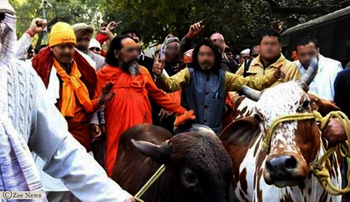
Cow vigilantes have no place in India: Modi govt tells Supreme Court

Agencies
July 21, 2017

New Delhi, Jul 21: The Centre on Friday informed Supreme Court that it does not support any kind of cow vigilantism in any state and no such group has any place in the country as per the procedure of law. The Apex Court then asked all the states to file an affidavit in the matter asking them how they will prevent cow vigilantism.Cowvigilantes

On the other hand, the BJP-ruled states Gujarat and Jharkhand told the top court that action has been taken against those involved in violence related to cow vigilantism.

A petition seeking a ban on cow vigilante groups across the nation was filed in the apex court.The petitioner had alleged that the vigilante groups have unleashed terror on Minority and Dalit communities, where the Centre has proven ineffective in training terror, unleashed by these groups.

Earlier the Court had sought a response from Centre and other states on the issue. Many cases of harassment and violence in the name of "gau raksha" (cow protection) were recorded, on which the nation stands divided.Prime Minister Narendra Modi, in June, had condemned the attacks in the name of cow vigilantism saying, "Killing people in the name of cow is unacceptable. No one has the right to take law into his/her hands. We belong to a land of non-violence. Violence is not the solution to any problem."

Earlier Parliamentary Affairs Minister Ananth Kumar after the all-party meeting had said, "Prime Minister Modi has asked the State Governments to take strict action against the anti-social elements creating violence in the name of cow vigilantism and punish them strictly."

Comments

imran ali
 - 
Monday, 24 Jul 2017

mai jana chahta hu sir maine passport b lga rkha h bt kuch process age nhi badh rhi ..call me 8858408885

Add new comment

  • Coastaldigest.com reserves the right to delete or block any comments.
  • Coastaldigset.com is not responsible for its readers’ comments.
  • Comments that are abusive, incendiary or irrelevant are strictly prohibited.
  • Please use a genuine email ID and provide your name to avoid reject.
News Network
June 23,2020

Bengaluru, Jun 23: Karnataka Medical Education Minister K Sudhakar's wife and daughter have tested positive for COVID-19, a day after his father was confirmed to have been infected with the virus.

"Test results of our family members have come. Unfortunately, my wife and daughter have tested positive for #Covid19 and are undergoing treatment," the minister tweeted on Tuesday.

He said he and his two sons have tested negative.

Sudhakar's father P N Keshava Reddy tested positive for coronavirus on Monday. He was admitted to the hospital with a cough and fever.

Earlier, the domestic help of the minister had tested coronavirus positive and was admitted to a hospital.

In April, Sudhakar was quarantined along with three other ministers for coming in contact with a journalist who was coronavirus positive.

Karnataka reported 249 new COVID-19 cases and five deaths on Monday taking the total number of cases in the state to 9,399 and the death toll to 142.

Comments

Add new comment

  • Coastaldigest.com reserves the right to delete or block any comments.
  • Coastaldigset.com is not responsible for its readers’ comments.
  • Comments that are abusive, incendiary or irrelevant are strictly prohibited.
  • Please use a genuine email ID and provide your name to avoid reject.
News Network
May 30,2020

Bengaluru, May 30: The Karnataka government will soon launch a project to maintain the health database of all its citizens, said Medical Education Minister Dr K Sudhakar on Friday.

A first of its kind initiative, the "State Health Register" will be a robust and standardised health repository of all the citizens, as per an official release.

Sudhakar said that the project will be implemented first in Chikkaballapur district on an experimental basis. "Enhanced focus on healthcare has become imperative and our government is committed to providing world-class healthcare to all citizens," he added.

While speaking to media, the minister said that COVID-19 experience has demonstrated the necessity of having robust, real-time public health data and, therefore, there is a need to maintain a repository of health data of each and every citizen.

He said that the government will be undertaking a survey of all 6.5 crore people in the state, by using a team of Primary Health Centre officials, revenue officials, education department staff and ASHA karyakartas.

"They will visit each household and collect health data of all the members of the family. This will not only help the government to provide better healthcare but will also help efficient resource allocation, management and better implementation of various citizen-centric schemes in the state," Sudhakar stated.

"Public-Private Partnership -- It's our vision to provide world-class healthcare to all citizens in the state and we need accurate data to make our vision a reality. The health register is a futuristic project which is taken up in the interest of the people. The project will include 50 per cent partnership of private hospitals. The data collected will help us to prioritise healthcare based on geography, demography and other targetted measures," read the release.

Chief Minister BS Yediyurappa has assured all support for the project and a detailed discussion will be undertaken in the upcoming cabinet meeting, said Dr Sudhakar.

The minister also assured that he is committed to ensuring that all citizens of the state have access to world-class healthcare.

Comments

Add new comment

  • Coastaldigest.com reserves the right to delete or block any comments.
  • Coastaldigset.com is not responsible for its readers’ comments.
  • Comments that are abusive, incendiary or irrelevant are strictly prohibited.
  • Please use a genuine email ID and provide your name to avoid reject.
Agencies
June 17,2020

Riyadh, Jun 17: Saudi Arabia is expected to scale back or call off this year's hajj pilgrimage for the first time in its modern history, observers say, a perilous decision as coronavirus cases spike.

Muslim nations are pressing Riyadh to give its much-delayed decision on whether the annual ritual will go ahead as scheduled in late July.

But as the kingdom negotiates a call fraught with political and economic risks in a tinderbox region, time is running out to organise logistics for one of the world's largest mass gatherings.

A full-scale hajj, which last year drew about 2.5 million pilgrims, appears increasingly unlikely after authorities advised Muslims in late March to defer preparations due to the fast-spreading disease.

"It's a toss-up between holding a nominal hajj and scrapping it entirely," a South Asian official in contact with Saudi hajj authorities said.

A Saudi official said: "The decision will soon be made and announced."

Indonesia, the world's most populous Muslim nation, withdrew from the pilgrimage this month after pressing Riyadh for clarity, with a minister calling it a "very bitter and difficult decision".

Malaysia, Senegal and Singapore followed suit with similar announcements.

Many other countries with Muslim populations -- from Egypt and Morocco to Turkey, Lebanon and Bulgaria -- have said they are still awaiting Riyadh's decision.

In countries like France, faith leaders have urged Muslims to "postpone" their pilgrimage plans until next year due to the prevailing risks.

The hajj, a must for able-bodied Muslims at least once in their lifetime, represents a major potential source of contagion as it packs millions of pilgrims into congested religious sites.

But any decision to limit or cancel the event risks annoying Muslim hardliners for whom religion trumps health concerns.

It could also trigger renewed scrutiny of the Saudi custodianship of Islam's holiest sites -- the kingdom's most powerful source of political legitimacy.

A series of deadly disasters over the years, including a 2015 stampede that killed up to 2,300 worshippers, has prompted criticism of the kingdom's management of the hajj.

"Saudi Arabia is caught between the devil and the deep blue sea," Umar Karim, a visiting fellow at the Royal United Services Institute in London, told AFP.

"The delay in announcing its decision shows it understands the political consequences of cancelling the hajj or reducing its scale."

"Buying time"

The kingdom is "buying time" as it treads cautiously, the South Asian official said.

"At the last minute if Saudi says 'we are ready to do a full hajj', (logistically) many countries will not be in a position" to participate, he said.

Amid an ongoing suspension of international flights, a reduced hajj with only local residents is a likely scenario, the official added.

A decision to cancel the hajj would be a first since the kingdom was founded in 1932.

Saudi Arabia managed to hold the pilgrimage during previous outbreaks of Ebola and MERS.

But it is struggling to contain the virus amid a serious spike in daily cases and deaths since authorities began easing a nationwide lockdown in late May.

In Saudi hospitals, sources say intensive care beds are fast filling up and a growing number of health workers are contracting the virus as the total number of cases has topped 130,000. Deaths surpassed 1,000 on Monday.

To counter the spike, authorities this month tightened lockdown restrictions in the city of Jeddah, gateway to the pilgrimage city of Mecca.

"Heartbroken"

"The hajj is the most important spiritual journey in the life of any Muslim, but if Saudi Arabia proceeds in this scenario it will not only exert pressure on its own health system," said Yasmine Farouk from the Carnegie Endowment for International Peace.

"It could also be widely held responsible for fanning the pandemic."

A cancelled or watered-down hajj would represent a major loss of revenue for the kingdom, which is already reeling from the twin shocks of the virus-induced slowdown and a plunge in oil prices.

The smaller year-round umrah pilgrimage was already suspended in March.

Together, they add $12 billion to the Saudi economy every year, according to government figures.

A negative decision would likely disappoint millions of Muslim pilgrims around the world who often invest their life savings and endure long waiting lists to make the trip.

"I can't help but be heartbroken -- I've been waiting for years," Indonesian civil servant Ria Taurisnawati, 37, told AFP as she sobbed.

"All my preparations were done, the clothes were ready and I got the necessary vaccination. But God has another plan."


Comments

Add new comment

  • Coastaldigest.com reserves the right to delete or block any comments.
  • Coastaldigset.com is not responsible for its readers’ comments.
  • Comments that are abusive, incendiary or irrelevant are strictly prohibited.
  • Please use a genuine email ID and provide your name to avoid reject.