


Cow vigilantes have no place in India: Modi govt tells Supreme Court

Agencies
July 21, 2017

New Delhi, Jul 21: The Centre on Friday informed Supreme Court that it does not support any kind of cow vigilantism in any state and no such group has any place in the country as per the procedure of law. The Apex Court then asked all the states to file an affidavit in the matter asking them how they will prevent cow vigilantism.Cowvigilantes
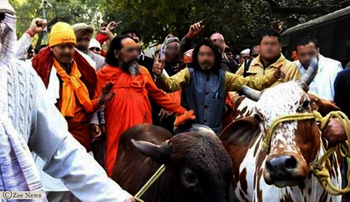
On the other hand, the BJP-ruled states Gujarat and Jharkhand told the top court that action has been taken against those involved in violence related to cow vigilantism.

A petition seeking a ban on cow vigilante groups across the nation was filed in the apex court.The petitioner had alleged that the vigilante groups have unleashed terror on Minority and Dalit communities, where the Centre has proven ineffective in training terror, unleashed by these groups.

Earlier the Court had sought a response from Centre and other states on the issue. Many cases of harassment and violence in the name of "gau raksha" (cow protection) were recorded, on which the nation stands divided.Prime Minister Narendra Modi, in June, had condemned the attacks in the name of cow vigilantism saying, "Killing people in the name of cow is unacceptable. No one has the right to take law into his/her hands. We belong to a land of non-violence. Violence is not the solution to any problem."

Earlier Parliamentary Affairs Minister Ananth Kumar after the all-party meeting had said, "Prime Minister Modi has asked the State Governments to take strict action against the anti-social elements creating violence in the name of cow vigilantism and punish them strictly."

Comments

imran ali
 - 
Monday, 24 Jul 2017

mai jana chahta hu sir maine passport b lga rkha h bt kuch process age nhi badh rhi ..call me 8858408885

Add new comment

  • Coastaldigest.com reserves the right to delete or block any comments.
  • Coastaldigset.com is not responsible for its readers’ comments.
  • Comments that are abusive, incendiary or irrelevant are strictly prohibited.
  • Please use a genuine email ID and provide your name to avoid reject.
News Network
February 22,2020

Bengaluru, Feb 22: President Ram Nath Kovind on Saturday said an ideal trade-off needs to be reached between new media -- which is fast and popular -- and traditional media which has developed skills to authenticate a news report, which is a costly operation.

Addressing the fourth edition of ‘the Huddle’ – the annual thought conclave of the Hindu here, he asserted that the internet and social media had democratised journalism and revitalised democracy, but had also led to many anxieties.

While the new media was fast and popular and people could choose what they wanted to watch, hear or read, traditional media would have to introspect on its role in society and find ways to earn the reader’s full trust again as "the project of democracy was incomplete without informed citizens – which means, without unbiased journalism."

Debate and discussion were internalised in India’s social psyche to arrive at truth since time immemorial, he said.

"There is no doubt that perception of truth is conditioned by circumstances. The conditions that cloud the truth’s positions are effectively dispelled by a contestation of ideas through debate, discussion and scientific temper. Prejudices and violence vitiate the search for truth."

Expressing happiness to attend ‘The Huddle’ organised by The Hindu, he said the Hindu group of publications had been relentlessly aiming to capture the essence of this great country through its responsible and ethical journalism. He commended them for their insistence on sticking to the five basic principles of journalism – truth-telling, freedom and independence, justice, humaneness and contributing to the social good, an official release here said.

Mr Kovind said dogmas and personal prejudices distorted the truth. In the 150th year of Gandhiji’s birth, he asked all to ponder over this question: "will it not be proper to pursue truth itself as the ideology? Gandhiji has shown us the path by walking ceaselessly in search of truth which would ultimately encompass every positive attribute that enriches the universe."

Comments

Add new comment

  • Coastaldigest.com reserves the right to delete or block any comments.
  • Coastaldigset.com is not responsible for its readers’ comments.
  • Comments that are abusive, incendiary or irrelevant are strictly prohibited.
  • Please use a genuine email ID and provide your name to avoid reject.
News Network
April 15,2020

Bengaluru, Apr 15: With the reporting of the death of an 80-yr-old female from Hirebagewadi taluk in Belagavi district, the number of persons, who were died due to COVID-19 related disease, increased to 12, in Karnataka on Wednesday.

According to official sources, the deceased was a relative of another COVID-19 infected person, was succumbed to death this morning at a designated Hospital in Belagavi district.

Comments

Add new comment

  • Coastaldigest.com reserves the right to delete or block any comments.
  • Coastaldigset.com is not responsible for its readers’ comments.
  • Comments that are abusive, incendiary or irrelevant are strictly prohibited.
  • Please use a genuine email ID and provide your name to avoid reject.
News Network
April 2,2020

The current physical distancing guidelines provided by the World Health Organisation (WHO) and by the US Centers for Disease Control and Prevention (CDC) may not be adequate to curb the coronavirus spread, according to a research which says the gas cloud from a cough or sneeze may help virus particles travel up to 8 metres. The research, published in the Journal of the American Medical Association, noted that the the current guidelines issued by the WHO and CDC are based on outdated models from the 1930s of how gas clouds from a cough, sneeze, or exhalation spread.

Study author, MIT associate professor Lydia Bourouiba, warned that droplets of all sizes can travel 23 to 27 feet, or 7-8 metres, carrying the pathogen.

According to Bourouiba, the current guidelines are based on "arbitrary" assumptions of droplet size, "overly simplified", and "may limit the effectiveness of the proposed interventions" against the deadly pandemic.

 She explained that the old guidelines assume droplets to be one of two categories, small or large, taking short-range semi-ballistic trajectories when a person exhales, coughs, or sneezes.

However based on more recent discoveries, the MIT scientist said, sneezes and coughs are made of a puff cloud that carries ambient air, transporting within it clusters of droplets of a wide range of sizes.

Bourouiba warned that this puff cloud, with ambient air entrapped in it, can offer the droplets moisture and warmth that can prevent it from evaporation in the outer environment.

"The locally moist and warm atmosphere within the turbulent gas cloud allows the contained droplets to evade evaporation for much longer than occurs with isolated droplets," she said.

"Under these conditions, the lifetime of a droplet could be considerably extended by a factor of up to 1000, from a fraction of a second to minutes," the researcher explained in the study.

The MIT scientist, who has researched the dynamics of coughs and sneezes for years, added that these droplets settle along the trajectory of a cough or sneeze contaminating surfaces, with their residues staying suspended in the air for hours.

"Even when maximum containment policies were enforced, the rapid international spread of COVID-19 suggests that using arbitrary droplet size cutoffs may not accurately reflect what actually occurs with respiratory emissions, possibly contributing to the ineffectiveness of some procedures used to limit the spread of respiratory disease," Bourouiba wrote in the study

Comments

Add new comment

  • Coastaldigest.com reserves the right to delete or block any comments.
  • Coastaldigset.com is not responsible for its readers’ comments.
  • Comments that are abusive, incendiary or irrelevant are strictly prohibited.
  • Please use a genuine email ID and provide your name to avoid reject.