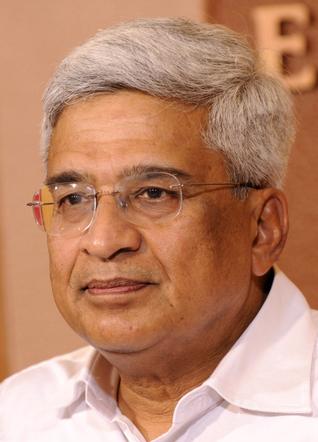
CPI(M) favours non-Congress candidate for VP post: Karat

July 12, 2012

karat

Chennai, July 12: As Congress intensified efforts for a consensus candidate for the Vice President's post, CPI(M) today said it is in favour of a person who does not belong to Congress.

This was conveyed by CPI(M) General Secretary Prakash Karat to Prime Minister Manmohan Singh who had recently contacted him as part of efforts to seek support of political parties in selection of a candidate in the Vice Presidential election.

"We have told the Prime Minister that we would like to have a person who does not belong to Congress party to be the Vice President," Karat told reporters here when asked about CPI(M)'s choice for the Vice President's post.

Observing that it was for UPA to decide whom it wants to put forward, the CPI(M) veteran said the candidate should also have a "stature and a distinguished background".

Karat, who is here for the party's three-day state committee meeting, said it was now upto Congress to decide, after which CPI(M) would respond.

The CPI(M) leader's observation comes in the midst of Congress giving broad hints that Hamid Ansari is a frontrunner in the Vice Presidential race. CPI(M) has extended support to UPA's presidential nominee Pranab Mukherjee.

Karat refused comment on the party's problems in Kerala.


Comments

Add new comment

  • Coastaldigest.com reserves the right to delete or block any comments.
  • Coastaldigset.com is not responsible for its readers’ comments.
  • Comments that are abusive, incendiary or irrelevant are strictly prohibited.
  • Please use a genuine email ID and provide your name to avoid reject.
News Network
May 9,2020

New Delhi, May 9: With 3,320 coronavirus cases and 95 deaths reported in the last 24 hours, India's COVID-19 cases rose to 59,662 on Saturday, informed the Union Ministry of Health and Family Welfare.

The total number of active cases in the country now stands at 39,834 while the number of cured/discharged/migrated stands at 17,847.

The country has reported 1,981 deaths so far, added the Ministry.

Maharashtra has the highest number of cases with 19, 063 followed by Gujarat with 7,402 cases and Delhi with 6,318 cases.

Meanwhile, the country continues to remain in a lockdown slated to end on May 17.

Comments

Add new comment

  • Coastaldigest.com reserves the right to delete or block any comments.
  • Coastaldigset.com is not responsible for its readers’ comments.
  • Comments that are abusive, incendiary or irrelevant are strictly prohibited.
  • Please use a genuine email ID and provide your name to avoid reject.
Agencies
April 23,2020

New Delhi, Apr 23: The nationwide lockdown in India which started about a month ago has impacted nearly 40 million internal migrants, the World Bank has said.

The lockdown in India has impacted the livelihoods of a large proportion of the country's nearly 40 million internal migrants. Around 50,000 60,000 moved from urban centers to rural areas of origin in the span of a few days, the bank said in a report released on Wednesday.

According to the report -- 'COVID-19 Crisis Through a Migration Lens' -- the magnitude of internal migration is about two-and-a-half times that of international migration.

Lockdowns, loss of employment, and social distancing prompted a chaotic and painful process of mass return for internal migrants in India and many countries in Latin America, it said.

Thus, the COVID-19 containment measures might have contributed to spreading the epidemic, the report said.

Governments need to address the challenges facing internal migrants by including them in health services and cash transfer and other social programmes, and protecting them from discrimination, it said.

World Bank said that coronavirus crisis has affected both international and internal migration in the South Asia region.

As the early phases of the crisis unfolded, many international migrants, especially from the Gulf countries, returned to countries such as India, Pakistan, and Bangladesh until travel restrictions halted these flows.

Some migrants had to be evacuated by governments, such as those of China and Iran, it said.

Before the coronavirus crisis, migrant outflows from the region were robust, the report said.

The number of recorded, primarily low-skilled emigrants from India and Pakistan rose in 2019 relative to the prior year but is expected to decline in 2020 due to the pandemic and oil price declines impacting the Gulf countries.

In India, the number of low-skilled emigrants seeking mandatory clearance for emigration rose slightly by eight percent to 368,048 in 2019.

In Pakistan, the number of emigrants jumped 63 per cent to 6,25,203 in 2019, largely due to a doubling of emigration to Saudi Arabia, it said.

According to the bank, migration flows are likely to fall, but the stock of international migrants may not decrease immediately, since migrants cannot return to their countries due to travel bans and disruption to transportation services.

In 2019, there were around 272 million international migrants.

The rate of voluntary return migration is likely to fall, except in the case of a few cross-border migration corridors in the South (such as Venezuela-Colombia, Nepal-India, Zimbabwe South Africa, Myanmar-Thailand), it said.

Migrant workers tend to be vulnerable to the loss of employment and wages during an economic crisis in their host country, more so than native-born workers.

Lockdowns in labour camps and dormitories can also increase the risk of contagion among migrant workers.

Many migrants have been stranded due to the suspension of transport services. Some host countries have granted visa extensions and temporary amnesty to migrant workers, and some have suspended the involuntary return of migrants, it said.

Observing that government policy responses to the COVID-19 crisis have largely excluded migrants and their families back home, the World Bank said there is a strong case for including migrants in the near-term health strategies of all countries, given the externalities associated with the health status of an entire population in the face of a highly contagious pandemic.

The Bank said governments would do well to consider short, medium and long-term interventions to support stranded migrants, remittance infrastructure, loss of subsistence income for families back home, and access to health, housing, education, and jobs for migrant workers in host/transit countries and their families back home.

The pandemic has also highlighted the global shortage of health professionals and an urgent need for global cooperation and long-term investments in medical training, it said.


Comments

Add new comment

  • Coastaldigest.com reserves the right to delete or block any comments.
  • Coastaldigset.com is not responsible for its readers’ comments.
  • Comments that are abusive, incendiary or irrelevant are strictly prohibited.
  • Please use a genuine email ID and provide your name to avoid reject.
Agencies
January 11,2020

Those owning a single house in joint names would continue to file their income tax returns (ITRs) in much simpler ITR-1 (Sahaj) and ITR-4 forms (Sugam) for assessment year 2020-21 with the government issuing a clarification in this regard.

The clarification has come days after the government modified the eligibility for filing the returns in ITR-1 and ITR-4, stating that those owning a property jointly, spending Rs 2 lakh on foreign travel and paying electricity bill of Rs 1 lakh in a year would not be able to file returns in the simpler forms.

They would have to file their returns with much more detailed information in other specified forms.

Following the changes in the eligibility for filing returns in the two forms, concerns were raised over it with taxpayers claiming that it will cause huge hardship for them.

"The matter has been examined and it has been decided to allow a person, who jointly owns a single house property, to file his/her return of income in ITR-1 or ITR-4 Form, as may be applicable, if he/she meets the other conditions," a Finance Ministry statement said.

"It has also been decided to allow a person, who is required to file return due to fulfilment of one or more conditions specified in the seventh proviso to section 139(1) of the Act, to file his/her return in ITR-1 Form," it added.

Tax practitioners welcomed the government’s move of going back to the previous position.

"This is a welcome clarification allowing middle class taxpayers owning a single house property to file simpler ITR forms, 1 and 4, and not the detailed ITR forms even if they own house property in joint names," said Shailesh Kumar, Director, Nangia Andersen Consulting.

It may be noted that taxpayers holding multiple house properties would have to file more detailed return forms.

In the major changes notified earlier this month by the Income-Tax department, individual taxpayers were disallowed to file return either in ITR-1 or ITR 4 if he or she was a joint-owner in house property.

In another change, those who deposited more than Rs 1 crore in bank account or spent Rs 2 lakh on foreign travel or paid Rs 1 lakh on electricity bill in a financial year were also barred from using the easy-to-fill return forms.

"By today's clarification, the government has maintained status quo. Now, the taxpayers can continue filing their returns in the same fashion in which they did last year," said Naveen Wadhwa, Deputy General Manager (DGM), Taxmann.

Comments

Add new comment

  • Coastaldigest.com reserves the right to delete or block any comments.
  • Coastaldigset.com is not responsible for its readers’ comments.
  • Comments that are abusive, incendiary or irrelevant are strictly prohibited.
  • Please use a genuine email ID and provide your name to avoid reject.