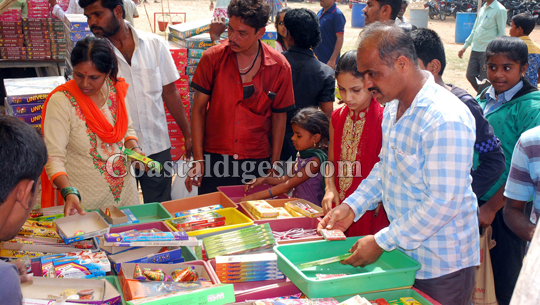
Cracker injuries darkenfestival of lights'; many hospitalised in Karnataka

[email protected] (CD Network)
October 31, 2016

Bengaluru, Oct 31: Despite awareness drives regarding precautions to be taken while bursting crackers, the eye hospitals in major cities of Karnataka witnessed a steady stream of patients, mostly minors, with some sustaining serious injuries.

diwali 6

For the family of ten-year-old Varun from Chikkaballapur Chintamani, this Diwali turned out to be a nightmare. Varun was rushed to Minto hospital on Sunday afternoon, after he sustained injuries on both eyes.

He got injured while bursting crackers outside his house, after cracker particles entered both the eyes. According to Minto hospital authorities his condition was serious and has been hospitalised.

A ten-year-old girl Dharini too was admitted at Minto Hospital for a major eye injury. For 39-year-old Kavitha, her decision to take a stroll near her house in Kallahalli proved costly, as she was admitted to Minto hospital with a major eye injury.

There were at least 28 cases of firecracker-related injuries, ranging from minor burns to potentially permanent eye injuries, during Diwali celebrations in Bengaluru city alone.

Minto Eye Hospital saw four cracker-related injuries; three of those were children, one as young as 3. All were minor cases, with patients receiving out-patient care.

Twenty persons were treated for minor burns at Narayana Nethralaya in Ra jajinagar. Two kids were brought to MC Modi Charitable Eye Hospital in Mahalakshmipuram. Samprathi Eye Hospital and Squint Centre treated a five-year-old boy who injured his eyelid.

A majority of those injured were bystanders, indicating that firecrackers were burst on the streets, and not in demarcated safe areas.

Humans were not the only ones affected by crackers. Animals too suffered burns and hearing loss, stray dogs in particular. The Happy Paws Foundation rescued six crows from across the city, who had been burnt by crackers. While five are out of danger, one is critical. The foundation will travel around the city, locating and treating injured animals.

diwali 1

diwali 2

diwali 3

diwali 4

diwali 5

diwali 7

diwali 8

diwali 9

diwali 10

Comments

PK
 - 
Tuesday, 1 Nov 2016

Wen diwali comes we should expect some losses of money and life... thats for sure... Wasting money and life.

When people are far from God.. they tend believe in every superstitious rituals..

Skazi
 - 
Monday, 31 Oct 2016

All those, who play with the fire crackers and cause pollution deserve punishment.

Add new comment

  • Coastaldigest.com reserves the right to delete or block any comments.
  • Coastaldigset.com is not responsible for its readers’ comments.
  • Comments that are abusive, incendiary or irrelevant are strictly prohibited.
  • Please use a genuine email ID and provide your name to avoid reject.
News Network
January 1,2020

Thiruvananthapuram, Jan 1: Kerala chief minister Pinarayi Vijayan on Wednesday said that the resolution passed by the Kerala Assembly is against the "unconstitutional Act passed by the Centre".

"The resolution passed by Kerala Assembly is against the unconstitutional Act passed by the Centre. It has been noticed by the whole country," Vijayan said.

The Kerala Assembly had on Tuesday passed a resolution seeking withdrawal of the Citizenship (Amendment) Act, 2019.

Before the resolution was passed against the Act, Vijayan in a special Assembly session targeted RSS and said that citizenship law is part of an agenda.

"The CAA is part of an agenda. Muslims are being considered as internal enemies by RSS, who is controlling the ruling dispensation at the Centre," he alleged.

The new law grants citizenship to Hindus, Sikhs, Jains, Parsis, Buddhists and Christians fleeing religious persecution in Pakistan, Afghanistan and Bangladesh who came to India on or before December 31, 2014.

Meanwhile, on Wednesday while talking about women safety, the Chief Minister said, "Those women, who are traveling face many problems, particularly regarding accommodation. To address this, government will start accommodation facilities in all towns. This project will be implemented with the help of local bodies."

Reacting to the development in the Kerala Assembly, BJP leader Mukhtar Abbas Naqvi said that Assembly has insulted the Constitution and parliament by passing a resolution seeking withdrawal of the Citizenship Amendment Act (CAA).

"The Constitution has delineated clearly the roles of parliament and state legislatures. When people who have taken an oath of the constitution, destroy it, it is a most irresponsible act. Both the houses of parliament have passed CAA and if a state assembly tries to hijack the Act it is an insult not only of the constitution but the parliament as well," Naqvi told news agency.

Comments

abdulla
 - 
Thursday, 2 Jan 2020

Dear scape goat Naqvi, dont try to fool us.   I know you are a liar as you are int he company of liars.  MPs are taking oath to respect and safeguard indian constitution and not to disrespect it and go agaisnt the teachings of constitution.  What Central Govt has done is 100 perent agaisnt the constitution and every citizen has the right to oppose this.   You are definately go with the Govt as you are paid for it.   But dont force other too to follow you.  What Kerala Govt has done is according to will of people and Central Govtr should respect it.   

Add new comment

  • Coastaldigest.com reserves the right to delete or block any comments.
  • Coastaldigset.com is not responsible for its readers’ comments.
  • Comments that are abusive, incendiary or irrelevant are strictly prohibited.
  • Please use a genuine email ID and provide your name to avoid reject.
coastaldigest.com web desk
July 24,2020

Indore, Jul 24: A woman who sells fruits on a cart and who lashed out at municipal officials here has done PhD in Materials Science. Her siblings too are well educated and sell fruits as they did not find jobs.

Dr Raisa Ansari, who lives at Bakery Street in Pardeshipura with her family said she wanted to be a scientist but did not get a job anywhere.

Speaking to media persons, Raisa said, "I have done PhD in Materials Science and wanted to be a scientist but did not get job anywhere. I sell fruit here but the municipal officials are bothering us. We are being forced to move from here to there like cattle. Our religion may be the reason why we are not getting jobs but we are proud to be Indian. I am still looking for a job."

Dr Raisa's mother Ayesha Ansari said she herself is not educated, but has four children of whom three girls and one boy studied a lot but no one got job.

Speaking to media persons Ayesha said, "I have four children and they are well educated. I have not studied but all my children are educated but did not get job so all of them sell fruits."

"When the matter came to marriage, one of the daughters got married. Raisa and Shahjahan Bi wanted an educated boy, but they were not able to find a suitable match because of their complexion and sometimes they rejected the proposal because of dowry, so both are single. Two of my grandchildren are studying biology. They will become doctors," said Ayesha.

Meanwhile, people in the neighbourhood lauded the family's abilities. They said theirs was an educated family had to sell fruits as they did not get jobs.

Comments

Add new comment

  • Coastaldigest.com reserves the right to delete or block any comments.
  • Coastaldigset.com is not responsible for its readers’ comments.
  • Comments that are abusive, incendiary or irrelevant are strictly prohibited.
  • Please use a genuine email ID and provide your name to avoid reject.
News Network
July 28,2020

Hounde, Jul 28: Coronavirus and its restrictions are pushing already hungry communities over the edge, killing an estimated 10,000 more young children a month as meager farms are cut off from markets and villages are isolated from food and medical aid, the United Nations warned Monday.

In the call to action shared with The Associated Press ahead of publication, four UN agencies warned that growing malnutrition would have long-term consequences, transforming individual tragedies into a generational catastrophe.

Hunger is already stalking Haboue Solange Boue, an infant from Burkina Faso who lost half her former body weight of 5.5 pounds (2.5 kilograms) in just a month. Coronavirus restrictions closed the markets, and her family sold fewer vegetables. Her mother was too malnourished to nurse.

“My child,” Danssanin Lanizou whispered, choking back tears as she unwrapped a blanket to reveal her baby's protruding ribs.

More than 550,000 additional children each month are being struck by what is called wasting, according to the UN — malnutrition that manifests in spindly limbs and distended bellies. Over a year, that's up 6.7 million from last year's total of 47 million. Wasting and stunting can permanently damage children physically and mentally.

“The food security effects of the COVID crisis are going to reflect many years from now,” said Dr. Francesco Branca, the WHO head of nutrition. “There is going to be a societal effect.”

From Latin America to South Asia to sub-Saharan Africa, more poor families than ever are staring down a future without enough food.

In April, World Food Program head David Beasley warned that the coronavirus economy would cause global famines “of biblical proportions” this year. There are different stages of what is known as food insecurity; famine is officially declared when, along with other measures, 30% of the population suffers from wasting.

The World Food Program estimated in February that one Venezuelan in three was already going hungry, as inflation rendered salaries nearly worthless and forced millions to flee abroad. Then the virus arrived.

“Every day we receive a malnourished child,” said Dr. Francisco Nieto, who works in a hospital in the border state of Tachira.

In May, Nieto recalled, after two months of quarantine, 18-month-old twins arrived with bodies bloated from malnutrition. The children's mother was jobless and living with her own mother. She told the doctor she fed them only a simple drink made with boiled bananas.

“Not even a cracker? Some chicken?” he asked.

“Nothing,” the children's grandmother responded. By the time the doctor saw them, it was too late: One boy died eight days later.

The leaders of four international agencies — the World Health Organization, UNICEF, the World Food Program and the Food and Agriculture Organization — have called for at least dollar 2.4 billion immediately to address global hunger.

But even more than lack of money, restrictions on movement have prevented families from seeking treatment, said Victor Aguayo, the head of UNICEF's nutrition program.

“By having schools closed, by having primary health care services disrupted, by having nutritional programs dysfunctional, we are also creating harm,” Aguayo said. He cited as an example the near-global suspension of Vitamin A supplements, which are a crucial way to bolster developing immune systems.

In Afghanistan, movement restrictions prevent families from bringing their malnourished children to hospitals for food and aid just when they need it most. The Indira Gandhi hospital in the capital, Kabul, has seen only three or four malnourished children, said specialist Nematullah Amiri. Last year, there were 10 times as many.

Because the children don't come in, there's no way to know for certain the scale of the problem, but a recent study by Johns Hopkins University indicated an additional 13,000 Afghans younger than 5 could die.

Afghanistan is now in a red zone of hunger, with severe childhood malnutrition spiking from 690,000 in January to 780,000 — a 13% increase, according to UNICEF.

In Yemen, restrictions on movement have blocked aid distribution, along with the stalling of salaries and price hikes. The Arab world's poorest country is suffering further from a fall in remittances and a drop in funding from humanitarian agencies.

Yemen is now on the brink of famine, according to the Famine Early Warning Systems Network, which uses surveys, satellite data and weather mapping to pinpoint places most in need.

Some of the worst hunger still occurs in sub-Saharan Africa. In Sudan, 9.6 million people live from one meal to the next — a 65% increase from the same time last year.

Lockdowns across Sudanese provinces, as around the world, have dried up work and incomes for millions. With inflation hitting 136%, prices for basic goods have more than tripled.

“It has never been easy but now we are starving, eating grass, weeds, just plants from the earth,” said Ibrahim Youssef, director of the Kalma camp for internally displaced people in war-ravaged south Darfur.

Adam Haroun, an official in the Krinding camp in west Darfur, recorded nine deaths linked with malnutrition, otherwise a rare occurrence, over the past two months — five newborns and four older adults, he said.

Before the pandemic and lockdown, the Abdullah family ate three meals a day, sometimes with bread, or they'd add butter to porridge. Now they are down to just one meal of “millet porridge” — water mixed with grain. Zakaria Yehia Abdullah, a farmer now at Krinding, said the hunger is showing “in my children's faces.”

“I don't have the basics I need to survive,” said the 67-year-old, who who hasn't worked the fields since April. “That means the 10 people counting on me can't survive either.”


Comments

Add new comment

  • Coastaldigest.com reserves the right to delete or block any comments.
  • Coastaldigset.com is not responsible for its readers’ comments.
  • Comments that are abusive, incendiary or irrelevant are strictly prohibited.
  • Please use a genuine email ID and provide your name to avoid reject.