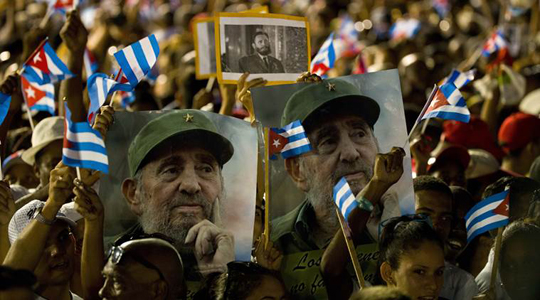
Cuba cracks down on dissidents after Castro death

December 19, 2016

Havana, Dec 19: Authorities across Cuba have cracked down on dissidents, arresting dozens, keeping others from marching in Havana, and detaining an American human rights lawyer, activists have said.

Cuba

In the first such anti-dissident operation since Fidel Castro's death last month, President Raul Castro seemed to indicate the Americas' only one-party communist state was in no mood for dissent.

A roundup in the country's east snared dozens and derailed street protests planned to demand that political prisoners be freed.

"There was a joint operation at 6:00 am in Santiago and Palma Soriano. They searched four homes, and so far we have 42 reported arrests -- 20 in Santiago, 12 in Palma and 10 in Havana," Jose Daniel Ferrer yesterday told AFP by phone.

The 46-year-old, who heads the Patriotic Union of Cuba (Unpacu), had called the demonstrations to demand that political prisoners be set free. Castro insists there are no political prisoners, just lawbreakers.

Ferrer said he was detained in Santiago, Cuba's second biggest city, at a police unit known as Micro 9.

"They threatened me, and said by calling the demonstration I was facilitating public disorder.... disobedience and espionage," Ferrer said.

Most arrests of dissidents in roundups are brief. Sometimes, the authorities prevent them from leaving their homes to attend a protest or march.

In Havana, the award-winning Ladies in White group, which presses for the release of jailed dissidents who are their relatives, said that at least 20 of its activists were "under siege," kept from attending their weekly march.

"At least 20 homes were blocking the residents to keep us from marching today," said group leader Berta Soler.

It was a step backward for the Ladies in White. They long have been considered the only dissidents the Cuban government allowed to march regularly; they hold one weekly protest outside a church in Havana.

But not yesterday, Soler said.

Kimberley Motley, an American human rights lawyer, was briefly detained on Friday along with Cuban activists Gorki Avila and Luis Alberto Marino when they planned to visit graffiti artist Danilo Maldonado, known as "El Sexto," in jail.

Maldonado was also arrested on November 26, a day after the death of Cuban revolutionary icon Fidel Castro, after painting on a wall in Havana the phrase "He's gone," her relatives say.

According to online newspaper 14 y medio, Motley left Cuba at the request of the government.

Comments

Add new comment

  • Coastaldigest.com reserves the right to delete or block any comments.
  • Coastaldigset.com is not responsible for its readers’ comments.
  • Comments that are abusive, incendiary or irrelevant are strictly prohibited.
  • Please use a genuine email ID and provide your name to avoid reject.
News Network
May 6,2020

May 6: In a first, a Pakistani Hindu youth has become the first person from the minority community to join the Pakistan Air Force.

Rahul Dev has been recruited as a General Duty Pilot Officer, the Pakistan Air Force (PAF) said in a tweet.

Dev hails from Tharparkar district of Sindh province.

Sharing the picture of the young man, the PAF recently tweeted, "Good news during #COVID19 tense situation. Thar rocked again...Congratulations #RahulDev who hails from very remote village of Tharparkar has been selected as GD Pilot in #PAF."

Though Dev's exact age is not known, those inducted in PAF at his level are often around 20.

The official Radio Pakistan on Wednesday said it is "for the first time in Pakistan's history" that a Hindu youth has been recruited as a general duty pilot officer in PAF.

The Express Tribune in a report published on Wednesday said the induction showed that the PAF was breaking barriers.

Last year, Kainat Junaid became the first woman from Khyber-Pakthunkhwa province to have been selected for fighter pilot training.

Junaid not only secured the top position in PAF's test for General Duty Pilot, but also became Pakistan’s first female fighter pilot to serve the country alongside her father.

Her father Ahmed Junaid is a Squadron Leader in the PAF.

Comments

Add new comment

  • Coastaldigest.com reserves the right to delete or block any comments.
  • Coastaldigset.com is not responsible for its readers’ comments.
  • Comments that are abusive, incendiary or irrelevant are strictly prohibited.
  • Please use a genuine email ID and provide your name to avoid reject.
Agencies
July 2,2020

Moscow, Jul 2: Russian voters approved changes to the constitution that will allow President Vladimir Putin to hold power until 2036, but the weeklong plebiscite that concluded Wednesday was tarnished by widespread reports of pressure on voters and other irregularities.

With most of the nation's polls closed and 20% of precincts counted, 72% voted for the constitutional amendments, according to election officials.

For the first time in Russia, polls were kept open for a week to bolster turnout without increasing crowds casting ballots amid the coronavirus pandemic a provision that Kremlin critics denounced as an extra tool to manipulate the outcome.

A massive propaganda campaign and the opposition's failure to mount a coordinated challenge helped Putin get the result he wanted, but the plebiscite could end up eroding his position because of the unconventional methods used to boost participation and the dubious legal basis for the balloting.

By the time polls closed in Moscow and most other parts of Western Russia, the overall turnout was at 65%, according to election officials. In some regions, almost 90% of eligible voters cast ballots.

On Russia's easternmost Chukchi Peninsula, nine hours ahead of Moscow, officials quickly announced full preliminary results showing 80% of voters supported the amendments, and in other parts of the Far East, they said over 70% of voters backed the changes.

Kremlin critics and independent election observers questioned the turnout figures.

We look at neighboring regions, and anomalies are obvious there are regions where the turnout is artificially (boosted), there are regions where it is more or less real, Grigory Melkonyants, co-chair of the independent election monitoring group Golos, told The Associated Press.

Putin voted at a Moscow polling station, dutifully showing his passport to the election worker. His face was uncovered, unlike most of the other voters who were offered free masks at the entrance.

The vote completes a convoluted saga that began in January, when Putin first proposed the constitutional changes.

He offered to broaden the powers of parliament and redistribute authority among the branches of government, stoking speculation he might seek to become parliamentary speaker or chairman of the State Council when his presidential term ends in 2024.

His intentions became clear only hours before a vote in parliament, when legislator Valentina Tereshkova, a Soviet-era cosmonaut who was the first woman in space in 1963, proposed letting him run two more times.

The amendments, which also emphasize the primacy of Russian law over international norms, outlaw same-sex marriages and mention a belief in God as a core value, were quickly passed by the Kremlin-controlled legislature.

Putin, who has been in power for more than two decades longer than any other Kremlin leader since Soviet dictator Josef Stalin said he would decide later whether to run again in 2024.

He argued that resetting the term count was necessary to keep his lieutenants focused on their work instead of darting their eyes in search for possible successors.

Analyst Gleb Pavlovsky, a former Kremlin political consultant, said Putin's push to hold the vote despite the fact that Russia has thousands of new coronavirus infections each day reflected his potential vulnerabilities.

Putin lacks confidence in his inner circle and he's worried about the future, Pavlovsky said.

He wants an irrefutable proof of public support.

Even though the parliament's approval was enough to make it law, the 67-year-old Russian president put his constitutional plan to voters to showcase his broad support and add a democratic veneer to the changes.

But then the coronavirus pandemic engulfed Russia, forcing him to postpone the April 22 plebiscite.

The delay made Putin's campaign blitz lose momentum and left his constitutional reform plan hanging as the damage from the virus mounted and public discontent grew.

Plummeting incomes and rising unemployment during the outbreak have dented his approval ratings, which sank to 59%, the lowest level since he came to power, according to the Levada Center, Russia's top independent pollster.

Moscow-based political analyst Ekaterina Schulmann said the Kremlin had faced a difficult dilemma: Holding the vote sooner would have brought accusations of jeopardizing public health for political ends, while delaying it raised the risks of defeat.

Holding it in the autumn would have been too risky, she said.

In Moscow, several activists briefly lay on Red Square, forming the number 2036 with their bodies in protest before police stopped them.

Some others in Moscow and St. Petersburg staged one-person pickets and police didn't intervene.

Several hundred opposition supporters rallied in central Moscow to protest the changes, defying a ban on public gatherings imposed for the coronavirus outbreak. Police didn't intervene and even handed masks to the participants.

Authorities mounted a sweeping effort to persuade teachers, doctors, workers at public sector enterprises and others who are paid by the state to cast ballots. Reports surfaced from across the vast country of managers coercing people to vote.

The Kremlin has used other tactics to boost turnout and support for the amendments.

Comments

Add new comment

  • Coastaldigest.com reserves the right to delete or block any comments.
  • Coastaldigset.com is not responsible for its readers’ comments.
  • Comments that are abusive, incendiary or irrelevant are strictly prohibited.
  • Please use a genuine email ID and provide your name to avoid reject.
Agencies
January 11,2020

New York, Jan 11: The United Nations Security Council (UNSC) on Friday renewed a six-year-long cross-border humanitarian aid deliveries mechanism into Syria.

According to Sputnik, the Security Council voted in favour of a resolution on Friday that allows cross border deliveries to be conducted via Turkey, preserving two checkpoints and excluding the Al-Yarubiyah border crossing with Iraq and the Al-Ramtha crossing with Jordan, until July 10, 2020.

Russia proposed to amend the adopted resolution by replacing a part of the draft which stipulates that humanitarian assistance into Syria should be delivered based on the principles of humanity, neutrality, impartiality and independence by the phrase that such aid should be provided "in accordance with the guiding principles of humanitarian emergency assistance, as contained in UNGA resolution 46/182."

The agreement was reached after Belgium and Germany decided to amend the original version of their joint resolution, which proposed keeping three points for cross-border deliveries into the Arab republic.

In December last year, the United Nations had said that over 235,000 people fled the Idlib region in the last two weeks after Russia and Syria launched airstrikes in a bid to take over the last major opposition bastion.

Russia backed Syria government launched a fresh assault to capture the province.

Syrian Bashar al-Assad regime, backed by Iran, has reportedly promised to take back the rebel-controlled area and broke a ceasefire that was announced in August.

They have since December 19 seized dozens of towns and villages from armed fighters amid clashes that have killed hundreds on both sides.

Comments

Add new comment

  • Coastaldigest.com reserves the right to delete or block any comments.
  • Coastaldigset.com is not responsible for its readers’ comments.
  • Comments that are abusive, incendiary or irrelevant are strictly prohibited.
  • Please use a genuine email ID and provide your name to avoid reject.