



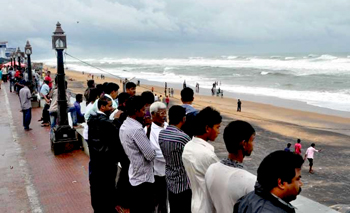
Cyclone Hudhud: Five killed in AP, Odisha

October 12, 2014

Cyclone Hudhud

Vishakapatnam, Oct 12: Severe cyclonic storm Hudhud hit the port city of Vishakapatnam on Sunday bringing with it torrential rains in three coastal districts of Andhra Pradesh and leaving five persons dead in the state and neighbouring Odisha besides snapping power and communication lines.

Normal life was thrown completely out of gear as winds with a speed of 170 to 180 kmph battered Visakhapatnam, Srikakulam and Vizianagaram districts.

The very severe cyclonic storm made landfall in Visakhapatnam before noon. The gale, accompanied by heavy downpour, resulted in trees being uprooted and roofs of thatched huts and sheds being swept away.

While authorities in Andhra Pradesh evacuated 90,013 people across the four districts of Srikakulam, Vizianagaram, Visakhaptnam and East Godavari, about 68,000 people were evacuated from coastal districts of Odisha.

In Delhi, IMD Director General Laxman Singh Rathore said that “Due to the hilly topography, the cyclone’s intensity will reduce in next six hours and further reduce in next 12 hours. However, the area (Vizag) will experience heavy to very heavy rainfall for the next three days.”

As the storm progresses, it will bring heavy rainfall to very heavy rainfall in Chhatisgarh, Bihar, East Madhya Pradesh and East UP and Gangetic belt of West Bengal.

“We are in touch with the chief secretaries of these state governments and providing with bulletins. Warnings have also been issued to shift crops which have been harvested to minimise the impact of heavy rains in these areas,” Mr. Rathore said.

Aircraft services will be able to operate from Monday morning as the weather is expected to improve.

“The PMO is monitoring the situation arising out of the cyclone at regular intervals,” he said.

While three persons were killed in rain-related incidents in Andhra Pradesh, two were killed in Odisha.

“Three deaths have been reported due to impact of Hudhud. Two died after trees fell on them and one in collapse of compound-wall in Visakhapatnam and Srikakulam districts, respectively,” AP Chief Secretary I V R Krishna Rao said.

Casualty in cyclone Hudhud rose to two in Odisha. A fisherman was caught in the sea current amid a tidal surge while he was trying to save his fishing boat anchored in the coast of Puri, Special Relief Commissioner P K Mohapatra said.

On Saturday, a nine-year-old girl drowned when a boat engaged in evacuation of the people in Satbhaya area of Kendrapara district capsized in the Baunsagadi rivulet.

Union Cabinet Secretary Ajit Kumar Seth said the Prime Minister was concerned not only about AP and Odisha but also wanted other states, which could face heavy rains minus the cyclone, to be alerted.

“We have done that,” Seth said, adding that while the Prime Minister reviewed the situation last night, he himself has been reviewing the situation closely and holding meetings with Chief Secretaries of Andhra Pradesh and Odisha twice daily.

Mr. Seth advised residents of cyclone-hit Vizag to exercise caution till the second phase of the high wind is over even as he lauded the efforts of the central agencies and state government in meeting the challenge.

He said once the initial brunt has been taken at the time of the landfall of the cyclone, there is a lull as the centre or eye of the storm passes but thereafter the wind speed is going to pick up again and it is going to be the same as was when it hit the coast first.

Mr. Seth said the government does not have the total estimate of the damage caused due to the cyclone as yet.

"State government, central agencies are on their job. They have done their job. The Army, the Navy and all other agencies are already there.

“Both the governments were well-prepared. We have been reviewing the situation with them... They have got their act together. They have taken necessary precautions and alerted the local population,” Seth said.

The NDRF has doubled the strength of its teams stationed in Vishakapatnam to 13 in order to undertake swift relief and rescue operations.

“We have increased our teams to 13 in Vizag after the landfall occurred. Earlier there were six teams stationed here,” National Disaster Response Force chief O P Singh said.

In Bhubaneswar, Chief Minister Naveen Patnaik said the cyclone had its impact in different districts like Ganjam, Gajapati, Koraput, Puri, Kalahandi and Kendrapara.

68,000 people have been evacuated to safe places, the chief minister said, directing the officials to continue the evacuation of people from vulnerable areas as the complete impact of the cyclone would be felt some hours after the landfall.

The affected people have been accommodated in 604 shelter homes, Patnaik said, adding the state government was prepared to face the situation caused by the cyclone and possible floods thereafter.

Under the impact of the cyclone, the entire coastal and southern region experienced moderate to heavy rainfall since early morning though the maximum wind speed was below 60 kmph.

However, the weather office predicted an increase in the wind speed in eight southern districts.

The state government has identified the eight districts of Ganjam, Gajapati, Malkangiri, Koraput, Rayagada, Nabarangpur, Kandhamal and Kalahandi which will bear the maximum brunt of the cyclone.

Food packets to cyclone affected areas

About one lakh food packets would be dispatched to cyclone-affected Visakhapatnam and other districts, East Godavari district collector Neetu Prasad said.

“As per a request made by the government, nearly one lakh food packets would be supplied from East Godavari district to cyclone affected people at Visakhapatnam and other places,” she said.

The district collector is monitoring the cyclone situation in the district along with special officer K.S. Jawahar Reddy and taking all precautionary measures.

She said there was disruption of power supply in the Agency area of Addateegala, Peddapuram and Talleruvu mandals due to heavy gales and it would be restored shortly after electricity officials restore power supply.

Uppada beach road in Kakinada rural mandal was damaged due to rains near Konapakapeta due to tidal waves.

Teams have been pressed into service in different parts of the coastal mandals, she added, “As a precautionary measure 30,000 people have been shifted to 72 relief camps in the district.

High alert was ordered in the coastal mandals to take all precautions to meet the heavy rains due to cyclone in the district, she said.

Comments

Add new comment

  • Coastaldigest.com reserves the right to delete or block any comments.
  • Coastaldigset.com is not responsible for its readers’ comments.
  • Comments that are abusive, incendiary or irrelevant are strictly prohibited.
  • Please use a genuine email ID and provide your name to avoid reject.
News Network
January 1,2020

Jan 1: The ban on the practice of instant triple talaq, making it a penal offence and the increase in the strength of Supreme Court judges were two of the major achievements of the law ministry in 2019.

In July, Parliament gave its nod to The Muslim Women (Protection of Rights on Marriage) Bill, 2019. The new law makes talaq-e-biddat or any other similar form of talaq having the effect of instantaneous and irrevocable divorce pronounced by a Muslim husband void and illegal.

It makes it illegal to pronounce talaq three times in spoken, written or through SMS or WhatsApp or any other electronic chat in one sitting.

According to the new law, any Muslim who pronounces the illegal form of talaq upon his wife shall be punished with imprisonment for a term which may extend to three years, and shall also be liable to fine.

During the year, four new judges were appointed to the Supreme Court in September, taking its strength to 34, the highest-ever.

However, vacancies in high courts and lower courts are on the rise and convincing state governments and the 25 high courts to come on board to create an all-India judicial service to recruit judges for the subordinate courts tops the agenda of the Law Ministry in 2020.

Besides creating a consensus on setting up the All-India Judicial Services, the ministry will also have to focus on filling up vacancies in the high court. On an average, the vacancies stood at 400 throughout this year.

With more than 5,000 positions of judicial officers in district and subordinate courts lying vacant, the Law Ministry has pitched for setting up all-India judicial services.

The sanctioned strength of the judicial officers in district and subordinate courts was 22,644. The number of judicial officers in position and vacant posts is 17,509 and 5,135, respectively.

The government has proposed that while states and high courts can recruit judicial officers, the Union Public Service Commission (UPSC) can hold pan-India entrance tests.

The ministry has made it clear that such services would not encroach on the powers of the states.

As of now, the selection and appointment of judges in subordinate courts is the responsibility of the high courts and state governments concerned.

The Narendra Modi government has given a fresh push to the long-pending proposal to set up the new service to have a separate cadre for the lower judiciary in the country.

But there is a divergence of opinion among state governments and respective high courts on the constitution of the All India Judicial Service (AIJS).

One of the problems cited is that since several states have used powers under Code of Criminal Procedure (CrPC) and Code of Civil Procedure (CPC) to declare that the local language would be used in lower courts even for writing orders, a person say selected from Tamil Nadu may find it difficult to hold proceedings in states like Uttar Pradesh and Bihar.

The other point of opposition is that an all India service may hamper the career progression of state judicial services officers.

Another key issue the ministry has to handle in 2020 is vacancies in the 25 high courts.

Throughout 2019, on an average, the high courts faced a shortage of 400 judges.

According to Law Ministry data, as on September 1, the high courts had 414 vacant positions as compared to the sanctioned strength of 1,079 judges. The figure was 409 in August and 403 in July, as per the data.

A three-member Supreme Court collegium recommends the names of candidates for appointment as high court judges. In case of appointments to the Supreme Court, the collegium consists of five top judges of the top court.

High court collegiums shortlist candidates for their respective high courts and send the names to the law ministry.

The ministry, along with background check reports by the Intelligence Bureau, forwards it to the Supreme Court collegium for a final call.

The government has maintained that appointment of judges in the high courts is a "continuous collaborative process" between the Executive and the Judiciary, as it requires consultation and approval from various Constitutional authorities.

Vacancies keep arising on account of retirement, resignation or elevation of judges and increase in judges' strength. In June last year, the vacancy position stood at 399, while it was 396 in May.

In April, 399 posts of judges were vacant, while the figure was 394 in March. The vacancy position in February stood at 400 and in January, it was 392, according to the data collated by the Department of Justice.

Over 43 lakh cases are pending in the 25 high courts.

Another priority would be the finalisation of the memorandum of the procedure to guide the appointment and transfer of the Supreme Court and high court judges. The issue had now been pending for over two years now with the SC collegium and the government failing to reach a consensus.

Successive governments have also been working on making India a hub of international arbitration. It has taken several steps to change laws dealing with commercial disputes.

Comments

Add new comment

  • Coastaldigest.com reserves the right to delete or block any comments.
  • Coastaldigset.com is not responsible for its readers’ comments.
  • Comments that are abusive, incendiary or irrelevant are strictly prohibited.
  • Please use a genuine email ID and provide your name to avoid reject.
Agencies
May 14,2020

Mumbai, May 14: The Shiv Sena on Thursday raised questions over the Centre's Rs 20 lakh crore stimulus package announced to revive the COVID-hit economy, and asked if India is not a "self-reliant" country at present.

An editorial in Sena mouthpiece 'Saamana' wondered how Rs 20 lakh crore will be raised, and opined that an environment needs to be created where industrialists, trade and business sectors are encouraged to invest.

On the path of new self-reliance, India cannot afford industrialists running away, and for that "political institutions like the ED and CBI need to be put in lockdown for some time," it said.

Prime Minister Narendra Modi on Tuesday announced new financial incentives on top of the previously announced packages for a combined stimulus of Rs 20 lakh crore, saying the COVID-19 crisis has provided India an opportunity to become self-reliant and emerge as the best in the world.

The Sena said the country is being told that the package will be beneficial for MSMEs (micro, small and medium enterprises), poor labourers, farmers and the tax-paying middle class.

"The package (as per the Centre) will reach 130 crore Indians and the country will become self-reliant. Does this mean India is not a self-reliant country at present?" the Marathi daily asked.

It is good that PPE kits and N95 masks are now being manufactured in India, it said.

"Any country progresses ahead while learning from crisis and through struggle. Before Independence, not even a needle was manufactured in India but in 60 years, India became self-reliant in science, technology, agro business, defence, manufacturing and atomic science," it said.

An institution like the Indian Council of Medical Research (ICMR), which is helping in the manufacturing of PPE kits, is part of the self-reliant India, it noted.

Wondering how Rs 20 lakh crore, as announced in the central package, will be raised, the Sena said an "environment needs to be created where industrialists, trade and business sectors will be encouraged to invest".

"India, on path of new self-reliance, cannot afford industrialists running away, and for that political institutions like the Enforcement Directorate (ED) and the Central Bureau of Investigation (CBI) need to be put in lockdown for some time," the paper said.

Despite announcing the 'lockdown-4' and the economic package, why its impact has not been reflected in the share market? it asked.

"Investors are in a dilemma. The prime minister and chief ministers must show them trust and support," it said.

"Earlier it was Pandit Nehru and now it is Modi. If (former prime minister) Rajiv Gandhi had not laid the foundation of a digital India, there wouldn't be video conference of PM, CMs and bureaucracy in times of coronavirus," the Uddhav Thackeray-led party said.

It agreed with Modi that coronavirus will stay for long, and lives need not revolve around it.

"We need to get back on our feet again," the Sena said.

Comments

Add new comment

  • Coastaldigest.com reserves the right to delete or block any comments.
  • Coastaldigset.com is not responsible for its readers’ comments.
  • Comments that are abusive, incendiary or irrelevant are strictly prohibited.
  • Please use a genuine email ID and provide your name to avoid reject.
News Network
January 7,2020

Mumbai, Jan 7: Against the backdrop of the attack on JNU students, the Shiv Sena on Tuesday hit out at Prime Minister Narendra Modi and Union Home Minister Amit Shah, alleging that what they wanted was happening, and said such "brutal politics" was never seen before in the country.

An editorial in Shiv Sena mouthpiece 'Saamana' further alleged that the BJP wanted to see "Hindu-Muslim riots" over the Citizenship Amendment Act, but that did not happen.

Since the BJP has been cornered over the issue of CAA, several things are happening out of "revenge", it said.

Comparing the attack on Jawaharlal Nehru University (JNU) students to the 26/11 Mumbai terror strikes, the Shiv Sena said: "divisive politics" was dangerous for the country.

It said the Union Home Ministry's decision to file cases against "unknown" attackers at JNU was laughable. "Those who entered JNU with masks are not unknown," it claimed.

On Sunday, a mob of masked young people stormed the Jawaharlal Nehru University (JNU) campus in south Delhi and targeted students in three hostels, unleashing mayhem with sticks, stones and iron rods, hitting inmates and breaking windows, furniture and personal belongings.

Nearly 34 people were injured in the violence.

"The fallout of JNU attack is being seen elsewhere in the country...what Modi and Shah want is happening. The country is in danger. Divisive politics is dangerous for the country," the Uddhav Thackeray-led party said.

Terrorists who attacked Mumbai on November 26, 2008, were also masked and the same was seen at JNU. Such elements need to be exposed, it said.

"Allowing blood stains in universities, colleges and beating up of students and indulging in politics over the burning situation...such brutal politics was never seen before," the Marathi publication said while terming the attack on JNU students as a "blot" on the law and order situation.

Lashing out at Amit Shah, the Sena said he his in Delhi and busy distributing official pamphlets door-to-door to promote the Citizenship Amendment Act.

There is "confusion and unrest" in the country over the new citizenship law, it pointed out.

"The BJP wanted to see Hindu-Muslim riots over the issue, but that did not happen. The nationwide protests are not being done by Muslims alone. Hindus will also be affected due to the new Act," the Shiv Sena said.

It said the BJP has been cornered over the CAA issue.

Since the prevailing situation is "BJP versus the rest", hence "out of revenge", several things are happening, the Marathi daily said, adding that "there is room for doubt if the JNU attack was part of the revenge."

The BJP has condemned the violence and said universities should stay away from politics, it noted.

"Who brought violence and politics in universities in the last five years? Who is implementing the policy of destroying those who don't agree with your ideology by use of power?" it asked.

Without taking any name, the Sena said those who call students opposing the CAA as anti-nationals, are themselves anti-national.

"When Amit Shah accuses Congress leaders Rahul Gandhi and Priyanka Gandhi of inciting violence, he admits that the Gandhi siblings have that much power to create mass awareness against a law brought in by the Centre and bring people to streets," the Sena said.

One cannot say if the Gandhi siblings incited violence, but one thing is sure that the Union Home Minister and his party are forced to distribute pamphlets to "clarify" on the new citizenship law, it said in sarcastic comments.

Comments

Add new comment

  • Coastaldigest.com reserves the right to delete or block any comments.
  • Coastaldigset.com is not responsible for its readers’ comments.
  • Comments that are abusive, incendiary or irrelevant are strictly prohibited.
  • Please use a genuine email ID and provide your name to avoid reject.