


Dalai visit caused serious damage to ties: China to India

April 6, 2017

Beijing, Apr 6: China warned on Wednesday that it will take “necessary measures” to defend its territorial sovereignty and interests after India “obstinately” allowed the Dalai Lama to visit the “disputed” parts of Arunachal Pradesh causing “serious damage” to bilateral ties.
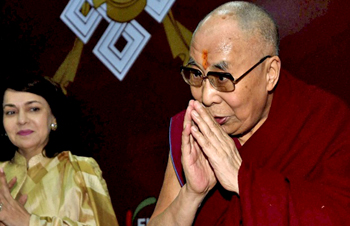
DalaiChina also lodged a protest with India's Ambassador in Beijing Vijay Gokhale over the Dalai Lama's visit.

“India in disregard to China's concerns obstinately arranged the Dalai Lama's visit to the disputed part of the eastern part of China-India border, causing serious damage to China's interests and China-India relations,” Chinese Foreign Ministry spokesperson Hua Chunying told reporters.

China firmly opposes this move, she asserted.“China's stand on the eastern part of the borders is consistent and clear. India is keenly aware of the role played by the 14th Dalai Lama,” she said.

“Arranging his visit to those sensitive and disputed areas not only runs counter to the Indian side's commitment to the issues related to Tibet but also escalates disputes over the border area,” she added.

Hua stated that it goes against the momentum of the sound growth of bilateral relations and will not benefit India in any way.

“The visit will for sure trigger China's dissatisfaction. This will not bring any benefit to India,” she said.

China will firmly take necessary measures to defend its territorial sovereignty and legitimate rights and interests, Hua asserted.

Asked what measures China would take, Hua did not elaborate. “I don't have much to add. I want to add the issues concerning Tibet have a bearing on China's core interests. India in disregard of China's concerns obstinately arranged the visit,” she said.

“We demand the Indian side immediately stop its actions using the Dalai Lama to undermine China's interests and not hype up sensitive issues between the two countries, not artificially damage the foundation of the talks between the two countries on the border issues and bilateral legislations and take concrete actions to safeguard the China-India relations,” she said.

The 81-year-old Tibetan spiritual leader reached Bomdila in West Kameng district on Tuesday, starting his nine-day visit to Arunachal Pradesh.

“We hope we can work together to maintain growth of India-China relations. We know India and China are two close neighbours and countries in Asia. Cooperation between us will serve interests of the region,” Hua said.

“We hope to maintain good momentum of growth but this move runs counter to this wish. So we hope India stops doing things that undermine our interests,” she said.

Comments

Add new comment

  • Coastaldigest.com reserves the right to delete or block any comments.
  • Coastaldigset.com is not responsible for its readers’ comments.
  • Comments that are abusive, incendiary or irrelevant are strictly prohibited.
  • Please use a genuine email ID and provide your name to avoid reject.
News Network
January 7,2020

Jan 7: Body of the senior Iranian military commander, Qasem Soleimani killed in a U.S. drone strike in Iraq last week, has arrived in his home town of Kerman in southeast Iran for burial, the official IRNA news agency said on Tuesday.

State TV broadcast live images of thousands of people in the streets of the town, many of them dressed in black, to mourn Soleimani's death.

Soleimani was widely seen as Iran’s second most powerful figure behind Supreme Leader Ayatollah Ali Khamenei, 80, who wept in grief along with hundreds of thousands of mourners who thronged the streets of Tehran for Soleimani’s funeral on Monday.

Khamenei led prayers at the funeral in the Iranian capital, pausing as his voice cracked with emotion. Soleimani, 62, was a national hero even to many who do not consider themselves supporters of Iran’s clerical rulers.

He was killed while leaving Baghdad airport last Friday. Mourners packed the streets, chanting: “Death to America!” - a show of national unity after anti-government protests in November in which many demonstrators were killed.

The crowd, which state media said numbered in the millions, recalled the masses gathered in 1989 for the funeral of the Islamic Republic’s founder, Ayatollah Ruhollah Khomeini.

The killing of Soleimani has prompted fears around the world of a broader regional conflict, as well as calls in the U.S. Congress for legislation to keep President Donald Trump from going to war against Iran.

Comments

Add new comment

  • Coastaldigest.com reserves the right to delete or block any comments.
  • Coastaldigset.com is not responsible for its readers’ comments.
  • Comments that are abusive, incendiary or irrelevant are strictly prohibited.
  • Please use a genuine email ID and provide your name to avoid reject.
Agencies
February 7,2020

Washington DC, Feb 7: United States on Thursday asked all countries to speak out against mistreatment of Muslims living in China especially in Xinjiang region by Chinese authorities.

Alice G. Wells, Principal Deputy Assistant Secretary for the Bureau of South and Central Asian Affairs, while talking to reporters appreciated the steps taken by Central Asian states to ensure that no ethnic Kazakh, Uighur, Kyrgyz is refouled to China and that the human rights of individuals who reach Central Asia are observed.

"As a matter of principle we urge all countries, not just Central Asian countries, to speak out against human rights abuses that are evident against Muslims in all of China but certainly in Xinjiang. And the countries of Central Asia, several of the countries of Central Asia have deep first-hand knowledge of those abuses given the direct impact it has on their own populations who have loved ones, family members, that are swept up in these detention centers," Wells said.

"We appreciate steps by Central Asian states to ensure that no ethnic Kazakh, Uighur, Kyrgyz is refouled to China, that the human rights of individuals who reach Central Asia are observed. And we also appreciate I think what countries like Kazakhstan can do to promote the free and safe travel of compatriots, ethnic compatriots across the border," she added.

China has been accused of oppressing the Uighurs by sending them to mass detention camps, interfering in their religious activities and sending the community to undergo some form of forceful re-education or indoctrination. However, Pakistan has stayed mum over this issue.

As many as 1 million people, or about 7 per cent of Xinjiang's Muslim population, have been incarcerated in a sprawling network of "political re-education" camps, according to US and UN studies.

In 2018, the New York-based Human Rights Watch released a report accusing Beijing of a "systematic campaign of human rights violations" against Uighur Muslims in Xinjiang.

Beijing says its camps in Xinjiang are "vocational training centres."

Last year, several documents leaked revealed details about Beijing's fears about religious extremism and its wholesale crackdown on Uighurs.

The US had called on the Chinese government to "immediately release all of those who are arbitrarily detained and to end its draconian policies that have terrorised its own citizens in Xinjiang."

Comments

Add new comment

  • Coastaldigest.com reserves the right to delete or block any comments.
  • Coastaldigset.com is not responsible for its readers’ comments.
  • Comments that are abusive, incendiary or irrelevant are strictly prohibited.
  • Please use a genuine email ID and provide your name to avoid reject.
Agencies
January 9,2020

Washington, Jan 9: The U.S. and Iran stepped back from the brink of possible war Wednesday as President Donald Trump signaled he would not retaliate militarily for Iran's missile strikes on Iraqi bases housing U.S. troops. No one was harmed in the strikes, but U.S. forces in the region remained on high alert.

Speaking from the White House, Trump seemed intent on deescalating the crisis, which spiralled after he authorized the assassination of Iran's top general, Qassem Soleimani. Iran responded overnight by firing more than a dozen missiles at two installations in Iraq, its most direct assault on America since the 1979 seizure of the U.S. Embassy in Tehran.

Trump's takeaway was that “Iran appears to be standing down, which is a good thing for all parties concerned and a very good thing for the world.”

The region remained on edge, however, and American troops including a quick-reaction force dispatched over the weekend were on high alert. Hours after Trump spoke, an ‘incoming’ siren went off in Baghdad's Green Zone after what seemed to be small rockets “impacted” the diplomatic area, a Western official said. There were no reports of casualties.

Iran's Supreme Leader Ayatollah Ali Khamenei said the overnight strike was not necessarily the totality of Iran's response. “Last night they received a slap,” Khamenei said. “These military actions are not sufficient (for revenge). What is important is that the corrupt presence of America in this region comes to an end.”

The strikes had pushed Tehran and Washington perilously close to all-out conflict and left the world waiting to see whether the American president would respond with more military force. Trump, in his nine-minute, televised address, spoke of a robust U.S. military with missiles that are “big, powerful, accurate, lethal and fast.'' But then he added: “We do not want to use it."

Iran for days had been promising to respond forcefully to Soleimani's killing, but its limited strike on two bases--one in the northern Iraqi city of Irbil and the other at Ain al-Asad in western Iraq--appeared to signal that it too was uninterested in a wider clash with the U.S. Foreign minister Mohammad Javad Zarif tweeted that the country had “concluded proportionate measures in self-defence.”

Trump said the U.S. was “ready to embrace peace with all who seek it.” That marked a sharp change in tone from his warning a day earlier that “if Iran does anything that they shouldn't be doing, they're going to be suffering the consequences, and very strongly.”

Trump opened his remarks at the White House by reiterating his promise that “Iran will never be allowed to have a nuclear weapon.” Iran had announced in the wake of Soleimani's killing that it would no longer comply with any of the limits on uranium enrichment in the 2015 nuclear deal crafted to keep it from building a nuclear device.

The president, who had earlier pulled the U.S. out of the deal, seized on the moment of calm to call for negotiations toward a new agreement that would do more to limit Iran's ballistic missile programmes and constrain regional proxy campaigns like those led by Soleimani.

Trump spoke of new sanctions on Iran, but it was not immediately clear what those would be.

Comments

Add new comment

  • Coastaldigest.com reserves the right to delete or block any comments.
  • Coastaldigset.com is not responsible for its readers’ comments.
  • Comments that are abusive, incendiary or irrelevant are strictly prohibited.
  • Please use a genuine email ID and provide your name to avoid reject.