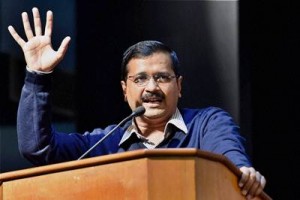
Dalit student's suicide 'murder of democracy': Kejriwal

January 19, 2016

New Delhi, Jan 19: Delhi Chief Minister Arvind Kejriwal on Tuesday described the suicide of the Hyderabad Dalit student as "murder of democracy, social justice and equality".

kejri"It's not suicide. It's murder. It's murder of democracy, social justice and equality. (Prime Minister Narendra) Modi ji should sack ministers and apologise to the nation," Kejriwal said in a tweet.

"(The) Modi government (is) constitutionally duty bound to uplift Dalits. Instead, Modi ji's ministers got five Dalit students ostracised and suspended."

Rohith Vemula, a second-year research scholar of science, technology and society studies department at the University of Hyderabad, was found hanging from the ceiling of a room in the New Research Scholars' Hostel late on Sunday.

He was one of the five Dalit students suspended and expelled from the hostel for staging a protest on the campus for the past 15 days.

Comments

AHMED
 - 
Tuesday, 19 Jan 2016

Dalits need to join hands and fight the injustice done by the so called elite criminals. When will U guys stop living in FEAR of this upper caste.. Everybody is equal in the eyes of GOD and no human is superior in the eyes of GOD and fear only GOD not human who says they are superior. Pejawar will never help in this matter... U guys are being deceived by the so called superior.
I feel proud that Prophet Muhammad pbuh taught us a beautiful teachings which says:
All mankind is from ADAM & EVE, An arab has no superiority over an non Arab NOR a non arab has any superiority over an Arab, Also A white has no superiority over black NOR a black has any superiority over white EXCEPT by PIETY and GOOD ACTION.
What it means is also A DALIT is as equal as any human being. Just like a MUSLIMs or any other people in the EARTH> When we follow God's religion. FEAR NOT. Fight for the oppression done by this Foxes who deceive people and keep the society in FEAR.

Add new comment

  • Coastaldigest.com reserves the right to delete or block any comments.
  • Coastaldigset.com is not responsible for its readers’ comments.
  • Comments that are abusive, incendiary or irrelevant are strictly prohibited.
  • Please use a genuine email ID and provide your name to avoid reject.
News Network
February 24,2020

New Delhi, Feb 24: They hail from vastly different backgrounds — Donald Trump is the son of a property tycoon while Narendra Modi is a descendant of a poor tea-seller.

Yet the two teetotallers, loved by right-wing nationalists in their home countries, share striking similarities that have seen them forge a close personal bond, analysts say.

Ahead of the American leader's first official visit to India, which begins in Modi's home state of Gujarat on Monday, the world's biggest democracy has gone out of its way to showcase the chemistry between them.

In Gujarat's capital Ahmedabad, large billboards with the words "two dynamic personalities, one momentous occasion" and "two strong nations, one great friendship" have gone up across the city.

"There's a lot that Trump and Modi share in common, and not surprisingly these convergences have translated into a warm chemistry between the two," Michael Kugelman of the Washington-based Wilson Center said.

"Personality politics are a major part of international diplomacy today. The idea of closed-door dialogue between top leaders has often taken a backseat to very public and spectacle-laden summitry."

Since assuming the top political office in their respective countries — Modi in 2014 and Trump in 2017 — the two men have been regularly compared to each other.

Trump, 73, and Modi, 69, both command crowds of adoring flag-waving supporters at rallies. A virtual cult of personality has emerged around them, with their faces and names at the centre of their political parties' campaigns.

A focus of Trump's administration has been his crackdown on migrants, including a travel ban that affects several Muslim-majority nations, among others, while critics charge that Modi has sought to differentiate Muslims from other immigrants through a contentious citizenship law that has sparked protests.

Both promote their countries' nationalist and trade protectionist movements — Trump with his "America First" clarion call and Modi with his "Make in India" mantra.

And while they head the world's largest democracies, critics have described the pair as part of a global club of strongmen that includes Russia's Vladimir Putin and Brazil's Jair Bolsonaro.

"There are many qualities that Trump and Modi share — a love for political grandstanding and an unshakable conviction that they can achieve the best solutions or deals," former Indian diplomat Rakesh Sood said.

Modi and Trump have sought to use their friendship to forge closer bonds between the two nations, even as they grapple with ongoing tensions over trade and defence.

Despite sharing many similarities in style and substance, analysts say there are some notable differences between the pair.

Modi is an insider who rose through the ranks of the Bharatiya Janata Party after starting out as a cadre in Rashtriya Swayamsevak Sangh.

Trump is a businessman and a political outsider who has in some sense taken over the Republican Party.

"Modi is a more conventional leader than is Trump in that he hasn't sought to revolutionise the office he holds in the way that Trump has," said Kugelman, a longtime observer of South Asian politics.

He added that genuine personal connections between leaders of both countries have helped to grow the partnership.

"George Bush and Manmohan Singh, Barack Obama and Singh, Obama and Modi, now Modi and Trump — there has been a strong chemistry in all these pairings that has clearly helped the relationship move forward," he added.

Trump has also stood by the Indian leader during controversial decisions, including his revocation of autonomy for Kashmir and his order for jets to enter Pakistani territory following a suicide bombing.

Analysts said the leaders would use the visit to bolster their image with voters.

A mega "Namaste Trump" rally in Ahmedabad on Monday will be modelled after the "Howdy, Modi" Houston extravaganza last year when the Indian leader visited the US and the two leaders appeared before tens of thousands of Indian-Americans at a football stadium.

"The success of this visit... will have a positive impact on his (Trump's) re-election campaign and the people of Indian origin who are voters in the US — a majority of them are from Gujarat," former Indian diplomat Surendra Kumar said.

"On the Indian side, the fact that Prime Minister Modi... (shares) such warmth, bonhomie and informality with the most powerful man on Earth adds to his stature... as well as with hardcore supporters."


Comments

Add new comment

  • Coastaldigest.com reserves the right to delete or block any comments.
  • Coastaldigset.com is not responsible for its readers’ comments.
  • Comments that are abusive, incendiary or irrelevant are strictly prohibited.
  • Please use a genuine email ID and provide your name to avoid reject.
News Network
March 3,2020

New Delhi, Mar 3: A day after two new cases of novel coronavirus that included one from Delhi were reported, the Health Ministry on Tuesday said six cases with "high-viral load" were detected during sample testing in Agra and these people have been kept in isolation. The six people had come in contact with a 45-year-old patient from Delhi, whose case came to light on Monday, and they include his family members.

According to government sources, the man, who is a resident of Mayur Vihar, had visited them in Agra.

The six have been kept in isolation at Safdarjung Hospital in Delhi and their samples are being sent to NIV, Pune for confirmation.

Contact tracing of the people who came in contact with the six is simultaneously being done through the Integrated Disease Surveillance Program (IDSP) network, the ministry said in a statement.

Sources said the patient from Mayur Vihar was shifted to a quarantine ward at Safdarjung Hospital on Sunday night.

His other family members have been asked to stay alert and look out for symptoms. One accountant, who came in contact with the man and some of his family members, was also quarantined, they said.

India on Monday reported two new cases of the novel coronavirus, one from Delhi and another one from Hyderabad. The government has stepped up its efforts to detect and check the infection which has killed 2,912 people in China.

On Monday, Rajasthan Health Minister Raghu Sharma had said that an Italian tourist tested positive for coronavirus in Jaipur.

The first sample collected from him on February 29 tested negative but his condition deteriorated, so a second sample was collected which tested positive on Monday, the minister said, adding, "Since there is a variation in the reports, the samples have been sent to the NIV, Pune for testing".

India had earlier reported three cases from Kerala, including two medical students from Wuhan in China, the epicentre of the deadly novel coronavirus. They had self-reported on their return to the country and tested positive for the infection. They were discharged from hospitals last month following recovery.

The infected person from Delhi had travelled to Italy, while the other patient who tested positive for the COVID-19 infection is from Telangana and had recently travelled to Dubai.

Both the patients had self-reported after they developed symptoms.

"They tested positive. They are stable and being closely monitored," ministry said on Monday.

The government has asked people to avoid non-essential travel to Iran, Italy, South Korea and Singapore and said India was in discussions with authorities in Iran and Italy, two countries badly affected by the infection, to evacuate Indians there.

The novel coronavirus or COVID-19, which originated in China, has spread to over 60 countries.

Comments

Add new comment

  • Coastaldigest.com reserves the right to delete or block any comments.
  • Coastaldigset.com is not responsible for its readers’ comments.
  • Comments that are abusive, incendiary or irrelevant are strictly prohibited.
  • Please use a genuine email ID and provide your name to avoid reject.
News Network
May 24,2020

New Delhi, May 24: The Indian economy is likely to slip into recession in the third quarter of this fiscal as loss in income and jobs and cautiousness among consumers will delay recovery in consumer demand even after the pandemic, says a report.

According to Dun & Bradstreet's latest Economic Observer, the country's economic recovery will depend on the efficacy and duration of implementation of the government's stimulus package.

"The multiplier effect of the stimulus measures on the economy will depend on three key aspects i.e. the time taken for effecting the withdrawal of the lockdown, the efficacy of implementation and duration of execution of the measures announced," Dun & Bradstreet India Chief Economist Arun Singh said.

The report noted that the government's larger-than-expected stimulus package is likely to re-start economic activities.

Besides, measures taken by the Reserve Bank of India like reducing the repo rate by a further 40 basis points to 4 per cent, extending the moratorium period by three months and facilitating working capital financing will also help stimulate the momentum.

Singh said while the measures announced by the government are "positive", most of them have been directed towards strengthening the supply side of the economy, and "it is to be noted that supply needs to be matched with demand", he said.

Besides, "in the absence of cash-in-hand benefits under the government's stimulus package, demand for goods and services is expected to remain depressed", he added.

He further said the loss in income and employment opportunities, and cautiousness among consumers, will lead to a delayed recovery in consumer demand, even after the pandemic. As debt and bad loan levels increase, the banking sector might face challenges.

The report further noted that even as the monetary stimulus is expected to inject liquidity and stimulate demand for a wider section of the economy, the channelisation of funds from the financial institutions will be subjected to several constraints.

The foremost concern being increase in risk averseness, as the balance sheets of firms, households, and banks/NBFCs have weakened considerably and low demand for funds by firms as production activities have been on a standstill during the lockdown period, Singh said.

India has been under lockdown since March 25 to contain the spread of the coronavirus, resulting in supply disruptions and demand compression.

Prime Minister Narendra Modi imposed a nationwide lockdown to control the spread of coronavirus on March 25. It has been extended thrice, with some relaxations. The fourth phase of the lockdown is set to expire on May 31. 

Comments

Add new comment

  • Coastaldigest.com reserves the right to delete or block any comments.
  • Coastaldigset.com is not responsible for its readers’ comments.
  • Comments that are abusive, incendiary or irrelevant are strictly prohibited.
  • Please use a genuine email ID and provide your name to avoid reject.