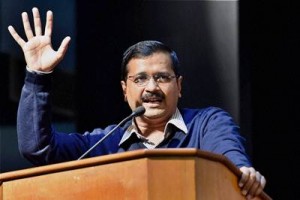
Dalit student's suicide 'murder of democracy': Kejriwal

January 19, 2016

New Delhi, Jan 19: Delhi Chief Minister Arvind Kejriwal on Tuesday described the suicide of the Hyderabad Dalit student as "murder of democracy, social justice and equality".

kejri"It's not suicide. It's murder. It's murder of democracy, social justice and equality. (Prime Minister Narendra) Modi ji should sack ministers and apologise to the nation," Kejriwal said in a tweet.

"(The) Modi government (is) constitutionally duty bound to uplift Dalits. Instead, Modi ji's ministers got five Dalit students ostracised and suspended."

Rohith Vemula, a second-year research scholar of science, technology and society studies department at the University of Hyderabad, was found hanging from the ceiling of a room in the New Research Scholars' Hostel late on Sunday.

He was one of the five Dalit students suspended and expelled from the hostel for staging a protest on the campus for the past 15 days.

Comments

AHMED
 - 
Tuesday, 19 Jan 2016

Dalits need to join hands and fight the injustice done by the so called elite criminals. When will U guys stop living in FEAR of this upper caste.. Everybody is equal in the eyes of GOD and no human is superior in the eyes of GOD and fear only GOD not human who says they are superior. Pejawar will never help in this matter... U guys are being deceived by the so called superior.
I feel proud that Prophet Muhammad pbuh taught us a beautiful teachings which says:
All mankind is from ADAM & EVE, An arab has no superiority over an non Arab NOR a non arab has any superiority over an Arab, Also A white has no superiority over black NOR a black has any superiority over white EXCEPT by PIETY and GOOD ACTION.
What it means is also A DALIT is as equal as any human being. Just like a MUSLIMs or any other people in the EARTH> When we follow God's religion. FEAR NOT. Fight for the oppression done by this Foxes who deceive people and keep the society in FEAR.

Add new comment

  • Coastaldigest.com reserves the right to delete or block any comments.
  • Coastaldigset.com is not responsible for its readers’ comments.
  • Comments that are abusive, incendiary or irrelevant are strictly prohibited.
  • Please use a genuine email ID and provide your name to avoid reject.
News Network
March 6,2020

New Delhi, Mar 6: As panicky depositors rushed to withdraw money from Yes Bank whose control was seized by the RBI in a dramatic late-night move, Finance Minister Nirmala Sitharaman on Friday assured depositors that their money is safe and said the central bank was working for an early resolution of the crisis.

The Reserve Bank of India (RBI) on Thursday evening capped withdrawals at Rs 50,000 for the next one month and imposed strict limits on operations at the country's fourth-largest private lender that faced "regular outflow of liquidity" after an effort to raise new capital failed.

"I am in continuous interaction with the RBI. The RBI is fully seized of the matter and has assured they will give a quick resolution," Sitharaman said here.

She said no depositor will lose his or her money and insisted that the immediate priority is to ensure Yes Bank customers are able to withdraw money within the stipulated cap.

"I want to assure every depositor that their money shall be safe. Their monies are safe," she said. "I am constantly in contact with the RBI and the steps that are taken are taken in the interest of depositors, banks and economy. We are fully seized of the development."

She was talking to reporters after meeting State Bank of India (SBI) Chairman Rajnish Kumar. On Thursday, the SBI board gave its "in-principle" approval to exploring investment opportunities in Yes Bank.

"So I repeat, the depositors can be assured that their money is safe," she said.

Soon after the RBI takeover, depositors thronged Yes Bank ATMs to withdraw money and police had to be deployed in some places to control the crowds.

Yes Bank has 1,000 branches across the country.

Refusing to elaborate on her meeting with the SBI chairman, the minister said that "was on a completely different matter".

"RBI governor has given me assurance that there will be an appropriate resolution soon. No depositor will lose (money)," she said. "Reserve Bank has taken cognizance of the problem."

The central bank, she said, has gone through the "process over and over again to find out an amicable solution".

"And that has been over the last couple of months. So it is not as if they have come in suddenly now. We have been monitoring the situation," she said adding the RBI has appointed an administrator who previously was with the SBI.

"Both the RBI and the government are looking at this with all the details before them, not just today. I have personally monitored the situation over the last couple of months with the RBI. Therefore we have taken a course which will be in everybody's interest," she added.

Yes Bank had been seeking new capital since last year to bolster its ratios and quell questions about its stability due to its exposure to the non-banking finance industry entangled in a prolonged crunch in the local credit market.

The SBI chairman said the resolution to the Yes Bank crisis will come "very shortly".

"This is not a sectoral problem. It is a bank-specific problem," he said. "The RBI will take all steps to ensure financial stability."

On SBI picking up a stake in Yes Bank, he said the lender already has an in-principle approval for doing so.

"If SBI has to pick up a stake in Yes Bank, we have an in-principle approval for that," he said.

Commenting on the crisis at Yes Bank, Alka Anbarasu, Vice President – Senior Credit Officer, Financial Institutions, Moody's Investors Service, said: "RBI's moratorium on Yes Bank is credit negative as it affects timely repayment of bank depositors and creditors."

"While Moody's expects Indian authorities will take steps to prevent the weakness in the bank's viability from significantly impacting its depositors and senior creditors, the lack of a coordinated and timely action highlights continued uncertainty around bank resolutions in India," she said.

Comments

Add new comment

  • Coastaldigest.com reserves the right to delete or block any comments.
  • Coastaldigset.com is not responsible for its readers’ comments.
  • Comments that are abusive, incendiary or irrelevant are strictly prohibited.
  • Please use a genuine email ID and provide your name to avoid reject.
News Network
March 11,2020

New Delhi, Mar 11: Jyotiraditya Scindia, the Madhya Pradesh politician whose surprise exit from the Congress has brought the Kamal Nath government to the brink of collapse, joined the Bharatiya Janata Party on Wednesday. Scindia joined the BJP at an event in national capital Delhi in the presence of party chief JP Nadda.

Scindia, who was warmly welcomed by Nadda, described 10 March, the day that he exited from the Congress as one of the two life-changing days of his life. The first, he said, was 30 September 2001 when he lost his father. Scindia underscored that the Congress was not the party that it had been and had been living in denial.

Scindia had ended his 18-year-old association with the Congress on Tuesday after meetings with Home Minister Amit Shah and Prime Minister Narendra Modi.

Scindia’s exit from the Congress was followed by resignation letters by about 22 MLAs who had been sequestered in Karnataka. The resignation letters were, however, sent to the Governor and not the assembly speaker, and threatens to upend the Kamal Nath government which has a wafer-thin majority.

If the resignations are accepted, the effective strength of the MP assembly will come down to 206, leaving the Bharatiya Janata Party (BJP) with a slender majority beyond the halfway mark of 103 with its 107 MLAs. For now, the Congress is trying to persuade the MLAs to not pull down the state government.

In his resignation letter to Congress chief Sonia Gandhi that Scindia put out on Twitter soon after, he alluded to his discomfort in the party over the last year or so. “...as you well know, this is a path that has been drawing itself out over the last year,” he had written in his letter.

It was seen as a reference to the Congress settling for Kamal Nath as the chief minister after the 2018 state elections though it was Scindia who had led from the front to oust the BJP from Madhya Pradesh. Scindia’s supporters had hoped that the Congress would tell Kamal Nath to give up his second charge - as the party chief in the state - but this also didn’t happen.

The first hint that something was amiss came in November last year when Scindia removed a reference to the Congress in his Twitter bio and instead wrote “public servant and cricket enthusiast”. He had then explained the change to an effort to make the Twitter bio shorter.

Jyotyiraditya Scindia’s aunt Yashodhara Raje Scindia appeared to declare soon after that the 49-year-old would join the BJP when she welcomed his resignation, calling it “ghar wapsi” or homecoming. “Jyotiraditya was being neglected in Congress,” Yashodhara Raje Scindia said.

Scindia’s grandmother, Vijaya Raje Scindia, was one of the founders of the Jana Sangh, the precursor to the BJP. His aunt Vasundhara Raje is a former Union minister and ex-chief minister of Rajasthan and another aunt Yashodhara Raje is a former minister in the Madhya Pradesh cabinet.

Comments

Add new comment

  • Coastaldigest.com reserves the right to delete or block any comments.
  • Coastaldigset.com is not responsible for its readers’ comments.
  • Comments that are abusive, incendiary or irrelevant are strictly prohibited.
  • Please use a genuine email ID and provide your name to avoid reject.
Agencies
April 23,2020

New Delhi, Apr 23: The nationwide lockdown in India which started about a month ago has impacted nearly 40 million internal migrants, the World Bank has said.

The lockdown in India has impacted the livelihoods of a large proportion of the country's nearly 40 million internal migrants. Around 50,000 60,000 moved from urban centers to rural areas of origin in the span of a few days, the bank said in a report released on Wednesday.

According to the report -- 'COVID-19 Crisis Through a Migration Lens' -- the magnitude of internal migration is about two-and-a-half times that of international migration.

Lockdowns, loss of employment, and social distancing prompted a chaotic and painful process of mass return for internal migrants in India and many countries in Latin America, it said.

Thus, the COVID-19 containment measures might have contributed to spreading the epidemic, the report said.

Governments need to address the challenges facing internal migrants by including them in health services and cash transfer and other social programmes, and protecting them from discrimination, it said.

World Bank said that coronavirus crisis has affected both international and internal migration in the South Asia region.

As the early phases of the crisis unfolded, many international migrants, especially from the Gulf countries, returned to countries such as India, Pakistan, and Bangladesh until travel restrictions halted these flows.

Some migrants had to be evacuated by governments, such as those of China and Iran, it said.

Before the coronavirus crisis, migrant outflows from the region were robust, the report said.

The number of recorded, primarily low-skilled emigrants from India and Pakistan rose in 2019 relative to the prior year but is expected to decline in 2020 due to the pandemic and oil price declines impacting the Gulf countries.

In India, the number of low-skilled emigrants seeking mandatory clearance for emigration rose slightly by eight percent to 368,048 in 2019.

In Pakistan, the number of emigrants jumped 63 per cent to 6,25,203 in 2019, largely due to a doubling of emigration to Saudi Arabia, it said.

According to the bank, migration flows are likely to fall, but the stock of international migrants may not decrease immediately, since migrants cannot return to their countries due to travel bans and disruption to transportation services.

In 2019, there were around 272 million international migrants.

The rate of voluntary return migration is likely to fall, except in the case of a few cross-border migration corridors in the South (such as Venezuela-Colombia, Nepal-India, Zimbabwe South Africa, Myanmar-Thailand), it said.

Migrant workers tend to be vulnerable to the loss of employment and wages during an economic crisis in their host country, more so than native-born workers.

Lockdowns in labour camps and dormitories can also increase the risk of contagion among migrant workers.

Many migrants have been stranded due to the suspension of transport services. Some host countries have granted visa extensions and temporary amnesty to migrant workers, and some have suspended the involuntary return of migrants, it said.

Observing that government policy responses to the COVID-19 crisis have largely excluded migrants and their families back home, the World Bank said there is a strong case for including migrants in the near-term health strategies of all countries, given the externalities associated with the health status of an entire population in the face of a highly contagious pandemic.

The Bank said governments would do well to consider short, medium and long-term interventions to support stranded migrants, remittance infrastructure, loss of subsistence income for families back home, and access to health, housing, education, and jobs for migrant workers in host/transit countries and their families back home.

The pandemic has also highlighted the global shortage of health professionals and an urgent need for global cooperation and long-term investments in medical training, it said.


Comments

Add new comment

  • Coastaldigest.com reserves the right to delete or block any comments.
  • Coastaldigset.com is not responsible for its readers’ comments.
  • Comments that are abusive, incendiary or irrelevant are strictly prohibited.
  • Please use a genuine email ID and provide your name to avoid reject.