


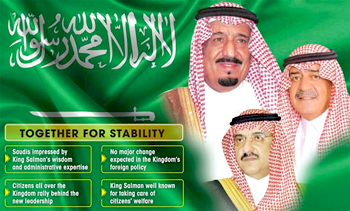
Dawn of a new era under King Salman

January 27, 2015

King Salman

Jeddah, Jan 27: A new era dawned in Saudi Arabia on Monday under the leadership of Custodian of the Two Holy Mosques King Salman as citizens across the country expressed their confidence in the new king’s ability to take the Kingdom to new heights of progress and prosperity.

The three-day mourning period for the late King Abdullah ended Sunday. King Salman, Crown Prince Muqrin, Deputy Crown Prince, Second Deputy Premier and Interior Minister Prince Mohammed bin Naif and other royal family members had received condolences from world leaders and citizens on Saturday and Sunday.

Saudis in the Kingdom and abroad have pledged their allegiance to the country’s new leaders, in personal meetings or through regional governors and ambassadors abroad.

On Sunday, thousands of citizens stood in line in front of Al-Yamamah Palace in Riyadh to meet King Salman. According to a report carried by Asharq Al-Awsat, there was no blockade in front of the palace to restrict entry.

“There was no discrimination. Everybody, including princes, ministers, Shoura members and ordinary citizens were allowed to meet the king without following any protocol,” the report said.

Citizens from across the Kingdom came in their traditional attire. Sheikh Ibrahim bin Mohammed Al-Khereiji, an elderly man who was imam of the big mosque in Al-Kharj, made his way to the palace in a wheelchair.

The man’s son, Abdul Aziz, said his father had met all the previous six kings. “He was a member of the delegation set up by King Abdul Aziz to receive King Farouk of Egypt when the latter visited the Kingdom on Jan. 24, 1945,” the son said.

Al-Khereiji was appointed by King Abdul Aziz as a secretary in Al-Kharj and was in charge of distributing land among citizens. He established contact with King Salman when he was appointed the governor of Riyadh in 1955, the son said.

The smooth transition in Saudi Arabia following the death of King Abdullah has won applause from Saudis and foreign leaders. Saudi Ambassador to Egypt Ahmed bin Abdul Aziz Qattan said the smooth transition has strengthened citizens’ confidence in the new leadership.

Speaking to the Saudi Press Agency after receiving citizens who came to express their condolences and pledge their allegiance to the new leadership, Qattan said Saudis have been impressed by King Salman’s wisdom and administrative expertise.

“King Salman has been in the government for the last 60 years, dedicating his life to the service of the Kingdom and its people. All Saudis will definitely rally behind their wise leadership as usual,” the ambassador said.

In his keynote speech after ascending the throne, King Salman said that his government would follow the straight path, based on the teachings of the Qur’an and Sunnah, without deviating from the policies of his predecessors.

The new leadership has taken over at a time when Saudi Arabia faces several challenges including falling oil prices — the Kingdom depends on oil for about 90 percent of its revenue — and the threat posed by the so-called Islamic State terrorist group in the north and the Houthis in the south.

“It is no secret that there has been no major change for several decades in Saudi foreign policy. It has always been based on certain basic principles and various geographic, historical, religious, economic, security and political factors,” said Salman Aldossary, editor in chief of Asharq Al-Awsat.

He said noninterference in the internal affairs of other countries, establishing strong relations with Gulf, Arab and Islamic countries, supporting Arab and Islamic causes and cooperation with other friendly countries, are the hallmarks of Saudi foreign policy. This included the Kingdom’s continuous efforts to ensure stability in the international oil market because it is one of the world’s largest oil producers, he said.

Mohammed bin Daqqas, a former employee at the royal court, said King Salman has always insisted on punctuality and hard work. “When he was the governor of Riyadh, he used to look into the matters of citizens himself. One day when he was outside the Kingdom, he contacted an official at the governorate to attend to the case of a citizen.

The official had left the office 30 minutes before the end of the working day. He then asked the official to return to the office and complete the work for that citizen.”

Comments

Add new comment

  • Coastaldigest.com reserves the right to delete or block any comments.
  • Coastaldigset.com is not responsible for its readers’ comments.
  • Comments that are abusive, incendiary or irrelevant are strictly prohibited.
  • Please use a genuine email ID and provide your name to avoid reject.
News Network
March 16,2020

Cairo, Mar 16: Saudi crown prince Mohammed bin Salman said G20 summit will work to combat coronavirus and coordinate efforts to ease its economic burdens, state news agency SPA said on Sunday.

In a phone call with British Prime Minister Boris Johnson, Salman discussed international efforts to fight the flu-like disease, saying the next G20 summit, which will be hosted by the Kingdom, will work on finding medical solutions, SPA added.

The G20 Summit is an annual gathering of representatives of the world's largest economies.

Comments

Add new comment

  • Coastaldigest.com reserves the right to delete or block any comments.
  • Coastaldigset.com is not responsible for its readers’ comments.
  • Comments that are abusive, incendiary or irrelevant are strictly prohibited.
  • Please use a genuine email ID and provide your name to avoid reject.
Agencies
May 18,2020

Jeddah, May 18: Saudi Arabia’s Grand Mufti and head of the Council of Senior Scholars and the Department of Scientific Research and Ifta Sheikh Abdul Aziz Al Asheikh ruled that it is permissible to perform Eid Al-Fitr prayer at home under exceptional circumstances similar to the current pandemic situation. The prayer consists of two rakats with reciting more numbers of takbeer and without a sermon.

Speaking to Okaz/Saudi Gazette, he said that Zakat Al-Fitr could be distributed through charitable societies if they are reliable ones, with the condition that it should be distributed before the day of Eid. The Grand Mufti urged parents to bring joy and happiness to their children and their families by spending more on them.

Meanwhile, Sheikh Abdul Salam Abdullah Al-Sulaiman, member of the Council of Senior Scholars and the Standing Committee of Fatwa, said that Eid prayer could be performed individually or in congregation.

Speaking to Okaz/Saudi Gazette, he said that the worshiper will recite takbeer to start salat and then follow it with six more takbeer in the first rakat before reciting Fatiha loudly and then it is ideal to recite Surah Al-Qaf.

In the second rakat, there will be five takbeer after the takbeer at the start of the rakat before starting to recite Surah Fatiha and then Surah Al-Qamar, following the example of the Prophet (peace be upon him). It is also ideal to recite Surah Al-A’la and Al-Ghashiya instead of Al-Qaf and Al-Qamar in each rakat respectively.

Sheikh Al-Sulaiman also cited the example of Anas Bin Malik, a prominent companion of the Prophet (pbuh). When Anas (May Allah be pleased with him), was at his home in Zawiya, a place near Basra, he did not find any Eid congregation prayer and therefore he performed prayer along with his family members and his aide Abdullah Bin Abi Otba.

The scholar said that the time for Eid prayer begins after sunrise and the best time is after the sun rises by the height of one or two spears as agreed by most scholars. This means 15 or 30 minutes after sunrise and its time continues until the end of the time of the Duha prayer; that is before the Zuhr prayer begins.

The prayer is forbidden at the moment when the sun rises, and the majority of jurists, including the schools of thought of Shafi, Maliki, and Hanbali opposed prayer at sunrise and favored to perform the prayer only after the sun rises by the height of one or two spears in the sky.

Regarding the recitation of takbeer on the occasion of Eid Al-Fitr, Sheikh Al-Suleiman said that it should begin during the night of the Eid and continue until the beginning of the Eid prayer.

Comments

Add new comment

  • Coastaldigest.com reserves the right to delete or block any comments.
  • Coastaldigset.com is not responsible for its readers’ comments.
  • Comments that are abusive, incendiary or irrelevant are strictly prohibited.
  • Please use a genuine email ID and provide your name to avoid reject.
News Network
May 21,2020

Dubai, May 21: Around 10,000 Iranian health workers have been infected with the new coronavirus, the semi-official ILNA news agency quoted a deputy health minister as saying on Thursday.

Health services are stretched thin in Iran, the Middle East country hardest hit by the respiratory pandemic, with 7,249 deaths and a total of 129,341 infections. The Health Ministry said in April that over 100 health workers had died of COVID-19.

No more details on infections among health workers were immediately available.

Earlier on Thursday, Health Minister Saeed Namaki appealed to Iranians to avoid travelling during the Eid al-Fitr religious holiday later this month to avoid the risk of a new surge of coronavirus infections, state TV reported.

Iranians often travel to different cities around the country to mark the end of the Muslim holy fasting month of Ramadan, something Namaki said could lead to a disregard of social distancing rules and a fresh outbreak of COVID-19.

"I am urging you not to travel during the Eid. Definitely, such trips mean new cases of infection...People should not travel to and from those high-risk red areas," Namaki was quoted by state television as saying.

"Some 90% of the population in many areas has not yet contracted the disease. In the case of a new outbreak, it will be very difficult for me and my colleagues to control it."

A report by parliament's research centre suggested that the actual tally of infections and deaths in Iran might be almost twice that announced by the health ministry.

However, worried that measures to limit public activities could wreck an economy which has already been battered by U.S. sanctions, the government has been easing most restrictions on normal life in late April.

Infected cases have been on a rising trajectory for the past two weeks. However, President Hassan Rouhani said on Wednesday that Iran was close to curbing the outbreak.

Comments

Add new comment

  • Coastaldigest.com reserves the right to delete or block any comments.
  • Coastaldigset.com is not responsible for its readers’ comments.
  • Comments that are abusive, incendiary or irrelevant are strictly prohibited.
  • Please use a genuine email ID and provide your name to avoid reject.