



Debating Secularism in a Communalized Society

[email protected] (Ram Puniyani)
July 12, 2014

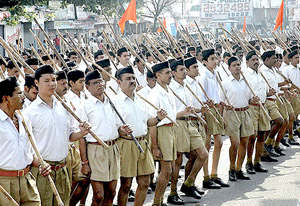
In the aftermath of the recent elections Congress, Communist parties, Samajvadi and Lalu’s RJD, which can be called secular in some sense; bit the dust. In the review of defeat the major opposition party Congress, which has been in power for maximum number of years, one major opinion from its top leader A.K. Antony came forth to say that the secularism practiced by Congress was seen more as an appeasement of minorities (read Muslims) and so the large sections turned against it emasculating it to a mere 19% votes with 44 seats in Lok Sabha. In a free for all; different opinions on secularism, and failure of Congress are coming forth.Rss cadre
BJP with glee and confident assertion came to claim that it has the correct opinion of secularism, "We (BJP) have always said secularism should mean justice for all, appeasement of none, discrimination against none” Ironically this assertion, which negates the very concept of a democratic and secular society, has come to be perceived by many as ‘the secularism’. Many a commentators opined that Modi could demonstrate the hypocrisy of secularism and went on to take the cake of power. Sometimes victory can be taken as the proof of correctness!

In Indian scenario, secularism has been a much debated word, more so after Independence. At the time of Independence critics went on to say that state is not curbing religious practices in official places and called it an erosion of secularism. What we see today in most public places, the pantheon of Hindu deities adorning the Government offices and vehicles, and is passé’ was criticized by many earlier. Hindu practices like Bhumi Pujan (worshipping land) before construction of Government buildings became part of ‘normal practice’. Sarswati Puja, Surya Namaskar in some Government outfits by now is becoming a matter of routine. When Nehru was asked by Andre Malraux about such religious practices going around, Nehru did confess that we have a secular constitution but the society is in the grip of religiosity. Today a Prime Minister-elect performing a Ganga Aarti is part of the official menu and the tables are turned on those who question such practice of secularism by state and party.

As such the beginning of secular values and practices has been very different in India. While the Kingdoms and feudal lords were ruling in close alliance with religious clergy, the process of secularization in India began with the coming of industrialization and modern education during the British period. With the rise of newer classes, the industrialists, workers and modern educated classes, the concept of India, ‘India as a nation in the making’ started coming up. The kings and feudal lords, who were later joined in by a section of elite upper caste/educated section of society came up with communal outfits, Muslim League and Hindu Mahasabha-RSS. While the rising classes were all inclusive, incorporating people of all religions, the latter declining sections-communal formations were restricted to Muslims or Hindu elite respectively. The triangle of British policy of divide and rule on one hand and Muslim and Hindu communalists on the other led to the formation of Pakistan in the name of Islam and ‘India that is Bharat’ on the basis of plural, secular values. While Pakistan went through a painfully long trajectory where after the demise of Quaid-e-Azam Jinnah, a leader with secular soul in the communal body of Muslim League, led to the blunt and assertive upsurge of communalism, Islamic Fundamentalism, dominated by Mullahs and Military in the driving seat. It went through different ups and downs; its situation worsened by the US intervention which went on strengthening the communal elements there. Lately the secular elements in Pakistan are trying to come up from the stranglehold of the domination of Islamic fundamentalism.

In India the trajectory had been very different. After Independence the communal outfit Hindu Mahasabha soon went into oblivion; while the progenitor of Hindu nationalism, RSS went on to float different organizations to achieve its goal of Hindu Rashtra. Initially it helped to form Bhartiya Jansangh with elements drawn from Hindu Mahasabha, later RSS was in total command and though it was not in the forefront in electoral arena, it kept spreading ‘adverse common sense’ against Muslims in the beginning and later against Christians. The communal version of history was made popular, ‘Muslims are more loyal to Pakistan’, and the atrocities of Muslim kings became the cannon fodder of painting the negative image of today’s Muslim minority.

In this scenario three factors shaped the nature of things to come. One, the wide prevalence of adverse ‘social common sense’ against Muslims became part of social thinking. Two, the communal violence in which; most of the victims have been Muslims; shook the deeper psyche of the community. This in turn led to strengthening of orthodox elements and dominance of Mullahs and communal politics within Muslim community. The third factor was the marginalization of Muslim community in the economic and social sphere. It is in this backdrop that Congress tried to walk the talk of secularism and faced severe obstacles. Irrespective of the propaganda that Congress is responsible for communal violence; those on ground know the reality of the impact of communal politics. Congress itself had many communal elements within and the leadership at times played an opportunistic role by compromising with communalism on regular basis.

So Congress did try the things which in a democratic society a secular dispensation should be doing. In the matters of communal violence against Muslims and in the matters of economic issues, but its attempts were half hearted due to the factors outlined above. As an umbrella party with secular ideology and plethora of communal opportunist elements within, it could not go far in taking the affirmative action for the community so instead it went on appeasing the orthodox elements, as was most visible in Shah Bano case. The community as a whole remained a victim of violence on one side and discrimination on the other. The statistics about violence data and reports like Gopal Singh Commission, Sachar Committee and Rangnath Mishra Commission tell the story not only of the Muslim community but of the travails through which our democracy had to pass, where a big chunk of population remained neglected.

While all this was on, the communal elements sensing the possibility of coming to power through polarization of society, took up identity issues on regular basis, Ram Temple issue being the major one. They were successful in projecting that Congress is appeasing the Muslims. As a matter of fact, Congress policies have not benefitted the Muslim community in any way. The words and pronouncements of Congress fell on the hard rock of communalized polity. Making the statements like ‘They have a first right on national resources’ was used to show the partisanship of Congress. As a matter of fact seen in the context of a caring state, to say that weaker sections have first right on national resources should be the sign of a state committed to welfare of all. So Congress dilemma of wanting to implement secular policies, protection of minorities and affirmative action for them, fell flat. At the same time it did give a handle to the communal opponents to project as if Congress is there only for Muslims. The UPA I and II showed that the caring affirmative action was targeted not only for Muslims but also for other different disadvantaged sections of society as well. Same way the attempt to bring Communal violence prevention bill was nullified through a vicious propaganda.

So Mr. Antony may be partly right, but the problem is deeper. It relates to the semi-secularized society, the ascendance of communal politics, majority and minority both, and so finally landing up to mere electoral arithmetic of talking (not implementing) of schemes to win over the minority votes. Congress has not kept up the ideological commitment to secular values. Its workers hardly think differently on the issues related to communal propaganda. Many of its leaders come from communal stock, for many others standing upright for secular values is not important at all. There is a serious need for introspection, not only for Congress but for all those wanting to uphold the values emerging from our National movement for freedom.

Comments

Add new comment

  • Coastaldigest.com reserves the right to delete or block any comments.
  • Coastaldigset.com is not responsible for its readers’ comments.
  • Comments that are abusive, incendiary or irrelevant are strictly prohibited.
  • Please use a genuine email ID and provide your name to avoid reject.
Ram Puniyani
January 14,2020

In the beginning of January 2020 two very disturbing events were reported from Pakistan. One was the attack on Nankana Sahib, the holy shrine where Sant Guru Nanak was born. While one report said that the place has been desecrated, the other stated that it was a fight between two Muslim groups. Prime Minister of Pakistan Imran Khan condemned the incident and the main accused Imran Chisti was arrested. The matter related to abduction and conversion of a Sikh girl Jagjit Kaur, daughter of Pathi (One who reads Holy Guru Granth Sahib in Gurudwara) of the Gurudwara. In another incident one Sikh youth Ravinder Singh, who was out on shopping for his marriage, was shot dead in Peshawar.

While these condemnable attacks took place on the Sikh minority in Pakistan, BJP was quick enough to jump to state that it is events like this which justify the Citizenship Amendment Act (CAA). Incidentally CAA is the Act which is discriminatory and relates to citizenship with Religion, which is not as per the norms of Indian constitution. There are constant debates and propaganda that population of Hindus has come down drastically in Pakistan and Bangla Desh. Amit Shah, the Home minister stated that in Pakistan the population of Hindus has come down from 23% at the time of partition to 3.7% at present. And in Bangla Desh it has come down from 22% to present 8%.

While not denying the fact that the religious minorities are getting a rough deal in both these countries, the figures which are presented are totally off the mark. These figures don’t take into consideration the painful migrations, which took place at the time of partition and formation of Bangla Desh later. Pakistan census figures tell a different tale. Their first census was held in 1951. As per this census the overall percentage of Non Muslim in Pakistan (East and West together) was 14.2%, of this in West Pakistan (Now Pakistan) it was 3.44 and in Eat Pakistan it was 23.2. In the census held in Pakistan 1998 it became 3.72%. As far as Bangla Desh is concerned the share of Non Muslims has gone down from 23.2 (1951) to 9.6% in 2011.

The largest minority of Pakistan is Ahmadis, (https://minorityrights.org/country/pakistan/) who are close to 4 Million and are not recognised as Muslims in Pakistan. In Bangla Desh the major migrations of Hindus from Bangla Desh took place in the backdrop of Pakistan army’s atrocities in the then East Pakistan.

As far as UN data on refugees in India it went up by 17% between 2016-2019 and largest numbers were from Tibet and Sri Lanka.  (https://www.un.org/en/development/desa/population/migration/publication…)

The state of minorities is in a way the index of strength of democracy. Most South Asian Countries have not been able to sustain democratic values properly. In Pakistan, the Republic began with Jinnah’s classic speech where secularism was to be central credo of Pakistan. This 11th August speech was in a way what the state policy should be, as per which people of all faiths are free to practice their religion. Soon enough the logic of ‘Two Nation theory” and formation of Pakistan, a separate state for Muslim took over. Army stepped in and dictatorship was to reign there intermittently. Democratic elements were suppressed and the worst came when Zia Ul Haq Islamized the state in collusion with Maulanas. The army was already a strong presence in Pakistan. The popular formulation for Pakistan was that it is ruled by three A’s, Army, America and Allah (Mullah).

Bangla Desh had a different trajectory. Its very formation was a nail in the coffin of ‘two nation theory’; that religion can be the basis of a state. Bangla Desh did begin as a secular republic but communal forces and secular forces kept struggling for their dominance and in 1988 it also became Islamic republic. At another level Myanmar, in the grip of military dictatorship, with democratic elements trying to retain their presence is also seeing a hard battle. Democracy or not, the army and Sanghas (Buddhist Sang has) are strong, in Myanmar as well. The most visible result is persecution of Rohingya Muslims.

Similar phenomenon is dominating in Sri Lanka also where Budhhist Sanghas and army have strong say in the political affairs, irrespective of which Government is ruling. Muslim and Christian minorities are a big victim there, while Tamils (Hindus, Christians etc.) suffered the biggest damage as ethnic and religious minorities. India had the best prospect of democracy, pluralism and secularism flourishing here. The secular constitution, the outcome of India’s freedom struggle, the leadership of Gandhi and Nehru did ensure the rooting of democracy and secularism in a strong way.

India so far had best democratic credentials amongst all the south Asian countries. Despite that though the population of minorities rose mainly due to poverty and illiteracy, their overall marginalisation was order of the day, it went on worsening with the rise of communal forces, with communal forces resorting to identity issues, and indulging in propaganda against minorities.

While other South Asian countries should had followed India to focus more on infrastructure and political culture of liberalism, today India is following the footsteps of Pakistan. The retrograde march of India is most visible in the issues which have dominated the political space during last few years. Issues like Ram Temple, Ghar Wapasi, Love Jihad, Beef-Cow are now finding their peak in CAA.

India’s reversal towards a polity with religion’s identity dominating the political scene was nicely presented by the late Pakistani poetess Fahmida Riaz in her poem, Tum bhi Hum Jaise Nikle (You also turned out to be like us). While trying to resist communal forces has been an arduous task, it is becoming more difficult by the day. This phenomenon has been variously called, Fundamentalism, Communalism or religious nationalism among others. Surely it has nothing to do with the religion as practiced by the great Saint and Sufi traditions of India; it resorts mainly to political mobilization by using religion as a tool.

Comments

Ashi
 - 
Tuesday, 14 Jan 2020

If Malaysia implement similar NRC/CAA, India and China are the loser.

Add new comment

  • Coastaldigest.com reserves the right to delete or block any comments.
  • Coastaldigset.com is not responsible for its readers’ comments.
  • Comments that are abusive, incendiary or irrelevant are strictly prohibited.
  • Please use a genuine email ID and provide your name to avoid reject.
Ram Puniyani
February 13,2020

Forthcoming Census and RSS campaign

Currently massive protests are going on against NPR, NCR and CAA. At the same time we are going to begin the process of decadal census in 2021. Already RSS is active in promoting NPR, NCR and CAA. At the same time RSS wants that Adivasis should register themselves as Hindus rather than ticking the column of ‘Others’. As per their spokesperson in the 2011 census many Adivasis groups ticked that column because of which the population of Hindus came down to by 0.7 percent point to come down to 79.8 %. This has sent signals to this Hindu nationalist organization and is planning to ensures that Adivasis tick the column of Hindus in this census.

As such RSS has a very clever attitude in defining the term Hindu. The first formulation was by Savakakar who said that all those who regard the land east of Indus as their Holy land and Father land are Hindus. This left out Muslims and Christians, and brought all others in the ambit of Hindu fold. From the decade of 1980s due to electoral compulsions they have been trying to articulate that all those who are living in India are Hindus. Murli Manohar Joshi stated that Muslims are Ahmadiya Hindus and Christians are Christi Hindus. Recently there was a controversy when they restated that Sikhs are not a separate religion but are a sect of Hinduism. Many Sikh organizations stood up to say that Sikhism is a religion by itself and recalled the book of Kahan Singh Nabha, “Hum Hindu Nahin”

As far as Adivasis are concerned in contrast to what is being planned by Hindu nationalist RSS, many Adivasis groups have been meeting from last couple of years to demand just the contrary. As per them there should be a column where they can tick their identity of Adivasis.  There are active campaigns among Adivasis groups to uphold their Adivasi identity in Census. As per them in the first census which was conducted in Independent India, the column, Aborigines, was there, which was later removed forcing them to club themselves with other religions.

After 1951 in addition to Hindu, Muslim, Sikh, Christian, Jain and Buddha, the column ‘others’ was also there which was removed in 2011. Even during British period if you look at the censuses of the British era (from 1871 to 1931); there was provision for tribes to choose Aborigine as an option. There are nearly 83 religious practices being followed by Adivasis. Few major of these are Sarna, Gondi, Punem, Adi, and Koya. What they share in common is that they are animists, worship nature and spirit of ancestors; do not have priestly class or Holy Scriptures and Gods and Goddesses characteristic of the broad Hindu pantheon.

RSS as per its political agenda of Hindu Nation regards them as Vanvasi. They pontificate that they have been part of Hindu society who were driven away to forests to escape the forcible conversion being done by the Muslim invaders. This concoction is contrary to the interpretations based on the studies from population genetics. The Hindu nationalist argues that Aryans have been the original inhabitants of the country from where they spread to other parts of the World. The book by Tony Joseph, ‘Early Indians’ tells us that away from the race theory, we are all mixed up. The first inhabitants in our land were the ones who emigrated from South Asia over Sixty thousand years ago.

The Indo-Aryans came here nearly three thousand years ago and they pushed the aborigines to the forests and hills and that’s what constitutes the Adivasi community of India.

Hindu Nationalists like all the nationalists who construct their nationalism around their religion claim to be the most original inhabitants of the land, and their interpretations of past are molded according to that. RSS right from beginning has not been using the word Adivasi, it calls them Vanvasi. As per its agenda it wants them to be part of Hindu fold, despite Adivasis themselves saying that they are not Hindus, they have beliefs and practices which are far away from Hinduism in whatever form.

To enhance its political reach from the decades of 1980s in particular its work in Adivasis areas has been intensified. While ‘Vanvasis Kalyan Ashram’, part of RSS Combine which was formed much earlier, it was in the decades of 1980s that their work was jacked up by sending more Pracharaks in Adivasi areas. We see that in Gujarat, Dangs and nearby area, Swami Aseemanand, in MP, centered around Jhabua-the followers of Asaram Bapu and in Orissa Swami Laxmananad stationed them. They saw Christian missionaries working in the field of education and health as an obstacle to Hinduization of Adivasis. Their propaganda against Christian missionaries led to the ghastly murder of Pastor Graham Stains. It was this propaganda which led to anti Christian violence in various forms, the most horrific being the Kandhamal violence of 2008.

In order to culturally co-opt them into the fold of Hinduism they began series of religious congregations, Kumbhs. Shabri Kumbh in Dangs and many other Adivasis predominant areas created an atmosphere of fear, Adivasis were asked to be part of it, saffron flags were distributed and they were made to put it in their houses. Two religious icons were popularized in these areas, one was Shabri and other was Hanuman. To cap it all, Ekal Vidyalayas, started spreading RSS’s interpretation of history in these areas. The other angle of the whole thing is that Adivasis are living in the areas rich in minerals, which the BJP supporter Corporate World wants to take over.

World over aborigines have similar pattern. They are animists and what they practice is a culture as such. Many have converted to other religions out of their choice for sure, but finally in these matters what is important is the self perception. Hemant Soren the Chief Minister of Jharkhand pointed out that “Adivasis are not Hindus. ”Keeping that in mind; the column of Aborigines needs to find its place in our census forms.

Comments

Add new comment

  • Coastaldigest.com reserves the right to delete or block any comments.
  • Coastaldigset.com is not responsible for its readers’ comments.
  • Comments that are abusive, incendiary or irrelevant are strictly prohibited.
  • Please use a genuine email ID and provide your name to avoid reject.
Ram Puniyani
February 22,2020

This January 2020, it is thirty years since the Kashmiri Pundits’ exodus from the Kashmir valley took place. They had suffered grave injustices, violence and humiliation prior to the migration away from the place of their social and cultural roots in Kashmir Valley. The phenomenon of this exodus had been due to the communalization of militancy in Kashmir in the decade of 1980s. While no ruling Government has applied itself enough to ‘solve’ this uprooting of pundits from their roots, there are communal elements who have been aggressively using ‘what about Kashmiri Pundits?’, every time liberal, human rights defenders talk about the plight of Muslim minority in India. This minority is now facing an overall erosion of their citizenship rights.

Time and over again in the aftermath of communal violence in particular, the human rights groups have been trying to put forward the demands for justice and rehabilitation of the victim minority. Instead of being listened to those particularly from Hindu nationalist combine, as a matter of routine shout back, where were you when Kashmiri Pundits were driven away from the Valley? In a way the tragedy being heaped on one minority is being justified in the name of suffering of Pundits and in the process violence is being normalized. This sounds as if two wrongs make a right, as if the suffering Muslim minority or those who are trying to talk in defense of minority rights have been responsible for the pain of Kashmiri Pundits.

During these three, many political formations have come to power, including BJP, Congress, third front and what have you. To begin with when the exodus took place Kashmir was under President’s rule and V. P. Singh Government was in power at the center. This Government had the external support of BJP at that time. Later BJP led NDA came to power for close to six years from 1998, under the leadership of Atal Bihari Vajpayee. Then from 2014 it is BJP, with Narerda Modi as PM, with BJP brute majority is in power. Other components of NDA are there to enjoy some spoils of power without any say in the policies being pursued by the Government. Modi is having absolute power with Amit Shah occasionally presenting Modi’s viewpoints.

Those blurting, ‘what about Kashmiri Pundits?’ are using it as a mere rhetoric to hide their communal color. The matters of Kashmir are very disturbing and cannot be attributed to be the making of Indian Muslims as it is being projected in an overt and subtle manner. Today, of course the steps taken by the Modi Government, that of abrogation of Article 370, abolition of clause 35 A, downgrading the status of Kashmir from a state to union territory have created a situation where the return of Kashmiri Pundits may have become more difficult, as the local atmosphere is more stifling and the leaders with democratic potential have been slapped with Public Safety Act, where they can be interned for long time without any answerability to the Courts. The internet had been suspended, communication being stifled in an atmosphere where democratic freedoms are curtailed which makes solution of any problem more difficult.

Kashmir has been a vexed issue where the suppression of the clause of autonomy, leading to alienation led to rise of militancy. This was duly supported by Pakistan. The entry of Al Qaeda elements, who having played their role against Russian army in 1980s entered into Kashmir and communalized the situation in Kashmir. The initial Kashmir militancy was on the grounds of Kashmiriyat. Kashmiriyat is not Islam, it is synthesis of teachings of Buddha, values of Vedant and preaching’s of Sufi Islam. The tormenting of Kashmiri Pundits begins with these elements entering Kashmir.

Also the pundits, who have been the integral part of Kashmir Valley, were urged upon by Goodwill mission to stay on, with local Muslims promising to counter the anti Pundit atmosphere. Jagmohan, the Governor, who later became a minister in NDA Government, instead of providing security to the Pundits thought, is fit to provide facilities for their mass migration. He could have intensified counter militancy and protected the vulnerable Pundit community. Why this was not done?

Today, ‘What about Kashmiri Pundits?’ needs to be given a serious thought away from the blame game or using it as a hammer to beat the ‘Muslims of India’ or human rights defenders? The previous NDA regime (2014) had thought of setting up enclosures of Pundits in the Valley. Is that a solution? Solution lies in giving justice to them. There is a need for judicial commission to identify the culprits and legal measures to reassure the Pundit community. Will they like to return if the high handed stifling atmosphere, with large number of military being present in the area? The cultural and religious spaces of Pundits need to be revived and Kashmiryat has to be made the base of any reconciliation process.

Surely, the Al Qaeda type elements do not represent the alienation of local Kashmiris, who need to be drawn into the process of dialogue for a peaceful Kashmir, which is the best guarantee for progress in this ex-state, now a Union territory. Communal amity, the hallmark of Kashmir cannot be brought in by changing the demographic composition by settling outsiders in the Valley. A true introspection is needed for this troubled area. Democracy is the only path for solving the emigration of Pundits and also of large numbers of Muslims, who also had to leave the valley due to the intimidating militancy and presence of armed forces in large numbers. One recalls Times of India report of 5th February 1992 which states that militants killed 1585 people from January 1990 to October 1992 out of which 982 were Muslims and 218 Hindus.

We have been taking a path where democratic norms are being stifled, and the promises of autonomy which were part of treaty of accession being ignored. Can it solve the problem of Pundits?

Comments

Add new comment

  • Coastaldigest.com reserves the right to delete or block any comments.
  • Coastaldigset.com is not responsible for its readers’ comments.
  • Comments that are abusive, incendiary or irrelevant are strictly prohibited.
  • Please use a genuine email ID and provide your name to avoid reject.