



Deluge, destruction in Jammu and Kashmir

September 14, 2014

Srinagar, Sep 14: These are unprecedented times. Generations of people of Jammu and Kashmir had not seen the kind of devastation that the floods of September second week have wrought on the Himalayan state.
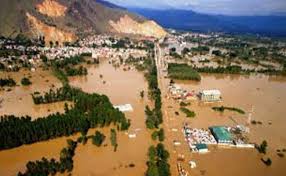
jkThe deluge has left a trail of destruction in almost every district of this already vexed state. The flood havoc has left the Jammu region and the Kashmir Valley equally ruined. A week of thunderous rainfall has breached canals and lakes and flooded the rivers, pushing the state, not known for its administrative efficiency, backward by a couple of decades. There is hardly any family which has not been affected by this completely unpredicted misery.

Days of rainfall and flooding have impacted every walk of life. After the thunder storm that started on September 6, only now Srinagar has started getting electricity supply, that too only in parts of the state capital. There is hardly any telephone connectivity. With mobile networks non-functional and power intermittent, the problem of contacting the near and dear ones is a tall order. There are tales of parents not knowing the whereabouts of the family members, mothers having lost children and brothers unaware what happened to the uncontactable cousins.

Take anything in J&K, they are under water. Shops and establishments, hospitals, banks, government and private offices, telephone exchanges, police stations, schools and colleges, power plants, petrol pumps and newspaper offices are under water and will remain closed for days to come. Of the seven hospitals in the city, only one – Sher-e-Kashmir - is functional. Godowns are under water. Petrol pumps are empty.

The HP and IOC oil storage tanks located in Pulwama district along the closed Srinagar-Jammu highway are submerged. Most of the buildings and houses are under at least 10 ft of water. There is a level-playing field here though. Chief Minister Omar Abdullah’s office, secretariat, Assembly building, areas like the posh Jawahar Nagar - where leading politicians and top bureaucrats live - have been under water. So much so that the chiefminister could not contact his own ministers or officials for days on end.

There are no stocks in ration shops. Left over stocks are looted by thieves who came in boats. There is an acute shortage of food across the affected districts. Medicine is urgently needed as receding flood waters may bring in diseases. The biggest problem is acute shortage of medicine and drinking water. Some temporary hospitals are set up as voluntary doctors are working but are devoid of medical facilities. Without water, there is the danger of people getting dehydrated. In the only paediatric hospital of Srinagar, 14 newborns died. There are reports that some bodies are lying on trees.

Relief camps have been set up but the condition there is sub-human. While seven of the 10 north Kashmir districts were affected, rain has started pounding south Kashmir since Friday. People’s anger is against both the state and the Central governments.

Affected residents say while the state government completely failed to come to the rescue of the flood-hit, the Centre could have done more. Instead of pressing just 100 boats in to service, what was needed was 1000 boats as lakhs were waiting to be rescued over six days without proper food or water. In Sringar alone, of the 6 lakh trapped in waters, only 1 lakh have been rescued.

Said Riaz Ahmed, a businessman: “This is the time when the rest of the country can really show that Kashmir is part of India, that they are ready to embrace us in this hour of tragedy. Help is coming, but it is insufficient, not streamlined.”

Cries of woe

Many have lost their lives and also savings and property. Says Mohd Mazan Bhat, a retired government official: “I constructed a house in Bemina out of my life savings. The house has been washed away in the floods. I lost everything in a matter of a few hours.” Bhat, now in a relief camp, weeps: “I don’t know how to restart my life.”

Four days after he was rescued from his house which is under 15 ft of water in Karan Nagar, advocate Jawed is not able to live down the horror he went through. “I was saved by an army boat after three days and two nights. I am still terrified, I am not able to sleep. I get hallucinations of the violent waves lashing my house engulfing it and the neighbourhood.”

Senior journalist Arshad Hussian of Kashmir Times and his mother are not traceable. He has three small children and all are rescued from his house at Shivpura on the banks of the Jhelum river. His wife, a doctor, was at her hospital when the tragedy struck and is safe. I have been trying to locate them at relief camps but am not successful.

There are hundreds of such stories here. As for my relatives, there is no information about dozens of them. Same with scores of journalist colleagues and friends.

But many have not left their homes despite army boats reaching them. They are scared that the moment they leave, whatever that is left at home would be taken away by the gangs of thieves.

Lack of connectivity is one of the biggest logistical problems. Authorities claim that 50 per cent of mobile connectivity is restored but in reality, it is not even 10 per cent. BSNL and Airtel connections are not working. Aircel network is available but only in some areas.

There is apprehension as to what will happen to the cash deposits in scores of banks across the state as well as the cash in the main state treasury situated on Residency Road in Lal Chowk which are under water. The chiefminister has assured the people that cash in banks as well as treasury is safe.

In south Kashmir, Anant Nag, Pulwama and Pehlgam have been devastated by floods. Almost 90 per cent of people there are affected. In north Kashmir, parts of Badgam, Baramulla and Bandipore districts are badly hit. In north, only Ganderbal, Kupwara and Shopean districts remain largely unaffected. On Friday, 40 bodies were retrieved from Pancheri village in Udhampur district in Jammu division, devastated by landslide. There are reports that several bodies are lying in different police stations in Srinagar. No one knows about the identity of these bodies.

Rehabilitation in J&K will take years. Public infrastructure is badly affected. In hospitals, all equipment, be it CT scan, x-ray, MRI machines etc are badly damaged under muddy water. Even if water recedes, it won’t be of much help.

Comments

Add new comment

  • Coastaldigest.com reserves the right to delete or block any comments.
  • Coastaldigset.com is not responsible for its readers’ comments.
  • Comments that are abusive, incendiary or irrelevant are strictly prohibited.
  • Please use a genuine email ID and provide your name to avoid reject.
Agencies
July 20,2020

New Delhi, Jul 20: Reiterating that China has still occupied India's territory, Congress leader Rahul Gandhi on Monday attacked Prime Minister Narendra Modi saying that he has fabricated a fake strongman image to come to power which has now become India's biggest weakness as he has to protect the idea of 'Chhapan Inch'.

Taking to Twitter, the Congress leader posted a video message and wrote, "PM fabricated a fake strongman image to come to power. It was his biggest strength. It is now India's biggest weakness."

In the video message, speaking on "China's Strategic Game Plan" the Congress leader said: "What is China's strategic and tactical game plan? It is simply not a border issue. The worry I have is that the Chinese are sitting in our territory today. Chinese don't do anything without thinking about it strategically."

"In their mind, they have mapped out the world and they are trying to shape the world. That's the scale of what they are doing. That's what Gwadar is, that is what belt and road is. It is a restructuring of the planet. So when you are thinking about the Chinese you have to understand that that is the level at which they are thinking," he added.

Now at the tactical level, they're trying to improve their position. Whether it is Galwan, whether it's Demchok or whether it is Pangong Lake. The idea is to position themselves, he said.

"They are disturbed by our highway they want to make our highway redundant and if they are thinking larger scale, they want to do something with Pakistan in Kashmir. So it is not simply a border issue. It is a border issue designed to put pressure on the Prime Minister of India," the Congress leader said.

"And they are thinking of putting pressure in a very particular way. And what they are doing, is that they are attacking his image. They understand that it in order for Mr Narendra Modi to be an effective politician; in order for Mr Narendra Modi to survive as a politician, he has to protect the idea of--Chhapan Inch. And this the real idea the Chinese are attacking. They are basically telling Mr Narendra Modi that if you do not do what we say, we will destroy the idea of Mr Narendra Modi as a strong leader," he added.

Gandhi continued saying, now the question is, how will PM Narendra Modi react. Will he take them on? Will he take on the challenge and say absolutely not, I'm the Prime Minister of India. I do not care about my image I'm going to take you on. Or will he succumb to them?

"The worry I have so far is that the Prime Minister has succumbed. The worry I have is, the Chinese are sitting in our territory today and the Prime Minister has said publicly they are not, which to me tells me that is worried about his image and defending his image," said Gandhi.

"And if he allows the Chinese to understand that they can manipulate him because of his image, the Indian Prime Minister will no longer be worth anything for India," he added.

Comments

Add new comment

  • Coastaldigest.com reserves the right to delete or block any comments.
  • Coastaldigset.com is not responsible for its readers’ comments.
  • Comments that are abusive, incendiary or irrelevant are strictly prohibited.
  • Please use a genuine email ID and provide your name to avoid reject.
Agencies
July 1,2020

Sopore, Jammu And Kashmir: A three-year-old boy survived as his grandfather was killed in a terror attack on the Central Reserve Police Force (CRPF) in Jammu and Kashmir's Sopore town this morning. A CRPF jawan was also killed in the line of duty as terrorists opened fire on a patrol team.

In heart-wrenching images, the child is seen sitting on the blood-splattered body of his grandfather, a civilian caught in the crossfire. The boy was numb with fear when he was picked up by policemen, according to the police.

The Kashmir police also tweeted a photo of the child being carried to safety by a policeman.

"Jammu and Kashmir police rescued a three-year-old boy from getting hit by bullets during the terrorist attack in Sopore," said the tweet by the Kashmir Zone Police.

The child was travelling in a Maruti car with his grandfather from Srinagar to Handwara when it was hit by a spray of bullets in Sopore town, which is in Baramulla district about 50 km from Srinagar.

The police said terrorists hiding in a mosque fired indiscriminately at the patrol team as it was getting off a bus. The CRPF troops retaliated but the terrorists managed to escape.

According to the CRPF, the grandfather stopped the car and got out to run to a safe spot but was shot dead in the firing by terrorists. The boy was later rescued by a policeman standing nearby.

Last week, a six-year-old boy was killed during a terror attack on the CRPF in Anantnag.

Little Nihaan Bhat was sleeping in a parked car when he was hit by a bullet. Police say the terrorist was on a bike and opened fire from a pistol on a CRPF patrol. One jawan was killed. The child's killing drew widespread anger and condemnation.

The terrorist believed to be involved in the Anantnag attack escaped yesterday after an encounter with security forces. Police said two other terrorists who were hiding with him at a village were killed.

Comments

Add new comment

  • Coastaldigest.com reserves the right to delete or block any comments.
  • Coastaldigset.com is not responsible for its readers’ comments.
  • Comments that are abusive, incendiary or irrelevant are strictly prohibited.
  • Please use a genuine email ID and provide your name to avoid reject.
Agencies
June 8,2020

New Delhi, Jun 8: Abortion access to around 1.85 million women was compromised across the country due to the nationwide restrictions imposed in response to the COVID-19 outbreak, a study conducted by Ipas Development Foundation (IDF) revealed.

These abortions were compromised at all points of care, including public and private sector facilities and chemist outlets during 68-day lockdown and the first week of Unlock 0.1 period. The study assesses the near-term impact of COVID-19 on abortion access in India since March 25 when the lockdown was imposed across the country with the announcement of Prime Minister Narendra Modi to contain the spread of novel coronavirus of COVID-19 pandemic.

It also highlights the need for a specially designed and integrated recovery plan for improving abortion services at facilities. The study estimates that access to abortion was highly compromised during lockdown 1 and 2 ( between March 25 and May 3) in which around 59 per cent of women seeking an abortion could not access the services.

However, with the Unlock phase or the recovery period as mentioned in the study starting on June 1, the situation is expected to improve - with 33 per cent abortions being compromised in 24 days. A huge number of women could not access safe abortion services during the lockdown, therefore it is extremely important that the healthcare system, public and private, is prepared to meet the needs of these women, the Ipas foundation says.

The model of the study strives to quantify the reduced access to abortions across three different points of care -public health facilities, private health facilities, and chemist outlets, said Vinoj Manning, CEO, Ipas Development Foundation in a statement.

"Majority of public health facilities and their staff are now focused on COVID-19 treatments and closures of private health facilities have compromised the access to safe abortions, which is a time-sensitive procedure."

He said that the study conducted by his foundation was to get a clearer picture of how COVID-19 restrictions have affected women seeking safe abortion services and what are the areas that would need focused efforts in the days to come.

Speaking on the methodology, Dr Sushanta Kumar Banerjee from Ipas Development Foundation said: "We conducted telephonic surveys and consulted with several experts from FOGSI leadership and social marketing organizations like PSI India Private Limited."

"After careful analysis of the data received from them, we have concluded that of the 3.9 million abortions that would have taken place in 3 months, access to around 1.85 million was compromised due to COVID-19 restrictions."

To facilitate the process Ipas Development Foundation has issued some initial recommendations which include: rapid mapping of facilities for first and second trimester abortions, assessing facilities' preparedness especially for second-trimester abortions, improving referral linkage and spread the word about the availability of the service, streamlining the supply chain for medical abortion drugs, and lastly including mechanisms to offset additional travel and out of pocket expenditures.

Ipas Development Foundation will be holding consultations with other partners and key stakeholders to facilitate meaningful collaborations to ensure access to safe abortions and ensure that no woman suffers long-term harm to her health due to lack of services.

Comments

Add new comment

  • Coastaldigest.com reserves the right to delete or block any comments.
  • Coastaldigset.com is not responsible for its readers’ comments.
  • Comments that are abusive, incendiary or irrelevant are strictly prohibited.
  • Please use a genuine email ID and provide your name to avoid reject.