



Deluge, destruction in Jammu and Kashmir

September 14, 2014

Srinagar, Sep 14: These are unprecedented times. Generations of people of Jammu and Kashmir had not seen the kind of devastation that the floods of September second week have wrought on the Himalayan state.
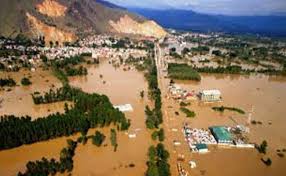
jkThe deluge has left a trail of destruction in almost every district of this already vexed state. The flood havoc has left the Jammu region and the Kashmir Valley equally ruined. A week of thunderous rainfall has breached canals and lakes and flooded the rivers, pushing the state, not known for its administrative efficiency, backward by a couple of decades. There is hardly any family which has not been affected by this completely unpredicted misery.

Days of rainfall and flooding have impacted every walk of life. After the thunder storm that started on September 6, only now Srinagar has started getting electricity supply, that too only in parts of the state capital. There is hardly any telephone connectivity. With mobile networks non-functional and power intermittent, the problem of contacting the near and dear ones is a tall order. There are tales of parents not knowing the whereabouts of the family members, mothers having lost children and brothers unaware what happened to the uncontactable cousins.

Take anything in J&K, they are under water. Shops and establishments, hospitals, banks, government and private offices, telephone exchanges, police stations, schools and colleges, power plants, petrol pumps and newspaper offices are under water and will remain closed for days to come. Of the seven hospitals in the city, only one – Sher-e-Kashmir - is functional. Godowns are under water. Petrol pumps are empty.

The HP and IOC oil storage tanks located in Pulwama district along the closed Srinagar-Jammu highway are submerged. Most of the buildings and houses are under at least 10 ft of water. There is a level-playing field here though. Chief Minister Omar Abdullah’s office, secretariat, Assembly building, areas like the posh Jawahar Nagar - where leading politicians and top bureaucrats live - have been under water. So much so that the chiefminister could not contact his own ministers or officials for days on end.

There are no stocks in ration shops. Left over stocks are looted by thieves who came in boats. There is an acute shortage of food across the affected districts. Medicine is urgently needed as receding flood waters may bring in diseases. The biggest problem is acute shortage of medicine and drinking water. Some temporary hospitals are set up as voluntary doctors are working but are devoid of medical facilities. Without water, there is the danger of people getting dehydrated. In the only paediatric hospital of Srinagar, 14 newborns died. There are reports that some bodies are lying on trees.

Relief camps have been set up but the condition there is sub-human. While seven of the 10 north Kashmir districts were affected, rain has started pounding south Kashmir since Friday. People’s anger is against both the state and the Central governments.

Affected residents say while the state government completely failed to come to the rescue of the flood-hit, the Centre could have done more. Instead of pressing just 100 boats in to service, what was needed was 1000 boats as lakhs were waiting to be rescued over six days without proper food or water. In Sringar alone, of the 6 lakh trapped in waters, only 1 lakh have been rescued.

Said Riaz Ahmed, a businessman: “This is the time when the rest of the country can really show that Kashmir is part of India, that they are ready to embrace us in this hour of tragedy. Help is coming, but it is insufficient, not streamlined.”

Cries of woe

Many have lost their lives and also savings and property. Says Mohd Mazan Bhat, a retired government official: “I constructed a house in Bemina out of my life savings. The house has been washed away in the floods. I lost everything in a matter of a few hours.” Bhat, now in a relief camp, weeps: “I don’t know how to restart my life.”

Four days after he was rescued from his house which is under 15 ft of water in Karan Nagar, advocate Jawed is not able to live down the horror he went through. “I was saved by an army boat after three days and two nights. I am still terrified, I am not able to sleep. I get hallucinations of the violent waves lashing my house engulfing it and the neighbourhood.”

Senior journalist Arshad Hussian of Kashmir Times and his mother are not traceable. He has three small children and all are rescued from his house at Shivpura on the banks of the Jhelum river. His wife, a doctor, was at her hospital when the tragedy struck and is safe. I have been trying to locate them at relief camps but am not successful.

There are hundreds of such stories here. As for my relatives, there is no information about dozens of them. Same with scores of journalist colleagues and friends.

But many have not left their homes despite army boats reaching them. They are scared that the moment they leave, whatever that is left at home would be taken away by the gangs of thieves.

Lack of connectivity is one of the biggest logistical problems. Authorities claim that 50 per cent of mobile connectivity is restored but in reality, it is not even 10 per cent. BSNL and Airtel connections are not working. Aircel network is available but only in some areas.

There is apprehension as to what will happen to the cash deposits in scores of banks across the state as well as the cash in the main state treasury situated on Residency Road in Lal Chowk which are under water. The chiefminister has assured the people that cash in banks as well as treasury is safe.

In south Kashmir, Anant Nag, Pulwama and Pehlgam have been devastated by floods. Almost 90 per cent of people there are affected. In north Kashmir, parts of Badgam, Baramulla and Bandipore districts are badly hit. In north, only Ganderbal, Kupwara and Shopean districts remain largely unaffected. On Friday, 40 bodies were retrieved from Pancheri village in Udhampur district in Jammu division, devastated by landslide. There are reports that several bodies are lying in different police stations in Srinagar. No one knows about the identity of these bodies.

Rehabilitation in J&K will take years. Public infrastructure is badly affected. In hospitals, all equipment, be it CT scan, x-ray, MRI machines etc are badly damaged under muddy water. Even if water recedes, it won’t be of much help.

Comments

Add new comment

  • Coastaldigest.com reserves the right to delete or block any comments.
  • Coastaldigset.com is not responsible for its readers’ comments.
  • Comments that are abusive, incendiary or irrelevant are strictly prohibited.
  • Please use a genuine email ID and provide your name to avoid reject.
News Network
April 4,2020

Mumbai, Apr 4: As many as six Central Industrial Security Force (CISF) personnel stationed at Mumbai airport in Maharashtra have tested positive for coronavirus, taking the total number of positive cases among the central force to 11. The first case of a CISF jawan being diagnosed with the viral disease was reported on March 28. 

After the first case, the armed police force reported four more cases of COVID-19 among the personnel stationed at the airport on Thursday. On the same day, the CISF collected samples of 146 staff and sent them to Kasturba hospital for testing. The results, which arrived on Friday, recorded six more COVID-19 cases among, reported news agency.

The personnel were posted at Kharghar adjoining Mumbai, a senior official told news agency.

As of now, there are 14 COVID-19 cases in Panvel Municipal Corporation (PMC) area in Mumbai. Kharghar comes under the civic body's jurisdiction.

All the 146 CISF personnel were shifted to a quarantine centre at a facility at Kamothe reported the Times of India.

Maharashtra reported 67 new COVID-19 cases, taking the total tally to 490. A total of 26 deaths have been reported in the state.  

In the meantime, the Centre on Friday said there is no shortage of medical supplies across the country to fight COVID-19 outbreak.

"The government of India is making sure that all the essential medical supplies are in place to fight COVID-19. Sixty-two lifeline Udan flights transported over 15.4 tons of essential medical supplies in the last five days," Union Minister for Chemical and Fertilisers DV Sadanada Gowda said in a tweet.

The government is also paying full attention to the manufacturing activities of essential items like pharmaceuticals and hospital devices. For this, over 200 units in Special Economic Zones (SEZs)  are operational, he added.

"A Central Control Room has also been set up for close monitoring of the distribution of essential medical items and to address logistic related issues," Gowda said.

Comments

Add new comment

  • Coastaldigest.com reserves the right to delete or block any comments.
  • Coastaldigset.com is not responsible for its readers’ comments.
  • Comments that are abusive, incendiary or irrelevant are strictly prohibited.
  • Please use a genuine email ID and provide your name to avoid reject.
News Network
June 22,2020

New Delhi, Jun 22: The Delhi Police Monday urged the Delhi High Court to grant them a day’s more time for seeking instructions on a plea by Jamia student Safoora Zargar, who was pregnant and arrested under the anti-terror law --UAPA--, seeking bail in a case related to communal violence in northeast Delhi during protests against the Citizenship Amendment Act in February.

Justice Rajiv Shakdher, who conducted the hearing through video conferencing, allowed the request after Zargar’s counsel said she has no objection to it and listed the matter for Tuesday.

Zargar, M Phil student of Jamia Millia Islamia University, is more than four months pregnant.

During the hearing, Solicitor General Tushar Mehta, representing the Delhi Police, sought a day’s time to take instructions on the issue and said it will be in “larger interest” if he is given indulgence.

Additional Solicitor General (ASG) Aman Lekhi also joined Mehta and said they are ready with the arguments on merits of the case but they do not intend to proceed on merits at this stage.

Advocate Nitya Ramakrishnan, appearing for Zargar, said the woman is in a delicate state and is in a fairly advanced stage pregnancy and if the police need time to respond to the plea, she be granted interim bail for the time being.

The high court asked Solicitor General (SG) Tushar Mehta to come back with instructions on Tuesday.

The police has also filed a status report in response to the bail plea.

Jamia Coordination Committee member Zargar, who was arrested by the Special Cell of Delhi Police on April 10, has challenged in the high court the June 4 order of the trial court denying her bail in the case.

The hearing in the high court also witnessed exchange of words between Mehta, Lekhi on one side and Delhi government standing counsel (criminal) Rahul Mehra who objected the appearance of the two senior law officers on behalf of Delhi Police in the case.

Mehra contended that unlike another North East Delhi violence matter in which requisite approval was sought by the Delhi Police to be represented by a team of lawyers led by the Solicitor General, no such procedure was followed in this case.

"They know that my view in such cases will be more humanitarian and not as per their whims and fancies. I am not supposed to be the mouth piece of the Delhi Police, I am an officer of the court," he said.

Lekhi shot back "a client chooses the lawyer and a lawyer cannot impose himself on the client.

He said this controversy would deviate the court from the issue in hand and Mehra's objection can be kept aside in this case.

The high court concluded the hearing, asking the counsel for Delhi Police to sort out their battles by tomorrow.

 The trial court, in its order, had said “when you choose to play with embers, you cannot blame the wind to have carried the spark a bit too far and spread the fire.”

It had said that during the course of investigation a larger conspiracy was discernible and if there was prima facie evidence of conspiracy, acts and statements made by any one of the conspirators, it is admissible against all.

The trial court had said that even if there was no direct act of violence attributable to the accused (Zargar), she cannot shy away from her liability under the provisions of the Unlawful Activities (Prevention) Act (UAPA).

However, the trial court had asked the concerned jail superintendent to provide adequate medical aid and the assistance to Zargar.

The police had earlier claimed that Zargar allegedly blocked a road near Jaffrabad metro station during the anti-CAA protests and instigated people that led to the riots in the area.

It further claimed that she was allegedly part of the “premediated conspiracy” to incite communal riots in northeast Delhi in February.

Communal clashes had broken out in northeast Delhi on February 24 after violence between citizenship law supporters and protesters spiralled out of control leaving at least 53 people dead and scores injured.

Comments

Add new comment

  • Coastaldigest.com reserves the right to delete or block any comments.
  • Coastaldigset.com is not responsible for its readers’ comments.
  • Comments that are abusive, incendiary or irrelevant are strictly prohibited.
  • Please use a genuine email ID and provide your name to avoid reject.
News Network
April 15,2020

New Delhi, Apr 15: As the world grapples with coronavirus, researchers have found the presence of a different kind of coronavirus -- bat coronavirus (BtCoV) --in two bat species from Kerala, Himachal Pradesh, Puducherry and Tamil Nadu, according to a study by the Indian Council of Medical Research (ICMR).

There is no evidence or research to claim that these bat coronaviruses can cause disease in humans, said Dr Pragya D Yadav, Scientist at the National Institute of Virology (NIV), Pune and also the first author of study.

The study has been published in the Indian Journal of Medical Research,

Twenty-five bats of Rousettus and Pteropus species from Kerala, Himachal Pradesh, Puducherry and Tamil Nadu were found positive for BtCoV in Kerala, Himachal Pradesh, Puducherry and Tamil Nadu.

"These bat coronaviruses have no relation with SARS-CoV2 responsible for the COVID-19 pandemic," Yadav said, adding that Pteropus bat species were earlier found positive for Nipah virus in 2018 and 2019 in Kerala.

"Bats are considered to be the natural reservoir for many viruses, of which some are potential human pathogens. In India, an association of Pteropus medius bats with the Nipah virus was reported in the past. It is suspected that the recently emerged severe acute respiratory syndrome coronavirus 2 (SARS-CoV-2) also has its association with bats," the objective of the study titled 'Detection of coronaviruses in Pteropus and Rousettus species of bats from different states of India' stated.

"In the present scenario of changing demography and ecological manipulations, it is challenging to have checks on the encounters of bats with other animals and humans," the study stated, highlighting that the need for active and continuous surveillance remains crucial for outbreak alerts for bat-associated viral agents with epidemic potential, which would be helpful in timely interventions.

"Although CoVs in the subfamily coronavirinae do not usually produce clinical symptoms in their natural hosts (bats), accidental transmission of these viruses to humans and other animals may result in respiratory, enteric, hepatic or neurologic diseases of variable severity. It is still not understood as to why only certain CoVs can infect people," the study said.

The scientists stressed on the need of proactive surveillance of zoonotic infections in bats.

The detection and identification of such viruses from bats also recommends cross-sectional antibody surveys (human and domestic animals) in localities where the viruses have been detected.

Similarly, if the epidemiological situation demands, evidence-based surveillance should also be conducted, the study said while emphasing on the need of developing strong mechanisms for working jointly with various stakeholders such as wildlife, poultry, animal husbandry and human health departments.

"In conclusion, our study showed detection of bat CoVs in two species of Indian bats. Continuous active surveillance is required to identify the emerging novel viruses with epidemic potential," Dr Yadav said.

Elaborating on the study, Dr Yadav said throat and rectal swab samples of two bat species -- Rousettus and Pteropus -- from seven states were screened for the bat coronvirus during which the representative samples collected from Kerala, Himachal Pradesh, Puducherry and Tamil Nadu tested positive while those from Karnataka, Chandigarh, Punjab, Telengana, Gujarat and Odisha came out negative.

The reverse-transcription polymerase chain reaction (RT-PCR) tests and sequencing were used for the confirmation of the findings.

"This is an ongoing study to understand the prevalence of the Nipah virus in bats," she said.

Comments

Add new comment

  • Coastaldigest.com reserves the right to delete or block any comments.
  • Coastaldigset.com is not responsible for its readers’ comments.
  • Comments that are abusive, incendiary or irrelevant are strictly prohibited.
  • Please use a genuine email ID and provide your name to avoid reject.