



Demonetisation: ED enquiry op at 50 banks across country

December 7, 2016

New Delhi, Dec 7: Stepping up action to check financial crimes post demonetisation, the ED today launched an 'enquiry of records' operation at over 50 bank branches across the country to detect money laundering and hawala dealing instances through these channels.
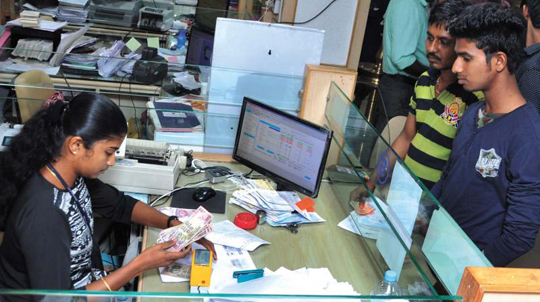
Demonetisation

Officials said multiple teams of the Enforcement Directorate (ED) swooped early morning at over 50 branches of at least ten banks, both in the private and public sector, along with banking auditors to "scrutinise" transaction records and account statements, armed with vital inputs gathered from financial snoop agencies.

They said ED teams have launched the operations at branches located in major cities like Delhi, Mumbai, Bengaluru, Hyderabad, Kolkata, Chennai and others based on records of transaction of these branches where the maximum amount of old notes have been deposited or huge cash has been deposited in bank accounts in one go or in a staggered fashion giving rise to suspicion of suspect deposits.

Officials said the sleuths and auditors are "looking at the banking transaction records post November 8" and instructions have been issued to these teams to ensure that regular operations and customer dealings are not affected due to this.

The ED, tasked with enforcing two important laws to check financial crimes--Prevention of Money Laundering Act (PMLA) and Foreign Exchange Management Act (FEMA)--has sourced Suspicious Transaction Reports (STRs) and Cash Transaction Reports (CTRs) of the banks under scanner from various financial intelligence agencies and has launched the operation to check possible financial irregularities, instances of money laundering and hawala dealings.

The agency had recently arrested two Axis Bank employees working at a branch in Delhi while probing a similar instance under PMLA.

ED, last week, had also conducted searches at 40 locations across the country in order to check black money held with currency exchanges, hawala dealers and others.

Comments

Skazi
 - 
Wednesday, 7 Dec 2016

Why only the transactions post Nov 8 are checked .... Make a comprehensive checking of all transactions from April 1 ....
Mr 56\ CHESTWALA... Pls show your courage"

Add new comment

  • Coastaldigest.com reserves the right to delete or block any comments.
  • Coastaldigset.com is not responsible for its readers’ comments.
  • Comments that are abusive, incendiary or irrelevant are strictly prohibited.
  • Please use a genuine email ID and provide your name to avoid reject.
News Network
June 15,2020

New Delhi, Jun 15: On Monday, petrol and diesel prices across the country were raised for the ninth consecutive day by 48 paise and 59 paise, respectively.

Petrol price per litre was raised to Rs 76.26 in New Delhi, Rs 83.17 in Mumbai, Rs 79.96 in Chennai, Rs 79.17 in Hyderabad, Rs 78.73 in Bengaluru and Rs 78.10 in Kolkata.

Diesel price per litre was hiked to Rs 74.62 in New Delhi, Rs 73.21 in Mumbai, Rs 72.69 in Chennai, Rs 72.93 in Hyderabad, Rs 70.95 in Bengaluru and Rs 70.33 in Kolkata.

Since 7 June, after ending their 82-day hiatus in daily revision, state-owned oil marketing companies have increased petrol price by Rs 5 per litre and diesel by Rs 5.23 per litre.

These prices are close to levels last seen in October-November 2018 when international oil prices had spiked close to $80 per barrel. In October 2018, petrol price in Mumbai had crossed Rs 90-mark and in Delhi, it was around Rs 83 per litre.

Comparatively, on Monday, Brent crude, the international benchmark for crude oil prices, fell 2.3 percent to $37.84 a barrel over concerns of subdued demand for fuel as new coronavirus infections were reported in China and the US.

The present spike in fuel prices in India could be attributed to the fact that central and state governments, along with oil marketing companies are looking to make up for their loss in revenues due to the lockdown.

Last month, the central government had increased the excise duty on per litre of petrol by Rs 10 and per litre of diesel by Rs 13. Several state governments have also hiked their VAT or cess on fuel in the last month. In fact, now around 70 percent of the retail price of fuel is just some form of tax.

Comments

Add new comment

  • Coastaldigest.com reserves the right to delete or block any comments.
  • Coastaldigset.com is not responsible for its readers’ comments.
  • Comments that are abusive, incendiary or irrelevant are strictly prohibited.
  • Please use a genuine email ID and provide your name to avoid reject.
News Network
February 29,2020

New Delhi, Feb 29: India’s economy expanded at its slowest pace in more than six years in the last three months of 2019, with analysts predicting further deceleration as the global Covid 19 coronavirus outbreak stifles growth in Asia’s third-largest economy.

The gross domestic product (GDP) data released yesterday showed government spending, private investment and exports slowing down, while there is a slight upturn in consumer spending and improvement in rural demand lent support.

The quarterly figure of 4.7% growth matched the consensus in a Reuters poll of analysts but was below a revised - and greatly increased - 5.1% rate for the previous quarter.

The central bank has warned that downside risks to global growth have increased as a result of the coronavirus epidemic, the full effects of which are still unfolding.

Prime minister Narendra Modi’s government has taken several steps to bolster economic growth, including a privatisation push and increased state spending, after cutting corporate tax rates last September.

In its annual budget presented this month, the government estimated that annual economic growth in the financial year to March 31 would be 5%, its lowest for last 11 years.

Modi’s government is targeting a slight recovery in growth to 6% for 2020/21, still far below the level needed to generate jobs for millions of young Indians entering the labour market each month.

The annual GDP figure for the September quarter was ramped up from an earlier estimate of 4.5%, while the April-June reading was similarly lifted to 5.6% from 5%, data released by the Ministry of Statistics showed on Friday.

Capital Investment Drop

In the December quarter, private investment grew 5.9%, up from 5.6% in the previous quarter, while government spending rose by 11.8%, against 13.2% in the previous three months.

However, corporate capital investment contracted by 5.2% after a 4.1% decline in the previous quarter, indicating that interest rate cuts by the central bank have failed to encourage new investment. Manufacturing, meanwhile, contracted by 0.2%.

“It appears growth slowdown is not just cyclical but more entrenched with consumption secularly joining the slowdown bandwagon even as the investment story continues to languish,” said Madhavi Arora of Edelweiss Securities in Mumbai.

Many economists said that the government stimulus could take four to six quarters of time before lifting the economy and the impact of those efforts could be outweighed by the global fallout from the coronavirus epidemic that began in China.

“The coronavirus remains the critical risk as India depends on China for both demand and supply of inputs,” said Abheek Barua, chief economist at HDFC Bank.

Indian shares sank on Friday for a sixth session running, capping their worst week in more than a decade. The NSE Nifty 50 index shed 7.3% over the week, while the Sensex dropped 6.8%, the worst weekly declines since the 2008-09 financial crisis.

Separately, India’s infrastructure output rose 2.2% year on year in January, data showed on Friday.

A spike in inflation to a more than 5-1/2 year high of 7.59% in January is expected to make the RBI hold off from further cuts to interest rates for now, while keeping its monetary stance accommodative.

Comments

Add new comment

  • Coastaldigest.com reserves the right to delete or block any comments.
  • Coastaldigset.com is not responsible for its readers’ comments.
  • Comments that are abusive, incendiary or irrelevant are strictly prohibited.
  • Please use a genuine email ID and provide your name to avoid reject.
News Network
June 19,2020

Jun 19: Ten Indian Army soldiers including four officers were released by the China’s People’s Liberation Army (PLA) on Friday capping three days of hard negotiations that followed the bloody battle at the eastern Ladakh’s Galwan valley on Monday.

The 10 jawans returned around 5.30 PM on Friday to Patrol Point 14 (PP-14) after Indian team leader Major Gen. Abhijit Bapat, the commanding officer of the Third Div made it clear to the Chinese that there couldn’t be any progress in the disengagement talks unless the soldiers were returned safely.

Asked to comment on the release of Indian soldiers, the Indian Army maintained silence. The force released a brief statement on Thursday stating that all its men were accounted for.

However, the extent of the brutal clash can be gauged from the fact that 76 Indian Army soldiers are still in the hospital out of which 58 soldiers have “minor injuries” and “should be back on duty within a week”, according to Army sources.

Return of the Indian soldiers has been the main point of negotiations for the last two days. The situation is now calmer at areas near PP-14 in the Galwan valley after the return of Indian soldiers even though large numbers of troops from both sides are still present in the area.

Meanwhile analysis of satellite images has revealed a large presence of Chinese troops in the northern banks of Pangong Tso, a disputed territory for years.

“In the past month, Chinese forces have become an overwhelming majority in the disputed areas (on the north bank of the 135 km long lake). Significant positions have been constructed between Fingers 4 and 5, including around 500 structures, fortified trenches and a new boat shed over 20 km further forward than previously. More structures appear to be under construction,” says a report published in the Strategist, the journal of the Australian Strategic Policy Institute.

“The scale and provocative nature of these new Chinese outposts is hard to overstate: 53 different forward positions have been built, including 19 that sit exactly on the ridge line separating Indian and Chinese patrols,” says the report, accompanied by satellite images showing overwhelming PLA presence.

The June 6 Corps Commander level meeting between the Indian and PLA armies did not result in a solution to the contentious muscle flexing by the Chinese on the shores of the Pangong lake. The meeting ended with the conclusion that more Lt Gen level talks between the two armies were needed to resolve such issues.

Comments

Add new comment

  • Coastaldigest.com reserves the right to delete or block any comments.
  • Coastaldigset.com is not responsible for its readers’ comments.
  • Comments that are abusive, incendiary or irrelevant are strictly prohibited.
  • Please use a genuine email ID and provide your name to avoid reject.