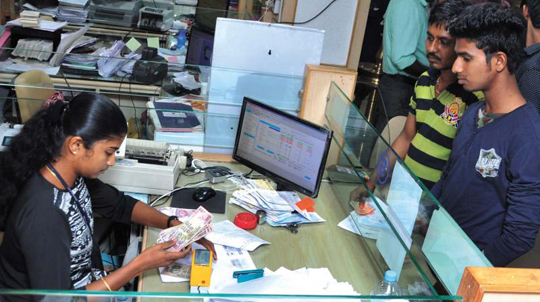
Demonetisation: ED enquiry op at 50 banks across country

December 7, 2016

New Delhi, Dec 7: Stepping up action to check financial crimes post demonetisation, the ED today launched an 'enquiry of records' operation at over 50 bank branches across the country to detect money laundering and hawala dealing instances through these channels.

Demonetisation

Officials said multiple teams of the Enforcement Directorate (ED) swooped early morning at over 50 branches of at least ten banks, both in the private and public sector, along with banking auditors to "scrutinise" transaction records and account statements, armed with vital inputs gathered from financial snoop agencies.

They said ED teams have launched the operations at branches located in major cities like Delhi, Mumbai, Bengaluru, Hyderabad, Kolkata, Chennai and others based on records of transaction of these branches where the maximum amount of old notes have been deposited or huge cash has been deposited in bank accounts in one go or in a staggered fashion giving rise to suspicion of suspect deposits.

Officials said the sleuths and auditors are "looking at the banking transaction records post November 8" and instructions have been issued to these teams to ensure that regular operations and customer dealings are not affected due to this.

The ED, tasked with enforcing two important laws to check financial crimes--Prevention of Money Laundering Act (PMLA) and Foreign Exchange Management Act (FEMA)--has sourced Suspicious Transaction Reports (STRs) and Cash Transaction Reports (CTRs) of the banks under scanner from various financial intelligence agencies and has launched the operation to check possible financial irregularities, instances of money laundering and hawala dealings.

The agency had recently arrested two Axis Bank employees working at a branch in Delhi while probing a similar instance under PMLA.

ED, last week, had also conducted searches at 40 locations across the country in order to check black money held with currency exchanges, hawala dealers and others.

Comments

Skazi
 - 
Wednesday, 7 Dec 2016

Why only the transactions post Nov 8 are checked .... Make a comprehensive checking of all transactions from April 1 ....
Mr 56\ CHESTWALA... Pls show your courage"

Add new comment

  • Coastaldigest.com reserves the right to delete or block any comments.
  • Coastaldigset.com is not responsible for its readers’ comments.
  • Comments that are abusive, incendiary or irrelevant are strictly prohibited.
  • Please use a genuine email ID and provide your name to avoid reject.
March 27,2020

Mumbai, Mar 27: The RBI on Friday put on hold EMI payments on all term loans for three months and cut interest rate by steepest in more than 11 years as it joined the government effort to rescue a slowing economy that has now got caught in coronavirus whirlwind.

The Reserve Bank of India (RBI) cut repo to 4.4 per cent, the lowest in at least 15 years. Also, it reduced the cash reserve ratio maintained by the banks for the first time in over seven years. CRR for all banks was cut by 100 basis points to release Rs 1.37 lakh crore across banking system.

The reverse repo rate was cut by 90 bps to 4 per cent, creating an asymmetrical corridor.

RBI Governor Shaktikanta Das predicted a big global recession and said India will not be immune.

It all depends how India responds to the situation, he said.

Global slowdown could make things difficult for India too, despite some help from falling crude prices, Das said, adding food prices may soften even further on record crop production.

Aggregate demand may weaken and ease core inflation further, he noted.

The liquidity measures announced include auction of targeted long-term repo operation of 3 year tenor for total amount of Rs 1 lakh crore at floating rate and accommodation under Marginal Standing Facility to be increased from 2 per cent to 3 per cent of Statutory Liquidity Ratio (SLR) with immediate effect till June 30.

Combined, these three measures will make available a total Rs 3,74,000 crore to the country's financial system.

After cutting policy rates five times in 2019, the RBI had been on a pause since December in view of high inflation.

The measures announced come a day after the government unveiled a Rs 1.7 lakh crore package of free foodgrains and cash doles to the poor to deal with the economic impact of the unprecedented 21-day nationwide lockdown.

While the Monetary Policy Committee (MPC) of the RBI originally was slated to meet in the first week of April, it was advanced by a week to meet the challenge of coronavirus.

Comments

Add new comment

  • Coastaldigest.com reserves the right to delete or block any comments.
  • Coastaldigset.com is not responsible for its readers’ comments.
  • Comments that are abusive, incendiary or irrelevant are strictly prohibited.
  • Please use a genuine email ID and provide your name to avoid reject.
Agencies
June 21,2020

New Delhi, June 21: The world is feeling the need for yoga more than ever due to the coronavirus pandemic and the ancient Indian practice is helping a large number of Covid-19 patients across the globe in defeating the disease, Prime Minister Narendra Modi said on Sunday.

The coronavirus specifically attacks the respiratory system and 'pranayama' or breathing exercise helps in strengthening the respiratory system the most, Modi said in his message on the sixth International Day of Yoga.

Modi said yoga has emerged as a force for unity and it does not discriminate as it goes beyond race, colour, gender, faith and nations.

"Yoga enhances our quest for a healthier planet. It has emerged as a force for unity and deepens the bonds of humanity. It does not discriminate. It goes beyond race, colour, gender, faith and nations. Anybody can embrace Yog," the prime minister said.

In his nearly 15-minute address early Sunday morning, Modi said that due to the coronavirus pandemic, the world is feeling the need for yoga more than ever.

"If our immunity is strong, it is of great help in defeating this disease. For boosting immunity, there are several methods in yoga, various 'asanas' are there. These asanas are such that they increase the strength of the body and also strengthen our metabolism," he said.

Talking about the benefits of 'pranayama' -- a form of breathing exercise, Modi said it is very effective and has countless variations like 'Sheetali, Kapalbhati and Bhrastika'.

"All these forms of yoga, help a lot in strengthening both our respiratory and immune system," he said, urging people to include 'pranayama' in their daily routine.

"A large number of Covid-19 patients all over the world are taking the benefits of all these techniques of yoga. The strength of yoga is helping them defeat this disease," Modi said.

Asserting that anybody can embrace yoga, the prime minister said that all that is needed is some part of one's time and an empty space.

"Yoga is giving us not only the physical strength, but also mental balance and emotional stability to confidently negotiate the challenges before us," Modi said.

"If we can fine-tune our chords of health and hope, the day is not far away when world will witness the success of a healthy and happy humanity. Yoga can definitely help us make this happen," he said.

With the shadow of the COVID-19 pandemic looming large, International Day of Yoga is being marked on digital media platforms sans mass gatherings. This year's theme is 'Yoga at Home and Yoga with Family'.

Yoga Day is going digital for the first time since June 21, 2015, when it began to be celebrated annually across the world, coinciding with the Summer Solstice each year.

On December 11, 2014, the United Nations General Assembly declared June 21 as 'International Day of Yoga', months after Prime Minister Modi had proposed the idea.

The Ministry of Ayurveda, Yoga & Naturopathy, Unani, Siddha and Homoeopathy (AYUSH) had planned to hold a grand event in Leh, but cancelled it due to the pandemic.

In his message on Sunday, Modi said the International Yoga Day is a day of unity and gives the message of universal brotherhood.

"It is a day of oneness and humanness. What brings us together, unites us, that is yoga. What bridges distances is yoga. In times of this coronavirus pandemic, people's participation in the 'My Life - My Yoga' across the world shows that people's interest in yoga is increasing," he said.

He said that doing work properly and fulfilling one's duties is also a form of yoga.

"Eating the right food, playing the right sports, having right habits of sleeping and waking, and doing your work and your duties is yoga," Modi said.

"With this 'karmayoga', we get the solution to all the problems. 'Karmayoga' is also helping others selflessly. This spirit of 'karmayoga' is embedded in the spirit of India. Whenever the need arose, the whole world witnessed India's selflessness," he said.

The power as an individual, society and country increases manifold when people act according to yoga and with the spirit of 'karmayoga', Modi said.

"Today we have to take a pledge in this spirit -- we will do everything possible for our health, for the health of our loved ones. As a conscious citizen, we will move forward unitedly as a family and society," he said.

The PM's message was followed by a live demonstration of Common Yoga Protocol (CYP). The CYP drill was designed keeping in mind people of different age groups and of varied walks of life, the ministry had said in its statement.

Yoga programmes are organised across the globe by Indian missions every year, but this year will be different. Several missions are organising digital events to mark the occasion.


Comments

Add new comment

  • Coastaldigest.com reserves the right to delete or block any comments.
  • Coastaldigset.com is not responsible for its readers’ comments.
  • Comments that are abusive, incendiary or irrelevant are strictly prohibited.
  • Please use a genuine email ID and provide your name to avoid reject.
News Network
June 23,2020

New Delhi, Jun 23: In an unexpected development, the pump price of diesel is all set to surpass the petrol price in the capital, making it the most expensive transport fuel for the first time in a long time.

Globally, diesel is priced slightly above petrol prices due to the very nature of the product that has a higher cost of production. But in India, due to the lopsided taxation structure, diesel attracts lesser of the tax between the two auto fuels keeping its prices lower than petrol for last several years.

Diesel is currently priced at Rs 79.40 a litre in the Capital, just 36 paise short of petrol price that is being retailed at Rs 79.76 a litre. Going by the trend of price movement in the two products for the last few days where diesel prices have consistently increased by 50-60 paise per litre while the daily increase in petrol prices have fallen to just 20 paise on Tuesday, it is set to surpass petrol prices in next few days.

"Diesel price movement is sharper in international market and if oil companies follow the global price trend, diesel prices will surpass that of petrol later this week. It will be after many years that this would happen and is expected to sustain for some time unless government changes the tax structure of the petroleum products again," said an oil sector expert from one of the big four audit and advisory firms asking not to be named.

Interestingly, even in India the base price of diesel is expensive than petrol. According to the Indian Oil Corporation (IOC), while the base price of petrol in Delhi currently comes to Rs 22.11 per litre, the same for diesel is higher at Rs 22.93 per litre (effective from June 16, 2020). This has been the case for a long time, but retail price of petrol can be higher than diesel due to central and state taxes.

What has now brought diesel prices to a whisker of petrol prices in the capital is the Delhi government's decision early May to increase the Value Added Tax on diesel from 16.75 per cent to 30 per cent and on petrol from 27 per cent to 30 per cent. This increased the retail price of diesel and petrol in Delhi by Rs 7.10 and Rs 1.67 a litre respectively. With Central taxes on the two products already reaching identical levels, the Delhi governments move hastened price parity between petrol and diesel.

Currently, the Central excise on petrol is Rs 32.98 a litre while that on diesel it is Rs 31.83 a litre. The VAT on petrol in Delhi is Rs 17.71 a litre and that on diesel is Rs 17.60 a litre.

While the movement of retail pricing is being seen with a sigh of relief by vehicle owners whose cars run on petrol, those buying the relatively expensive diesel cars are now repenting on their decision. The development is also being seen with caution by automobile companies who have spent millions to ramp up their facilities for diesel run vehicles. The expectation is that demand for such cars will now fall, causing more damage to companies where sales are already impacted due to persistent economic slowdown and now the spread of COVID-19 pandemic.

"The pricing development would push automobile companies to strategies being followed by companies in the western markets where diesel run cars are not sold on fuel pricing differential, but on overall make and quality that puts them ahead of petrol run cars," the expert quoted earlier.

Yes, but for commercial vehicle sector the rising price of diesel had not been welcomed. In fact, the commercial transport sector had time an again threatened strike against the move to raise fuel prices.

With petrol and diesel retail prices closing, the case for adultering fuel has also gone down much to the relief of vehicle owners.

Comments

Add new comment

  • Coastaldigest.com reserves the right to delete or block any comments.
  • Coastaldigset.com is not responsible for its readers’ comments.
  • Comments that are abusive, incendiary or irrelevant are strictly prohibited.
  • Please use a genuine email ID and provide your name to avoid reject.