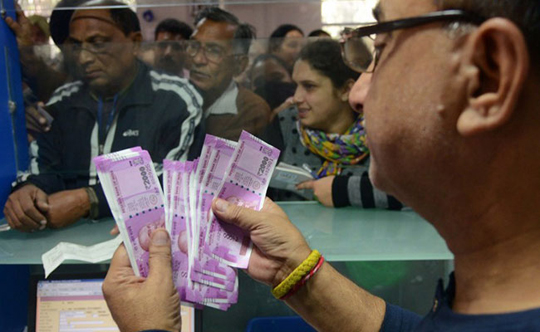
Demonetisation necessary step to address corruption: US

December 1, 2016

Washington, Dec 1: The US today supported India's move of demonetising Rs 500 and Rs 1000 currency notes, saying that it was an "important" and "necessary" step to address corruption.

Toner

"We believe, an important and necessary step to crack down on this - illegal actions or illicit actions," State Department Deputy Spokesman Mark Toner said.

"American citizens who are working and living in India, I think have the proper information now to exchange those notes or to get new notes, and it's a little bit of an adjustment, just as it was an inconvenience, I'm sure, for many Indians, but I think a necessary one to address corruption," Toner said in response to a question.

Discontinuance of the 500 and 1,000 rupee notes he said is designed to target illicit cash proceeds from corruption and tax dodging.

"With respect to your question about the impact on American citizens, we got this question I think the day that this was announced," he said.

"Indeed, as it was an inconvenience for many Indians, it was an inconvenience for Americans who were also there, and we actually put out a statement through our US embassy to American citizens in India about the changes," Toner said.

Comments

Rikaz
 - 
Thursday, 1 Dec 2016

Did it succeed eliminating corruption....I don't think so...recently police caught a lot of 2000 currencies going towards bribing people in election declared areas....

The demonetization did not help any public but it created a lot of problems to them....let the government give problems to biggest business men who parked their money in foreign banks....

Add new comment

  • Coastaldigest.com reserves the right to delete or block any comments.
  • Coastaldigset.com is not responsible for its readers’ comments.
  • Comments that are abusive, incendiary or irrelevant are strictly prohibited.
  • Please use a genuine email ID and provide your name to avoid reject.
News Network
March 28,2020

Berlin, Mar 28: The number of confirmed coronavirus infections worldwide topped 600,000 on Saturday as new cases stacked up quickly in Europe and the United States and officials dug in for a long fight against the pandemic.

The latest landmark came only two days after the world passed half a million infections, according to a tally by John Hopkins University, showing that much work remains to be done to slow the spread of the virus. It showed more than 602,000 cases and a total of over 27,000 deaths.

While the U.S. now leads the world in reported infections — with more than 104,000 cases — five countries exceed its roughly 1,700 deaths: Italy, Spain, China, Iran and France.

“We cannot completely prevent infections at this stage, but we can and must in the immediate future achieve fewer new infections per day, a slower spread,” German Chancellor Angela Merkel, who is in quarantine at home after her doctor tested positive for the virus, told her compatriots in an audio message. “That will decide whether our health system can stand up to the virus.”

The virus already has put health systems in Italy, Spain and France under extreme strain. Lockdowns of varying severity have been introduced across Europe. Merkel's chief of staff, Helge Braun, said that Germany — where authorities closed nonessential shops and banned gatherings of more than two in public — won't relax its restrictions before April 20.

As the epicenter has shifted westward, the situation has calmed in China, where some restrictions on people's lives have now been lifted. Six subway lines restored limited service in Wuhan, where the virus first emerged in December, after the city had its official coronavirus risk evaluation downgraded from high to medium on Friday. Five districts of the city of 11 million people had other restrictions on travel loosened after their risk factor was downgraded to low.

For most people, the coronavirus causes mild or moderate symptoms, such as fever and cough that clear up in two to three weeks. But for others, especially older adults and people with existing health problems, the virus can cause more severe illness, including pneumonia, and lead to death.

More than 130,000 people have recovered, according to Johns Hopkins' tally.

In one way or another, the effects of the COVID-19 outbreak have been felt by the powerful and the poor alike.

On Friday, British Prime Minister Boris Johnson became the first leader of a major country to test positive for the virus. He said he would continue to work from self-quarantine.

Countries are still scrambling bring home some citizens stranded abroad by border closures and a near-shutdown of flights. On Saturday, 174 foreign tourists and four Nepali nationals on the foothills of Mount Everest were flown out days after being stranded on the only airstrip serving the world's highest mountain.

In neighboring India, authorities sent a fleet of buses to the outskirts of the capital to meet an exodus of migrant workers desperately trying to reach their home villages during the world's largest lockdown.

Thousands of people, mostly young male day laborers but also families, had fled their New Delhi homes after Prime Minister Narendra Modi announced a 21-day lockdown that began on Wednesday and effectively put millions of Indians who live off daily earnings out of work.

In a possibly hopeful sign, the U.S. Food and Drug Administration cleared a new rapid test from Abbott Laboratories, which the company says can detect the coronavirus in about 5 minutes. Medical device maker Abbott announced the emergency clearance of its cartridge-based test Friday night, saying the test delivers a negative result in 13 minutes when the virus is not detected.

While New York remained the worst-hit city in the U.S., Americans braced for worsening conditions elsewhere, with worrisome infection numbers being reported in New Orleans, Chicago and Detroit.

New Orleans’ sprawling Ernest N. Morial Convention Center, along the Mississippi River, was being converted into a massive hospital as officials prepared for thousands more patients than they could accommodate.

In New York, where there are more than 44,000 cases statewide, the number of people hospitalized with COVID-19 passed 6,000 on Friday, double what it had been three days earlier.

Gov. Andrew Cuomo called for 4,000 more temporary beds across New York City, where the Jacob K. Javits Convention Center has already been converted into a hospital.

The struggle to defeat the virus will take “weeks and weeks and weeks,” Cuomo told members of the National Guard working at the Javits Center.

President Donald Trump invoked the Defense Production Act on Friday, ordering General Motors to begin manufacturing ventilators. Trump had previously rejected Cuomo's pleas for tens of thousands more of the machines and the governor's calls to implement the Korean War-era production law.

Trump signed a $2.2 trillion stimulus package, after the House approved the sweeping measure by voice vote. Lawmakers in both parties lined up behind the law to send checks to millions of Americans, boost unemployment benefits, help businesses and toss a life preserver to an overwhelmed health care system.

Dr. John Brooks of the U.S. Centers for Disease Control and Prevention warned Americans remained “in the acceleration phase” of the pandemic and that all corners of the country were at risk.

"There is no geographic part of the United States that is spared from this," he said.

Comments

Add new comment

  • Coastaldigest.com reserves the right to delete or block any comments.
  • Coastaldigset.com is not responsible for its readers’ comments.
  • Comments that are abusive, incendiary or irrelevant are strictly prohibited.
  • Please use a genuine email ID and provide your name to avoid reject.
Agencies
May 26,2020

UN, May 26: Countries could see a "second peak" of coronavirus cases during the first wave of the pandemic if lockdown restrictions were lifted too soon, the World Health Organization (WHO) has warned.

Mike Ryan, the WHO's head of emergencies, told a briefing on Monday that the world was "right in the middle of the first wave", the BBC reported.

He said because the disease was "still on the way up", countries need to be aware that "the disease can jump up at any time".

"We cannot make assumptions that just because the disease is on the way down now that it's going to keep going down," Ryan said.

There would be a number of months to prepare for a second peak, he added.

The stark warning comes as countries around the world start to gradually ease lockdown restrictions, allowing shops to reopen and larger groups of people to gather.

Experts have said that without a vaccine to give people immunity, infections could increase again when social-distancing measures are relaxed.

Ryan said countries where cases are declining should be using this time to develop effective trace-and-test regimes to "ensure that we continue on a downwards trajectory and we don't have an immediate second peak".

Also on Monday, Tedros Adhanom Ghebreyesus, WHO Director-General, said that a clinical trial of hydroxychloroquine (HCQ) on COVID-19 patients has come to "a temporary pause", while the safety data of the the anti-malaria drug was being reviewed.

According to the WHO chief, The Lancet medical journal on May 22 had published an observational study on HCQ and chloroquine and its effects on COVID-19 patients that have been hospitalized, reports Xinhua news agency.

The authors of the study reported that among patients receiving the drug, when used alone or with a macrolide, they estimated a higher mortality rate.

"The Executive Group of the Solidarity Trial, representing 10 of the participating countries, met on Saturday (May 23) and has agreed to review a comprehensive analysis and critical appraisal of all evidence available globally," Tedros said in a virtual press conference.

The developments come as the total number of global COVID-19 cases has increased to 5,508,904, with 346,508 deaths, according to the Johns Hopkins University.

Comments

Add new comment

  • Coastaldigest.com reserves the right to delete or block any comments.
  • Coastaldigset.com is not responsible for its readers’ comments.
  • Comments that are abusive, incendiary or irrelevant are strictly prohibited.
  • Please use a genuine email ID and provide your name to avoid reject.
News Network
May 30,2020

May 30: Warning of the tightrope walk ahead as governments battle the coronavirus crisis, Nobel laureate Peter Charles Doherty has expressed concern about densely populated countries such as India relaxing lockdown norms while also describing a complete shutdown as “an economic and social impossibility”.

The Australian immunologist, who cautioned that the number of COVID-19 cases will rise in the coming days, said the earliest time frame for an effective vaccine “going into large numbers of people” is nine to 12 months.

"If all goes well with testing, we could know if some of the candidate vaccines are both safe and effective as early as September/October. Then, rolling a vaccine out will depend on the type of product and how quickly it can be made, put in vials and so forth," Doherty told PTI in an email interview from Melbourne.

The novel coronavirus, he added, does not change fast like influenza and, from what is known so far, “the same vaccine should work everywhere”.

Doherty, who is with the Department of Microbiology and Immunology at the Doherty Institute, University of Melbourne, won the Nobel Prize for Medicine in 1996 for his discovery of how the body’s immune system distinguishes virus-infected cells from normal ones.

Discussing the lockdown, he said, "If it was purely a matter of hard science, everywhere should stay locked down. But that’s pretty much an economic and social impossibility.”

The expectation, he said, is the numbers will rise and limiting spread will depend on people acting responsibly and the capacity for rapid response and extensive contact testing.

“And in a densely populated country like India I think that it will be very difficult," the scientist said.

Several countries, including India, began relaxing lockdown norms in mid-May despite the WHO’s warning about a second wave. India’s lockdown began on March 25 and has since been extended. The fourth phase ends on Sunday.

Asked whether there are any alternatives to a lockdown, the 79-year-old said, "There is no other option other than closing borders. South Korea, for example, conducted massive, intensive testing and contact tracing in a wealthy country with a very disciplined population. Otherwise, not till we have effective vaccines."

He added that he personally doesn’t see the point of closing borders for people coming in if there’s already a high incidence of disease in the community, “unless it’s to avoid the need to care for them and use scarce hospital beds".

According to Doherty, the coronavirus "is a new virus which has come straight out of nature".

“It (the virus) has moved so rapidly across the world because of people travelling on international planes as well as tourist ships," he added.

The immunologist also warned against the use of hydroxychloroquine to treat COVID-19, and said current and planned trials of the anti-malaria drug should be stopped.

“My understanding is that the use of the drug in severe disease is definitely contra-indicated, but it’s not yet clear whether, if taken under medical supervision, it could have some useful effect if taken early on, or as a preventive. Those trials just haven’t been done properly," Doherty noted.

The Indian Council of Medical Research (ICMR) has backed the use of hydroxychloroquine as a preventive against COVID-19 even after the WHO suspended clinical trials of the drug citing safety concerns.

Asked whether plasma therapy can be an effective treatment for COVID-19, Doherty said, "We lack good properly controlled trials but, especially if the plasma has been tested for antibody levels and there’s evidence of good activity, it could be helpful. If I had the disease and was offered plasma therapy I would certainly accept, but I would not take hydroxychloroquine."

Doherty is also very optimistic about herd immunity developing against the SARS-CoV-2 infection.

"We think that (herd immunity) will cut in and have an obvious effect when, say, 60 per cent of people have been infected. Best hope is to boost herd immunity with a vaccine," he stated.

Herd immunity is a form of indirect protection from infectious disease that occurs when a large percentage of a population has become immune to an infection, whether through vaccination or previous infections.

The number of COVID-19 cases have crossed 5.9 million and the fatalities 3,65,000, according to the Johns Hopkins University on Saturday. 

In India, the death toll has risen to 4,971 and the number of cases to 1,73,763, according to the Union Health Ministry on Saturday.

Several states, including Bihar, Uttar Pradesh, Madhya Pradesh, Jharkhand and Chhattisgarh, have reported a rise in number since lockdown norms were relaxed in early May and migrant workers reached home.

In Uttar Pradesh, for instance, the number of infections rose from around 3,000 on May 4 to 6,532 on May 26. Similarly, Bihar’s numbers increased from around 500 to over 2,700 in the period.


Comments

Add new comment

  • Coastaldigest.com reserves the right to delete or block any comments.
  • Coastaldigset.com is not responsible for its readers’ comments.
  • Comments that are abusive, incendiary or irrelevant are strictly prohibited.
  • Please use a genuine email ID and provide your name to avoid reject.